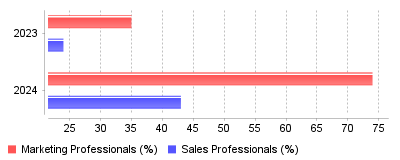
Marketing professionals doubled AI usage to 74% while sales adoption lagged at 43% in 2024
Generative AI Utilization Rates in CRM Roles (2023 vs. 2024)
Recent industry reports reveal a dramatic pivot in the CRM landscape: the transition from static databases to "agentic" AI systems. Data from 2023 to 2024 highlights a massive surge in Generative AI adoption among CRM users, with marketing utilization more than doubling and sales adoption nearly doubling in just one year. This trend signals a fundamental shift where CRM software is evolving from a passive system of record into an active "teammate" capable of executing complex autonomous tasks. 2. Trend data (JSON): ```json { "trends": &x5b; { "name": "Generative AI Utilization Rat
| Year |
Marketing Professionals (%) |
Sales Professionals (%) |
| 2023 |
35 |
24 |
| 2024 |
74 |
43 |
The "Agentic" Shift: Generative AI Adoption in CRM
What is this showing
The data illustrates a rapid acceleration in the adoption of Generative AI (GenAI) within Customer Relationship Management (CRM) workflows between 2023 and 2024. Specifically, AI usage among marketing professionals surged from 35% to 74%, while adoption among sales professionals nearly doubled from 24% to 43% in the same period [1][2]. This indicates that AI capabilities are no longer experimental features but are becoming core operational tools for revenue teams.
What this means
For the micro-industry, this signifies that CRM platforms are evolving from passive "systems of record"—where humans manually input data—to active "systems of action" where AI agents autonomously draft content, score leads, and manage outreach. At a macro level, the disparity between marketing and sales adoption (74% vs. 43%) suggests that while content-heavy tasks were the first to be automated, transactional sales functions are following quickly as trust in AI "agents" grows [3]. Furthermore, recent reports from 2025 indicate this trend is accelerating toward fully autonomous agents, with Salesforce reporting a 119% increase in the creation of AI agents during the first half of the year [4]. This shift is redefining the competitive baseline; companies not leveraging AI agents face a productivity gap where competitors can execute campaigns and service interactions at significantly lower marginal costs.
Why is this important
This trend is critical because it directly correlates with business outcomes rather than just operational efficiency. Research shows that companies adopting GenAI in their CRM systems report 25-30% increases in customer engagement and up to 20% improvements in sales productivity [5]. Additionally, as "agentic" AI becomes standard, the metric for CRM success is shifting from "user adoption" (are people logging in?) to "agent resolution" (how many tasks did the AI complete autonomously?), fundamentally changing how software ROI is calculated [4].
What might have caused this
The primary driver is likely the integration of Large Language Models (LLMs) directly into major CRM ecosystems (e.g., Salesforce Agentforce, HubSpot AI), which removed the technical barrier to entry for non-technical users. The dramatic jump in 2024 adoption likely stems from the "democratization" of these tools; users no longer need to leave their CRM to use ChatGPT but can invoke AI assistants directly within their email and deal workflows [1]. Furthermore, economic pressure to do "more with less" has likely pushed organizations to embrace AI for labor-intensive tasks like content personalization and lead qualification. Speculatively, the higher adoption in marketing (74%) compared to sales reflects the lower risk profile of drafting emails versus the high-stakes nature of closing deals, though this gap is closing as "AI Agents" prove their reliability [2].
Conclusion
The era of the static CRM is ending, replaced by AI-driven platforms where human effort is augmented by digital agents. The data proves that 2024 was the tipping point where AI usage crossed from early adopters to the majority, particularly in marketing. The key takeaway for businesses is that AI integration in CRM is no longer an optional upgrade but a standard requirement for maintaining competitive velocity in sales and customer engagement [4].
The State of CRM: A Critical Analysis of Market Trajectory and Operational Friction
The global Customer Relationship Management (CRM) software market is experiencing a paradoxical period of explosive growth and operational stagnation. While market valuation is projected to surge from approximately $78 billion in 2024 to over $250 billion by 2033, driven by a compound annual growth rate (CAGR) of 14% [1], organizations face deepening challenges in realizing value from these investments. The industry has moved beyond simple contact storage to complex ecosystems of engagement, yet fundamental operational hurdles—specifically data hygiene, user adoption, and vertical-specific workflow integration—remains persistent barriers to ROI.
This analysis dissects the current operational landscape of CRM software, evaluating the friction points that hinder performance and the emerging trends attempting to resolve them. It further examines how distinct industries, from construction to financial services, are forced to navigate these challenges through specialized solutions rather than generic platforms.
The Data Crisis: The Multi-Trillion Dollar Cost of "Bad Data"
The most pervasive operational challenge in modern CRM ecosystems is data integrity. Despite the increasing sophistication of data ingestion tools, the underlying quality of CRM data remains a critical vulnerability. Research indicates that poor data quality costs the U.S. economy approximately $3.1 trillion annually [2][3]. For individual organizations, the impact is equally severe, with poor data quality costing an average of $12.9 million per year in wasted resources and lost opportunities [4].
The Physics of Data Decay
Data is not static; it decays at an alarming rate. B2B contact data deteriorates at a rate of approximately 22.5% to 70.3% annually, largely due to job turnover, company restructuring, and contact information changes [5]. Specific data points, such as business email addresses, have seen decay accelerate to as high as 3.6% in a single month as of late 2024 [6]. This velocity of obsolescence renders static databases liabilities rather than assets.
The operational consequence is that sales and marketing teams often operate with intelligence that is factually incorrect. Nearly 94% of businesses suspect their customer and prospect data is inaccurate [7]. This inaccuracy leads to severe downstream effects:
- Inefficient Prospecting: Sales representatives waste significant time chasing dead leads or navigating incorrect hierarchies.
- Marketing Waste: Budget is dissipated on campaigns targeting invalid contacts or mismatched personas.
- Strategic Misalignment: Executive leadership makes decisions based on flawed forecasts and pipeline analytics.
The Integration Gap and Siloed Intelligence
Compounding the issue of decay is the challenge of data silos. Organizations use an average of nearly 900 different applications, yet only a fraction interact seamlessly with the CRM [8]. When data resides in disconnected Customer Data Platforms (CDPs), ERPs, or proprietary back-end systems, the CRM fails to provide a "single source of truth." Research highlights that 5% of organizations have data completely siloed, while 80% cite data complexity as a primary barrier to quality [7].
The "Cognitive Drag" of CRM Adoption
While data quality is a technical challenge, user adoption is a psychological and behavioral one. The industry is currently grappling with "cognitive drag"—the mental effort required to interact with complex software that disrupts the primary workflow of revenue-generating employees.
The Productivity Paradox
The primary value proposition of CRM—to organize sales activity—often conflicts with the reality of sales execution. Sales representatives spend only approximately 28% to 30% of their week actually selling [9][10]. The remaining 70% is consumed by administrative tasks, meeting preparation, and manual data entry [11].
This imbalance creates a negative feedback loop:
1.
High Effort, Low Immediate Reward: Reps perceive CRM data entry as a tax on their time that benefits management reporting rather than their own deal velocity [12].
2.
Compliance over Accuracy: To satisfy management mandates, users often enter the bare minimum data required, leading to incomplete records [12].
3.
System Distrust: Because the data is incomplete, the system provides little predictive value, further discouraging high-quality input.
Cognitive Load and Interface Fatigue
Modern CRMs have suffered from feature bloat, leading to complex interfaces that require significant cognitive load to navigate. Sales professionals report spending 12-18 minutes just clicking through tabs to prep for a single call [13]. The psychological resistance to this "admin work" is a major driver of failed implementations. Successful adoption strategies are shifting away from enforcement and toward friction reduction, utilizing automation to capture activity data (emails, calls, meetings) without human intervention [14].
Vertical-Specific Operational Challenges
The notion of a "one-size-fits-all" CRM is increasingly obsolete. Different industries face unique operational pressures that generic horizontal CRMs often fail to address without extensive (and expensive) customization.
Construction and Trade Services
In the construction and home service sectors, the primary operational challenge is the synchronization gap between the field and the office. General contractors, plumbers, and roofers require systems that can handle project-based workflows, mobile dispatching, and change order management rather than traditional lead funnels.
For trade professionals, a critical pain point is the management of change orders and daily logs. Failure to track these accurately can result in unbilled work and project delays [15]. Generic CRMs often lack the native ability to track intricate project bids or integrate with construction-specific accounting tools. Consequently,
contact management platforms for contractors and
contact management platforms for roofing companies are evolving to include project management features, mobile-first interfaces for field crews, and GPS tracking to ensure seamless communication between job sites and headquarters [16].
Similarly, service-oriented trades face high-volume dispatching needs.
Contact management platforms for plumbers must prioritize scheduling efficiency and automated customer notifications over complex long-cycle pipeline management.
Financial Services and Wealth Management
For financial professionals, trust and compliance are paramount. The operational challenge here is managing deep, multi-generational relationships while adhering to strict regulatory frameworks (SEC, FINRA). Generic tools often lack the data structures to map complex family trees, trust entities, and household assets.
Wealth managers struggle with "laborious implementation" and the inability to see a holistic view of a client's financial life [17].
Contact management platforms for financial advisors address this by integrating directly with custodial data feeds and financial planning software, reducing the need for manual portfolio updates. Furthermore, dealing with high-net-worth individuals often requires managing sensitive interactions that must be logged for compliance—a feature sets that standard sales CRMs may treat as an afterthought.
In the lending space,
contact management platforms for mortgage brokers and
contact management platforms for loan officers must tackle the specific workflow of loan origination. The "killer feature" in this vertical is often integration with Loan Origination Systems (LOS) and automated status updates to realtors and borrowers, reducing the immense volume of "status check" emails that drain productivity [18].
For institutional investment,
contact management platforms for private equity firms focus heavily on deal flow management and relationship intelligence, tracking who knows whom across portfolio companies and investment partners.
Insurance
Insurance agents face high-volume data management and the dual pressure of acquisition and retention. A significant challenge is the fragmentation of policy data across different carrier portals.
Contact management platforms for insurance agents and
contact management platforms for insurance brokers are designed to aggregate this data, automating policy renewal reminders and identifying cross-sell opportunities that would otherwise be missed in a manual review [19].
Digital Agencies and E-Commerce
Marketing agencies operate in a client-centric project environment. Their challenge is maintaining visibility into client health and campaign performance simultaneously.
Contact management platforms for digital marketing agencies often blend CRM with project management, allowing account managers to track not just "deals won" but "deliverables sent," ensuring that the promise of the sale aligns with the reality of fulfillment [20].
In the e-commerce sector, the CRM must handle high-velocity transactional data.
Contact management platforms for Shopify sellers face the specific hurdle of integrating order history with customer support profiles. The goal is to prevent the "blind support" scenario where an agent helps a customer without knowing their high-value purchase history [8].
Recruitment
Staffing firms face a unique overlap between CRM (managing clients) and ATS (Applicant Tracking Systems, managing candidates).
Contact management platforms for recruitment agencies are increasingly hybridizing these functions to prevent data duplication. The challenge is ensuring that a candidate placed in a job is automatically converted to a contact record for future business development, a workflow that generic CRMs often fail to automate [21].
Creative Services and Small Business
For creative solopreneurs, such as those needing
contact management platforms for photographers, the challenge is typically overwhelming administrative overhead versus actual creative work. These users require visual pipeline management and automated booking/invoicing integrations that remove the need for a separate accounting tool.
Emerging Trends: AI, Automation, and New Pricing Models
To address these operational friction points, the CRM industry is undergoing a significant technological shift.
The Rise of Agentic AI
Artificial Intelligence is moving beyond predictive analytics (e.g., lead scoring) to "Agentic AI"—autonomous agents capable of executing tasks. In customer service, this is manifesting as AI agents that resolve inquiries without human intervention. This shift is so profound that vendors like Zendesk are introducing "outcome-based pricing," where customers are charged only for automated resolutions rather than seat licenses [22]. This aligns vendor incentives with actual operational efficiency.
Generative AI for Content and Synthesis
Generative AI is directly attacking the "cognitive drag" of data entry and content creation. Tools like Salesforce Einstein and HubSpot’s AI features can now draft sales emails, summarize meeting transcripts, and auto-populate CRM fields from unstructured data [23]. This directly addresses the 70% of non-selling time that plagues sales representatives.
Composable CRM
As the "all-in-one" suites become unwieldy, there is a trend toward "composable CRM." This approach allows businesses to assemble a CRM stack from modular components (packaged business capabilities) rather than buying a monolithic system. This trend is particularly relevant for mid-market and enterprise organizations that need to tailor their stack to specific vertical workflows without incurring the technical debt of custom code [24].
Future Outlook and Strategic Implications
The future of CRM lies in invisibility. The most effective CRM of 2025 and beyond will be the one that users interact with the least.
Business Implications:
*
From System of Record to System of Action: CRMs will transition from passive databases to active participants in the sales process, triggering actions based on real-time data signals.
*
Verticalization will Deepen: The market share of industry-specific CRMs will likely grow as buyers reject generic tools that require heavy customization. A construction company will no longer accept a sales-centric CRM that cannot handle blueprints and change orders.
*
Data Governance as a Competitive Advantage: As AI becomes commoditized, the differentiator will be the quality of the proprietary data feeding the AI. Companies that solve the data decay problem will have superior AI performance.
In conclusion, while the CRM market continues to expand, the operational reality is one of friction. The winners in the next decade will not be the organizations that simply buy the most powerful software, but those that successfully minimize the gap between data entry and strategic utility, likely through the aggressive adoption of vertical-specific platforms and autonomous AI agents.