


| Year | Automated Traceability Coverage (%) | Manual Validation Workload Reduction (%) |
|---|---|---|
| 2022 | 54 | 0 |
| 2023 | 63 | 16 |
| 2024 | 72 | 33 |
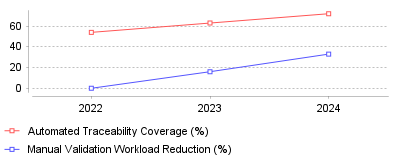
The latest market analysis reveals a decisive break from manual requirement tracking. Between 2022 and 2024, automated traceability coverage across enterprise projects surged from 54% to 72% [1]. Concurrently, this shift has driven a quantifiable efficiency gain, with organizations reporting a 33% reduction in the manual workload previously required for validation tasks [1]. This data indicates that the "Excel-sheet matrix" era is ending, replaced by tools that algorithmically link specs to code and tests.
On a micro level, this means individual product owners and systems engineers are spending significantly less time manually mapping identifiers between documents. Instead, they are utilizing "Human-AI Collaboration" (HAIC), which now accounts for over 54% of requirements engineering techniques, to assist in linking and verifying complex dependencies [2]. On a macro industry level, this signifies a maturation of the DevOps pipeline; requirements tools are no longer isolated silos but are now integrated with testing and Agile platforms in 69% of deployments [1]. This integration allows for "live traceability," where the impact of a code change on a high-level safety requirement can be assessed instantly rather than retrospectively.
This trend is critical because software complexity is outpacing human capacity to manage it manually; the average project now contains 380 documented requirements, up from 210 just five years ago [1]. Furthermore, improved traceability is directly correlated with product quality. Enterprises utilizing these automated analysis tools have reported a 27% reduction in defect leakage, preventing costly errors from reaching production [1]. For regulated industries like medical devices or automotive, where 100% verification coverage is often mandatory, automation is becoming the only viable way to remain compliant without slowing down development cycles.
The primary catalyst is likely the mainstream availability of AI and Natural Language Processing (NLP) within legacy and modern ALM tools. Approximately 58.2% of practitioners now report using AI in requirements engineering, specifically for tasks like analyzing dependencies and detecting ambiguity [3]. Additionally, the widespread shift toward "continuous" delivery models has made the latency of manual traceability matrices unacceptable. When teams deploy monthly or weekly, they cannot afford the weeks-long documentation freezes that legacy tools (like DOORS) often necessitated due to their client-server architecture performance bottlenecks [4].
The trend line points toward a future where "requirements management" becomes less about writing documents and more about managing a digital thread of logic. As automated coverage passes the 70% threshold, the competitive advantage shifts to teams that leverage this data for predictive decision-making rather than just retroactive auditing. The takeaway for leadership is clear: manual traceability is now a technical debt that actively hinders speed and quality; investment in automated, AI-assisted linking is the new baseline for complex systems engineering.
The landscape of software and product development is undergoing a structural shift, driven by the collision of increasing system complexity, stringent regulatory frameworks, and the democratization of artificial intelligence. Requirements management (RM)—the discipline of defining, documenting, and maintaining requirements—has transitioned from a bureaucratic phase of the waterfall model to a dynamic, continuous operational necessity. The cost of failure in this domain is quantifiable and staggering: a 2022 report by the Consortium for Information & Software Quality (CISQ) estimated that poor software quality cost the U.S. economy approximately $2.41 trillion, with a significant portion attributed to requirements and design flaws [1].
As organizations navigate this environment, the tools utilized to manage specifications have evolved from static repositories into active intelligence platforms. This report analyzes the current trends, operational challenges, and strategic imperatives facing engineering and product leaders in the domain of Requirements Management & Spec Tools. It explores how the integration of AI, the convergence of hardware and software lifecycles, and the rise of hybrid methodologies are reshaping how products are defined and delivered.
The global market for requirements management tools is experiencing robust growth, projected to reach approximately $1.59 billion by 2025 with a compound annual growth rate (CAGR) of 12.8% [2]. This expansion is not merely a reflection of IT budget increases but a response to the escalating "cost of quality" (CoQ). The principle that defects become exponentially more expensive to fix the later they are discovered remains a governing economic law of software engineering. Research consistently indicates that errors identified in the requirements phase cost significantly less to rectify than those found in production—often by a factor of 100 [3].
Despite the availability of sophisticated Project Management & Productivity Tools, project failure rates remain stubbornly high. Poor requirements gathering is cited as a primary cause in nearly 39% of project failures [4]. The operational reality is that "moving fast and breaking things" is no longer a viable strategy for enterprise-grade or safety-critical systems. Organizations are increasingly seeking tools that offer rigorous traceability without sacrificing the velocity required by modern digital markets.
The operational friction in requirements management has shifted from simple documentation issues to complex systemic disconnects. The primary challenges facing organizations today include the "Agile-Compliance Paradox," the hardware-software silo, and the fragmentation of truth.
A significant operational tension exists between the fluidity of Agile methodologies and the rigidity of regulatory compliance. Agile emphasizes working software over comprehensive documentation, yet industries such as automotive, aerospace, and MedTech require exhaustive traceability to meet standards like ISO 26262 or the emerging ISO/SAE 21434 for cybersecurity [5].
This paradox creates a "traceability gap." Engineering teams often maintain "shadow specs"—informal requirements living in wikis, spreadsheets, or code comments—while the official compliance documentation languishes in a separate, rarely updated system. This bifurcation leads to audit risks and, more critically, product safety vulnerabilities. To bridge this gap, organizations are increasingly turning to Requirements Tools Integrated with Issue Tracking. These solutions allow dynamic linking between high-level compliance requirements and individual Jira tickets or user stories, ensuring that "definition of done" includes regulatory verification.
As products become increasingly "smart," the distinction between hardware and software engineering is blurring. A modern vehicle, for instance, is a software-defined asset wrapped in physical hardware. However, the tools used to manage these domains often remain distinct: Application Lifecycle Management (ALM) for software and Product Lifecycle Management (PLM) for hardware.
The lack of integration between ALM and PLM systems results in misaligned release cycles. A software update might be ready for deployment, but if it relies on a specific hardware revision that has been delayed, the disconnect can lead to integration failures. Best-in-class operations are now deploying Product Spec Tools with Design and Engineering Collaboration capabilities that federate data across these disciplines, creating a single digital thread that spans mechanical, electrical, and software specifications [6].
The most disruptive trend in 2024 and beyond is the integration of Generative AI (GenAI) into requirements engineering. Gartner predicts that by 2027, 80% of the engineering workforce will need to upskill to accommodate GenAI transformations [7]. In the context of RM, AI is moving beyond simple grammar checking to semantic analysis and automated generation.
Modern tools are beginning to offer "smart authoring" capabilities where the AI analyzes a requirement for ambiguity, completeness, and testability in real-time. For example, an AI agent can flag a requirement like "The system must be fast" as non-verifiable and suggest a quantified alternative (e.g., "The system must respond within 200ms"). Furthermore, AI is being utilized to automate the tedious mapping of traceability matrices, identifying gaps where requirements lack associated test cases [8]. This shift transitions RM from a passive administrative task to an active, AI-assisted engineering discipline.
The dogmatic debate between Waterfall and Agile is largely resolving into a pragmatic "Hybrid" consensus. The State of Agile Report and PMI data indicate a steady rise in hybrid approaches, particularly in large enterprises where pure Agile struggles to handle complex architectural dependencies [9].
Operational data suggests that 57% of organizations have increased their use of hybrid approaches over the last three years [10]. This trend necessitates tools that can support bimodal IT—allowing some teams to sprint in Scrum while the broader program tracks milestones in a predictive, waterfall-like structure. This is particularly relevant for Requirements Management Tools for Enterprise Products, which must aggregate diverse work streams into a unified view of project health and scope delivery.
New regulatory frameworks are forcing a maturity upgrade in requirements processes. The EU AI Act, which classifies AI systems based on risk, mandates rigorous technical documentation, record-keeping, and human oversight for "high-risk" systems [11]. Similarly, ISO/SAE 21434 has standardized cybersecurity engineering for road vehicles, requiring evidence that security requirements are managed throughout the vehicle lifecycle [12].
These regulations effectively outlaw the use of disconnected documents (like Excel or Word) for managing specifications in regulated sectors. Traceability is no longer a "nice-to-have" for quality assurance; it is a legal prerequisite for market access. Tools are adapting by offering pre-configured compliance templates and automated audit trails that link requirements to risk assessments and validation results [13].
Gartner predicts that by 2027, 30% of large global enterprises will include software sustainability in their non-functional requirements (NFRs), up from less than 10% in 2024 [14]. "Green software engineering" requires teams to specify energy efficiency targets alongside traditional performance metrics. This adds a new layer of complexity to specification tools, which must now track carbon footprint constraints and energy consumption targets as first-class requirements, traceable through to architectural decisions and code implementation.
The operational trends described above carry profound business implications. Organizations that fail to modernize their requirements tooling face existential risks related to speed, security, and compliance.
In the event of a product failure—whether it be a medical device malfunction or a security breach in a connected vehicle—the ability to produce a complete audit trail is the primary defense against liability. If an organization cannot prove that a specific safety requirement was tested and verified in the software version running at the time of the incident, they face severe legal and reputational damage. Modern RM tools serve as a "flight recorder" for the development process, preserving the decision logic and verification evidence required for liability protection.
The integration of requirements with issue tracking and testing tools facilitates the "Shift Left" strategy—moving testing earlier in the development cycle. By validating requirements before code is written (often using AI simulations or model-based systems engineering), companies can avoid the 100x cost penalty of fixing bugs in production [4]. This requires a cultural shift where requirements are viewed not as bureaucratic hurdles but as the initial phase of quality assurance.
Looking forward, the domain of requirements management will evolve from "managing documents" to "managing intent."
| Year | Automated Traceability Coverage (%) | Manual Validation Workload Reduction (%) |
|---|---|---|
| 2022 | 54 | 0 |
| 2023 | 63 | 16 |
| 2024 | 72 | 33 |
The latest market analysis reveals a decisive break from manual requirement tracking. Between 2022 and 2024, automated traceability coverage across enterprise projects surged from 54% to 72% [1]. Concurrently, this shift has driven a quantifiable efficiency gain, with organizations reporting a 33% reduction in the manual workload previously required for validation tasks [1]. This data indicates that the "Excel-sheet matrix" era is ending, replaced by tools that algorithmically link specs to code and tests.
On a micro level, this means individual product owners and systems engineers are spending significantly less time manually mapping identifiers between documents. Instead, they are utilizing "Human-AI Collaboration" (HAIC), which now accounts for over 54% of requirements engineering techniques, to assist in linking and verifying complex dependencies [2]. On a macro industry level, this signifies a maturation of the DevOps pipeline; requirements tools are no longer isolated silos but are now integrated with testing and Agile platforms in 69% of deployments [1]. This integration allows for "live traceability," where the impact of a code change on a high-level safety requirement can be assessed instantly rather than retrospectively.
This trend is critical because software complexity is outpacing human capacity to manage it manually; the average project now contains 380 documented requirements, up from 210 just five years ago [1]. Furthermore, improved traceability is directly correlated with product quality. Enterprises utilizing these automated analysis tools have reported a 27% reduction in defect leakage, preventing costly errors from reaching production [1]. For regulated industries like medical devices or automotive, where 100% verification coverage is often mandatory, automation is becoming the only viable way to remain compliant without slowing down development cycles.
The primary catalyst is likely the mainstream availability of AI and Natural Language Processing (NLP) within legacy and modern ALM tools. Approximately 58.2% of practitioners now report using AI in requirements engineering, specifically for tasks like analyzing dependencies and detecting ambiguity [3]. Additionally, the widespread shift toward "continuous" delivery models has made the latency of manual traceability matrices unacceptable. When teams deploy monthly or weekly, they cannot afford the weeks-long documentation freezes that legacy tools (like DOORS) often necessitated due to their client-server architecture performance bottlenecks [4].
The trend line points toward a future where "requirements management" becomes less about writing documents and more about managing a digital thread of logic. As automated coverage passes the 70% threshold, the competitive advantage shifts to teams that leverage this data for predictive decision-making rather than just retroactive auditing. The takeaway for leadership is clear: manual traceability is now a technical debt that actively hinders speed and quality; investment in automated, AI-assisted linking is the new baseline for complex systems engineering.