


| Year | Enrollments Per Minute | Total GenAI Enrollments Millions |
|---|---|---|
| 2023 | 1 | 0.5 |
| 2024 | 8 | 4 |
| 2025 | 12 | 8 |
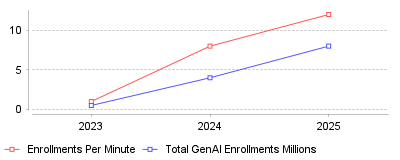
Data from late 2024 through 2025 highlights a dramatic divergence between financial investment in training and the time employees dedicate to it. While U.S. corporate training expenditures rebounded to $102.8 billion in 2025 (a 4.9% increase), the average number of formal learning hours utilized per employee plummeted to just 13.7 hours, down significantly from 17.4 hours in 2023 [1] [2]. Simultaneously, the intensity of demand for specific, high-value skills has exploded; specifically, Generative AI course enrollments on platforms like Coursera accelerated from 1 enrollment per minute in 2023 to 12 enrollments per minute by 2025 [3].
This trend signals a transition from "just-in-case" comprehensive training to "just-in-time" high-velocity micro-skilling. The data indicates that while organizations are willing to pay more per learner—spending rose to $874 per employee in 2025—they are investing in premium, technology-driven efficiency rather than time-intensive coursework [4]. The market is witnessing a consolidation of focus where "soft" metrics like total hours are becoming irrelevant compared to the rapid acquisition of critical technical capabilities. Furthermore, the sheer speed of GenAI adoption (195% year-over-year enrollment growth) suggests that the workforce is self-correcting for a skills gap that traditional corporate curriculums may be too slow to address [5].
This is a critical indicator of the "efficiency paradox" in modern workforce development: companies are spending record amounts to combat a talent crisis, yet employees have less capacity than ever to engage with that content. With 75% of employees noting they need to supplement their skills to advance, but formal learning hours in decline, there is a dangerous gap between organizational ambition and operational reality [6]. Failure to adapt L&D delivery to this "low-time, high-impact" reality contributes to the 10-year low in employee engagement levels currently observed in the U.S. market [7].
The decline in learning hours is likely driven by increased operational workloads and the fragmentation of the hybrid workday, which has left 53% of employees feeling they have "no room" for training despite the need [8]. The concurrent spike in spending and GenAI adoption suggests that companies are panic-buying external solutions and tools to solve productivity bottlenecks rapidly rather than building internal academies from scratch. Additionally, the rise of AI tools in L&D (used by 40% of organizations) may be compressing the time required to learn, allowing workers to gain competence faster, which would statistically lower "hours spent" while maintaining or increasing skill acquisition [9].
The 2025 landscape for Employee Training Platforms is defined by an aggressive pursuit of efficiency: higher spending on better tools, compressed into shorter timeframes. Organizations are moving away from measuring success by "butts in seats" (hours) and toward high-velocity competency acquisition, particularly in AI literacy. The key takeaway for L&D leaders is that availability of content is no longer the metric of success; the new competitive advantage lies in "enablement"—integrating learning so seamlessly into the workflow that it requires minimal time away from production [10].

| Year | Enrollments Per Minute | Total GenAI Enrollments Millions |
|---|---|---|
| 2023 | 1 | 0.5 |
| 2024 | 8 | 4 |
| 2025 | 12 | 8 |
Data from late 2024 through 2025 highlights a dramatic divergence between financial investment in training and the time employees dedicate to it. While U.S. corporate training expenditures rebounded to $102.8 billion in 2025 (a 4.9% increase), the average number of formal learning hours utilized per employee plummeted to just 13.7 hours, down significantly from 17.4 hours in 2023 [1] [2]. Simultaneously, the intensity of demand for specific, high-value skills has exploded; specifically, Generative AI course enrollments on platforms like Coursera accelerated from 1 enrollment per minute in 2023 to 12 enrollments per minute by 2025 [3].
This trend signals a transition from "just-in-case" comprehensive training to "just-in-time" high-velocity micro-skilling. The data indicates that while organizations are willing to pay more per learner—spending rose to $874 per employee in 2025—they are investing in premium, technology-driven efficiency rather than time-intensive coursework [4]. The market is witnessing a consolidation of focus where "soft" metrics like total hours are becoming irrelevant compared to the rapid acquisition of critical technical capabilities. Furthermore, the sheer speed of GenAI adoption (195% year-over-year enrollment growth) suggests that the workforce is self-correcting for a skills gap that traditional corporate curriculums may be too slow to address [5].
This is a critical indicator of the "efficiency paradox" in modern workforce development: companies are spending record amounts to combat a talent crisis, yet employees have less capacity than ever to engage with that content. With 75% of employees noting they need to supplement their skills to advance, but formal learning hours in decline, there is a dangerous gap between organizational ambition and operational reality [6]. Failure to adapt L&D delivery to this "low-time, high-impact" reality contributes to the 10-year low in employee engagement levels currently observed in the U.S. market [7].
The decline in learning hours is likely driven by increased operational workloads and the fragmentation of the hybrid workday, which has left 53% of employees feeling they have "no room" for training despite the need [8]. The concurrent spike in spending and GenAI adoption suggests that companies are panic-buying external solutions and tools to solve productivity bottlenecks rapidly rather than building internal academies from scratch. Additionally, the rise of AI tools in L&D (used by 40% of organizations) may be compressing the time required to learn, allowing workers to gain competence faster, which would statistically lower "hours spent" while maintaining or increasing skill acquisition [9].
The 2025 landscape for Employee Training Platforms is defined by an aggressive pursuit of efficiency: higher spending on better tools, compressed into shorter timeframes. Organizations are moving away from measuring success by "butts in seats" (hours) and toward high-velocity competency acquisition, particularly in AI literacy. The key takeaway for L&D leaders is that availability of content is no longer the metric of success; the new competitive advantage lies in "enablement"—integrating learning so seamlessly into the workflow that it requires minimal time away from production [10].