


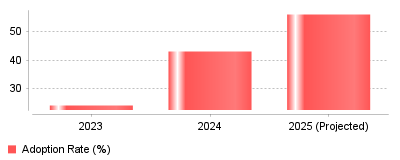
The surge in AI-driven sales coaching adoption represents a fundamental shift in the industry, with usage rates nearly doubling from 24% in 2023 to 43% in 2024. This trend highlights a move away from sporadic, human-led training seminars toward continuous, generative AI-powered roleplay and real-time feedback systems designed to address plummeting quota attainment rates.
| Year | Adoption Rate (%) |
|---|---|
| 2023 | 24 |
| 2024 | 43 |
| 2025 (Projected) | 56 |
The data reveals a dramatic acceleration in the adoption of AI technologies within sales training and coaching platforms. Specifically, adoption rates among sales representatives jumped from 24% in 2023 to 43% in 2024, with projections hitting 56% by 2025 [1]. This correlates with the AI-driven sales coaching market reaching a valuation of $2.13 billion in 2024, driven by a compound annual growth rate (CAGR) of 18.9% [2]. The trend indicates a rapid departure from static learning management systems (LMS) to dynamic, interactive AI tools.
On a micro level, this trend signifies that sales representatives are increasingly relying on "always-on" digital coaches rather than waiting for scheduled sessions with human managers. Platforms are now capable of providing realistic, generative AI roleplay scenarios that simulate complex buyer interactions, offering instant, objective feedback on soft skills like empathy and objection handling [3]. Macro-economically, the industry is witnessing a democratization of high-level coaching; where deep, personalized training was once reserved for top-tier executives or high-performers, scalable AI allows organizations to provide elite-level skill development to every member of a distributed workforce [4]. This shift is redefining the software stack for revenue teams, making AI-integration a non-negotiable feature for training platforms.
This trend is critical because traditional coaching methods are failing to keep pace with the modern selling environment. With quota attainment hovering around 43% in late 2024 [5], organizations are facing a performance crisis that human managers—often stretched too thin to coach effectively—cannot solve alone [6]. Furthermore, 75% of sellers who exceed their quotas now use AI, establishing a clear link between the utilization of these platforms and revenue success [3].
The primary catalyst is the maturation of Large Language Models (LLMs), which have finally made "human-like" roleplay scalable and accessible without human intervention. Additionally, the persistence of remote and hybrid work models has made "osmosis training"—learning by listening to a neighbor's sales call—impossible, necessitating digital tools that can analyze patterns across thousands of remote calls [2]. Economic pressure to reduce ramp time for new hires has also forced companies to abandon slow, theory-based onboarding in favor of simulation-based practice that accelerates competency [7].
We have moved past the era of passive video-based training into the age of active, AI-facilitated simulation. The data confirms that AI coaching is no longer experimental; it is a competitive necessity, with early adopters seeing twice the likelihood of exceeding sales targets compared to non-users [1]. Sales leaders must now audit their tech stacks to ensure they are not just tracking activity, but actively improving rep behavior through generative feedback loops.
The global landscape for sales training and coaching is undergoing a structural transformation, driven by the convergence of generative artificial intelligence (AI), distributed workforces, and increasingly complex buyer journeys. Historically viewed as a periodic intervention—often in the form of annual kick-offs or quarterly workshops—sales training has evolved into a continuous, data-driven operational necessity. The global sales training software market, valued at approximately $3.4 billion in 2024, is projected to expand significantly, reaching an estimated $12.2 billion by 2034 [1], [1]. This growth reflects a broader shift in organizational priorities from mere content repository management to active, algorithmic skill development.
As organizations navigate this expansion, they face a dual challenge: integrating sophisticated technology into legacy workflows while ensuring adoption among a skeptical or overwhelmed frontline. The operational mandate has shifted from "availability of learning" to "precision of application." In this context, Sales Training & Coaching Platforms are no longer standalone educational tools but are becoming central nervous systems for revenue operations, often sitting alongside or integrated within Field Service & Operations Software ecosystems to ensure continuity across customer-facing roles.
The most significant trend reshaping sales coaching in 2024 and heading into 2025 is the operationalization of Artificial Intelligence beyond simple analytics. While previous iterations of sales technology focused on recording calls and transcribing text, the current generation of tools employs generative AI to actively coach representatives. According to recent industry reports, the use of AI in sales training programs has increased by 164% year-over-year [2].

Modern platforms are transitioning from passive "call listening" to active simulation. AI-driven role-play scenarios allow representatives to practice pitches, objection handling, and negotiation with synthetic buyers that react in real-time. This capability addresses a critical operational bottleneck: the scarcity of manager time. Traditionally, role-play required two humans, making it difficult to scale. AI agents can now simulate various buyer personas—from the skeptical CFO to the enthusiastic champion—allowing for infinite repetition without burning manager cycles [3], [4].
This shift is particularly vital for Sales Coaching Platforms with Video and Role Play Features, where the integration of AI allows for immediate, objective feedback on soft skills such as tone, pacing, and filler words, alongside content accuracy. Research indicates that companies integrating AI into their sales coaching strategies see a 3.3x year-over-year growth in quota attainment compared to those using AI for other purposes without the coaching component [5], [6].
Intuition-based coaching is rapidly being replaced by evidence-based methodologies. By 2025, it is predicted that 60% of B2B sales organizations will transition from experience-based selling to data-driven sales strategies [7]. Platforms are now capable of correlating specific behaviors—such as the timing of pricing discussions or the ratio of listening to speaking—directly with win rates. This allows organizations to move away from "sheep-dip" training (where everyone receives the same curriculum) to hyper-personalized learning paths based on individual performance gaps.
For example, if data indicates a rep struggles specifically with early-stage discovery but excels at closing, the platform automatically serves modules and role-play scenarios targeted at discovery questions. This precision is critical for Sales Training Platforms for Mid Market Account Executives, where deal velocity is higher than enterprise sales, and agility in skill correction can immediately impact quarterly revenue [8].
Despite the promise of technology, operational friction remains high. The primary failure point for sales training platforms is rarely the technology itself, but the operational processes surrounding its deployment and the human element of adoption.
Frontline sales managers are the linchpin of training effectiveness, yet they are often the most resource-constrained. Industry data suggests that top-performing sales reps receive significantly more coaching than average performers, yet managers often struggle to find the time to deliver it [9], [10]. The operational challenge lies in the "coaching tax"—the administrative burden of reviewing calls and preparing feedback. While AI helps summarize calls, managers must still synthesize this into behavioral change.
Platforms that fail to integrate seamlessly into a manager’s daily workflow—forcing them to log into separate systems to view dashboards—often see low adoption. This is exacerbated in high-volume environments utilizing Sales Training Platforms for Call Center and Inside Sales, where high turnover and relentless call volumes leave little margin for offline coaching sessions. Here, the challenge is delivering "micro-coaching" in the flow of work rather than in dedicated sessions [11], [12].
A persistent operational issue is the retention of training material. Research suggests that without reinforcement, 87% of training content is forgotten within weeks [13]. The operational challenge is shifting from "event-based" training (e.g., onboarding bootcamp) to continuous reinforcement. Platforms must engineer "spaced repetition" into the daily lives of sellers without disrupting revenue-generating activities. This is particularly difficult for Sales Training Platforms for SDR and BDR Teams, where the pressure to hit activity metrics (calls/emails) can make any time spent away from the phone feel like lost income [14].
Sales organizations are often plagued by a fragmented tech stack. A typical rep might use a CRM, a sales engagement platform, a conversation intelligence tool, and a separate Learning Management System (LMS). The operational challenge is data unification. If the training platform does not "talk" to the CRM to see how training completion correlates with pipeline progression, the ROI of coaching remains opaque. This complexity is often cited as a barrier to adoption, with bloated stacks slowing down sales teams rather than enabling them [15].
The challenges and requirements for sales training platforms vary significantly depending on the sales motion and target customer segment. A "one-size-fits-all" approach to platform selection is a common operational error.
In transactional environments, speed to productivity is the primary metric. Sales Training Platforms for Short Ramp Transactional Sales must focus on rapid onboarding and script adherence. The operational challenge here is high turnover; if a rep stays only 12 months, the payback period for training must be less than three. Platforms in this space emphasize micro-learning and gamification to keep engagement high among younger demographics who often populate these roles [16], [17].
Conversely, Sales Training Platforms for Enterprise Sales Teams face the challenge of depth over speed. Enterprise deals involve multi-threading, committee buying, and long cycles (6-18 months). Operational challenges here involve mapping training to non-linear buying journeys. Content cannot simply be about product features; it must cover strategic account planning, stakeholder management, and business acumen. The platform must support "just-in-time" learning that delivers specific competitive intelligence or negotiation tactics exactly when a deal stage requires it [18], [19].
Perhaps the most operationally complex environment is the indirect channel. Sales Training Platforms for Channel and Partner Sales must engage users who are not employees. These partners sell multiple products from different vendors, making their attention span the scarcest resource. The operational challenge is creating "partner-first" usability where training is voluntary. If the platform is difficult to access or the content isn't immediately helpful in closing a deal, partners will ignore it. Trends here point toward integration with Partner Relationship Management (PRM) systems to tie training certification directly to tier advancement and margin incentives [20], [21].
The divergence between organizations with mature, tech-enabled coaching cultures and those without is widening. The business implications of failing to modernize sales training infrastructure are measurable and severe.
Data consistently shows a strong correlation between formal coaching processes and revenue attainment. Companies that couple AI with sales training report win rates and quota attainment significantly higher than their peers. Specifically, research highlights that high-performing sales organizations are 5.2x more likely to provide resources that specifically prepare managers to coach [22]. Furthermore, organizations leveraging AI in coaching see an improvement in profit margins by up to 118% due to better value selling and less reliance on discounting [5], [23].
In an era of "quiet quitting" and high mobility, development is a retention tool. Over two-thirds of employees reporting to a manager who is not a good coach consider quitting their jobs [10]. Conversely, effective training and coaching platforms signal investment in the employee's career capital. For SDRs and BDRs, where burnout is rampant, the presence of a structured, supportive coaching environment—facilitated by platforms that objectively track progress—can reduce attrition, saving the organization substantial recruitment and ramp-up costs [11], [12].
As AI begins to take over more coaching duties, a new business implication emerges: trust. Sales reps may be wary of "Big Brother" surveillance if coaching platforms are used solely for compliance and punishment rather than development. Operational transparency is required. Organizations must clearly communicate that the AI analysis of their calls is intended to help them hit quota and earn commission, not to build a case for termination. Trust in the validity of the AI's feedback is also crucial; if the "coach" gives bad advice, adoption collapses [24].
Looking ahead, the sales training and coaching market will be defined by the integration of predictive analytics and the dissolution of the "training" category into the broader "revenue enablement" ecosystem.
The silo between sales training, marketing enablement, and customer success coaching is breaking down. Future platforms will likely address the entire revenue engine. This "Revenue Enablement" approach ensures that the message promised by marketing is the same one pitched by sales and delivered by customer success. This holistic view is necessary to support the 60% of B2B sales organizations moving toward a data-driven approach by 2025 [7].
By 2028, it is predicted that 60% of B2B seller work will be executed via conversational user interfaces powered by generative AI [25], [26]. In the context of training, this means the platform will become a real-time copilot. Instead of taking a course on negotiation weeks before a deal, the AI will likely surface a "micro-simulation" or a battlecard during the meeting preparation phase, or even prompt the rep in real-time during a call. The operational challenge will shift from "training delivery" to "contextual guidance."
Training platforms will increasingly interface with Digital Sales Rooms. As buyers prefer self-service and digital interaction, reps need training on how to curate and manage these digital spaces. The coaching of the future will involve analyzing how a rep constructs a DSR and how the buyer interacts with it, moving coaching beyond just "verbal" skills to "digital interaction" skills [27].
The operational landscape of sales training and coaching platforms is shifting from content libraries to active, AI-driven performance engines. The successful organizations of the next decade will be those that solve the operational challenges of manager bandwidth, data integration, and user engagement. They will leverage these platforms not just to fix broken sales processes, but to build a resilient, adaptable revenue workforce capable of navigating an increasingly complex B2B buying environment. The integration of specialized tools—whether for high-velocity SDRs, complex enterprise teams, or external partners—will be the defining characteristic of a mature sales operations strategy.
The surge in AI-driven sales coaching adoption represents a fundamental shift in the industry, with usage rates nearly doubling from 24% in 2023 to 43% in 2024. This trend highlights a move away from sporadic, human-led training seminars toward continuous, generative AI-powered roleplay and real-time feedback systems designed to address plummeting quota attainment rates.
| Year | Adoption Rate (%) |
|---|---|
| 2023 | 24 |
| 2024 | 43 |
| 2025 (Projected) | 56 |
The data reveals a dramatic acceleration in the adoption of AI technologies within sales training and coaching platforms. Specifically, adoption rates among sales representatives jumped from 24% in 2023 to 43% in 2024, with projections hitting 56% by 2025 [1]. This correlates with the AI-driven sales coaching market reaching a valuation of $2.13 billion in 2024, driven by a compound annual growth rate (CAGR) of 18.9% [2]. The trend indicates a rapid departure from static learning management systems (LMS) to dynamic, interactive AI tools.
On a micro level, this trend signifies that sales representatives are increasingly relying on "always-on" digital coaches rather than waiting for scheduled sessions with human managers. Platforms are now capable of providing realistic, generative AI roleplay scenarios that simulate complex buyer interactions, offering instant, objective feedback on soft skills like empathy and objection handling [3]. Macro-economically, the industry is witnessing a democratization of high-level coaching; where deep, personalized training was once reserved for top-tier executives or high-performers, scalable AI allows organizations to provide elite-level skill development to every member of a distributed workforce [4]. This shift is redefining the software stack for revenue teams, making AI-integration a non-negotiable feature for training platforms.
This trend is critical because traditional coaching methods are failing to keep pace with the modern selling environment. With quota attainment hovering around 43% in late 2024 [5], organizations are facing a performance crisis that human managers—often stretched too thin to coach effectively—cannot solve alone [6]. Furthermore, 75% of sellers who exceed their quotas now use AI, establishing a clear link between the utilization of these platforms and revenue success [3].
The primary catalyst is the maturation of Large Language Models (LLMs), which have finally made "human-like" roleplay scalable and accessible without human intervention. Additionally, the persistence of remote and hybrid work models has made "osmosis training"—learning by listening to a neighbor's sales call—impossible, necessitating digital tools that can analyze patterns across thousands of remote calls [2]. Economic pressure to reduce ramp time for new hires has also forced companies to abandon slow, theory-based onboarding in favor of simulation-based practice that accelerates competency [7].
We have moved past the era of passive video-based training into the age of active, AI-facilitated simulation. The data confirms that AI coaching is no longer experimental; it is a competitive necessity, with early adopters seeing twice the likelihood of exceeding sales targets compared to non-users [1]. Sales leaders must now audit their tech stacks to ensure they are not just tracking activity, but actively improving rep behavior through generative feedback loops.