


Recent data from late 2024 through mid-2025 reveals a definitive "efficiency bifurcation" in the ITSM landscape: organizations fully integrating Generative AI (GenAI) into their service desks are resolving incidents significantly faster than those that have not. Specifically, GenAI-enabled teams have established a 30.5% performance lead in resolution speeds over their non-AI counterparts, creating
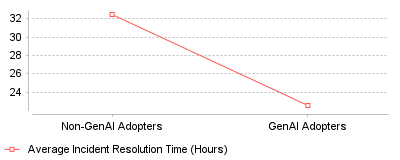
| Category | Average Incident Resolution Time (Hours) |
|---|---|
| Non-GenAI Adopters | 32.46 |
| GenAI Adopters | 22.55 |
This trend highlights a stark divergence in operational performance between IT service desks that have integrated Generative AI and those that have not. According to data analyzing over 60,000 incident records between August 2024 and July 2025, organizations utilizing GenAI capabilities achieved an average incident resolution time of 22.55 hours, compared to 32.46 hours for non-adopters [1]. Furthermore, adoption rates for Generative AI in the workforce have climbed steadily, rising from 44.6% in August 2024 to 54.6% by August 2025 [2].
On a micro level, this data indicates that the "experimentation phase" of AI in ITSM is over; the technology is now driving tangible operational metrics, with adopters saving nearly 10 hours per ticket compared to non-adopters [1]. Macro-economically, the industry is entering a period of bifurcation where "GenAI-enabled" becomes the baseline for service delivery, pushing the market toward the next frontier: "Agentic AI" (autonomous agents). While GenAI assists humans, the emerging Agentic AI trend—predicted to be in 33% of enterprise software by 2028—represents a shift toward systems that act independently to resolve issues [3]. However, this transition is not without risk; forecasts suggest that up to 40% of these advanced Agentic AI projects may fail by 2027 due to governance and complexity challenges [4].
The implications of this efficiency gap are financial and structural: Atlassian reports that ineffective collaboration and outdated practices contribute to 25 billion lost work hours annually among Fortune 500 companies [5]. By reclaiming nearly 5 hours per incident through AI enablement, ITSM teams are directly combating this productivity crisis [6]. Furthermore, as ticket volumes grow and hybrid work complexities persist, the ability to automate routine diagnostics and summaries is becoming essential for preventing burnout and maintaining Service Level Agreements (SLAs) [7].
The sharp reduction in resolution times is likely driven by the maturation of specific AI features such as automated ticket summarization, sentiment analysis, and predictive categorization, which remove the "cognitive load" from human agents [1]. Simultaneously, the rapid rise in adoption rates suggests a network effect where AI tools are becoming embedded in standard enterprise platforms, lowering the barrier to entry [2]. We can also speculate that the shift is being accelerated by the impending rise of "Agentic AI," where organizations are rushing to modernize their data foundations to prepare for fully autonomous agents that don't just recommend solutions but execute them [8].
The data from the last 12 months confirms that AI in ITSM has graduated from a buzzword to a critical performance differentiator. Organizations that fail to bridge the "efficiency gap" risk falling behind by nearly 30% in operational speed, a deficit that will likely prove insurmountable as the industry pivots toward fully autonomous Agentic AI. The prominent takeaway is that 2025 marks the year where AI adoption became the primary determinant of Service Desk velocity and success.
IT Service Management (ITSM) has moved beyond the help desk. For two decades, the sector focused on logging, tracking, and managing tickets. That era is over. The mandate for 2025 is resolution—preferably without human intervention. CIOs and infrastructure leaders now face a dual pressure: flat budgets and spiraling complexity caused by distributed workforces and cloud-native architectures.
Operational efficiency is no longer just a metric; it is a survival mechanism. The global ITSM market, valued at $12.43 billion in 2024, is projected to reach $14.42 billion in 2025 [1]. This 16% growth rate signals capital investment, but the spending mix has changed. Enterprises are diverting funds from seat-based licensing to automated workflows and predictive intelligence. They are buying outcomes, not tools.
We are witnessing a bifurcation in the market. On one side, legacy platforms struggle to retrofit generative AI into decade-old architectures. On the other, agile entrants and modernized incumbents are rewriting the playbook on service delivery. This report analyzes the operational challenges driving this split, the regulatory hammers forcing compliance, and the specific vendor moves reshaping the sector.
Generative AI has graduated from experimental pilots to production environments. The data proves that early adopters are widening the performance gap against laggards. SolarWinds analyzed over 60,000 incident records for their 2025 State of ITSM Report, revealing a stark divide. Teams using GenAI-enabled features resolved tickets 17.8% faster than they did prior to adoption [2].
The time savings are concrete. The average resolution time for GenAI users stands at 22.55 hours, compared to 32.46 hours for non-users [3]. That ten-hour difference per incident compounds rapidly across a fiscal year. For a mid-sized enterprise handling 5,000 tickets annually, this differential represents thousands of reclaimed engineering hours. These are hours previously lost to categorization, summarization, and routine triage.
Salesforce validated this trend with aggressive internal restructuring. In early 2025, the company reduced its customer support headcount from roughly 9,000 to 5,000 [4]. CEO Marc Benioff attributed this reduction directly to the efficacy of their Agentforce AI agents. While layoffs are a harsh metric, they signal a permanent change in staffing models. The Tier 1 support role is vanishing. Human agents are moving to Tier 2 and Tier 3, handling complex edge cases while algorithms manage the volume.
This shift impacts how organizations select software. Buyers evaluating IT service management (ITSM) platforms for SaaS companies prioritize API extensibility and AI maturity over standard ticketing features. High-growth tech firms cannot afford to scale support headcount linearly with customer growth. They require platforms that decouple revenue growth from support costs.

Speed is now a legal requirement. Regulatory bodies in the EU and US have introduced strict reporting timelines for cyber incidents, forcing ITSM and cybersecurity teams to integrate their workflows tighter than ever before. The days of siloed Security Operations Centers (SOC) and Service Desks are numbered.
The Digital Operational Resilience Act (DORA), fully applicable as of January 2025, sets a blistering pace for financial entities operating in the EU. Organizations must submit an initial notification within four hours of classifying a major ICT-related incident [5]. This is not a target; it is a mandate. An intermediate report is due within 72 hours, followed by a final root-cause analysis one month post-resolution [6].
United States regulators are equally demanding. The SEC's cybersecurity disclosure rules, effective late 2023, require public companies to disclose material cybersecurity incidents on Form 8-K within four business days of determination [7]. While "materiality" allows for some interpretation, the clock starts ticking the moment that determination is made.
These regulations create an operational crisis for disjointed IT environments. If a service desk platform cannot instantly correlate a server outage with a security breach, the four-hour DORA deadline will be missed. Incident response workflows must trigger automatic escalation to legal and compliance teams. We are seeing a surge in demand for Cybersecurity, Privacy & Compliance Software that integrates natively with ITSM systems to automate this reporting chain.
The financial penalty for service interruption has escalated alongside regulatory risk. New Relic's 2024 Observability Forecast revealed that the median annual downtime for high-impact outages is 77 hours [8]. The cost is staggering: $1.9 million per hour for significant outages. This represents a 500% increase compared to Gartner's $300,000 per hour estimate from a decade ago [9].
This inflation stems from digital dependency. Ten years ago, an email server outage was an inconvenience. Today, a microservice failure can halt production lines, block transactions, and sever customer communication simultaneously. The cost structure includes lost revenue, engineering overtime, SLA penalties, and long-term reputational damage.
Forrester's analysis of Atlassian Jira Service Management (JSM) highlights the ROI of mitigating these risks. Their composite organization realized $2.3 million in savings over three years simply by retiring legacy solutions and reducing management labor [10]. More importantly, improved service desk productivity contributed $2.9 million in value. Speed is the only hedge against the $1.9 million hourly burn rate of downtime.
Metrics often lie. A service desk can boast 99% SLA adherence while user satisfaction plummets. This phenomenon, known as the "Watermelon Effect" (green on the outside, red on the inside), plagues modern IT departments. HappySignals' 2024 Global IT Experience Benchmark analyzed 1.86 million end-user responses and found a glaring disconnect between IT perception and user reality [11].
End-users report losing over three hours of productivity per incident. While IT celebrates a "closed ticket," the employee is still reinstalling software or waiting for permissions. The benchmark data shows that corporate devices and enterprise applications have the lowest happiness scores, incurring the significant time loss [12]. Ticket reassignments are a primary driver of frustration; bouncing a user between Tier 1 and Tier 2 adds friction, not value.
Organizations are shifting from Service Level Agreements (SLAs) to Experience Level Agreements (XLAs). An SLA measures speed: "Did we answer in 15 minutes?" An XLA measures outcome: "Can the user work?" This shift is particularly critical for IT service management (ITSM) platforms for staffing agencies. In staffing, the workforce is often remote, transient, and using personal devices. If their access is blocked, revenue stops immediately. Traditional SLAs fail to capture the urgency of these distributed outages.
The vendor market is contracting into platform plays. Best-of-breed point solutions are losing ground to unified suites that combine ITSM, Enterprise Service Management (ESM), and Asset Management. CIOs want fewer contracts to manage and fewer integration points to break.
Atlassian aggressively moved to consolidate its position with the launch of the "Service Collection" in October 2025 [13]. This bundle unifies Jira Service Management, Customer Service Management, and Assets into a single SKU. This move directly targets ServiceNow's dominance in the enterprise by offering a comparable breadth of features at a lower price point.
The integration includes "Rovo," Atlassian's AI agent technology. Rovo agents automate triage and knowledge creation, addressing the efficiency gap mentioned earlier. For IT service management (ITSM) platforms for startups, this consolidation is attractive. Startups rarely have dedicated procurement teams to manage six different vendor relationships. A single platform that handles internal IT support and external customer support allows them to scale without administrative bloat.
Freshworks is countering with a focus on simplicity and "agentic AI." Their November 2025 release introduced "Freddy AI Agents" capable of resolving 80% of customer queries autonomously [14]. Freshworks also published a "Cost of Complexity" report, noting that 42% of agents cite uncustomizable workflows as a major productivity blocker.
Their strategy appeals to the mid-market and departments within large enterprises that are fatigued by the heavy implementation requirements of legacy tools. By integrating digital employee experience (DEX) data from partners like Riverbed directly into tickets, Freshservice attempts to solve the Watermelon Effect—giving agents visibility into device health before the user even complains.
Ivanti continues to merge ITSM with Unified Endpoint Management (UEM). Their 2025 roadmap emphasizes "self-healing" devices [15]. The logic is sound: if the ITSM platform controls the device, it can fix the device. Features like "AI write assist" and automated policy assignment reduce the cognitive load on agents. This convergence is vital for sectors with heavy compliance needs, where device security status must be linked to support tickets.
Operational challenges vary significantly by industry vertical. A one-size-fits-all ITSM deployment is a recipe for failure.
Recruitment agencies face high turnover and seasonal spikes. The operational challenge is onboarding velocity. Manual provisioning of accounts leads to days of lost productivity for new recruiters. IT service management (ITSM) platforms for recruitment agencies must automate the "Joiner, Mover, Leaver" (JML) process completely. Automation here cuts onboarding time by 5 days and increases retention by 16% [16]. If an ITSM tool cannot trigger an Active Directory creation and provision a CRM license in real-time, it is unfit for this sector.
For SaaS providers, internal ITSM often bleeds into external customer support. Engineering teams use Jira; support teams use Zendesk or Salesforce. The friction at this intersection causes delayed bug fixes. The trend is toward "swarming" models where developers and support agents collaborate in a single environment. Platforms that sync bi-directionally between development backlogs and support tickets are gaining market share.
The trajectory of the ITSM market is clear: we are moving toward autonomous operations. By 2026, we expect standard requests (password resets, software provisioning, access rights) to be handled entirely by AI agents with zero human oversight.
The role of the ITSM professional is changing from "ticket solver" to "automation architect." The skill set required will shift from technical troubleshooting to workflow design and AI governance. Organizations that fail to upskill their teams will find themselves staffing a help desk that no longer exists, managing tickets that should never have been logged.
Security convergence will accelerate. The DORA and SEC mandates are just the beginning. We anticipate further regulation in APAC and LATAM that will mirror these strict reporting requirements. ITSM & Service Desk Platforms will essentially become compliance engines, logging every digital interaction to satisfy auditors and regulators.
The market will punish inefficiency. With downtime costing nearly $2 million an hour, the tolerance for manual error is gone. The winners in this sector will be the platforms that make IT invisible—solving problems before the user even knows they exist.
Recent data from late 2024 through mid-2025 reveals a definitive "efficiency bifurcation" in the ITSM landscape: organizations fully integrating Generative AI (GenAI) into their service desks are resolving incidents significantly faster than those that have not. Specifically, GenAI-enabled teams have established a 30.5% performance lead in resolution speeds over their non-AI counterparts, creating
| Category | Average Incident Resolution Time (Hours) |
|---|---|
| Non-GenAI Adopters | 32.46 |
| GenAI Adopters | 22.55 |
This trend highlights a stark divergence in operational performance between IT service desks that have integrated Generative AI and those that have not. According to data analyzing over 60,000 incident records between August 2024 and July 2025, organizations utilizing GenAI capabilities achieved an average incident resolution time of 22.55 hours, compared to 32.46 hours for non-adopters [1]. Furthermore, adoption rates for Generative AI in the workforce have climbed steadily, rising from 44.6% in August 2024 to 54.6% by August 2025 [2].
On a micro level, this data indicates that the "experimentation phase" of AI in ITSM is over; the technology is now driving tangible operational metrics, with adopters saving nearly 10 hours per ticket compared to non-adopters [1]. Macro-economically, the industry is entering a period of bifurcation where "GenAI-enabled" becomes the baseline for service delivery, pushing the market toward the next frontier: "Agentic AI" (autonomous agents). While GenAI assists humans, the emerging Agentic AI trend—predicted to be in 33% of enterprise software by 2028—represents a shift toward systems that act independently to resolve issues [3]. However, this transition is not without risk; forecasts suggest that up to 40% of these advanced Agentic AI projects may fail by 2027 due to governance and complexity challenges [4].
The implications of this efficiency gap are financial and structural: Atlassian reports that ineffective collaboration and outdated practices contribute to 25 billion lost work hours annually among Fortune 500 companies [5]. By reclaiming nearly 5 hours per incident through AI enablement, ITSM teams are directly combating this productivity crisis [6]. Furthermore, as ticket volumes grow and hybrid work complexities persist, the ability to automate routine diagnostics and summaries is becoming essential for preventing burnout and maintaining Service Level Agreements (SLAs) [7].
The sharp reduction in resolution times is likely driven by the maturation of specific AI features such as automated ticket summarization, sentiment analysis, and predictive categorization, which remove the "cognitive load" from human agents [1]. Simultaneously, the rapid rise in adoption rates suggests a network effect where AI tools are becoming embedded in standard enterprise platforms, lowering the barrier to entry [2]. We can also speculate that the shift is being accelerated by the impending rise of "Agentic AI," where organizations are rushing to modernize their data foundations to prepare for fully autonomous agents that don't just recommend solutions but execute them [8].
The data from the last 12 months confirms that AI in ITSM has graduated from a buzzword to a critical performance differentiator. Organizations that fail to bridge the "efficiency gap" risk falling behind by nearly 30% in operational speed, a deficit that will likely prove insurmountable as the industry pivots toward fully autonomous Agentic AI. The prominent takeaway is that 2025 marks the year where AI adoption became the primary determinant of Service Desk velocity and success.