


Trend Analysis
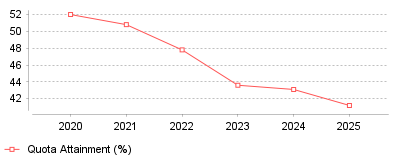
| Year | Quota Attainment (%) |
|---|---|
| 2020 | 52 |
| 2021 | 50.8 |
| 2022 | 47.8 |
| 2023 | 43.6 |
| 2024 | 43.1 |
| 2025 | 41.2 |
This data illustrates a stark, multi-year decline in software sales quota attainment, dropping steadily from 52.0% in 2020 to just 41.2% in early 2025 [1] [2]. Simultaneously, it shows the aggressive expansion of the Global Sales Performance Management (SPM) market, which grew from $2.20 billion in 2022 to an estimated $3.31 billion in 2025 [3] [4]. Organizations are responding to falling sales productivity by heavily investing in digital platforms that automate and optimize territory alignment, quota setting, and incentive compensation.
On a macro level, the era of relying on massive, inexperienced sales floors to drive pure volume has officially ended, replaced by a hyper-focus on sales efficiency and unit economics. Companies are using SPM software to overhaul their compensation structures, shifting away from flat bonuses in favor of aggressive commission accelerators for proven top performers. This shift has created a widening pay gap, with top Account Executives earning up to $200,000 more than average performers as of 2025 [5]. At the micro level, entry-level sales professionals are facing declining on-target earnings (OTE) and highly rigorous quota expectations that feel systematically unattainable, forcing companies to pay more for certainty and less for potential.
Understanding this trend is critical because it forces a fundamental redesign of how B2B companies motivate and retain talent in a saturated market. If businesses fail to deploy modern incentive compensation management tools, they risk severe pay compression and the swift departure of their few quota-carrying closers. Furthermore, the ability to rapidly model specific compensation scenarios and execute quarterly plan modifications is becoming a mandatory capability for Chief Revenue Officers attempting to stabilize revenue amidst falling attainment [6].
The continuous drop in quota attainment is heavily influenced by the escalating complexity of the modern B2B buying process, where the average buying committee now includes 11 diverse stakeholders, effectively crippling deal velocity [7]. Additionally, private equity firms and finance leaders have applied immense pressure on software companies to lower their cost of sales, resulting in artificially inflated quotas that exist to manage payroll expenses rather than reflect true market demand. Saturated software categories, tight ROI scrutiny from buyers, and an overcapacity of quota-carrying reps chasing fewer deals have all contributed to this bottleneck. Consequently, the boom in SPM software is a direct market reaction; companies require advanced AI-powered analytics to identify these systemic pipeline failures and mathematically justify their incentive payouts.
The intersection of plummeting quota attainment and surging SPM software adoption underscores a paradigm shift from scaling headcount to scaling intelligence. Sales compensation is no longer a backend administrative chore, but a strategic lever used to concentrate rewards on elite sellers capable of navigating modern buying committees. Ultimately, the prominent takeaway is that organizations leveraging real-time commission software to dynamically align their pay structures with realistic performance outcomes will secure the best talent and survive the ongoing quota crisis.
Global sales performance management software will grow from $3.15 billion in 2024 to $14.83 billion by 2035 [1]. Demand for automated back-office functions drives this 15.14% compound annual growth rate [1]. Legacy systems fail to support modern variable pay structures, forcing chief revenue officers to procure dedicated incentive engines. Incentive compensation management acts as the primary solution type within this sector, capturing 64.65% of specific software deployments [1]. Companies use these specific modules to align compensation with exact performance metrics rather than arbitrary qualitative reviews.
Large organizations drive the majority of this software adoption. Enterprises account for 63.2% of market shares [2]. These companies manage large territories and require automated systems to handle thousands of concurrent payout rules. North America dominates regional adoption with a 40.6% share of global implementations [2]. Cloud environments hold 70.25% of the market [3]. Application programming interfaces allow these cloud systems to pull live transaction data from adjacent revenue tools without requiring flat-file database transfers.
Administrative errors in manual commission systems cause average overpayments of 2% to 8% annually [4]. An organization paying $5 million in total commissions loses between $150,000 and $400,000 to miscalculations [5]. Management rarely detects these overpayments. Employees do not voluntarily report excessive deposits when checks clear their bank accounts. These financial leaks degrade operating margins over several fiscal quarters.
Underpayments create distinct operational hazards. Sales representatives who doubt their payout accuracy resort to duplicate ledger tracking. This verification process consumes up to two days of selling time each month [6]. Uncertainty breeds rapid attrition. Organizations with unclear commission structures experience a 35% annual turnover rate among sales representatives [7]. The turnover rate for other corporate departments sits at 10% [7]. Finding replacements requires heavy capital investment. Losing a single tenured financial advisor costs a firm $2 million in future revenue [5]. Replacing 25% of a sales team increases total selling costs by 50% [8]. High voluntary turnover leaves organizations struggling to fill pipeline gaps.

Salesforce acquired commission platform Spiff for $419 million in February 2024 [9]. Cash comprised $374 million of the purchase price [9]. This valuation exceeded Spiff's estimated value by $150 million [9]. The transaction embeds incentive calculation directly into the core customer relationship management interface. Independent software vendors face mounting pressure to offer native connectivity rather than standalone portals. The CRM vendor allocated $323 million in goodwill for the acquired employees and anticipated market opportunities [9]. This consolidation signals a shift toward unified operational platforms.
Executives want fewer disconnected tools. Seventy percent of companies fail to connect their sales strategies with their revenue software [10]. Disparate data sources force analysts to reconcile conflicting spreadsheets manually. Procuring commission tools integrated with CRM and billing allows finance departments to calculate payouts using live transaction statuses. Spiff incorporates an artificial intelligence toolset to help administrators build commission schedules without writing custom code [9]. Synchronizing the customer database with the payout engine eliminates duplicate record creation.
Sixty-one percent of software companies offer consumption pricing [11]. This transition forces sales leaders to abandon flat percentage payouts. Paying a representative an upfront commission based on estimated annual contract value causes immediate cash flow problems when actual billing depends on monthly server usage. Customers prefer these models because they remove barriers to software adoption and increase billing transparency [12].
Consumption contracts require account expansion. Organizations pay lower upfront commissions and reward ongoing client activity [13]. Administrators must deploy commission tools for complex enterprise plans to manage these staggered reconciliation periods. Reconciliation periods align actual customer consumption with representative compensation. Companies linking sales rewards to value metrics achieve 28% higher win rates [13]. Forecasting becomes difficult because pipeline valuations rely on usage estimates rather than fixed contract terms [14]. Customers experience friction if their usage spikes unexpectedly without proactive account management intervention.
Rule ASC 606 changed how public companies report commission expenses. The Financial Accounting Standards Board requires businesses to capitalize incremental costs of obtaining a contract [15]. Finance teams can no longer expense sales commissions immediately upon signature. They must amortize these payments over the expected life of the customer contract [16]. If a client cancels a multi-year software agreement prematurely, the accounting department must recalculate the remaining asset value.
Compliance demands precise record-keeping. The standard introduces a strict five-step model. Accounting departments must identify the contract, isolate specific performance obligations, determine the final transaction price, allocate that price across obligations, and recognize revenue only upon fulfillment [17]. Software companies unbundle their offerings to assign distinct values to software licenses, implementation services, and ongoing support [15]. Administrators must link specific commission payments to individual performance obligations. Spreadsheets cannot handle this amortization logic accurately at scale. Modern platforms tag performance obligations and update revenue waterfalls automatically [17].
Different sales functions require distinct payout triggers. Enterprise account executives typically earn commissions based on a percentage of the final contract value. Sales development representatives operate under different parameters. Managers compensate these initial contact workers using per-meeting bonuses and quarterly pipeline contributions [18]. Complex payout rules prevent account executives from hoarding leads without closing them. Organizations apply decelerators to penalize partial performance without entirely removing the incentive to sell.
Multi-stakeholder software deals create payment timing challenges. Enterprise sales cycles span 90 to 180 days [18]. A representative might source a deal in January but secure the signature in November. Compensation structures must include interim milestone incentives. Rewarding meaningful progression prevents financial instability for the seller [18]. Software architecture must support split commissions when multiple account executives collaborate on a global deployment.
Total compensation costs in the pharmaceutical sector grew by 4.5% in 2024 [19]. Organizations must increase employee productivity to justify these higher payroll expenses. Two-thirds of companies are refining their incentive models to prioritize performance over base salary [20]. Sales leaders link specific commission tiers to pipeline quality, win rates, and customer retention metrics.
Tactical bonuses drive short-term behavior. Leaders deploy sales incentive tools with SPIFF and bonus programs to accelerate specific product lines. A manager might offer a $200 bonus for every new product sold during a launch month [21]. These targeted funds clear old inventory and push priority items. Organizations must keep these plans simple. Only 24% of account managers can accurately calculate their variable pay [21]. Extreme complexity reduces motivation and invites calculation disputes. Reps struggle to align their daily actions with their earnings when models contain too many operational variables.
Industry dynamics dictate commission strategy. Media companies expected 51% of their sellers to achieve quota in 2024 [22]. This represented an increase from 42% in the prior year [22]. Headcount additions in this sector focus heavily on post-sales account managers who drive customer retention [22]. Higher quota attainment and increased headcount led to a 5.7% increase in media sales compensation costs [22].
Biotechnology faces different pressures. Employee turnover in life sciences fell to 10% in 2024 [19]. Over half of companies in this sector adjust pay based on geographic location [19]. Managers alter measure weights and payout curves to reflect the long research cycles inherent to pharmaceutical sales. Just 19% of pharmaceutical companies rate their compensation plans as highly effective [19]. The market demands constant revision of these incentive structures.
Visibility determines the success of any variable pay initiative. Eighteen percent of employers fail to report commission results to their teams [7]. This opacity distracts representatives from their core selling activities. Unclear compensation plans lead 42% of surveyed professionals to quit their roles [7]. Delayed payouts leave employees waiting months for clarity on their personal earnings.
Real-time dashboards eliminate this friction. Connecting performance platforms to central invoicing systems allows sellers to view pending payouts. Representatives track their progress toward quota accelerators daily. Clear communication about on-target earnings builds credibility and prevents end-of-quarter disputes [23]. Trust erodes quickly when managers manually adjust commission figures at the end of a pay period. Automation guarantees uniform policy enforcement.
Predictive analytics shape the next generation of commission software. System architects embed artificial intelligence into territory mapping and quota optimization [3]. Administrators simulate compensation outcomes before rolling out new incentive structures [24]. The sales analytics segment will grow at an 18.67% compound annual rate through 2035 [1].
Simulations reveal potential overpayments and misaligned targets. Revenue leaders test multiple payout curves against historical performance data. Artificial intelligence analyzes past sales volume to forecast how a new tier system will alter seller behavior [24]. This capability prevents quota inconsistencies from draining corporate profit margins. Algorithms identify optimal commission rates for specific product bundles.
Handling compensation data introduces significant privacy risks. Commission software processes sensitive employee earnings and performance metrics. Organizations operating in regulated industries face strict compliance mandates regarding data access. Breaches in payroll systems trigger severe corporate penalties.
The Financial Industry Regulatory Authority requires broker-dealers to enforce supervisory policies [5]. Automated trade surveillance and audit trails simplify this compliance burden [5]. Administrators grant seat-based access to finance roles while restricting frontline managers from viewing total departmental payroll data [25]. Detailed permission sets prevent individual contributors from viewing compensation details of their peers.
Not all sales roles tie directly to revenue generation. Account managers and customer success representatives frequently operate under Management by Objectives models [21]. These structures reward employees for completing custom targets rather than closing raw revenue. A business might set an objective for a representative to migrate twenty legacy customers to a new cloud product.
Qualitative targets prevent employees from prioritizing easy sales over strategic corporate goals. System administrators must track these milestones within their commission software. Relying on managers to track completion via email approvals introduces severe payout delays. Modern platforms allow managers to score qualitative performance directly within the application.
Multinational companies face distinct obstacles when unifying their compensation practices. A global sales team operates across multiple currency zones and tax jurisdictions. Paying a representative in Germany requires compliance with the European Union Pay Transparency Directive [26]. Administrators must adapt global compensation frameworks to accommodate local country nuances [26].
Software platforms must calculate split commissions between a lead generator in the United Kingdom and an account executive in the United States. Static spreadsheets fail to update daily currency exchange rates accurately. Centralized compensation engines convert foreign transactions into localized payouts while maintaining standard corporate margin targets. This localization removes mathematical friction from cross-border transactions.
Deploying a dedicated compensation engine requires capital investment. Software licensing represents only a fraction of the total deployment cost. Organizations must hire external implementation consultants to map existing spreadsheet logic into the new database. Integration hurdles demand meticulous planning and custom development work [27].
A successful migration requires leadership buy-in and dedicated technology capabilities [27]. If administrators map flawed compensation logic into a new system, the software will simply automate incorrect payouts faster. The return on investment depends entirely on the accuracy of the underlying sales data. Customer relationship management systems improve revenue by 29% and productivity by 34% when implemented correctly [27].
Enterprise software architecture moves toward consumption-aligned pricing. Modern platforms undercut legacy license models by charging based on transaction volume [3]. SAP will sunset its CallidusCloud environment, forcing thousands of legacy users to migrate to modern infrastructure [3]. Purchasers demand flexible cloud architectures over rigid local installations.
Vendors differentiate their products through application programming interfaces. Seamless connections between revenue operations stacks and compensation engines broaden the buyer base [3]. No-code configuration allows small organizations to deploy complex payout rules without hiring external developers. The market rewards agility over static feature lists. Software must adapt to frequent territory restructures without requiring manual database intervention.
Trend Analysis
| Year | Quota Attainment (%) |
|---|---|
| 2020 | 52 |
| 2021 | 50.8 |
| 2022 | 47.8 |
| 2023 | 43.6 |
| 2024 | 43.1 |
| 2025 | 41.2 |
This data illustrates a stark, multi-year decline in software sales quota attainment, dropping steadily from 52.0% in 2020 to just 41.2% in early 2025 [1] [2]. Simultaneously, it shows the aggressive expansion of the Global Sales Performance Management (SPM) market, which grew from $2.20 billion in 2022 to an estimated $3.31 billion in 2025 [3] [4]. Organizations are responding to falling sales productivity by heavily investing in digital platforms that automate and optimize territory alignment, quota setting, and incentive compensation.
On a macro level, the era of relying on massive, inexperienced sales floors to drive pure volume has officially ended, replaced by a hyper-focus on sales efficiency and unit economics. Companies are using SPM software to overhaul their compensation structures, shifting away from flat bonuses in favor of aggressive commission accelerators for proven top performers. This shift has created a widening pay gap, with top Account Executives earning up to $200,000 more than average performers as of 2025 [5]. At the micro level, entry-level sales professionals are facing declining on-target earnings (OTE) and highly rigorous quota expectations that feel systematically unattainable, forcing companies to pay more for certainty and less for potential.
Understanding this trend is critical because it forces a fundamental redesign of how B2B companies motivate and retain talent in a saturated market. If businesses fail to deploy modern incentive compensation management tools, they risk severe pay compression and the swift departure of their few quota-carrying closers. Furthermore, the ability to rapidly model specific compensation scenarios and execute quarterly plan modifications is becoming a mandatory capability for Chief Revenue Officers attempting to stabilize revenue amidst falling attainment [6].
The continuous drop in quota attainment is heavily influenced by the escalating complexity of the modern B2B buying process, where the average buying committee now includes 11 diverse stakeholders, effectively crippling deal velocity [7]. Additionally, private equity firms and finance leaders have applied immense pressure on software companies to lower their cost of sales, resulting in artificially inflated quotas that exist to manage payroll expenses rather than reflect true market demand. Saturated software categories, tight ROI scrutiny from buyers, and an overcapacity of quota-carrying reps chasing fewer deals have all contributed to this bottleneck. Consequently, the boom in SPM software is a direct market reaction; companies require advanced AI-powered analytics to identify these systemic pipeline failures and mathematically justify their incentive payouts.
The intersection of plummeting quota attainment and surging SPM software adoption underscores a paradigm shift from scaling headcount to scaling intelligence. Sales compensation is no longer a backend administrative chore, but a strategic lever used to concentrate rewards on elite sellers capable of navigating modern buying committees. Ultimately, the prominent takeaway is that organizations leveraging real-time commission software to dynamically align their pay structures with realistic performance outcomes will secure the best talent and survive the ongoing quota crisis.