

| Year | Business AI Adoption Rate | Consumer Comfort With AI |
|---|---|---|
| 2023 | 55 | 57 |
| 2024 | 76 | 51 |
| 2025 | 79 | 46 |
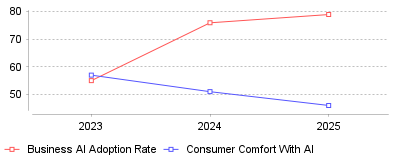
The data highlights a sharp divergence between business strategy and consumer sentiment regarding Artificial Intelligence in customer service. While 79% of support teams are planning to invest in or have adopted AI for 2025—up significantly from 55% in 2023 [1]—consumer comfort with using AI has dropped by 11 percentage points year-over-year to just 46% [2]. Essentially, as AI becomes more ubiquitous in support channels, customers are becoming less trusting of it, with only 26% of consumers trusting organizations to use AI responsibly [3].
For the industry, this signals a potential crisis of engagement where technology implementation is outpacing user acceptance. Macros trends show that while CX leaders expect 80% of interactions to be resolved without humans in the near future [4], the "AI hype" has given way to skepticism among users [3]. This creates a friction point: companies are optimizing for "deflection" and "automated resolution" to save costs, but they risk increasing customer churn if the AI experience feels robotic or dismissive. The market is responding by shifting focus toward "Human-Centric AI," where 64% of consumers say they are more likely to trust AI agents that embody friendliness and empathy [5].
This trend is critical because customer loyalty is declining; 53% of consumers report cutting spending after a bad experience [2]. If businesses force reluctant customers into AI channels that lack emotional intelligence, they sacrifice revenue for operational efficiency. Furthermore, the "trust gap" suggests that simply having an AI chatbot is no longer a competitive advantage—it is a liability unless it can deliver a personalized, secure, and empathetic experience [6].
The decline in consumer comfort is likely caused by the "uncanny valley" effect and privacy anxieties, where 64% of consumers are concerned about companies using their personal data for AI personalization [2]. Additionally, the rapid proliferation of low-quality, "wrapper" AI bots in 2023 and 2024 may have fatigued users who found themselves in loops unable to reach human agents. There is also a disconnect in perception: while 90% of CX leaders report positive ROI from AI, customers often feel the technology is being used to gatekeep human support rather than assist them [4].
The "AI-first" era of customer service has arrived, but it has collided with a wall of consumer skepticism. To survive 2025, platforms must move beyond raw automation rates and focus on "Human-Centric AI" that builds trust through empathy and transparency [6]. The prominent takeaway is that while AI adoption is inevitable, the winners will be those who use AI to enhance, rather than replace, the human connection.
The landscape of customer experience (CX) is undergoing its most significant structural transformation in decades, driven by the maturation of artificial intelligence from experimental chatbots to autonomous, "agentic" systems. As we move through 2025, the market for AI, Automation & Machine Learning Tools continues to expand rapidly, with the global AI for customer service market valued at approximately $13 billion in 2024 and projected to grow at a compound annual growth rate (CAGR) exceeding 23% through 2033 [1]. This growth is not merely a function of adoption volume but represents a fundamental shift in operational logic: organizations are moving from using AI as a tool for cost reduction to deploying it as the primary architect of the customer journey.
Current research indicates that while adoption is high, operational maturity remains uneven. Approximately 75% of executives aim to automate at least half of their customer service operations within three years, yet only a small fraction report being fully operational across all channels [2]. This gap between ambition and execution highlights the critical operational challenges facing enterprises today: legacy system integration, data governance in an era of strict regulation, and the delicate balance between algorithmic efficiency and human empathy.
This report analyzes the prevailing trends and operational hurdles defining the sector, with a specific focus on AI-Powered Customer Experience Platforms. It synthesizes data from 2024 and 2025 to provide a roadmap for navigating the complexities of agentic AI, hyper-personalization, and sector-specific compliance.
The most profound trend in 2025 is the migration from Generative AI (GenAI)—which creates content—to Agentic AI, which executes tasks. Unlike their predecessors, which relied on pre-scripted decision trees or simple text generation, AI agents possess the autonomy to reason, plan, and execute multi-step workflows across disparate systems without human intervention [3].

Organizations are increasingly deploying "digital workers" capable of handling end-to-end service lifecycles. Research suggests that by 2027, the number of customer interactions automated by AI agents will surge by over 1,000%, reaching 34 billion interactions [4]. This shift is driven by the realization that conversational ability alone does not equate to resolution. True operational value is realized only when the AI can access backend systems to process refunds, update shipping addresses, or modify policy details autonomously.
Modern platforms are moving beyond reactive service to predictive engagement. By leveraging vast datasets, AI systems can now anticipate customer needs before they are explicitly articulated. In 2025, this capability is expected to evolve into "hyper-personalization," where AI analyzes real-time behavior, sentiment, and historical data to tailor every interaction [5]. This trend is particularly relevant for AI Customer Experience Platforms for Ecommerce Businesses, where predictive models can dynamically adjust pricing, recommend products based on visual search queries, and manage inventory in real-time to prevent stockouts during peak demand [6].
The siloed approach to channels—voice, chat, email—is collapsing into multimodal fluidity. Customers now expect to switch between text and voice seamlessly within the same interaction, with the AI maintaining full context. This "channel-less" experience is powered by multimodal Large Language Models (LLMs) that can process text, audio, and visual inputs simultaneously, reducing friction and repetition for the user [7].
Despite the technological advancements, the integration of AI into customer experience workflows introduces significant operational risks. The primary challenge has shifted from "can we build it?" to "can we trust it?"
Trust remains a volatile currency in the AI economy. As AI agents take on more autonomy, the risk of "hallucinations"—confident but incorrect responses—poses a severe threat to brand reputation. Furthermore, algorithmic bias remains a persistent operational risk, particularly in regulated industries. If an AI system is trained on historical data containing biases, it may perpetuate discriminatory practices in loan approvals, insurance underwriting, or targeted marketing [8]. Organizations must implement rigorous "human-in-the-loop" protocols to audit AI decisions and ensure ethical compliance.
The reliance on vast datasets for training and personalization clashes with an increasingly stringent global regulatory environment. In 2025, data sovereignty—the concept that data is subject to the laws of the country in which it is located—has become a critical operational hurdle. Marketing agencies and global platforms face the dual challenge of personalizing experiences while adhering to diverse regulations like GDPR in Europe and state-level privacy laws in the US [9]. The phasing out of third-party cookies further complicates this, forcing companies to rely on first-party data strategies that require robust consent management architectures.
A significant barrier to the adoption of agentic AI is the state of existing IT infrastructure. Many enterprises operate on fragmented legacy systems that lack the API connectivity required for autonomous agents to function effectively. The integration of modern AI Customer Experience Platforms for Customer Support Teams often requires a complete overhaul of backend data structures to eliminate silos, a process that is both costly and time-consuming [10].
The impact of AI on customer experience varies significantly across industries, each facing unique operational pressures and regulatory environments.
In the retail sector, AI is transforming the fundamental mechanics of shopping. Specialized AI Customer Experience Platforms for Ecommerce Stores are deploying autonomous agents that act as personal shoppers. These agents can negotiate prices, track orders across complex supply chains, and execute returns without human assistance. However, operational challenges arise in "visual search" accuracy and the potential for AI to recommend incompatible products, which can increase return rates rather than reduce them [11]. Furthermore, the "uncanny valley" effect—where AI interactions feel almost but not quite human—can alienate customers if the technology attempts to fake empathy too aggressively.
The insurance industry faces perhaps the highest stakes in AI implementation. AI Customer Experience Platforms for Insurance Agents are being used to automate claims processing and policy underwriting. While this reduces processing time from days to minutes, it introduces liability risks. Who is responsible if an AI agent incorrectly denies a claim or offers a policy that violates regulatory standards? In 2025, insurers are navigating complex frameworks such as the NAIC's model bulletin on AI use, which mandates strict governance and explainability for AI-driven decisions [12]. The operational imperative here is "explainability"—the ability to reverse-engineer an AI's decision to prove it was fair and compliant.
For marketing firms, AI offers the ability to generate content at scale, but this creates a risk of brand homogenization. AI Customer Experience Platforms for Marketing Agencies are struggling to maintain distinct brand voices when utilizing the same underlying Foundation Models (like GPT-4 or Claude) as their competitors. The operational challenge lies in fine-tuning these models on proprietary data to ensure content remains authentic [13]. Additionally, agencies must navigate the "trust deficit" where consumers are increasingly skeptical of AI-generated content, necessitating clear disclosure and "human-verified" markers.
The deployment of agentic AI is forcing a restructuring of the workforce. The fear of job displacement is being replaced by the reality of job evolution. Operational roles are shifting from "doing" to "supervising." In customer support, agents are becoming "AI handlers" who manage exceptions that the AI cannot resolve [14]. This requires a significant investment in upskilling, as employees need to understand not just the product, but how to interact with and correct the AI tools they oversee.
Looking ahead to late 2025 and 2026, the industry is poised for the emergence of "Experience Agents"—fully autonomous entities that negotiate with other bots on behalf of consumers [15]. For businesses, this means their customer experience strategy must account for "machine customers" as well as human ones. Operational readiness will depend on the ability to expose services via APIs that these external agents can consume, effectively creating a B2B2C model where the "customer" is software acting on a human's behalf.
The transition to AI-powered customer experience platforms is no longer optional but is fraught with operational complexity. Success in this new era requires more than just technology adoption; it demands a robust governance framework that addresses bias, ensures privacy, and maintains trust. Companies that succeed will be those that use AI not to replace human connection, but to remove the friction that prevents it, employing agentic AI to handle the logistics of experience while reserving human talent for moments of truth that require genuine empathy and judgment.
| Year | Business AI Adoption Rate | Consumer Comfort With AI |
|---|---|---|
| 2023 | 55 | 57 |
| 2024 | 76 | 51 |
| 2025 | 79 | 46 |
The data highlights a sharp divergence between business strategy and consumer sentiment regarding Artificial Intelligence in customer service. While 79% of support teams are planning to invest in or have adopted AI for 2025—up significantly from 55% in 2023 [1]—consumer comfort with using AI has dropped by 11 percentage points year-over-year to just 46% [2]. Essentially, as AI becomes more ubiquitous in support channels, customers are becoming less trusting of it, with only 26% of consumers trusting organizations to use AI responsibly [3].
For the industry, this signals a potential crisis of engagement where technology implementation is outpacing user acceptance. Macros trends show that while CX leaders expect 80% of interactions to be resolved without humans in the near future [4], the "AI hype" has given way to skepticism among users [3]. This creates a friction point: companies are optimizing for "deflection" and "automated resolution" to save costs, but they risk increasing customer churn if the AI experience feels robotic or dismissive. The market is responding by shifting focus toward "Human-Centric AI," where 64% of consumers say they are more likely to trust AI agents that embody friendliness and empathy [5].
This trend is critical because customer loyalty is declining; 53% of consumers report cutting spending after a bad experience [2]. If businesses force reluctant customers into AI channels that lack emotional intelligence, they sacrifice revenue for operational efficiency. Furthermore, the "trust gap" suggests that simply having an AI chatbot is no longer a competitive advantage—it is a liability unless it can deliver a personalized, secure, and empathetic experience [6].
The decline in consumer comfort is likely caused by the "uncanny valley" effect and privacy anxieties, where 64% of consumers are concerned about companies using their personal data for AI personalization [2]. Additionally, the rapid proliferation of low-quality, "wrapper" AI bots in 2023 and 2024 may have fatigued users who found themselves in loops unable to reach human agents. There is also a disconnect in perception: while 90% of CX leaders report positive ROI from AI, customers often feel the technology is being used to gatekeep human support rather than assist them [4].
The "AI-first" era of customer service has arrived, but it has collided with a wall of consumer skepticism. To survive 2025, platforms must move beyond raw automation rates and focus on "Human-Centric AI" that builds trust through empathy and transparency [6]. The prominent takeaway is that while AI adoption is inevitable, the winners will be those who use AI to enhance, rather than replace, the human connection.