

The Hybrid Billing Revolution: SaaS Abandons Flat Rates for Consumption Models Research into the Subscription Billing & Recurring Revenue Tools category reveals a decisive shift away from static, seat-based pricing toward Hybrid Billing Models—structures that combine a recurring subscription base with dynamic usage or consumption fees. Data from early 2025 reports indicates this trend has ac
| Year | Adoption Rate Percent |
|---|---|
| 2021 | 45 |
| 2022 | 52 |
| 2023 | 61 |
| 2025 | 67 |
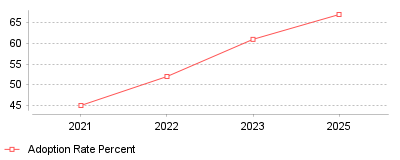
The data reveals a consistent migration from flat-rate subscriptions to usage-based and hybrid pricing strategies across the SaaS landscape. According to Maxio's 2025 Pricing Trends Report, 67% of SaaS companies now leverage usage or consumption-based pricing, a significant increase from 52% in 2022 [1]. This aligns with findings from Paddle, which reported that adoption of hybrid models specifically (combining platform fees with usage) jumped from 49% in 2024 to 61% in 2025 [2].
This trend signals the end of the "growth at all costs" era where companies relied on shelving expensive seat-based contracts. In the current micro-economic climate, businesses are demanding that costs align strictly with value received, forcing vendors to adopt "pay-as-you-grow" structures. On a macro level, this shift is fundamentally altering SaaS unit economics; companies using hybrid models are reporting median growth rates of 21%, outperforming both pure subscription and pure usage-based competitors [3]. It represents a maturation of the software industry into a utility-like economy, where revenue is tied to active consumption rather than passive access.
The survival of SaaS vendors now depends on retention and expansion rather than just net new logos. With subscriber acquisition rates crashing from 4.1% in 2021 to just 2.8% in 2024, it has become mathematically difficult to grow solely through acquisition [4]. Hybrid pricing solves this by lowering the barrier to entry (cheaper base fees) while allowing revenue to scale automatically as successful customers consume more resources, effectively building "Net Revenue Retention" (NRR) directly into the contract structure.
Two primary factors are driving this rapid evolution: the "AI tax" and market efficiency pressures. As companies integrate Generative AI features, they face real variable costs (compute tokens) for every interaction, making unlimited flat-rate plans unprofitable; 44% of SaaS companies now explicitly monetize AI features to cover these costs [3]. Additionally, as noted by Bessemer Venture Partners, AI is shifting software value from "access" (seats) to "outcomes" (work done), necessitating pricing models that can capture value based on output and consumption rather than human headcount [5].
The "Hybrid Billing Revolution" is not a temporary experiment but a permanent structural change in how software is valued and sold. By 2025, the standard B2B contract has evolved to include a recurring platform fee for predictability alongside consumption elements for scalability. For founders and billing operators, the takeaway is clear: static pricing is becoming a competitive disadvantage, and implementing metering capabilities is now as critical as the core product itself.

Many legacy billing systems were designed to handle simple recurring intervals (e.g., $50/month), not millions of usage events. This creates a technological gap where billing errors and revenue leakage become rampant. For organizations navigating this transition, deploying specialized Subscription Billing Platforms for Usage-Based Pricing Models is critical. These platforms act as a ledger for usage data, ensuring that every API call or gigabyte is accurately rated and billed, preventing the 1-5% revenue leakage often seen in manual usage reporting [3].
A major operational bottleneck for B2B finance teams is managing contract amendments—mid-cycle upgrades, downgrades, or seat additions. If a billing system cannot automatically prorate these changes and generate a compliant invoice, finance teams are forced into manual spreadsheets, increasing Days Sales Outstanding (DSO). Consequently, there is rising demand for Subscription Billing Platforms for B2B Invoiced Subscriptions that integrate deeply with CPQ (Configure, Price, Quote) and CRM tools to automate complex contract lifecycles [4].
The operational battleground for B2C is managing high-velocity transactions across borders while minimizing involuntary churn (discussed below). Solutions in this space, specifically Subscription Billing Platforms for Consumer Subscription Services, differentiate themselves through advanced dunning capabilities and direct integrations with global payment gateways to maximize acceptance rates [5].
For high-volume sectors, particularly those utilizing Subscription Billing Platforms for Media and Digital Content, these features are existential. Media streaming services face high "rotational churn" where users subscribe for specific content and then cancel. Minimizing payment friction ensures that the barrier to staying subscribed remains as low as possible [10].
Legacy billing systems often offloaded this responsibility to the accounting team. Today, "Merchant of Record" (MoR) models and tight integrations with tax engines are becoming standard requirements for Subscription Billing Platforms for SaaS Companies. These tools determine the precise tax rate in real-time during checkout, preventing non-compliance fines that can reach significant percentages of global revenue [11].
The Hybrid Billing Revolution: SaaS Abandons Flat Rates for Consumption Models Research into the Subscription Billing & Recurring Revenue Tools category reveals a decisive shift away from static, seat-based pricing toward Hybrid Billing Models—structures that combine a recurring subscription base with dynamic usage or consumption fees. Data from early 2025 reports indicates this trend has ac
| Year | Adoption Rate Percent |
|---|---|
| 2021 | 45 |
| 2022 | 52 |
| 2023 | 61 |
| 2025 | 67 |
The data reveals a consistent migration from flat-rate subscriptions to usage-based and hybrid pricing strategies across the SaaS landscape. According to Maxio's 2025 Pricing Trends Report, 67% of SaaS companies now leverage usage or consumption-based pricing, a significant increase from 52% in 2022 [1]. This aligns with findings from Paddle, which reported that adoption of hybrid models specifically (combining platform fees with usage) jumped from 49% in 2024 to 61% in 2025 [2].
This trend signals the end of the "growth at all costs" era where companies relied on shelving expensive seat-based contracts. In the current micro-economic climate, businesses are demanding that costs align strictly with value received, forcing vendors to adopt "pay-as-you-grow" structures. On a macro level, this shift is fundamentally altering SaaS unit economics; companies using hybrid models are reporting median growth rates of 21%, outperforming both pure subscription and pure usage-based competitors [3]. It represents a maturation of the software industry into a utility-like economy, where revenue is tied to active consumption rather than passive access.
The survival of SaaS vendors now depends on retention and expansion rather than just net new logos. With subscriber acquisition rates crashing from 4.1% in 2021 to just 2.8% in 2024, it has become mathematically difficult to grow solely through acquisition [4]. Hybrid pricing solves this by lowering the barrier to entry (cheaper base fees) while allowing revenue to scale automatically as successful customers consume more resources, effectively building "Net Revenue Retention" (NRR) directly into the contract structure.
Two primary factors are driving this rapid evolution: the "AI tax" and market efficiency pressures. As companies integrate Generative AI features, they face real variable costs (compute tokens) for every interaction, making unlimited flat-rate plans unprofitable; 44% of SaaS companies now explicitly monetize AI features to cover these costs [3]. Additionally, as noted by Bessemer Venture Partners, AI is shifting software value from "access" (seats) to "outcomes" (work done), necessitating pricing models that can capture value based on output and consumption rather than human headcount [5].
The "Hybrid Billing Revolution" is not a temporary experiment but a permanent structural change in how software is valued and sold. By 2025, the standard B2B contract has evolved to include a recurring platform fee for predictability alongside consumption elements for scalability. For founders and billing operators, the takeaway is clear: static pricing is becoming a competitive disadvantage, and implementing metering capabilities is now as critical as the core product itself.