
Employee Engagement & Pulse Survey Platforms
These are the specialized categories within Employee Engagement & Pulse Survey Platforms. Looking for something broader? See all HR & People Management Software categories.

How big is your team?
What's your budget situation?
What's your team's technical comfort level?
What's the ONE thing this tool must do well?
CultureMonkey Engagement Platform
Best for Employee Engagement & Feedback Platforms for Recruitment Agencies
CultureMonkey is a perfect fit for recruitment agencies, as it aids in automating employee surveys and capturing feedback effectively. This SaaS solution is designed to enhance the employee engagement process, a crucial aspect for recruitment agencies aiming to attract and retain high-quality candidates.
Best for Employee Engagement & Feedback Platforms for Recruitment Agencies
Expert Take
CultureMonkey excels as a premium employee engagement platform tailored for recruitment agencies. It offers robust automation and analytics capabilities, enhancing employee feedback processes. While its enterprise pricing may limit transparency, its strong market credibility and usability justify its position as a top-tier solution.
Pros
- Exceptional customer support rated 9.5/10 on G2
- Omni-channel delivery via WhatsApp, Slack, and SMS
- Deep sentiment analysis with AI-driven insights
- Strong enterprise security (SOC 2, ISO 27001)
- Seamless integration with Workday and other HRIS
Cons
- Lacks native performance management or rewards modules
- Exported reports may lose visual fidelity
- Pricing is not transparent on the official site
- Navigation can become complex for new admins
- Focused solely on 'listening' vs full HR suite
Best for teams that are
- Enterprises with large deskless or frontline workforces
- Global companies requiring multilingual survey support
- Organizations needing WhatsApp or SMS-based feedback
Skip if
- Small businesses looking for a free, basic tool
- Companies seeking a full-suite HRIS replacement
- Teams that do not need mobile-first distribution
Best for teams that are
- Enterprises with large deskless or frontline workforces
- Global companies requiring multilingual survey support
- Organizations needing WhatsApp or SMS-based feedback
Skip if
- Small businesses looking for a free, basic tool
- Companies seeking a full-suite HRIS replacement
- Teams that do not need mobile-first distribution
Pros
- Exceptional customer support rated 9.5/10 on G2
- Omni-channel delivery via WhatsApp, Slack, and SMS
- Deep sentiment analysis with AI-driven insights
- Strong enterprise security (SOC 2, ISO 27001)
- Seamless integration with Workday and other HRIS
Cons
- Lacks native performance management or rewards modules
- Exported reports may lose visual fidelity
- Pricing is not transparent on the official site
- Navigation can become complex for new admins
- Focused solely on 'listening' vs full HR suite
Expert Take
CultureMonkey excels as a premium employee engagement platform tailored for recruitment agencies. It offers robust automation and analytics capabilities, enhancing employee feedback processes. While its enterprise pricing may limit transparency, its strong market credibility and usability justify its position as a top-tier solution.
Workvivo: Employee Experience Platform
Best for Employee Engagement & Feedback Platforms for Contractors

Workvivo is a potent tool specifically designed for contractors, allowing them to measure and enhance employee engagement efficiently. It streamlines the feedback collection process through automated engagement surveys bringing in-depth insights about employee experiences, thereby helping contractors to improve their workforce management and increase productivity.
Best for Employee Engagement & Feedback Platforms for Contractors
Expert Take
Workvivo excels in providing a comprehensive employee engagement platform tailored for contractors. It offers automated engagement surveys and valuable insights, enhancing workforce management. Despite the lack of upfront pricing, its features and industry recognition position it as a leading solution in its category.
Pros
- Meta's only preferred migration partner
- Social-media-style interface drives adoption
- Native Zoom livestreaming integration
- Includes digital signage (Workvivo TV)
- Strong employee recognition features
Cons
- Mobile app performance lag reported
- High minimum annual cost (~$20k)
- No free trial available
- Limited interface customization
- Not suitable for small businesses
Best for teams that are
- Companies needing a social-first platform combining intranet and communications.
- Organizations with large deskless teams requiring mobile-friendly access.
Skip if
- Teams wanting a highly customized, built-from-scratch intranet solution.
- Companies only needing basic mobile alerts without full platform features.
Best for teams that are
- Companies needing a social-first platform combining intranet and communications.
- Organizations with large deskless teams requiring mobile-friendly access.
Skip if
- Teams wanting a highly customized, built-from-scratch intranet solution.
- Companies only needing basic mobile alerts without full platform features.
Pros
- Meta's only preferred migration partner
- Social-media-style interface drives adoption
- Native Zoom livestreaming integration
- Includes digital signage (Workvivo TV)
- Strong employee recognition features
Cons
- Mobile app performance lag reported
- High minimum annual cost (~$20k)
- No free trial available
- Limited interface customization
- Not suitable for small businesses
Expert Take
Workvivo excels in providing a comprehensive employee engagement platform tailored for contractors. It offers automated engagement surveys and valuable insights, enhancing workforce management. Despite the lack of upfront pricing, its features and industry recognition position it as a leading solution in its category.

Culture Amp is a leading SaaS solution specifically designed for companies seeking to enhance employee engagement and feedback. It offers a range of features such as AI analysis, customizable surveys, and integrated recommendations that address the unique needs of SaaS industry professionals, helping them to streamline HR tasks and optimize workforce management.
Best for Employee Engagement & Feedback Platforms for SaaS Companies
Expert Take
Culture Amp excels in providing a comprehensive employee engagement platform tailored for SaaS companies. Its AI-driven insights and customizable surveys enhance HR efficiency and workforce management. The product's strong market credibility and usability make it a top choice for organizations seeking to improve employee experiences.
Pros
- Unified engagement and performance platform
- Predictive analytics for turnover risk
- Strong Slack and MS Teams integrations
- SOC 2 Type II and ISO 27001 certified
- Science-backed survey templates
Cons
- High minimum annual cost (~$4,500)
- Opaque pricing requires sales contact
- Steep learning curve for analytics
- HRIS integrations often gated
- Navigation can be complex
Best for teams that are
- Midsize to enterprise companies wanting structured performance reviews [cite: 4, 5].
- HR teams in tech and finance looking for deep analytics backed by People Science [cite: 4, 6].
Skip if
- Organizations requiring highly customizable and flexible administrative workflows [cite: 4].
- Small startups unwilling to invest time in a steep learning curve and complex setup [cite: 4].
Best for teams that are
- Midsize to enterprise companies wanting structured performance reviews [cite: 4, 5].
- HR teams in tech and finance looking for deep analytics backed by People Science [cite: 4, 6].
Skip if
- Organizations requiring highly customizable and flexible administrative workflows [cite: 4].
- Small startups unwilling to invest time in a steep learning curve and complex setup [cite: 4].
Pros
- Unified engagement and performance platform
- Predictive analytics for turnover risk
- Strong Slack and MS Teams integrations
- SOC 2 Type II and ISO 27001 certified
- Science-backed survey templates
Cons
- High minimum annual cost (~$4,500)
- Opaque pricing requires sales contact
- Steep learning curve for analytics
- HRIS integrations often gated
- Navigation can be complex
Expert Take
Culture Amp excels in providing a comprehensive employee engagement platform tailored for SaaS companies. Its AI-driven insights and customizable surveys enhance HR efficiency and workforce management. The product's strong market credibility and usability make it a top choice for organizations seeking to improve employee experiences.

Culture Amp Engage is a powerful employee engagement platform specifically designed for recruitment agencies. It offers deep insights into employee motivation, helping to foster engagement and act on survey feedback, thus addressing the unique needs of this industry where employee satisfaction and retention are key.
Best for Employee Engagement & Feedback Platforms for Recruitment Agencies
Expert Take
Culture Amp Engage stands out as a leading employee engagement platform tailored for recruitment agencies. It provides comprehensive insights into employee motivation and satisfaction, crucial for retention in this sector. The platform is recognized for its intuitive interface and actionable feedback capabilities, making it a preferred choice for industry professionals.
Pros
- Backed by PhD-level I/O psychology research
- Massive benchmarking dataset (1.5B+ data points)
- ISO 42001 certified for AI governance
- Deep integrations with Slack, Teams, and HRIS
- Predictive analytics for employee retention
Cons
- Opaque pricing with high minimum spend
- Expensive for small teams (<100 employees)
- Steep learning curve for advanced admin tools
- Limited customization for complex survey logic
- Support access can be tiered/limited
Best for teams that are
- Data-driven HR teams in mid-to-large enterprises
- Companies needing deep psychometric benchmarks
- Organizations combining engagement with performance data
Skip if
- Small startups with limited budgets
- Teams wanting a simple, lightweight pulse tool
- Organizations with no dedicated HR analyst resources
Best for teams that are
- Data-driven HR teams in mid-to-large enterprises
- Companies needing deep psychometric benchmarks
- Organizations combining engagement with performance data
Skip if
- Small startups with limited budgets
- Teams wanting a simple, lightweight pulse tool
- Organizations with no dedicated HR analyst resources
Pros
- Backed by PhD-level I/O psychology research
- Massive benchmarking dataset (1.5B+ data points)
- ISO 42001 certified for AI governance
- Deep integrations with Slack, Teams, and HRIS
- Predictive analytics for employee retention
Cons
- Opaque pricing with high minimum spend
- Expensive for small teams (<100 employees)
- Steep learning curve for advanced admin tools
- Limited customization for complex survey logic
- Support access can be tiered/limited
Expert Take
Culture Amp Engage stands out as a leading employee engagement platform tailored for recruitment agencies. It provides comprehensive insights into employee motivation and satisfaction, crucial for retention in this sector. The platform is recognized for its intuitive interface and actionable feedback capabilities, making it a preferred choice for industry professionals.

Great Place To Work's Employee Survey Software is a dynamic tool for staffing agencies seeking to gauge the pulse of their workforce. It goes beyond just measuring engagement, capturing the full employee experience to help the agency understand their staff better, improve their workplace environment, and ultimately enhance their service delivery.
Best for Employee Engagement & Feedback Platforms for Staffing Agencies
Expert Take
Great Place To Work Surveys excels in providing comprehensive employee insights and benchmarking capabilities, making it a valuable tool for staffing agencies. While it lacks pricing transparency and has limited third-party integrations, its strengths in employee engagement and feedback collection justify its premium positioning.
Pros
- Global standard for workplace culture benchmarking
- Certified companies show ~4x stock market returns
- Rigorous, research-backed Trust Index™ methodology
- Strong employer branding and recruitment benefits
- SOC 2 and GDPR compliant platform
Cons
- Entry-level package lacks heatmaps and comments
- No customization allowed in 'Assess' tier
- Can be perceived as 'pay-to-play' for badges
- Less flexible than modern pulse survey tools
- Pricing transparency requires custom quotes
Best for teams that are
- Companies seeking external employer branding and certification
- Organizations prioritizing industry benchmarking against top peers
Skip if
- Teams wanting continuous, real-time pulse feedback tools
- Budget-conscious startups not interested in awards/certification
Best for teams that are
- Companies seeking external employer branding and certification
- Organizations prioritizing industry benchmarking against top peers
Skip if
- Teams wanting continuous, real-time pulse feedback tools
- Budget-conscious startups not interested in awards/certification
Pros
- Global standard for workplace culture benchmarking
- Certified companies show ~4x stock market returns
- Rigorous, research-backed Trust Index™ methodology
- Strong employer branding and recruitment benefits
- SOC 2 and GDPR compliant platform
Cons
- Entry-level package lacks heatmaps and comments
- No customization allowed in 'Assess' tier
- Can be perceived as 'pay-to-play' for badges
- Less flexible than modern pulse survey tools
- Pricing transparency requires custom quotes
Expert Take
Great Place To Work Surveys excels in providing comprehensive employee insights and benchmarking capabilities, making it a valuable tool for staffing agencies. While it lacks pricing transparency and has limited third-party integrations, its strengths in employee engagement and feedback collection justify its premium positioning.

ThriveSparrow revolutionizes HR processes for contractors by combining 360-degree reviews, pulse surveys, and a recognition module to foster engagement. Ideal for growing companies, its modular pricing and AI-driven insights provide an intuitive, scalable solution.
Best for Employee Engagement & Feedback Platforms for Contractors
Expert Take
ThriveSparrow stands out by transforming traditional, stagnant HR processes into continuous, engaging experiences. By blending 360-degree performance reviews with highly interactive pulse surveys and an integrated 'Kudos' recognition module, it creates a holistic employee success ecosystem. Its modular pricing allows growing companies to scale their HR tech stack efficiently without overpaying. Backed by the robust architecture of SurveySparrow, its intuitive design and AI-driven sentiment analy
Pros
- Intuitive interface with a minimal learning curve
- Transparent and modular pricing structure
- Actionable real-time engagement heatmaps
- Exceptional and highly responsive customer support
Cons
- Limited integrations with broader HR systems
- Advanced customization options are somewhat restricted
- Occasional lag during high-volume feedback processing
Best for teams that are
- Small to medium businesses seeking an affordable and user-friendly platform.
- HR teams wanting simple pulse surveys combined with peer recognition features.
Skip if
- Large enterprises needing highly customizable or complex survey workflows.
- Organizations requiring deep integrations with many legacy enterprise systems.
Best for teams that are
- Small to medium businesses seeking an affordable and user-friendly platform.
- HR teams wanting simple pulse surveys combined with peer recognition features.
Skip if
- Large enterprises needing highly customizable or complex survey workflows.
- Organizations requiring deep integrations with many legacy enterprise systems.
Pros
- Intuitive interface with a minimal learning curve
- Transparent and modular pricing structure
- Actionable real-time engagement heatmaps
- Exceptional and highly responsive customer support
Cons
- Limited integrations with broader HR systems
- Advanced customization options are somewhat restricted
- Occasional lag during high-volume feedback processing
Expert Take
ThriveSparrow stands out by transforming traditional, stagnant HR processes into continuous, engaging experiences. By blending 360-degree performance reviews with highly interactive pulse surveys and an integrated 'Kudos' recognition module, it creates a holistic employee success ecosystem. Its modular pricing allows growing companies to scale their HR tech stack efficiently without overpaying. Backed by the robust architecture of SurveySparrow, its intuitive design and AI-driven sentiment analy

Lattice offers a comprehensive solution for SaaS companies looking to boost employee engagement and foster continuous improvement. Its centralized platform is tailored to the needs of HR teams in the SaaS industry, offering robust performance management, real-time feedback, and engagement tracking tools.
Best for Employee Engagement & Feedback Platforms for SaaS Companies
Expert Take
Lattice Employee Engagement is a specialized platform designed for SaaS companies, offering robust tools for performance management and real-time feedback. Its focus on the SaaS industry and comprehensive feature set make it a leading choice in its category, despite some limitations in advanced analytics.
Pros
- Unified engagement and performance data
- Deep Slack and Microsoft Teams integration
- AI-powered sentiment and driver analysis
- Robust anonymity and privacy controls
- Extensive library of survey templates
Cons
- $4,000 minimum annual contract
- Reporting can be rigid/complex
- Steep learning curve for admins
- Not a standalone HRIS solution
- Mobile app has limited admin features
Best for teams that are
- Fast-growing mid-sized tech companies and startups with 100 to 1,000 employees [cite: 7, 8].
- HR teams wanting to unify OKR tracking, continuous feedback, and performance reviews [cite: 8].
Skip if
- Very large enterprises where complex OKR management could become difficult to scale [cite: 7].
- Companies seeking highly flexible and customizable learning or onboarding solutions [cite: 9].
Best for teams that are
- Fast-growing mid-sized tech companies and startups with 100 to 1,000 employees [cite: 7, 8].
- HR teams wanting to unify OKR tracking, continuous feedback, and performance reviews [cite: 8].
Skip if
- Very large enterprises where complex OKR management could become difficult to scale [cite: 7].
- Companies seeking highly flexible and customizable learning or onboarding solutions [cite: 9].
Pros
- Unified engagement and performance data
- Deep Slack and Microsoft Teams integration
- AI-powered sentiment and driver analysis
- Robust anonymity and privacy controls
- Extensive library of survey templates
Cons
- $4,000 minimum annual contract
- Reporting can be rigid/complex
- Steep learning curve for admins
- Not a standalone HRIS solution
- Mobile app has limited admin features
Expert Take
Lattice Employee Engagement is a specialized platform designed for SaaS companies, offering robust tools for performance management and real-time feedback. Its focus on the SaaS industry and comprehensive feature set make it a leading choice in its category, despite some limitations in advanced analytics.

Yourco's SMS-based platform is designed specifically for the construction industry, providing managers with an effective and immediate way to connect with field workers. The platform facilitates real-time communication, enabling managers to send shift reminders, safety alerts, and company updates, thereby addressing the industry's need for efficient communication and increased employee engagement.
Best for Employee Engagement & Feedback Platforms for Contractors
Expert Take
Yourco Employee Engagement excels in providing industry-specific communication tools for the construction sector, enhancing real-time engagement and safety. Its market credibility is supported by its niche focus, though reliance on mobile connectivity and potential training needs are noted limitations.
Pros
- No app download required
- Free plan for 50 users
- AI translation (135+ languages)
- SOC 2 Type II certified
- 98% message read rate
Cons
- SMS character limits apply
- Integrations gated to Enterprise
- Not for desk-based workflows
- Limited rich media features
- No native video conferencing
Best for teams that are
- Companies with frontline workers who lack corporate email addresses.
- Organizations needing high response rates via simple, text-based SMS surveys.
Skip if
- Office-based teams heavily reliant on email and traditional desktop tools.
- Companies needing complex, long-form surveys best completed on a computer.
Best for teams that are
- Companies with frontline workers who lack corporate email addresses.
- Organizations needing high response rates via simple, text-based SMS surveys.
Skip if
- Office-based teams heavily reliant on email and traditional desktop tools.
- Companies needing complex, long-form surveys best completed on a computer.
Pros
- No app download required
- Free plan for 50 users
- AI translation (135+ languages)
- SOC 2 Type II certified
- 98% message read rate
Cons
- SMS character limits apply
- Integrations gated to Enterprise
- Not for desk-based workflows
- Limited rich media features
- No native video conferencing
Expert Take
Yourco Employee Engagement excels in providing industry-specific communication tools for the construction sector, enhancing real-time engagement and safety. Its market credibility is supported by its niche focus, though reliance on mobile connectivity and potential training needs are noted limitations.
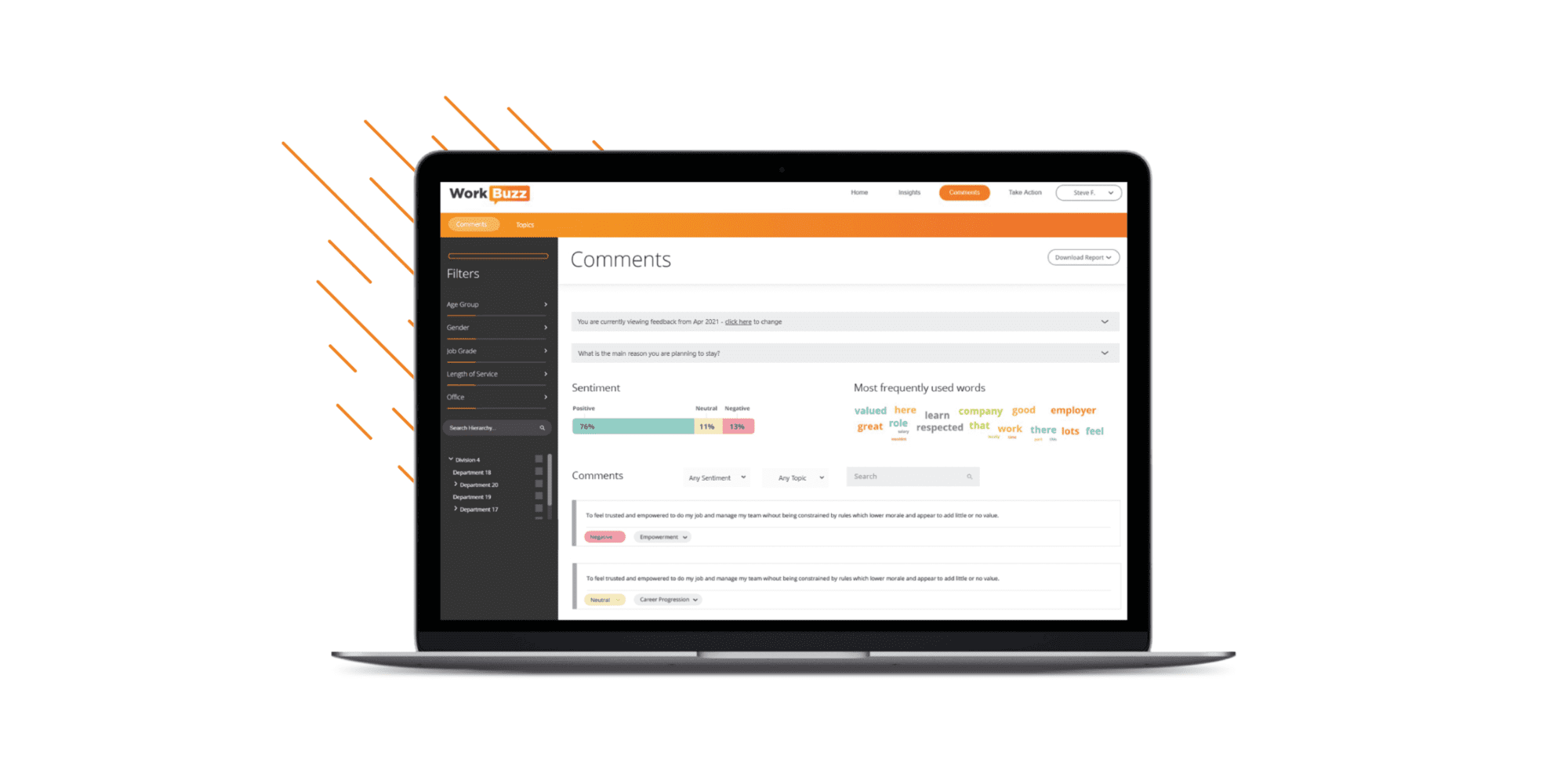
WorkBuzz is an HR platform specifically designed to drive employee engagement in private equity firms. Through this platform, HR leaders can deploy engaging surveys, analyze workforce sentiment in real time, and adapt their strategies based on actionable insights. Its value for private equity firms lies in its ability to foster a positive work environment, which in turn can boost productivity and profitability.
Best for Employee Engagement & Feedback Platforms for Private Equity Firms
Expert Take
WorkBuzz HR Platform excels in providing real-time workforce sentiment analysis and engaging survey creation, specifically tailored for private equity firms. Its ability to deliver actionable insights and adapt strategies effectively positions it as a leading solution in its niche, despite some customization limitations.
Pros
- 98% client retention rate
- Kiosk mode for deskless workers
- ISO 27001 & Cyber Essentials certified
- Dedicated People Science consultancy
- NPS score of 83
Cons
- Minimum 12-month contract
- Reporting limits for complex enterprises
- Basic integrations vs. enterprise peers
- Pricing requires quote request
- Setup takes 4-6 weeks
Best for teams that are
- Mid-to-large organizations (500+ employees) with significant frontline or deskless workforces.
- Companies needing flexible, accessible surveys (QR codes, kiosk mode) for remote staff.
Skip if
- Very small businesses or teams (under 50 employees) looking for a lightweight tool.
- Global enterprises requiring complex, seamless integration with niche global HR systems.
Best for teams that are
- Mid-to-large organizations (500+ employees) with significant frontline or deskless workforces.
- Companies needing flexible, accessible surveys (QR codes, kiosk mode) for remote staff.
Skip if
- Very small businesses or teams (under 50 employees) looking for a lightweight tool.
- Global enterprises requiring complex, seamless integration with niche global HR systems.
Pros
- 98% client retention rate
- Kiosk mode for deskless workers
- ISO 27001 & Cyber Essentials certified
- Dedicated People Science consultancy
- NPS score of 83
Cons
- Minimum 12-month contract
- Reporting limits for complex enterprises
- Basic integrations vs. enterprise peers
- Pricing requires quote request
- Setup takes 4-6 weeks
Expert Take
WorkBuzz HR Platform excels in providing real-time workforce sentiment analysis and engaging survey creation, specifically tailored for private equity firms. Its ability to deliver actionable insights and adapt strategies effectively positions it as a leading solution in its niche, despite some customization limitations.

Client Savvy is a specialized SaaS solution for contractors seeking to optimize employee engagement and productivity. This platform provides targeted surveys, comprehensive assessments, and robust feedback systems, directly addressing the industry's need for real-time team insights and continuous improvement.
Best for Employee Engagement & Feedback Platforms for Contractors
Expert Take
Client Savvy Engagement Platform is tailored for the contracting industry, providing specialized tools for employee engagement and productivity. Its comprehensive features and industry-specific focus make it a standout solution, although the lack of transparent pricing and potential training requirements are noted tradeoffs.
Pros
- FTE-based pricing allows unlimited users
- Deep integration with Deltek Vantagepoint
- Milestone-based feedback for long projects
- Founded by architects for AEC industry
- AI-powered response generation tools
Cons
- Requires high organizational commitment
- No free trial available
- Brand transition caused some user confusion
- Pricing is not publicly listed
- Niche focus limits utility outside AEC
Best for teams that are
- Professional services firms like architects, engineers, and contractors.
- Companies looking to align employee engagement directly with client satisfaction.
Skip if
- Traditional retail or purely internal-focused organizations.
- Companies looking for standard, standalone employee pulse surveys.
Best for teams that are
- Professional services firms like architects, engineers, and contractors.
- Companies looking to align employee engagement directly with client satisfaction.
Skip if
- Traditional retail or purely internal-focused organizations.
- Companies looking for standard, standalone employee pulse surveys.
Pros
- FTE-based pricing allows unlimited users
- Deep integration with Deltek Vantagepoint
- Milestone-based feedback for long projects
- Founded by architects for AEC industry
- AI-powered response generation tools
Cons
- Requires high organizational commitment
- No free trial available
- Brand transition caused some user confusion
- Pricing is not publicly listed
- Niche focus limits utility outside AEC
Expert Take
Client Savvy Engagement Platform is tailored for the contracting industry, providing specialized tools for employee engagement and productivity. Its comprehensive features and industry-specific focus make it a standout solution, although the lack of transparent pricing and potential training requirements are noted tradeoffs.
Explore Categories
-
 Employee Engagement & Feedback Platforms for Contractors
-
 Employee Engagement & Feedback Platforms for Private Equity Firms
-
 Employee Engagement & Feedback Platforms for Recruitment Agencies
-
 Employee Engagement & Feedback Platforms for SaaS Companies
-
 Employee Engagement & Feedback Platforms for Staffing Agencies
Loading comparison data…
Employee Engagement & Feedback Platforms for Contractors
Employee Engagement & Feedback Platforms for Private Equity Firms
Employee Engagement & Feedback Platforms for Recruitment Agencies
Employee Engagement & Feedback Platforms for SaaS Companies
Employee Engagement & Feedback Platforms for Staffing Agencies