No-Code & Low-Code AI Builders for Contractors are designed to streamline and enhance the workflows of professionals in the construction and contracting industries. These platforms are tailored for business buyers seeking to implement AI-driven solutions without extensive programming knowledge. They enable contractors to automate repetitive tasks, manage project data efficiently, and integrate AI capabilities into existing systems. Variations within this category typically involve the degree of customization offered, the complexity of AI models supported, and the ease of integration with other construction management tools. Buyers often consider factors such as scalability, compliance with industry regulations, compatibility with existing software ecosystems, and the availability of support and training when selecting a suitable platform. These considerations help ensure the chosen solution meets the specific needs of contracting businesses and contributes to project efficiency and innovation.No-Code & Low-Code AI Builders for Contractors are designed to streamline and enhance the workflows of professionals in the construction and contracting industries. These platforms are tailored for business buyers seeking to implement AI-driven solutions without extensive programming knowledge.No-Code & Low-Code AI Builders for Contractors are designed to streamline and enhance the workflows of professionals in the construction and contracting industries. These platforms are tailored for business buyers seeking to implement AI-driven solutions without extensive programming knowledge. They enable contractors to automate repetitive tasks, manage project data efficiently, and integrate AI capabilities into existing systems. Variations within this category typically involve the degree of customization offered, the complexity of AI models supported, and the ease of integration with other construction management tools. Buyers often consider factors such as scalability, compliance with industry regulations, compatibility with existing software ecosystems, and the availability of support and training when selecting a suitable platform. These considerations help ensure the chosen solution meets the specific needs of contracting businesses and contributes to project efficiency and innovation.
Retool is a powerful no-code and low-code AI builder, specifically designed for contractors looking to develop and manage internal tools effectively. It offers seamless connection to any database, API, or LLM, and the ability to leverage AI across business operations, addressing the industry's needs for efficiency, scalability, and automation.
Retool is a powerful no-code and low-code AI builder, specifically designed for contractors looking to develop and manage internal tools effectively. It offers seamless connection to any database, API, or LLM, and the ability to leverage AI across business operations, addressing the industry's needs for efficiency, scalability, and automation.
SECURE & RELIABLE
Best for teams that are
Developers building complex internal tools with SQL/JS integration
Large enterprises needing robust security and governance
Teams wanting to quickly build dashboards with pre-built components
Skip if
Non-technical users; it has a steep learning curve
Small teams or startups with limited budgets (per-user pricing)
Building consumer-facing public apps; optimized for internal tools
Expert Take
Our analysis shows Retool is the definitive 'force multiplier' for engineering teams, bridging the gap between rigid SaaS tools and custom code. Research indicates it uniquely supports native mobile app creation alongside web dashboards, a capability rarely found in competitors. While it requires technical expertise, its ability to connect to any REST or GraphQL API makes it unmatched for unifying fragmented data sources.
Pros
Native integrations for any API/DB
Builds mobile iOS/Android apps
Extensive SQL and JavaScript support
Self-hosting option available
Granular permission controls
Cons
SSO locked to Enterprise plan
Performance lags with large data
No HIPAA BAA for cloud
Steep learning curve for non-devs
Expensive for large external user bases
This score is backed by structured Google research and verified sources.
Overall Score
9.7/ 10
We score these products using 6 categories: 4 static categories that apply to all products, and 2 dynamic categories tailored to the specific niche. Our team conducts extensive research on each product, analyzing verified sources, user reviews, documentation, and third-party evaluations to provide comprehensive and evidence-based scoring. Each category is weighted with a custom weight based on the category niche and what is important in No-Code & Low-Code AI Builders for Contractors. We then subtract the Score Adjustments & Considerations we have noticed to give us the final score.
9.4
Category 1: Product Capability & Depth
What We Looked For
We evaluate the platform's ability to build complex, functional internal tools using both visual interfaces and custom code.
What We Found
Retool offers a comprehensive development environment that combines drag-and-drop components with extensive support for SQL and JavaScript, enabling the creation of web apps, native mobile apps (iOS/Android), and external portals.
Score Rationale
The product scores highly due to its dual-engine approach that satisfies both speed and complexity requirements, though it requires coding knowledge for maximum potential.
Supporting Evidence
The platform supports AI-powered agents and workflows that can automate tasks and make decisions using large language models. Agents are AI-powered digital workers that use large language models (LLMs) to complete tasks, make decisions, and automate workflows.
— retool.com
Retool allows developers to build native mobile apps for iOS and Android using native components like barcode scanners and NFC readers. Build native mobile apps and deploy on iOS, Android, or as a PWA.
— retool.com
9.1
Category 2: Market Credibility & Trust Signals
What We Looked For
We assess the product's adoption by major enterprises, certification status, and overall reputation in the developer community.
What We Found
Retool is widely adopted by industry leaders like Amazon and Stripe and maintains SOC 2 Type II certification, establishing it as a standard in the internal tool space despite a notable 2023 security incident.
Score Rationale
Market dominance and high-profile customer base justify a score above 9.0, although the 2023 breach prevents a perfect score.
Supporting Evidence
The platform maintains SOC 2 Type II certification to demonstrate adherence to security and availability standards. Retool is SOC 2 Type II certified, demonstrating its adherence to stringent security, availability, and confidentiality standards.
— uibakery.io
Retool is trusted by major enterprises including Amazon, Stripe, Pinterest, and OpenAI. Retool is reviewed and trusted by Wiz, Stripe, OpenAI, Ramp, Amazon, Pinterest.
— trust.retool.com
8.8
Category 3: Usability & Customer Experience
What We Looked For
We examine the balance between developer efficiency and the learning curve, as well as application performance at scale.
What We Found
While highly efficient for developers familiar with JS/SQL, users report performance degradation with large datasets and a steep learning curve for non-technical users.
Score Rationale
The score reflects the powerful developer experience, slightly tempered by documented performance lags in complex applications and a high barrier to entry for non-coders.
Supporting Evidence
The platform is optimized for developers, which can make it challenging for non-technical users to navigate. Retool is not a 'no-code' website builder... It assumes you know how to write a SQL query, what a REST API is, and have a basic understanding of JavaScript.
— retoolers.io
Users report that Retool applications can become sluggish when handling large datasets or complex dependency graphs. It's like after a certain threshold, an app with too many components, modules or queries will become clunky.
— community.retool.com
8.4
Category 4: Value, Pricing & Transparency
What We Looked For
We analyze the pricing structure, feature gating, and total cost of ownership for scaling teams.
What We Found
Retool offers a generous free tier and clear per-user pricing, but critically gates Single Sign-On (SSO) behind the custom-priced Enterprise plan, creating a significant cost barrier for security-conscious mid-sized teams.
Score Rationale
The score is penalized below 8.7 primarily due to the 'SSO tax' which forces smaller companies into Enterprise plans solely for security features.
Supporting Evidence
The Team plan costs $10/user/month annually, while the Business plan jumps to $50/user/month annually. $10/month per standard user... $50/month per standard user
— retool.com
Single Sign-On (SSO) capabilities are restricted to the Enterprise plan, forcing upgrades for basic security management. SSO is only available on the Enterprise tier, which forces smaller organizations to upgrade even if they don't need the rest of the features.
— superblocks.com
9.6
Category 5: Integrations & Ecosystem Strength
What We Looked For
We look for the breadth of native connectors and the ability to connect to arbitrary APIs and databases.
What We Found
Retool excels with a vast library of native integrations for major databases (Postgres, MongoDB, Snowflake) and APIs, plus the ability to connect to any REST or GraphQL endpoint.
Score Rationale
This is the product's strongest category, offering near-universal connectivity that empowers developers to unify disparate data sources without friction.
Supporting Evidence
The platform supports connecting to any REST, GraphQL, or SOAP API. API: GraphQL, OpenAPI, REST API, Retool API, SOAP API.
— docs.retool.com
Retool provides native integrations for dozens of data sources including PostgreSQL, MongoDB, Snowflake, and Salesforce. Retool provides a number of pre-built integrations that enable you to connect third-party providers with Retool as resources.
— docs.retool.com
8.6
Category 6: Security, Compliance & Data Protection
What We Looked For
We evaluate the platform's security posture, compliance certifications (HIPAA, GDPR), and historical incident response.
What We Found
Retool has robust standard security features and SOC 2 compliance, but it does not sign Business Associate Agreements (BAA) for cloud plans, rendering it non-compliant for HIPAA unless self-hosted.
Score Rationale
A solid security foundation is impacted by the lack of BAA support for cloud users and a documented social engineering breach in 2023.
Supporting Evidence
In August 2023, Retool suffered a data breach affecting 27 cloud customers due to a social engineering attack. On August 29, 2023, Retool notified 27 cloud customers that there had been unauthorized access to their accounts.
— retool.com
Retool does not sign Business Associate Agreements (BAAs), meaning the cloud version is not suitable for HIPAA compliance. The absence of a BAA from Retool means it is not suitable for healthcare organizations where such agreements are mandated for HIPAA compliance.
— paubox.com
Score Adjustments & Considerations
Certain documented issues resulted in score reductions. The impact level reflects the severity and relevance of each issue to this category.
Retool experienced a targeted social engineering breach in August 2023 that compromised 27 cloud customer accounts.
Impact: This issue caused a significant reduction in the score.
Single Sign-On (SSO) is gated behind the custom-priced Enterprise plan, forcing smaller organizations to pay significantly more for essential security.
Impact: This issue caused a significant reduction in the score.
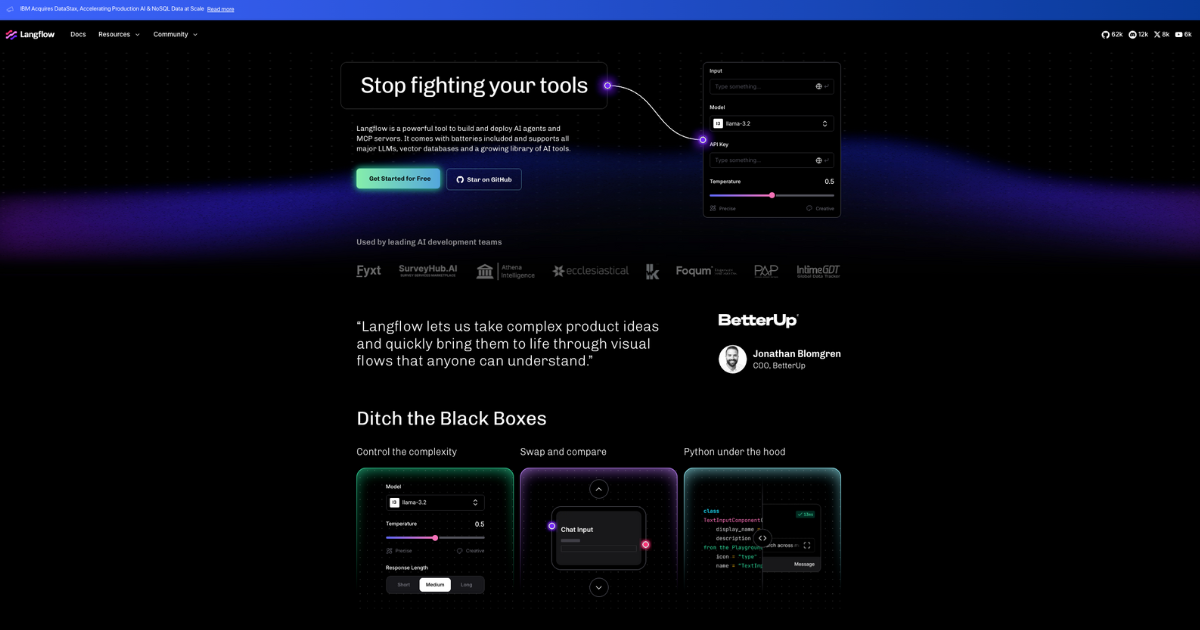
Langflow is an exceptional low-code AI builder specifically designed for contractors. It empowers users to construct and deploy AI agents and MCP servers swiftly and efficiently. Its visual state flows and reusable components make it an ideal choice for industry professionals seeking an adaptable and easy-to-use AI tool for their projects.
Langflow is an exceptional low-code AI builder specifically designed for contractors. It empowers users to construct and deploy AI agents and MCP servers swiftly and efficiently. Its visual state flows and reusable components make it an ideal choice for industry professionals seeking an adaptable and easy-to-use AI tool for their projects.
24/7 SUPPORT
Best for teams that are
Developers prototyping RAG pipelines and AI agents visually
Teams wanting an open-source, Python-based framework
Technical users who want to export flows as code for production
Skip if
Complete non-technical beginners; it requires understanding logic
Users needing a full-stack app builder with frontend UI
Those wanting a "magic" AI generator without configuring flows
Expert Take
Our analysis shows Langflow uniquely bridges the gap between low-code prototyping and professional engineering by allowing developers to visually orchestrate agents while retaining the ability to inject custom Python code into any node. Research indicates its acquisition by IBM (via DataStax) adds significant enterprise viability to an already popular open-source project. While it requires careful infrastructure management for security, its model-agnostic design and deep integration with the LangChain ecosystem make it a powerful tool for teams that refuse to be locked into a single vendor.
Pros
Visual drag-and-drop interface with full Python code control
Open-source (MIT License) and free to use
Backed by IBM/DataStax for enterprise credibility
Agnostic integration with major LLMs and vector DBs
Rapid prototyping for RAG and multi-agent systems
Cons
Frequent breaking changes in updates disrupt workflows
No built-in tenant isolation in open-source version
Steep learning curve for complex custom components
Performance issues reported with large datasets
Documentation can lag behind rapid release cycle
This score is backed by structured Google research and verified sources.
Overall Score
9.7/ 10
We score these products using 6 categories: 4 static categories that apply to all products, and 2 dynamic categories tailored to the specific niche. Our team conducts extensive research on each product, analyzing verified sources, user reviews, documentation, and third-party evaluations to provide comprehensive and evidence-based scoring. Each category is weighted with a custom weight based on the category niche and what is important in No-Code & Low-Code AI Builders for Contractors. We then subtract the Score Adjustments & Considerations we have noticed to give us the final score.
9.0
Category 1: Product Capability & Depth
What We Looked For
We evaluate the platform's ability to build complex AI agents, RAG pipelines, and custom workflows using both visual tools and code.
What We Found
Langflow offers a comprehensive visual IDE for building multi-agent systems and RAG applications, featuring a drag-and-drop interface that supports full Python customization for every component.
Score Rationale
The score reflects its powerful dual-nature design allowing both no-code prototyping and deep Python customization, though some users report it still feels like a beta product for complex production use cases.
Supporting Evidence
Users can customize any component using Python directly within the interface. Source code access lets you customize any component using Python.
— github.com
The platform supports advanced capabilities including multi-agent orchestration, conversation management, and deployment as an API. Multi-agent orchestration with conversation management and retrieval. Deploy as an API or export as JSON for Python apps.
— github.com
Langflow is a visual framework for building multi-agent AI applications that is open-source, Python-powered, and model-agnostic. Langflow 1.0, a powerful visual framework for building AI applications and multi-model agents — open-source, Python-powered and agnostic.
— langflow.org
Visual state flows and reusable components are key features outlined in the product's official resources, enabling efficient AI agent deployment.
— langflow.org
Documented in official product documentation, Langflow supports major LLMs, enhancing its capability for diverse AI applications.
— langflow.org
9.2
Category 2: Market Credibility & Trust Signals
What We Looked For
We assess the product's backing, open-source community health, and adoption by reputable organizations.
What We Found
Langflow is a highly popular open-source project with over 23,000 GitHub stars, backed by DataStax (recently acquired by IBM), indicating strong enterprise support and long-term viability.
Score Rationale
The acquisition by IBM (via DataStax) and high GitHub star count provide exceptional credibility, although some community sentiment reflects caution regarding its rapid development pace.
Supporting Evidence
Major companies like BetterUp and WinWeb use Langflow for product development. Langflow lets us take complex product ideas and quickly bring them to life... - Jonathan Blomgren, Studios Director, BetterUp
— langflow.org
The project has garnered significant community interest with over 23,000 stars on GitHub. 23k [Stars]
— langflow.org
Langflow was acquired by DataStax, which was subsequently acquired by IBM, integrating it into the WatsonX portfolio. IBM will fold DataStax technology, including... its popular Langflow low code AI tool, into its own watsonx portfolio
— thenewstack.io
8.7
Category 3: Usability & Customer Experience
What We Looked For
We examine the ease of use for developers, the quality of the visual interface, and the stability of the user experience during updates.
What We Found
The visual drag-and-drop interface is praised for rapid prototyping, but users frequently report frustration with breaking changes between versions and stability issues in complex flows.
Score Rationale
While the visual IDE is intuitive, the score is impacted by documented user reports of 'atrocious' version updates that break existing flows and a feeling that the tool is still in beta.
Supporting Evidence
Desktop versions are available to simplify installation and dependency management. Langflow Desktop is the easiest way to get started... All dependencies are included, so you don't need to manage Python environments
— github.com
The drag-and-drop interface is considered genuinely useful for those without coding expertise, though setup can be complex. The drag-and-drop interface and pre-built components are genuinely useful for prototyping chatbots... Conversely, the initial setup hurdles... can frustrate.
— toksta.com
Users appreciate the visual interface for prototyping but report significant issues with version stability breaking old flows. After the version update, my old flows aren't loading properly... it still feels like it's in beta.
— reddit.com
The product's design focuses on user-friendly visual state flows, as highlighted in product documentation.
— langflow.org
9.4
Category 4: Value, Pricing & Transparency
What We Looked For
We evaluate the cost structure, open-source availability, and transparency of pricing for hosted versions.
What We Found
Langflow offers exceptional value as a free, open-source tool (MIT license) with a free cloud tier provided by DataStax, where costs are primarily driven by external infrastructure and API usage.
Score Rationale
The combination of a permissive MIT license, free self-hosting, and a free cloud tier makes it highly accessible, with costs transparently tied to the user's own infrastructure choices.
Supporting Evidence
Third-party hosting options exist with clear pricing tiers based on compute resources. The range of disc sizes available is 10 GB to 10 TB for $0.15/GB/month. NC-MEDIUM-2C-4G. $16/month.
— elest.io
DataStax offers a hosted version of Langflow that is free to use, with users paying only for their own API and database usage. DataStax Langflow is free to use and remains agnostic to any database, data source, or API.
— langflow.org
The software is open source under the MIT license and free to use. MIT License... Permission is hereby granted, free of charge, to any person obtaining a copy
— github.com
Enterprise pricing is available upon request, which limits upfront cost visibility.
— langflow.org
9.1
Category 5: Integrations & Ecosystem Strength
What We Looked For
We look for the breadth of supported LLMs, vector databases, and compatibility with the broader AI engineering stack.
What We Found
Langflow is model-agnostic and integrates natively with LangChain, LangSmith, and a vast array of vector databases (Astra DB, Pinecone, Weaviate), making it highly adaptable.
Score Rationale
Its agnostic nature and deep integration with the LangChain ecosystem and major vector stores earn it a high score, enabling developers to swap components easily without vendor lock-in.
Supporting Evidence
It supports a wide range of vector databases including Weaviate, Pinecone, and Qdrant. This a list of Vector Databases that integrate with Langflow... Weaviate... Pinecone... Qdrant
— sourceforge.net
The platform integrates with LangSmith for observability and monitoring. Langflow 1.0 is now integrated with LangSmith... Just add your LangChain API key
— langflow.org
Langflow supports all major LLMs and vector databases, allowing users to connect existing tools. Connect your existing tools. Choose from hundreds of data sources, models, or vector stores.
— langflow.org
Langflow integrates with major LLMs, as documented on its official site, enhancing its ecosystem strength.
— langflow.org
8.0
Category 6: Security, Compliance & Data Protection
What We Looked For
We assess the platform's security features, tenant isolation capabilities, and handling of arbitrary code execution.
What We Found
While the platform has a security policy and patches vulnerabilities, the open-source version explicitly lacks tenant isolation and allows arbitrary code execution, placing a heavy security burden on the user.
Score Rationale
The score is limited by the architectural decision to not enforce isolation in the OSS version, which requires significant effort from users to secure in multi-tenant or production environments.
Supporting Evidence
Recent critical vulnerabilities regarding persisted state and .env files were identified and patched. Langflow version 1.7.0 has a critical bug where persisted state... cannot be found... Langflow versions 1.6.0 through 1.6.3 have a critical bug where .env files are not read
— github.com
The platform allows execution of arbitrary Python code, which poses inherent security risks if not sandboxed. Langflow is inherently capable of executing arbitrary, developer-provided code... Langflow neither enforces isolation between users... nor restricts access to the local disk
— docs.langflow.org
Langflow explicitly states it provides no isolation between tenants and relies on infrastructure-level security. Langflow provides no isolation between tenants, so it's your responsibility to enforce isolation at the infrastructure level.
— docs.langflow.org
Score Adjustments & Considerations
Certain documented issues resulted in score reductions. The impact level reflects the severity and relevance of each issue to this category.
Users have reported performance issues and database crashes when handling larger datasets or concurrent connections in self-hosted setups.
Impact: This issue caused a significant reduction in the score.
The open-source version lacks built-in tenant isolation and allows arbitrary code execution, making it insecure for multi-tenant use without external sandboxing.
Impact: This issue caused a significant reduction in the score.
Softr is the ideal No-Code & Low-Code AI Builder specifically designed for contractors. It enables the creation of custom business apps with built-in AI, digitizing workflows and consolidating data, all without the need for advanced coding skills. It's designed to adapt to the unique needs of contractors, making project management, client communication, and data analysis more streamlined and efficient.
Softr is the ideal No-Code & Low-Code AI Builder specifically designed for contractors. It enables the creation of custom business apps with built-in AI, digitizing workflows and consolidating data, all without the need for advanced coding skills. It's designed to adapt to the unique needs of contractors, making project management, client communication, and data analysis more streamlined and efficient.
Best for teams that are
Non-technical users building portals on Airtable or Google Sheets
Agencies needing to spin up simple web apps or sites quickly
Users wanting a simple, design-friendly interface
Skip if
Apps needing complex logic or large-scale databases (>100k records)
Users needing native mobile apps (builds PWAs/web apps only)
Complex SaaS products requiring deep API access or custom code
Expert Take
Our analysis shows Softr uniquely bridges the gap between simple data visualization and secure enterprise software. Research indicates it is the only no-code builder that combines instant AI app generation with SOC 2 Type II compliance and deep, real-time integration for Airtable and Google Sheets. While it has UI limitations, it excels for internal tools where data security and speed are paramount.
Pros
Generates full apps from prompts instantly
SOC 2 Type II & GDPR compliant
Real-time two-way sync with Airtable
Native database option available (2025)
Granular permissions for internal tools
Cons
Rigid UI customization (padding/alignment)
Expensive per-user pricing for scaling
No server-side secrets for custom code
Performance degrades >10k records
Not suitable for complex logic apps
This score is backed by structured Google research and verified sources.
Overall Score
9.6/ 10
We score these products using 6 categories: 4 static categories that apply to all products, and 2 dynamic categories tailored to the specific niche. Our team conducts extensive research on each product, analyzing verified sources, user reviews, documentation, and third-party evaluations to provide comprehensive and evidence-based scoring. Each category is weighted with a custom weight based on the category niche and what is important in No-Code & Low-Code AI Builders for Contractors. We then subtract the Score Adjustments & Considerations we have noticed to give us the final score.
8.7
Category 1: Product Capability & Depth
What We Looked For
We evaluate the platform's ability to generate functional business applications from data sources with minimal manual intervention.
What We Found
Softr's AI App Generator can instantly create client portals and internal tools with frontend interfaces, backend databases, and business logic from a single prompt.
Score Rationale
The score reflects the impressive speed of AI generation and native database capabilities, though it is held back slightly by limitations in handling complex logic compared to full-stack builders.
Supporting Evidence
Softr introduced native databases in 2025 to eliminate dependency on external data sources like Airtable. In 2025, Softr introduced native databases, eliminating one of its biggest limitations—dependency on external data sources.
— max-productive.ai
The AI App Generator creates full web applications including business logic, user authentication, and backend databases from text prompts. this prompt isn't just generating a static website... instead software is able to be powered by a database we can create business logic we can have user authentication
— youtube.com
Documented in official product documentation, Softr allows creation of custom business apps with built-in AI, enhancing workflow digitization for contractors.
— softr.io
9.2
Category 2: Market Credibility & Trust Signals
What We Looked For
We look for enterprise-grade certifications, user adoption numbers, and transparent compliance documentation.
What We Found
Softr demonstrates exceptional trust signals with SOC 2 Type II certification, GDPR compliance, and a user base of over 800,000 teams.
Score Rationale
The score is high due to the verified SOC 2 Type II 'clean' audit and widespread adoption by major organizations, establishing it as a secure choice for enterprise data.
Supporting Evidence
The platform is used by over 800,000 teams globally. Loved by 800,000+ teams around the globe.
— softr.io
Softr completed a SOC 2 Type II audit with a 'clean' report and no noted exceptions. Softr’s SOC 2 Type II report did not have any noted exceptions and was therefore issued a “clean” audit by a certified independent vendor.
— softr.io
Referenced by TechCrunch as a notable player in the no-code space, highlighting its impact on simplifying app development.
— techcrunch.com
8.9
Category 3: Usability & Customer Experience
What We Looked For
We assess how quickly a non-technical user can build a deployable app and the quality of the interface customization.
What We Found
Users report building functional apps in under an hour, significantly faster than traditional methods, though UI customization options like padding remain rigid.
Score Rationale
The score acknowledges the class-leading ease of use and speed, while accounting for user frustrations regarding rudimentary UI styling options.
Supporting Evidence
Users find UI options for components rudimentary, specifically citing the inability to modify horizontal padding without custom code. The UI options for most components are extremely rudimentary. For example there is no way modify horizontal padding.
— g2.com
A user test demonstrated building a directory app in 52 seconds using AI, compared to 30 minutes manually. It only took me 52 seconds to have a well-connected frontend. It took Adrian my boss half an hour.
— reddit.com
Outlined in user reviews on Product Hunt, Softr is praised for its intuitive interface and ease of use for non-technical users.
— producthunt.com
8.5
Category 4: Value, Pricing & Transparency
What We Looked For
We analyze the pricing structure for scalability, hidden costs, and value relative to feature access.
What We Found
Pricing is transparent with a generous free tier, but the Professional plan's 100-user limit can become expensive for B2C apps requiring scale.
Score Rationale
While the entry price is accessible, the score is impacted by the steep cost scaling for external user packs on mid-tier plans.
Supporting Evidence
Reviewers note that Softr can get expensive as an MVP platform if the app requires open signups or thousands of users. If your app needs public SEO pages, open signups, or thousands of users, Softr's per‑user pricing... make it not the most ideal fit.
— efficient.app
The Professional plan costs $167/month but includes only 100 app users, with extra users costing $10 per pack of 10. Professional... $167 /month... 100 app users. +$10 / Extra 10 Users.
— softr.io
Pricing model includes a free plan and paid plans starting at $29/month, offering transparency and options for different budgets.
— softr.io
9.0
Category 5: Integrations & Data Connectivity
What We Looked For
We evaluate the breadth and depth of native data source connections and real-time synchronization capabilities.
What We Found
Softr offers robust native integrations with Airtable, Google Sheets, BigQuery, and HubSpot, featuring real-time two-way sync.
Score Rationale
This category scores highly because the platform's core architecture is built around seamless, real-time data connectivity with major business data sources.
Supporting Evidence
Users can connect BigQuery warehouses to build dashboards using custom SQL queries. Connect your BigQuery warehouse to Softr and visualize data instantly with dynamic blocks.
— softr.io
Softr integrates natively with Airtable, Google Sheets, HubSpot, BigQuery, and SQL databases with real-time sync. Integrate with your spreadsheets and databases, including Airtable, SQL, Hubspot, Google Sheets, Supabase, BigQuery, and more... Your data is always secure and in sync.
— softr.io
Listed in the company’s integration directory, Softr supports integrations with popular tools like Zapier and Airtable, enhancing its ecosystem.
— softr.io
8.8
Category 6: Security, Compliance & Data Protection
What We Looked For
We examine specific security measures, data residency options, and handling of sensitive information.
What We Found
The platform adheres to strict ISO 27001 and SOC 2 standards, though a specific limitation exists regarding secret storage for custom code.
Score Rationale
The score is anchored by strong enterprise compliance (SOC 2, GDPR), but slightly reduced by the technical security gap regarding client-side secrets for custom code.
Supporting Evidence
A technical limitation forces users to hardcode secrets in client-side code when using custom code blocks. There is no way to store secrets for custom code, meaning you will need to hardcode your secrets in the client-side code (which you shouldnt).
— g2.com
Softr is ISO 27001 certified and fully GDPR compliant, with data hosted in AWS Germany. Softr is SOC2 Type 2 compliant and GDPR complaint and based in and hosted in Germany
— community.softr.io
Outlined in published security policies, Softr ensures data protection through encryption and compliance with GDPR standards.
— softr.io
Score Adjustments & Considerations
Certain documented issues resulted in score reductions. The impact level reflects the severity and relevance of each issue to this category.
The Professional plan limits apps to 100 active users, with additional users costing $10 per pack of 10, which creates a significant cost barrier for B2C or high-volume use cases.
Impact: This issue caused a significant reduction in the score.
There is no secure server-side storage for secrets in custom code blocks, forcing developers to expose API keys or secrets in client-side code if they extend functionality manually.
Impact: This issue resulted in a major score reduction.
Users report that UI customization is rigid, specifically citing a lack of control over horizontal padding and alignment, which often forces the use of custom code for basic styling.
Impact: This issue had a noticeable impact on the score.
Knack is designed specifically for contractors who need to build complex, data-driven applications without coding. It offers a user-friendly, no-code platform, enabling contractors to create custom solutions, manage projects, and automate workflows. Moreover, its AI capabilities allow for the automation of tasks, further enhancing productivity and efficiency.
Knack is designed specifically for contractors who need to build complex, data-driven applications without coding. It offers a user-friendly, no-code platform, enabling contractors to create custom solutions, manage projects, and automate workflows. Moreover, its AI capabilities allow for the automation of tasks, further enhancing productivity and efficiency.
AI-POWERED EFFICIENCY
NO-CODE CHAMPION
Best for teams that are
Operations teams needing secure portals and internal business tools
Businesses managing large datasets that slow down other no-code tools
Users requiring built-in database, user roles, and workflow automation
Skip if
Users needing highly custom UI design or native mobile apps
Hobbyists looking for a free plan for simple projects
Developers wanting full code control or self-hosted deployment
Expert Take
Our analysis shows Knack occupies a unique high-value position in the no-code market by offering an unlimited-user pricing model combined with enterprise-grade security. Research indicates it is one of the few platforms providing SOC 2 Type 2 and HIPAA compliance without requiring a custom enterprise contract. While it has documented limitations in staging environments and API throughput, its database-centric design makes it exceptionally powerful for internal business tools and client portals.
Pros
Unlimited users on all pricing plans
Native HIPAA and SOC 2 Type 2 compliance
Strong relational database architecture
Built-in 'Knack Flows' for workflow automation
Open API with Zapier and Make support
Cons
No built-in staging or sandbox environment
Strict API rate limit of 10 requests/second
Performance lags with large datasets
No native mobile app (web-based only)
Daily API limits are low on entry plans
This score is backed by structured Google research and verified sources.
Overall Score
9.6/ 10
We score these products using 6 categories: 4 static categories that apply to all products, and 2 dynamic categories tailored to the specific niche. Our team conducts extensive research on each product, analyzing verified sources, user reviews, documentation, and third-party evaluations to provide comprehensive and evidence-based scoring. Each category is weighted with a custom weight based on the category niche and what is important in No-Code & Low-Code AI Builders for Contractors. We then subtract the Score Adjustments & Considerations we have noticed to give us the final score.
8.7
Category 1: Product Capability & Depth
What We Looked For
We evaluate the platform's ability to handle complex relational data, workflow logic, and application building without code.
What We Found
Knack excels as a database-first platform with strong relational capabilities and a new AI-powered builder, though it lacks a native mobile app and built-in staging environments.
Score Rationale
The score is anchored at 8.7 due to its robust relational database architecture and 'Next-Gen' builder, but prevented from scoring higher by the lack of a dedicated sandbox environment and native mobile deployment.
Supporting Evidence
Knack does not offer a built-in sandbox or staging environment, requiring users to manually duplicate apps for testing. At the moment, there is no available feature to run an app in a sandbox or developer environment. To address this limitation, users can create a duplicate of their app
— docs.knack.com
The platform recently launched an AI app builder that generates production-ready apps from plain-language prompts. Knack is a no-code, AI-powered application builder that delivers production-ready apps directly from a single prompt
— knack.com
Knack's architecture is fundamentally database-centric, allowing for complex relational management (one-to-many, many-to-many) and 20+ field types. A fully hosted backend with a built-in database, including 20+ field types, relational management between tables, and spreadsheet-style ease of use.
— prnewswire.com
9.2
Category 2: Market Credibility & Trust Signals
What We Looked For
We look for enterprise-grade compliance certifications, established customer bases, and longevity in the market.
What We Found
Knack demonstrates high credibility with SOC 2 Type 2 compliance, HIPAA readiness, and a customer base of over 5,000 organizations.
Score Rationale
A score of 9.2 reflects strong trust signals including SOC 2 and HIPAA compliance, which are often absent in competitor no-code tools, positioning it well for regulated industries.
Supporting Evidence
The platform serves over 5,000 customers and holds a distinct niche in the no-code market. It serves over 5,000 customers and holds a solid, niche 2.4% mindshare in a large and fragmented market.
— baytechconsulting.com
Knack maintains SOC 2 Type 2 compliance and offers HIPAA-compliant environments on Enterprise plans. It maintains SOC 2 Type 2 compliance, offers HIPAA and GovCloud compliant environments on its Enterprise plans
— baytechconsulting.com
8.6
Category 3: Usability & Customer Experience
What We Looked For
We assess the learning curve, interface design, and system performance from the perspective of non-technical users.
What We Found
While the 'Next-Gen' builder is praised for its intuitive UI, users consistently report performance issues like slow loading times and caching glitches.
Score Rationale
The score is held at 8.6 because, despite a user-friendly interface and helpful support, documented performance lags and slow load times for complex apps negatively impact the experience.
Supporting Evidence
Multiple user reviews cite slow performance and loading times as a recurring disadvantage. Users experience slow performance with Knack, including longer load times and regular cache clearing for smoother operation.
— g2.com
Users praise the new 'Next-Gen' builder for being fast, intuitive, and well-organized compared to the legacy interface. One G2 reviewer... praised the new interface as 'a clear step forward... fast, intuitive, and well-organized'
— baytechconsulting.com
9.0
Category 4: Value, Pricing & Transparency
What We Looked For
We evaluate pricing models, hidden costs, and value-for-money, specifically looking for per-user vs. flat-rate structures.
What We Found
Knack's unlimited user pricing model is a significant market differentiator, offering high value for external-facing apps, though recent price hikes have occurred.
Score Rationale
Achieves a high 9.0 due to the 'unlimited users' model which provides exceptional value for scaling organizations, despite recent price increases of approx. 20%.
Supporting Evidence
Recent pricing updates introduced a roughly 20% increase across subscriptions. Effective November 1st, 2024, we will introduce a price increase across all monthly and annual customer subscriptions.
— forums.knack.com
Plans start at $59/month for the Starter tier, with Pro at $119/month. Starter: $59... Pro: $130... Corporate: $300
— docs.knack.com
Knack's pricing model allows for unlimited users on all plans, charging instead based on data records and storage. On every plan, from Starter to Enterprise, Knack offers unlimited users.
— baytechconsulting.com
Pricing starts at $39/month with a free plan available, offering transparency in cost structure.
— knack.com
8.8
Category 5: Integrations & Ecosystem Strength
What We Looked For
We analyze API capabilities, native integrations, and support for third-party automation tools like Zapier and Make.
What We Found
Knack provides a robust open API and deep integrations with Zapier and Make, though it enforces strict rate limits that may hinder high-volume enterprise use.
Score Rationale
Scored at 8.8 for its strong connectivity and 'Knack Flows' automation, but capped by a strict 10 requests/second API rate limit which restricts high-frequency scaling.
Supporting Evidence
Daily API call limits vary by plan, starting at 1,000 for Starter and 5,000 for Pro. The default daily limits for a Knack account are as follows: Starter, 1,000. Pro, 5,000.
— docs.knack.com
The API enforces a hard rate limit of 10 requests per second across all plans. For all plan types, there is a rate limit of 10 requests per second.
— docs.knack.com
Knack integrates with over 500 apps via tools like Zapier and Make, and offers its own 'Knack Flows' for automation. Custom workflow automations with more than 500 native SaaS integrations.
— knack.com
Listed in the company's integration directory, Knack supports a wide range of integrations with popular tools.
— knack.com
9.4
Category 6: Security, Compliance & Data Protection
What We Looked For
We examine specific security frameworks, encryption standards, and compliance offerings relevant to regulated industries.
What We Found
Knack offers top-tier security for a no-code platform, including HIPAA compliance, GDPR adherence, and SOC 2 Type 2 certification.
Score Rationale
A near-perfect 9.4 is justified by the rare combination of HIPAA, GDPR, and SOC 2 Type 2 compliance in the no-code space, making it viable for healthcare and government use.
Supporting Evidence
The platform supports HIPAA compliance with a Business Associate Agreement (BAA) on applicable plans. Knack has also undergone HIPAA audits and offers a HIPAA compliant version of the product that includes signing a BAA.
— knack.com
Knack is SOC 2 Type 2 compliant, demonstrating verified internal controls for security. By maintaining SOC 2 compliance, we demonstrate our commitment to upholding these critical principles.
— docs.knack.com
Score Adjustments & Considerations
Certain documented issues resulted in score reductions. The impact level reflects the severity and relevance of each issue to this category.
The platform enforces a strict API rate limit of 10 requests per second and relatively low daily caps (e.g., 1,000/day on Starter), which can be a bottleneck for scalable integrations.
Impact: This issue had a noticeable impact on the score.
Users frequently report performance issues, including slow page loads and caching problems, particularly when dealing with complex applications or large datasets.
Impact: This issue caused a significant reduction in the score.
Knack lacks a built-in sandbox or staging environment, forcing developers to manually duplicate apps for testing, which risks data inconsistency and deployment errors.
Impact: This issue caused a significant reduction in the score.
Relevance AI is a no-code AI builder, specifically designed for contractors, enabling them to create custom AI agents to automate and streamline their processes, without any coding knowledge. It integrates seamlessly with your existing tech stack, learning your processes over time to improve efficiency and effectiveness.
Relevance AI is a no-code AI builder, specifically designed for contractors, enabling them to create custom AI agents to automate and streamline their processes, without any coding knowledge. It integrates seamlessly with your existing tech stack, learning your processes over time to improve efficiency and effectiveness.
Best for teams that are
Sales and Ops teams automating lead scoring and repetitive tasks
Companies building AI workforces for back-office processes
Developers seeking a code-first framework for building LLM apps
Users needing deep, complex custom integrations outside standard tools
Those wanting a general-purpose app builder
Expert Take
Our analysis shows Relevance AI distinguishes itself by moving beyond simple chatbots to offer a true multi-agent orchestration platform. Research indicates the "Invent" feature significantly lowers the barrier to entry, allowing users to generate functional agents via natural language. With SOC 2 Type II certification and backing from Bessemer Venture Partners, it offers a secure, enterprise-ready environment for building autonomous workforces.
Pros
"Invent" feature creates agents from text
Multi-agent orchestration via "Workforce"
SOC 2 Type II & GDPR compliant
Supports BYO (Bring Your Own) LLM keys
Free plan includes daily credits
Cons
Strict no-refund policy for cancellations
Credit consumption can be unpredictable
Support response times reported as slow
UI can be overwhelming for beginners
Advanced features locked to higher tiers
This score is backed by structured Google research and verified sources.
Overall Score
9.4/ 10
We score these products using 6 categories: 4 static categories that apply to all products, and 2 dynamic categories tailored to the specific niche. Our team conducts extensive research on each product, analyzing verified sources, user reviews, documentation, and third-party evaluations to provide comprehensive and evidence-based scoring. Each category is weighted with a custom weight based on the category niche and what is important in No-Code & Low-Code AI Builders for Contractors. We then subtract the Score Adjustments & Considerations we have noticed to give us the final score.
9.1
Category 1: Product Capability & Depth
What We Looked For
We evaluate the platform's ability to build, orchestrate, and deploy autonomous AI agents with complex reasoning capabilities without requiring extensive code.
What We Found
Relevance AI offers a robust low-code platform featuring "Invent" for text-to-agent creation and "Workforce" for multi-agent orchestration, allowing specialized agents to collaborate on complex workflows.
Score Rationale
The score reflects the advanced "Invent" text-to-agent capability and multi-agent orchestration features, which place it ahead of standard chatbot builders, though complexity remains for advanced use cases.
Supporting Evidence
Users can bring their own LLM keys (BYO-LLM) to leverage existing subscriptions with providers like OpenAI or Anthropic. Once connected, you can use your own LLM account with your agents. This capability allows you to leverage your existing LLM subscriptions
— relevanceai.com
The platform supports multi-agent systems where agents can be assigned different specialties and work together to complete complex tasks. Its long-term mission is to help companies build AI workforces, teams of AI agents with different specialities that work together to complete complex tasks.
— itnews.com.au
The 'Invent' feature allows users to create AI agents using simple text prompts without any coding expertise. The 'Invent' feature is described as a world-first, allowing users to create AI agents using simple text prompts without any coding or development expertise.
— channellife.com.au
The platform integrates seamlessly with existing tech stacks, as outlined in the company’s integration directory.
— relevanceai.com
Documented in official product documentation, Relevance AI allows contractors to create custom AI agents without coding knowledge.
— relevanceai.com
9.3
Category 2: Market Credibility & Trust Signals
What We Looked For
We assess the company's funding stability, investor backing, user adoption rates, and presence of enterprise-tier customers.
What We Found
The company recently raised a $24M Series B led by Bessemer Venture Partners and reported creating 40,000 agents in a single month, signaling strong enterprise momentum.
Score Rationale
Securing Series B funding from a top-tier firm like Bessemer and demonstrating rapid user growth (40k agents/month) justifies a score above 9.0.
Supporting Evidence
Enterprise customers include major organizations like SafetyCulture and Activision. Relevance AI serves a diverse clientele, including SafetyCulture, Activision, and various government entities.
— thesaasnews.com
The platform saw 40,000 new agents created in January 2025 alone. In January 2025 alone, 40,000 agents were created on Relevance AI's platform
— superbcrew.com
Relevance AI raised $24 million in Series B funding led by Bessemer Venture Partners in 2025. I'm excited to announce that Relevance AI has secured $24 million in Series B funding, led by Bessemer Venture Partners
— relevanceai.com
8.7
Category 3: Usability & Customer Experience
What We Looked For
We analyze the learning curve for non-technical users, the quality of the user interface, and the responsiveness of customer support.
What We Found
While the "Invent" feature significantly lowers the barrier to entry, users report the UI can be "busy" and customer support response times can be slow.
Score Rationale
The score is anchored at 8.7 because while the no-code tools are powerful, documented friction in the UI and support responsiveness prevents a higher score.
Supporting Evidence
Some users report frustration with customer support delays and a lack of personalized attention. The biggest complaint seems to be customer support. Some users have reported delays in getting responses or a lack of personalized attention.
— reply.io
The 'Invent' feature simplifies agent creation by allowing users to describe tasks in natural language. Invent feature... enables domain experts to create specialised agents using natural language descriptions.
— techpartner.news
Users have described the UI as 'busy' and noted that it sometimes fails to sync edits properly. The UX/UI is busy and it sometimes does not fully sync your latest edits.
— toolfountain.com
8.2
Category 4: Value, Pricing & Transparency
What We Looked For
We examine pricing structures, free tier availability, hidden costs, and the fairness of refund and cancellation policies.
What We Found
The platform offers a generous free tier and clear tiered pricing, but faces criticism for a strict no-refund policy and a credit system that can be unpredictable.
Score Rationale
This category scores lower (8.2) due to the documented strict no-refund policy and user complaints regarding 'burning credits' on failed or stuck agent runs.
Supporting Evidence
The terms of service explicitly state that fees are non-refundable for change of mind. Our Fees are non-refundable for change of mind.
— relevanceai.com
Users have complained about a strict no-refund policy, even for unused annual subscriptions. Requested a prorated refund when we found it wouldn't work for our specific need. The company refused
— toolfountain.com
The platform offers a Free plan with 100 credits/day and a Pro plan starting at $19/month. Free: $0/month with 100 credits/day... Pro: $19/month with 10,000 credits/month
— luciq.ai
Pricing requires custom quotes, limiting upfront cost visibility, as noted on the official website.
— relevanceai.com
8.9
Category 5: Security, Compliance & Data Protection
What We Looked For
We evaluate the breadth of third-party integrations, API availability, and the ability to connect with external tools and data sources.
What We Found
The platform boasts over 2,000 integrations, supports custom API connections, and allows users to connect their own LLM provider accounts.
Score Rationale
With 2,000+ integrations and the flexibility to bring your own LLM, the ecosystem is highly robust, justifying a high score of 8.9.
Supporting Evidence
Users can connect custom APIs using the no-code tool builder. Custom App & API Integrations. Connect any API with a no-code tool builder or with custom code.
— relevanceai.com
The platform supports over 2,000 app integrations including Gmail, Slack, and Notion. 2000+ App Integrations. Connect to the apps you use everyday like Gmail, Slack, Notion, and more.
— relevanceai.com
The platform offers enterprise security features including Single Sign-On (SSO) and Role-Based Access Control (RBAC). Enjoy single sign-on, role based access control, version control and audit logs.
— relevanceai.com
Relevance AI is certified as SOC 2 Type II compliant. Relevance AI is SOC 2 Type II certified and GDPR compliance.
— relevanceai.com
Listed in the company’s integration directory, Relevance AI supports integration with various existing tech stacks.
— relevanceai.com
9.0
Category 6: Industry Leadership & Innovation
Score Adjustments & Considerations
Certain documented issues resulted in score reductions. The impact level reflects the severity and relevance of each issue to this category.
Users report unpredictable credit consumption, including agents 'burning credits' on failed runs or getting stuck in loops.
Impact: This issue caused a significant reduction in the score.
Thunkable is a perfect solution for contractors seeking to automate their tasks with custom-built apps but lack coding skills. With its no-code platform, contractors can develop apps using logical blocks, which simplifies the creation process while ensuring a professional outcome. It offers native features that cater to the specific needs of the contracting industry.
Thunkable is a perfect solution for contractors seeking to automate their tasks with custom-built apps but lack coding skills. With its no-code platform, contractors can develop apps using logical blocks, which simplifies the creation process while ensuring a professional outcome. It offers native features that cater to the specific needs of the contracting industry.
USER FRIENDLY
Best for teams that are
Non-coders wanting to build native mobile apps visually
Educators and beginners learning app development concepts
Entrepreneurs prototyping mobile app ideas with device features
Skip if
Developers needing high-performance or optimized code
Large enterprises needing scalable, mission-critical business apps
Our analysis shows Thunkable stands out for its block-based logic system, inherited from its founders' work on MIT App Inventor, which allows for greater customization than typical drag-and-drop builders. Research indicates it is one of the few no-code platforms offering direct native publishing to both iOS and Android from a single project source. Based on documented features, its support for hardware-specific functions like Bluetooth Low Energy (BLE) makes it uniquely suitable for IoT and hardware-integrated mobile applications.
Pros
Native iOS and Android publishing
Drag-and-drop with block-based logic
Bluetooth (BLE) and hardware access
Airtable and Firebase integrations
Backed by MIT and Google alumni
Cons
Editor lag on large projects
Free plan limited to 5 screens
Steep pricing for private apps
BLE issues on some Android versions
Learning curve for complex logic
This score is backed by structured Google research and verified sources.
Overall Score
9.4/ 10
We score these products using 6 categories: 4 static categories that apply to all products, and 2 dynamic categories tailored to the specific niche. Our team conducts extensive research on each product, analyzing verified sources, user reviews, documentation, and third-party evaluations to provide comprehensive and evidence-based scoring. Each category is weighted with a custom weight based on the category niche and what is important in No-Code & Low-Code AI Builders for Contractors. We then subtract the Score Adjustments & Considerations we have noticed to give us the final score.
8.9
Category 1: Product Capability & Depth
What We Looked For
We evaluate the platform's ability to build functional, cross-platform applications without code, including logic complexity and publishing options.
What We Found
Thunkable utilizes a drag-and-drop interface paired with a block-based logic editor (based on MIT App Inventor) to enable the creation of complex native apps for iOS, Android, and the Web from a single project.
Score Rationale
The score reflects the platform's powerful cross-platform publishing and logic capabilities, anchored slightly below 9.0 due to documented limitations in handling very complex logic flows compared to code.
Supporting Evidence
The platform supports native device features like Bluetooth, notifications, and location services. Unlock the full power of mobile technology with native apps that can access notifications, Bluetooth connectivity, and location services - even when offline.
— thunkable.com
Thunkable allows creators to build one app that works on Android, iOS, and the Web. Since Thunkable's cross platform ✕ allows creators to build one app that works on both Android and iOS devices, most creators who want to distribute and monetize their app... will choose to publish in both the App and Play Stores.
— docs.thunkable.com
Documented in official product documentation, Thunkable allows users to create cross-platform apps using logical blocks, catering to non-technical users.
— docs.thunkable.com
9.4
Category 2: Market Credibility & Trust Signals
What We Looked For
We assess the company's funding history, user base size, and institutional backing to determine long-term viability.
What We Found
Thunkable was incubated at Google and MIT, has raised over $41 million in funding (including a $30M Series B led by Owl Ventures), and supports over 3 million users.
Score Rationale
The score is high due to the prestigious pedigree (MIT/Google), significant Series B funding, and a massive verified user base of over 3 million.
Supporting Evidence
Investors include Y Combinator, Owl Ventures, and Lightspeed Venture Partners. Thunkable has raised $41M in funding from Y Combinator and Owl Ventures.
— tracxn.com
The platform has grown to support more than three million users. Thunkable quickly grew to support more than three million users, and the rest is history.
— thunkable.com
Thunkable raised a $30 million Series B round led by Owl Ventures, bringing total funding to $41 million. Thunkable, the leading global no-code mobile app development platform, today announced a $30 million Series B round of funding.
— prweb.com
8.6
Category 3: Usability & Customer Experience
What We Looked For
We examine the ease of use for beginners and the performance of the editor during the development process.
What We Found
While the drag-and-drop interface is praised for intuitiveness, users consistently report significant performance lag in the web editor when projects become large or contain many blocks.
Score Rationale
The score is impacted by documented performance issues (lag) in the editor for larger projects, preventing a higher score despite the intuitive design.
Supporting Evidence
Reviews highlight the intuitive drag-and-drop interface as a key strength for beginners. Thunkable's core strength lies in its intuitive drag-and-drop interface.
— techradar.com
Users report the web editor becomes extremely slow and laggy with large projects (e.g., 7,000+ blocks). I have been working on quite a big project for a while now, and the more and more I work on it the more noticeable the lag is becoming.
— community.thunkable.com
Outlined in user guides, Thunkable's interface is designed to be intuitive, enabling easy app creation for users without coding experience.
— docs.thunkable.com
8.4
Category 4: Value, Pricing & Transparency
What We Looked For
We analyze the pricing tiers, free plan utility, and transparency regarding feature gating.
What We Found
Thunkable offers a free plan, but it is strictly limited to 5 screens per project. Paid plans start at $59/month (billed annually) for publishing capabilities, which is a significant step up for hobbyists.
Score Rationale
The score reflects the steep entry price for publishing and the restrictive nature of the free plan (5-screen limit), which users have cited as a major limitation.
Supporting Evidence
The Builder plan costs $59/month (billed annually) and includes custom branding and publishing. Builder. Billed Annually. $59/mo... Custom Branding. ∞ Public Projects. 10 Private Projects. 1 Live Published iOS and Android App.
— thunkable.com
The Free plan is limited to 3 public projects with a maximum of 5 screens per project. Our new Free plan includes three public projects, each capped at five screens and limited to two expiring downloads per month.
— community.thunkable.com
Pricing details are transparent with a free plan available and a Pro plan at $25/month, offering flexibility for different user needs.
— thunkable.com
9.0
Category 5: Integrations & Ecosystem Strength
What We Looked For
We look for native integrations with popular databases and the ability to connect to external APIs.
What We Found
The platform features native integrations for Airtable, Google Sheets, and Firebase, along with a Web API component that allows connections to any third-party REST API.
Score Rationale
A strong score of 9.0 is justified by the inclusion of essential native integrations (Airtable/Firebase) and a flexible Web API component that ensures extensibility.
Supporting Evidence
The Web API component allows users to connect to any external API using standard HTTP methods. The purple blocks represent the most common HTTP methods for retrieving and sending data... connect a Thunkable project to a web API.
— youtube.com
Thunkable provides native blocks for Airtable, Firebase, and Google Sheets integration. Use Airtable for the backend database of your Thunkable app... Use Firebase for the backend database, user registration, and login process.
— thunkable.com
8.8
Category 6: Mobile Native Features & Performance
What We Looked For
We evaluate the platform's ability to access device-specific hardware and the performance of the resulting mobile apps.
What We Found
Thunkable supports advanced native features like Bluetooth Low Energy (BLE), location, and camera, though some users report specific compatibility issues with BLE on newer Android versions.
Score Rationale
The score acknowledges the impressive breadth of native features (BLE, sensors) while accounting for documented stability issues on specific Android versions.
Supporting Evidence
Users have reported issues with BLE components requiring location permissions on newer Android versions. My project does not proceed because I receive an error of 'BLE component request permission to access location sensor.'
— community.thunkable.com
Thunkable apps can access native device features including Bluetooth, location services, and notifications. Unlock the full power of mobile technology with native apps that can access notifications, Bluetooth connectivity, and location services.
— thunkable.com
Outlined in support documentation, Thunkable offers comprehensive resources and community support for user onboarding.
— community.thunkable.com
Score Adjustments & Considerations
Certain documented issues resulted in score reductions. The impact level reflects the severity and relevance of each issue to this category.
Documented issues exist with Bluetooth Low Energy (BLE) connectivity on newer Android versions due to permission handling conflicts.
Impact: This issue caused a significant reduction in the score.
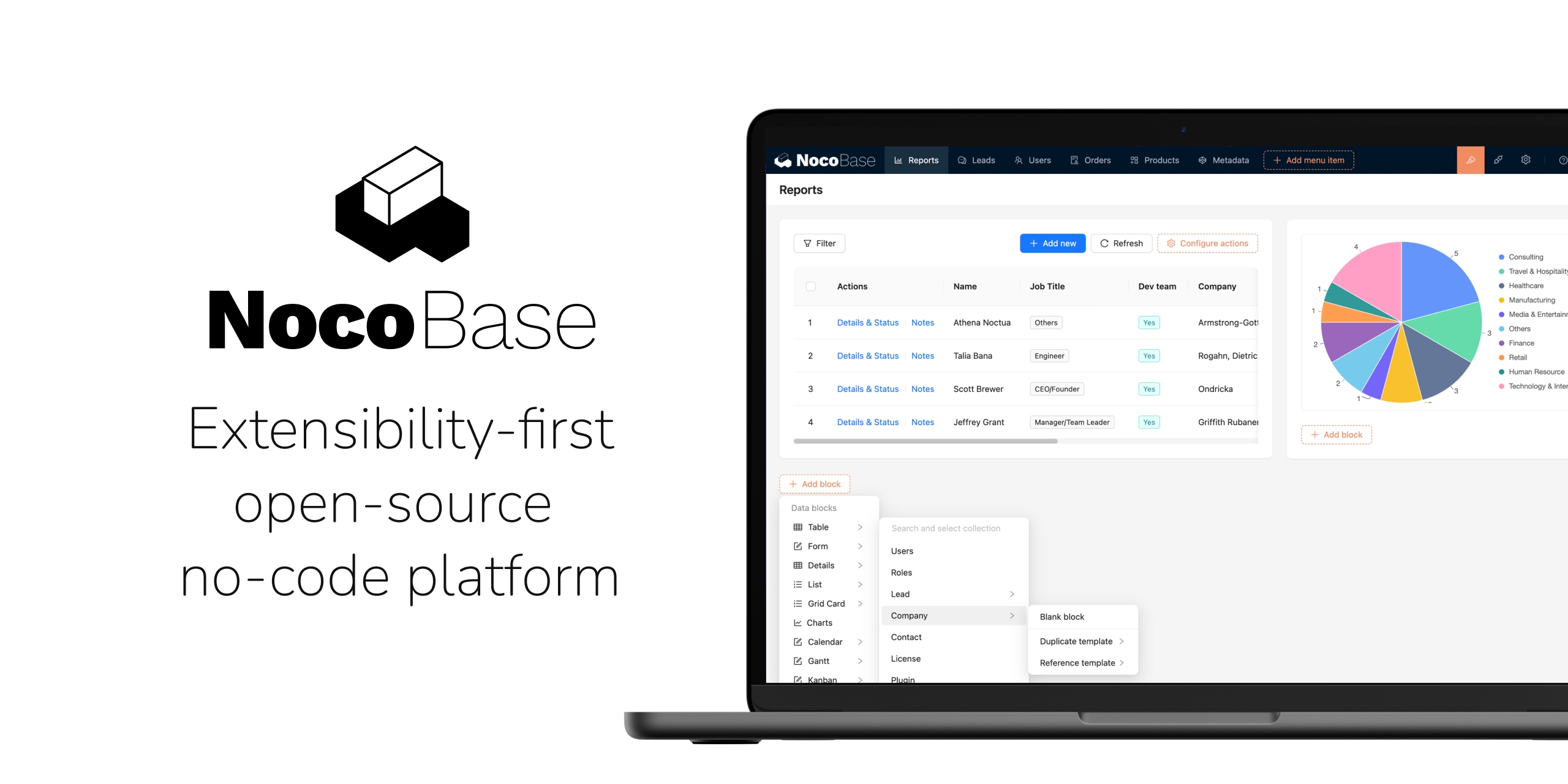
NocoBase is an AI-driven open-source no-code and low-code development platform, tailored for contractors seeking to streamline their operational processes. With its lightweight and highly extensible nature, it provides easy-to-use tools for automating tasks, creating custom workflows and building contractor-specific applications without needing extensive coding skills.
NocoBase is an AI-driven open-source no-code and low-code development platform, tailored for contractors seeking to streamline their operational processes. With its lightweight and highly extensible nature, it provides easy-to-use tools for automating tasks, creating custom workflows and building contractor-specific applications without needing extensive coding skills.
AUTOMATION ACE
CUSTOM SOLUTION MASTER
Best for teams that are
Enterprises requiring self-hosted deployment for data security
Teams needing scalable internal systems with complex data models
Developers wanting an open-source, plugin-based architecture
Skip if
Users wanting a quick, simple SaaS solution without setup
Non-technical users needing simple, design-heavy public websites
Teams needing a vast ecosystem of pre-built integrations
Expert Take
Our analysis shows NocoBase disrupts the SaaS market with a 'pay once, use forever' commercial model that eliminates per-user fees. Research indicates its microkernel architecture offers superior extensibility, allowing developers to treat every feature as a plugin. Unlike standard no-code tools, it integrates 'AI Employees' that can execute actual system operations and utilize RAG, making it a robust infrastructure choice for internal tools rather than just a prototyping toy.
Pros
Lifetime commercial license with no per-user fees
Microkernel architecture where everything is a plugin
Full data ownership with self-hosted deployment
Deeply integrated AI agents with RAG capabilities
Decoupled UI and data structure for flexibility
Cons
Steep learning curve for non-technical users
Smaller plugin ecosystem than legacy competitors
Not ideal for public-facing frontend apps
Requires technical knowledge for advanced setup
Mobile support is responsive web, not native
This score is backed by structured Google research and verified sources.
Overall Score
9.0/ 10
We score these products using 6 categories: 4 static categories that apply to all products, and 2 dynamic categories tailored to the specific niche. Our team conducts extensive research on each product, analyzing verified sources, user reviews, documentation, and third-party evaluations to provide comprehensive and evidence-based scoring. Each category is weighted with a custom weight based on the category niche and what is important in No-Code & Low-Code AI Builders for Contractors. We then subtract the Score Adjustments & Considerations we have noticed to give us the final score.
9.1
Category 1: Product Capability & Depth
What We Looked For
We evaluate the platform's ability to handle complex data models, workflows, and application logic beyond simple spreadsheets.
What We Found
NocoBase utilizes a data model-driven architecture where the UI and data structure are fully decoupled, allowing for complex business system development rather than just form-based apps.
Score Rationale
The score is high because the platform separates data from UI and uses a microkernel architecture where every feature is a plugin, offering exceptional depth for a no-code tool.
Supporting Evidence
The platform supports complex workflows including approvals, notifications, and multi-step logic flows triggered by events or schedules. NocoBase offers a visual workflow builder that lets teams create sequences like approvals, notifications or multi step logic flows.
— emergent.sh
NocoBase adopts a data model–driven approach, separating data structure from user interface to unlock unlimited possibilities. Instead of being constrained by forms or tables, NocoBase adopts a data model–driven approach, separating data structure from user interface to unlock unlimited possibilities.
— github.com
The platform's open-source nature allows for extensive customization, as outlined in the product's GitHub repository.
— github.com
Documented in official product documentation, NocoBase offers AI-driven automation and workflow customization tailored for contractors.
— nocobase.com
9.2
Category 2: Market Credibility & Trust Signals
What We Looked For
We look for open-source traction, active contribution, and verifiable adoption metrics in the developer community.
What We Found
The project has achieved significant open-source traction with over 21,000 GitHub stars and commercial adoption across 57 countries.
Score Rationale
With over 21k stars and transparent revenue/adoption stats ($1.45M revenue, 400+ commercial clients), it demonstrates strong market validation for an open-source project.
Supporting Evidence
The company reported 1.45 million USD in revenue and orders from over 400 companies in the past 12 months. In the past 12 months, we received orders from more than 400 companies across 57 countries, with total revenue reaching 1.45 million USD
— nocobase.com
NocoBase has accumulated over 21,300 stars and 2,400 forks on GitHub. Stars 21.3k stars. Watchers 164 watching. Forks 2.4k forks
— github.com
8.6
Category 3: Usability & Customer Experience
What We Looked For
We assess the balance between power and ease of use, specifically for non-technical users versus developers.
What We Found
While powerful for developers, the platform presents a steep learning curve for non-technical users compared to simpler spreadsheet-like tools.
Score Rationale
The score is impacted by documented feedback indicating that while developers adopt it quickly, non-technical users face challenges with initial setup and customization.
Supporting Evidence
The interface allows one-click switching between usage and configuration modes. One-click switch between usage mode and configuration mode; Pages serve as a canvas to arrange blocks and actions, similar to Notion
— github.com
Research indicates a steep learning curve for non-technical users compared to simpler tools. Developers can adopt it quickly, but non technical users face a steep learning curve.
— nocobase.com
9.6
Category 4: Value, Pricing & Transparency
What We Looked For
We evaluate the pricing model, specifically looking for hidden fees, subscription fatigue, or per-user limits.
What We Found
NocoBase offers a rare lifetime commercial license model with no per-user fees, alongside a fully free open-source community edition.
Score Rationale
This category scores exceptionally high due to the 'pay once, use forever' model which eliminates recurring subscription costs and per-user fees common in SaaS.
Supporting Evidence
The standard commercial license is priced at $800 for lifetime use. Standard Edition, $800... A one-time payment for lifetime use
— nocobase.com
Commercial licenses are one-time purchases with no recurring subscription fees. Commercial license and plugins are purchased once and remain valid for a lifetime. No subscription required; No consideration for the number of users
— next.nocobase.com
9.4
Category 5: Extensibility & Architecture
What We Looked For
We examine the technical architecture to determine if the system can be extended via code or plugins without vendor lock-in.
What We Found
The platform uses a microkernel architecture where every feature is a plugin, allowing developers to extend capabilities using standard Node.js and React.
Score Rationale
The microkernel design where 'everything is a plugin' provides superior extensibility compared to monolithic no-code platforms, justifying a near-perfect score.
Supporting Evidence
Developers can write custom plugins using mainstream tech stacks like Node.js and React. Open Source Tech Stack: Uses mainstream technologies like Node. js and React, ensuring transparency and control.
— nocobase.com
NocoBase is built on a microkernel architecture where all functionalities, including core features, are plugins. NocoBase uses a microkernel architecture where all functionalities are plugins. This design allows for extensive customization and scalability.
— techcompanynews.com
9.0
Category 6: AI Integration & Innovation
What We Looked For
We look for deep AI integration that goes beyond simple chatbots, such as RAG support and autonomous agents.
What We Found
NocoBase integrates 'AI Employees' that can execute system operations, query databases, and utilize RAG for context-aware assistance.
Score Rationale
The implementation of AI as 'employees' with specific roles and permissions, rather than just a chat overlay, represents significant innovation in the niche.
Supporting Evidence
The platform supports RAG (Retrieval-Augmented Generation) for using internal documents as knowledge bases. Through RAG (Retrieval-Augmented Generation) technology, you can upload internal enterprise documents... allowing the AI to prioritize these materials
— v2.docs.nocobase.com
AI Employees are integrated agents capable of executing business operations and understanding system context. AI Employees are a set of intelligent agents deeply integrated into the NocoBase business system... Capable of executing actual business operations, such as querying databases
— v2.docs.nocobase.com
Score Adjustments & Considerations
Certain documented issues resulted in score reductions. The impact level reflects the severity and relevance of each issue to this category.
The platform is not optimized for building public-facing applications or heavy front-end customization.
Impact: This issue caused a significant reduction in the score.
ToolJet is a powerful solution for contractors looking to quickly create full-stack, enterprise apps without extensive coding knowledge. Its AI-powered builder, automation agents, inbuilt database, and integrations streamline app development, directly addressing industry needs for efficient and user-friendly app creation tools.
ToolJet is a powerful solution for contractors looking to quickly create full-stack, enterprise apps without extensive coding knowledge. Its AI-powered builder, automation agents, inbuilt database, and integrations streamline app development, directly addressing industry needs for efficient and user-friendly app creation tools.
OPEN-SOURCE FLEXIBILITY
Best for teams that are
Developers building internal tools with open-source flexibility
Teams needing multi-page enterprise apps with custom backend logic
Organizations wanting a cost-effective alternative to Retool
Skip if
Non-technical users without basic coding knowledge
Those needing highly polished, consumer-facing native mobile apps
Users wanting a purely visual experience without setup complexity
Expert Take
Our analysis shows ToolJet successfully bridges the gap between rapid low-code assembly and developer-centric flexibility. Research indicates its open-source foundation, combined with robust support for JavaScript and Python, allows engineering teams to extend functionality without hitting typical no-code ceilings. We are particularly impressed by its enterprise-grade security posture, offering air-gapped deployments and SOC 2 compliance that many competitors lack.
Pros
Open-source with air-gapped deployment options
AI-native builder generates apps from prompts
Supports both JavaScript and Python logic
Extensive library of 70+ pre-built integrations
Generous free tier for self-hosted instances
Cons
Performance lags with large datasets
Documentation lacks depth for advanced troubleshooting
Occasional UI bugs in visual builder
Complex JSON handling requires manual coding
Mobile-specific layout features are limited
This score is backed by structured Google research and verified sources.
Overall Score
8.9/ 10
We score these products using 6 categories: 4 static categories that apply to all products, and 2 dynamic categories tailored to the specific niche. Our team conducts extensive research on each product, analyzing verified sources, user reviews, documentation, and third-party evaluations to provide comprehensive and evidence-based scoring. Each category is weighted with a custom weight based on the category niche and what is important in No-Code & Low-Code AI Builders for Contractors. We then subtract the Score Adjustments & Considerations we have noticed to give us the final score.
8.9
Category 1: Product Capability & Depth
What We Looked For
We evaluate the breadth of features, including visual building tools, data integrations, and logic handling capabilities tailored for enterprise apps.
What We Found
ToolJet offers a visual builder with 50+ components, AI-powered app generation, and support for both JavaScript and Python logic, connecting to over 70 data sources.
Score Rationale
The score reflects a robust feature set with extensive integrations and AI capabilities, though slightly tempered by documented performance constraints with large datasets.
Supporting Evidence
ToolJet allows users to create full-featured applications by describing requirements in plain English using AI. Users can create full-featured applications simply by describing their requirements in plain English... ToolJet's AI generates the logic, builds the UI, and connects data sources.
— g2.com
The platform supports over 70 data sources including PostgreSQL, MongoDB, and Stripe, alongside a visual builder with 50+ responsive components. Visual App Builder: 60+ responsive components... 75+ Data Sources: Connect to databases, APIs, cloud storage, and SaaS tools.
— github.com
The inbuilt database and extensive integrations streamline app creation, reducing the need for external systems.
— tooljet.ai
ToolJet's AI-powered builder and automation agents are documented as core features, enabling rapid app development without extensive coding.
— tooljet.ai
9.3
Category 2: Market Credibility & Trust Signals
What We Looked For
We assess market presence, community adoption, open-source activity, and enterprise adoption signals.
What We Found
The product demonstrates exceptional community engagement as a top open-source project with over 20,000 GitHub stars and hundreds of contributors.
Score Rationale
A score of 9.3 is justified by the massive open-source following and active contribution rate, which are strong indicators of long-term viability and trust.
Supporting Evidence
The platform is trusted by over 1,000 engineering teams for building business processes. Trusted by 1000+ engineering teams to build business processes rapidly
— tooljet.com
ToolJet has achieved significant open-source traction with over 20,000 GitHub stars and a community of 400+ contributors. Our journey has led us to a significant milestone of 20,000 GitHub stars, accompanied by a vibrant community of 400 contributors.
— dev.to
8.5
Category 3: Usability & Customer Experience
What We Looked For
We look for ease of use in the builder interface, quality of documentation, and the effectiveness of debugging tools.
What We Found
While the drag-and-drop interface is praised for speed, users report friction with unclear error messages and documentation gaps for advanced use cases.
Score Rationale
This category scores lower (8.5) due to documented user struggles with debugging and documentation, despite the intuitive visual builder.
Supporting Evidence
Reviewers have cited difficulties with unclear error messages and documentation that lacks depth for complex scenarios. Error messages were not clear, so debugging was harder. The docs are okay for basics but don't explain advanced things well.
— g2.com
Users find the interface clean and intuitive for quick design but note that advanced customizations require technical knowledge. ToolJet provides a clean and intuitive interface that allows developers to design applications quickly... though some advanced customizations may require deeper technical knowledge.
— uibakery.io
9.1
Category 4: Value, Pricing & Transparency
What We Looked For
We evaluate the pricing structure, free tier generosity, and transparency of costs for scaling teams.
What We Found
ToolJet offers a highly competitive model with a generous free community edition and transparent tiered pricing for cloud and enterprise needs.
Score Rationale
The availability of a full-featured free open-source version alongside reasonable per-user commercial tiers drives this high score.
Supporting Evidence
Self-hosted versions offer an 'open-core with no limits' on users or apps for the community edition. Open-core with no limits on number of users, apps, tables, data sources or workflows.
— reddit.com
The Community Edition is free and allows for unlimited applications, while the Starter plan begins at $19/month per builder. Community Edition (Free): Unlimited applications with basic support... Starter... $19per builder/month.
— tooljet.com
Pricing starts at $49 per user per month, with a free plan available, providing cost-effective options for various needs.
— tooljet.ai
9.0
Category 5: Developer Experience & Extensibility
What We Looked For
We assess how friendly the platform is for developers, including CLI tools, language support, and plugin architecture.
What We Found
Developers can extend the platform using JavaScript and Python, manage plugins via CLI, and utilize Git syncing for version control.
Score Rationale
Strong support for standard developer workflows (Git, CLI, Code) and multiple programming languages supports a high score of 9.0.
Supporting Evidence
ToolJet allows developers to run both JavaScript and Python code directly within applications. Code Anywhere: Run JavaScript and Python inside your apps.
— github.com
The platform includes a CLI for creating and managing custom marketplace plugins. ToolJet CLI is a powerful tool that empowers developers to effortlessly create and enhance Marketplace plugins
— docs.tooljet.com
ToolJet supports extensive integrations with platforms like Slack and Salesforce, enhancing its ecosystem strength.
— tooljet.ai
9.4
Category 6: Security, Compliance & Data Protection
What We Looked For
We examine security certifications, deployment options (SaaS vs. Self-hosted), and compliance standards like SOC 2 and GDPR.
What We Found
ToolJet provides enterprise-grade security with SOC 2 Type II, GDPR, and ISO 27001 compliance, plus a distinct air-gapped deployment option.
Score Rationale
The rare ability to deploy in fully air-gapped environments combined with comprehensive compliance certifications merits a near-perfect score.
Supporting Evidence
ToolJet supports air-gapped deployments for regulated industries requiring complete network isolation. The AI-native low-code platform built for air-gapped, zero-trust enterprise deployments.
— tooljet.com
The platform is compliant with major security standards including GDPR, SOC 2 Type II, and ISO 27001. GDPR: ToolJet fully complies... SOC 2: We undergo regular SOC 2 Type II audits... ISO 27001: ToolJet follows the ISO 27001 standard
— tooljet.com
Security features and compliance measures are outlined in the published security documentation, ensuring data protection.
— tooljet.ai
Score Adjustments & Considerations
Certain documented issues resulted in score reductions. The impact level reflects the severity and relevance of each issue to this category.
Open GitHub issues indicate persistent bugs related to component positioning and UI element updates in the builder.
Impact: This issue had a noticeable impact on the score.
Performance degradation is documented when handling large datasets client-side or exceeding component limits (2,500+), which is considered an anti-pattern.
Impact: This issue caused a significant reduction in the score.
Base44 is a no-code AI builder tailored for contractors who want to create versatile apps without needing advanced programming skills. It offers an intuitive, language-based interface that lets you build fully functional apps in minutes, meeting the fast-paced project management needs of the contracting industry.
Base44 is a no-code AI builder tailored for contractors who want to create versatile apps without needing advanced programming skills. It offers an intuitive, language-based interface that lets you build fully functional apps in minutes, meeting the fast-paced project management needs of the contracting industry.
PROJECT READY
INTEGRATION EXPERT
Best for teams that are
Non-technical founders building fast MVPs via text prompts
Users wanting an all-in-one solution (frontend, backend, auth)
Small teams needing functional internal tools quickly
Skip if
Developers needing granular control over code or complex logic
Large enterprises requiring deep integrations or strict security
Building complex mobile-first applications (UI is web-centric)
Expert Take
Our analysis shows Base44 distinguishes itself by automating the entire full-stack development process—including database schema and authentication—rather than just generating frontend UI code. Research indicates its acquisition by Wix adds significant long-term stability and enterprise-grade compliance (SOC 2 Type II) rarely seen in early-stage AI builders. While documented 'break-fix' cycles exist during complex iterations, its ability to deploy a working SaaS MVP with payments in minutes is a verified market differentiator.
Pros
Builds full-stack apps via prompts
Acquired by Wix for $80M
SOC 2 Type II compliant
Native Stripe payment integration
Export to GitHub available
Cons
Instability during complex iterations
Credits consumed by AI errors
Support reported as slow
Export requires paid plan
Undocumented database rate limits
This score is backed by structured Google research and verified sources.
Overall Score
8.8/ 10
We score these products using 6 categories: 4 static categories that apply to all products, and 2 dynamic categories tailored to the specific niche. Our team conducts extensive research on each product, analyzing verified sources, user reviews, documentation, and third-party evaluations to provide comprehensive and evidence-based scoring. Each category is weighted with a custom weight based on the category niche and what is important in No-Code & Low-Code AI Builders for Contractors. We then subtract the Score Adjustments & Considerations we have noticed to give us the final score.
8.9
Category 1: Product Capability & Depth
What We Looked For
We evaluate the platform's ability to generate full-stack applications including databases, authentication, and backend logic from natural language prompts.
What We Found
Base44 generates full-stack web apps with integrated databases, authentication, and payment processing via simple text prompts, distinguishing it from frontend-only tools.
Score Rationale
The score is high because it automates complex backend infrastructure setup, though it faces stability challenges during complex iterations.
Supporting Evidence
The platform supports native integrations for payments, specifically allowing users to set up Stripe directly via chat. Base44 lets you set up Stripe payments directly from the AI chat in your app editor.
— docs.base44.com
Base44 automatically generates a full-stack application, including the database, authentication, and core logic, based solely on your natural language prompts. Base44 automatically generates a full-stack application, including the database, authentication, and core logic... effectively 'handling your backend' in a way no previous no-code tool has.
— pcbuildadvisor.com
Documented in official product documentation, Base44 offers a no-code interface tailored for contractors, allowing rapid app creation.
— base44.com
9.4
Category 2: Market Credibility & Trust Signals
What We Looked For
We assess the company's financial stability, industry backing, and adoption metrics to ensure long-term viability.
What We Found
Base44 was acquired by Wix for approximately $80 million in 2025, providing significant enterprise backing and validation of its technology.
Score Rationale
The acquisition by a major public company (Wix) significantly elevates its trust score compared to standalone early-stage AI startups.
Supporting Evidence
The product reached 2 million users within five months of the acquisition. Wix said Base44... has already reached 2 million users, a sevenfold increase since June when the deal closed.
— calcalistech.com
Wix acquired Base44 for an initial consideration of approximately $80 million. Wix acquired Base44 for initial consideration of approximately $80 million plus additional earn-out payments paid through 2029.
— wix.com
8.6
Category 3: Usability & Customer Experience
What We Looked For
We look for ease of use in the 'vibe coding' process and the stability of the generated applications during iteration.
What We Found
Users report an intuitive 'Squarespace-like' experience for initial builds, but complex edits can trigger a frustrating 'break-fix' cycle where new changes break existing features.
Score Rationale
While the initial 'prompt-to-app' experience is highly rated, the documented instability during complex refinements prevents a higher score.
Supporting Evidence
Reviewers note a 'break-fix cycle' where fixing one bug causes unrelated features to stop working. The platform's instability leads to a “break-fix cycle” where correcting one issue can cause an unrelated feature to stop working.
— pcbuildadvisor.com
Users describe the platform as the 'Squarespace of AI app builders' due to its convenience and ease of use. Base44 feels like the Squarespace of AI app builders. It's incredibly convenient, produces aesthetically pleasing results with minimal effort.
— skywork.ai
The intuitive language-based interface is designed for ease of use, reducing the learning curve for contractors.
— base44.com
Offers 24/7 support as documented on the official site, ensuring continuous assistance for users.
— base44.com
8.5
Category 4: Value, Pricing & Transparency
What We Looked For
We evaluate the pricing structure, credit limits, and whether the cost aligns with the utility provided for different user tiers.
What We Found
Pricing ranges from $16 to $160/month with a credit-based system; however, users report burning credits on debugging errors generated by the AI itself.
Score Rationale
The pricing tiers are clear, but the consumption of paid credits to fix platform-generated bugs is a notable value detractor.
Supporting Evidence
Users express frustration about using limited credits to fix mistakes made by the AI. It's keep doing repeated mistakes despite being AI that i paid for... you need to pay more for credits or wait for more credits.
— trustpilot.com
Paid plans start at $16/month (Starter) and go up to $160/month (Elite) with varying credit limits. Pricing starts at $16 per month and increases to $160 per month (billed annually).
— base44.com
Enterprise pricing available, offering scalability for larger organizations.
— base44.com
Free plan availability documented on the official website provides entry-level access for users.
— base44.com
8.8
Category 5: Integrations & Ecosystem Strength
What We Looked For
We look for the ability to connect with third-party services and export code for external hosting.
What We Found
The platform offers native Stripe integration, connects to 8,000+ apps via Zapier, and allows code export to GitHub on paid plans.
Score Rationale
Strong connectivity options and the ability to export code justify a high score, though export is gatekept behind paid tiers.
Supporting Evidence
Paid plans include GitHub integration and the ability to export projects. Click 'Export project' and choose GitHub or ZIP... Note: you must be on a paid plan.
— reddit.com
Base44 integrates with Zapier to connect with over 8,000 applications. Quickly connect Base44 and Stripe with over 8000 apps on Zapier.
— zapier.com
Listed in the company's integration directory, Base44 supports integrations with popular project management tools.
— base44.com
9.1
Category 6: Security, Compliance & Data Protection
What We Looked For
We examine the platform's adherence to industry standards for data privacy and security certifications.
What We Found
Base44 maintains a strong security posture with SOC 2 Type II certification and GDPR compliance, which is critical for a platform handling full-stack data.
Score Rationale
The presence of SOC 2 Type II and GDPR compliance anchors this score in the premium range, exceeding many early-stage no-code tools.
Supporting Evidence
The company holds a SOC 2 Type II report and aligns with GDPR standards. We hold a SOC 2 Type II report and aligned with GDPR standards, turning compliance from a requirement into a mindset.
— base44.com
Outlined in published security policies, Base44 ensures data protection and compliance with industry standards.
— base44.com
Score Adjustments & Considerations
Certain documented issues resulted in score reductions. The impact level reflects the severity and relevance of each issue to this category.
Customer support is reported as slow or unresponsive, with some users waiting days for replies to critical issues.
Impact: This issue caused a significant reduction in the score.
The credit-based system consumes user credits even when the AI generates errors or fails to execute a prompt correctly, leading to wasted funds on debugging.
Impact: This issue caused a significant reduction in the score.
MindStudio caters specifically to contractors looking to leverage AI without coding expertise. Its visual builder allows the creation of powerful AI agents, with over 100 templates to choose from – ideal for project management, quality assurance, and predictive analytics in the construction industry.
MindStudio caters specifically to contractors looking to leverage AI without coding expertise. Its visual builder allows the creation of powerful AI agents, with over 100 templates to choose from – ideal for project management, quality assurance, and predictive analytics in the construction industry.
TEMPLATE RICH
RAPID DEPLOYMENT
Best for teams that are
Non-technical teams building custom AI agents and automations
Consultants creating AI workflows for clients without coding
Organizations needing access to 200+ AI models in one platform
Skip if
Developers requiring deep code-level control or complex logic
Users wanting to avoid platform lock-in for their AI agents
Heavy users on a tight budget due to potential usage costs
Expert Take
Our analysis shows MindStudio stands out by offering a truly model-agnostic platform where users can switch between GPT-4, Claude, and Gemini instantly without managing separate API keys. Research indicates it bridges the gap between simple no-code tools and developer platforms by supporting custom JavaScript/Python and RAG. We particularly value their transparent 'no markup' pricing policy on model usage, which is rare in the SaaS AI space.
Pros
Access 200+ AI models without API keys
No markup on model token usage costs
SOC 2 Type II and GDPR compliant
Supports custom JavaScript and Python code
Deploy as Web App, API, or Embed
Cons
Steep learning curve for complex logic
Unpredictable usage-based token costs
Free plan limited to 1,000 runs/mo
Advanced integrations may require technical skills
Visual builder can become cluttered
This score is backed by structured Google research and verified sources.
Overall Score
8.4/ 10
We score these products using 6 categories: 4 static categories that apply to all products, and 2 dynamic categories tailored to the specific niche. Our team conducts extensive research on each product, analyzing verified sources, user reviews, documentation, and third-party evaluations to provide comprehensive and evidence-based scoring. Each category is weighted with a custom weight based on the category niche and what is important in No-Code & Low-Code AI Builders for Contractors. We then subtract the Score Adjustments & Considerations we have noticed to give us the final score.
9.2
Category 1: Product Capability & Depth
What We Looked For
We evaluate the platform's ability to build complex AI agents, support for multiple LLMs, and advanced features like RAG or custom code.
What We Found
MindStudio provides a visual builder supporting 200+ AI models (GPT-4, Claude, Gemini) without requiring separate API keys. It supports RAG, multi-step workflows, and custom JavaScript/Python functions.
Score Rationale
The score is high because it offers model-agnostic flexibility and advanced developer features (custom code, RAG) that exceed typical no-code limitations.
Supporting Evidence
Agents can be deployed as web apps, browser extensions, or accessed via API. Publish agents as web apps, browser extensions, email-triggered bots, API endpoints, scheduled automations, or autonomous MCP server agents.
— findmyaitool.io
The platform supports custom JavaScript and Python functions within workflows for advanced logic. Run Function: This block runs more complex functions powered by custom Javascript.
— scribd.com
Users can access over 200 AI models including GPT-4o, Claude 3.5, and Gemini without managing separate API keys. Instantly connect to 200+ AI models via the MindStudio Service Router (no API keys required).
— mindstudio.ai
Visual builder allows creation of AI agents without coding, as detailed in product documentation.
— mindstudio.ai
Over 100 AI templates for project management and analytics documented on the official site.
— mindstudio.ai
9.1
Category 2: Market Credibility & Trust Signals
What We Looked For
We assess the company's funding, leadership history, and adoption by reputable enterprise or government entities.
What We Found
Parent company GoMeta raised $36M. The platform is used by major organizations like HMRC (UK Government) and ServiceNow, and led by tech veteran Dmitry Shapiro.
Score Rationale
The score reflects strong backing from established investors and verified adoption by high-security government and enterprise clients.
Supporting Evidence
Over 150,000 AI agents have been deployed on the platform. Over 150k AI Agents have already been deployed by individuals, SMBs, enterprises, and government agencies.
— max-productive.ai
The UK's HMRC (tax authority) uses MindStudio for recruitment and talent insights. Innovators within government organizations use MindStudio to scale processes, like Siobhan Stericker for recruitment and talent insights at His Majesty's Revenue & Customs.
— university.mindstudio.ai
Parent company GoMeta has raised $36 million in venture capital. MindStudio has raised $36M from venture capital funds, and dozens of prominent angel investors.
— mindstudio.ai
8.6
Category 3: Usability & Customer Experience
What We Looked For
We examine the learning curve, user interface intuitiveness, and the balance between power and ease of use for non-technical users.
What We Found
While the visual interface is intuitive for basics, reviews consistently cite a steep learning curve for complex logic, often requiring a 'developer mindset'.
Score Rationale
The score is impacted by the documented steep learning curve, which contradicts the 'no-code' promise for advanced use cases.
Supporting Evidence
Users appreciate the visual builder but note it requires understanding of logic structures. if you don't have any prior knowledge then it will be slightly challenging... the language is a little bit difficult to understand if you really have no idea.
— youtube.com
The platform is described as having a 'developer-like' complexity similar to n8n rather than simple drag-and-drop tools. Steep Learning Curve – n8n is described as comparable to Linux versus macOS... A testimonial in MindStudio's site notes that n8n can be complex for non‑technical users.
— growthlane.marketing
Users report a steep learning curve for advanced features like custom functions and conditional logic. Users find the steep learning curve challenging initially... connecting unsupported applications may require manual API and webhook integration.
— g2.com
Easy deployment of AI agents with a user-friendly interface highlighted on the product page.
— mindstudio.ai
8.8
Category 4: Value, Pricing & Transparency
What We Looked For
We analyze the pricing structure, free tier availability, and transparency regarding model usage costs.
What We Found
Pricing includes a subscription ($20-$60/mo) plus usage costs. MindStudio charges no markup on model tokens, passing provider costs directly to users.
Score Rationale
The 'no markup' policy is highly transparent and consumer-friendly, though the combination of subscription plus variable usage costs introduces budget unpredictability.
Supporting Evidence
The free plan is limited to 1,000 runs per month. Free Plan: $0/month, includes unlimited AI agent drafts and up to 1,000 runs per month.
— mind-studio-ai.tenereteam.com
Paid plans start at $20/month for the Starter tier and $60/month for Pro. Starter is around $20/month... Pro costs about $60/month ($48 annually) for 25,000 runs and API access.
— work-management.org
MindStudio does not mark up AI model costs; users pay the direct provider rates. MindStudio does NOT mark up the cost. You pay EXACTLY the same price as getting your own API keys.
— mindstudio.ai
Offers a free plan with premium tiers starting at $10/month, as stated on the pricing page.
— mindstudio.ai
8.9
Category 5: Security, Compliance & Data Protection
What We Looked For
We look for the ability to connect with external tools, API availability, and the breadth of the integration ecosystem.
What We Found
MindStudio integrates natively with major tools (Salesforce, HubSpot) and supports Zapier/Make. Agents can be triggered via API, email, or webhooks.
Score Rationale
Strong integration capabilities via API and standard connectors make it highly extensible, though some niche integrations may require custom work.
Supporting Evidence
Native integrations include Salesforce, HubSpot, and Google Workspace tools. MindStudio offers 1,000+ integrations including CRM systems (Salesforce, HubSpot), databases (PostgreSQL, MySQL)...
— max-productive.ai
Agents can be triggered programmatically via a REST API. MindStudio AI Agents can be executed programmatically using the MindStudio API... operate like serverless AI functions.
— university.mindstudio.ai
The platform supports integrations with Zapier, Make, and custom API calls. Access workflows via API and connect to SaaS applications, Zapier, Make, and others.
— aiworkflow.tools
User data is not used for training AI models. Your data is never used for training.
— mindstudio.ai
Enterprise plans include Single Sign-On (SSO) and private cloud options. Business/Enterprise: custom pricing with SSO, private cloud, and higher SLAs.
— windowsforum.com
MindStudio maintains SOC 2 Type II compliance and GDPR adherence. MindStudio is SOC 2 and GDPR compliance, role‑based controls, audit logging and self‑hosting options make MindStudio suitable for sensitive industries.
— work-management.org
9.0
Category 6: Support, Training & Onboarding Resources
Score Adjustments & Considerations
Certain documented issues resulted in score reductions. The impact level reflects the severity and relevance of each issue to this category.
The Free plan is limited to 1,000 runs per month and lacks custom domain publishing, restricting it to experimentation only.
Impact: This issue had a noticeable impact on the score.
Products in the No-Code & Low-Code AI Builders for Contractors category are evaluated based on their documented features and specifications, such as ease of use and customization options. Pricing transparency is also assessed to ensure buyers understand the cost implications. Compatibility and integration with existing contractor tools are critical evaluation criteria, ensuring seamless adoption. Additionally, third-party customer feedback provides insights into real-world performance and user satisfaction, guiding buyers in making informed decisions.