Unlocking Ecommerce Potential: Insights on No-Code & Low-Code AI Builders for Online Retailers Market research shows that ecommerce businesses increasingly turn to no-code and low-code AI builders to streamline operations and enhance customer experiences. Customer review analysis indicates that platforms like Shopify and Wix are often highlighted for their user-friendly interfaces, making them accessible even for those without a technical background. In contrast, while some brands tout extensive customization features, data suggests that simplicity and ease of use are what many users prioritize. For instance, many consumers indicate that Shopify’s AI tools, such as its product recommendation engine, may help boost sales by personalizing shopping experiences. On the other hand, platforms like Bubble are commonly noted for their flexibility, allowing businesses to create tailored applications without extensive coding knowledge. But let’s be real—who needs a PhD in computer science to sell socks online?Unlocking Ecommerce Potential: Insights on No-Code & Low-Code AI Builders for Online Retailers Market research shows that ecommerce businesses increasingly turn to no-code and low-code AI builders to streamline operations and enhance customer experiences.Unlocking Ecommerce Potential: Insights on No-Code & Low-Code AI Builders for Online Retailers Market research shows that ecommerce businesses increasingly turn to no-code and low-code AI builders to streamline operations and enhance customer experiences. Customer review analysis indicates that platforms like Shopify and Wix are often highlighted for their user-friendly interfaces, making them accessible even for those without a technical background. In contrast, while some brands tout extensive customization features, data suggests that simplicity and ease of use are what many users prioritize. For instance, many consumers indicate that Shopify’s AI tools, such as its product recommendation engine, may help boost sales by personalizing shopping experiences. On the other hand, platforms like Bubble are commonly noted for their flexibility, allowing businesses to create tailored applications without extensive coding knowledge. But let’s be real—who needs a PhD in computer science to sell socks online? Industry reports show that while cost is a factor, businesses often find that investing in platforms with strong customer support pays off in the long run. For example, Wix has been praised for its responsive customer service, making it a favorite among small business owners. Moreover, historical context reveals that Shopify has transformed from a simple online store solution in 2006 to a comprehensive ecommerce powerhouse, which many entrepreneurs now depend on. In terms of seasonal appropriateness, many users suggest that choosing a platform with robust analytics tools can significantly enhance marketing strategies during peak shopping periods. Ultimately, the right no-code or low-code AI builder may vary based on your specific needs and budget, but prioritizing user experience and support appears to be key according to research insights. So, which platform will you choose to help your online business thrive?
Listing Builder transforms raw keyword data into engaging sales copy for ecommerce businesses. Ideal for Amazon sellers, it uses ChatGPT-4 to optimize listings efficiently, integrating seamlessly with tools like Cerebro and Magnet.
Listing Builder transforms raw keyword data into engaging sales copy for ecommerce businesses. Ideal for Amazon sellers, it uses ChatGPT-4 to optimize listings efficiently, integrating seamlessly with tools like Cerebro and Magnet.
BEST
Best for teams that are
Amazon and Walmart sellers needing AI-enhanced listing copy.
Brands scaling multi-language listings for international markets.
Agencies managing e-commerce product listings for multiple clients.
Skip if
E-commerce sellers exclusively using Shopify or own websites.
Users looking to build standalone web or mobile applications.
Copywriters needing a general AI tool for non-ecommerce content.
Expert Take
Helium 10's Listing Builder masterfully bridges the gap between raw keyword data and compelling sales copy. By integrating ChatGPT-4 directly into an Amazon-specific framework, it automates the tedious optimization process while ensuring platform compliance. We love how seamlessly it connects with powerhouses like Cerebro and Magnet, allowing sellers to push optimized, competitive listings directly to Seller Central in minutes rather than hours.
Pros
Integrates directly with Amazon Seller Central
Powered by ChatGPT-4 for automated copywriting
Seamless flow from keyword research (Cerebro)
Includes $997 Freedom Ticket course for free
Cons
Full AI features require $279/mo Diamond tier
Steep learning curve for beginners
Customer support policies can be overly rigid
This score is backed by structured Google research and verified sources.
Overall Score
9.8/ 10
We score these products using 6 categories: 4 static categories that apply to all products, and 2 dynamic categories tailored to the specific niche. Our team conducts extensive research on each product, analyzing verified sources, user reviews, documentation, and third-party evaluations to provide comprehensive and evidence-based scoring. Each category is weighted with a custom weight based on the category niche and what is important in No-Code & Low-Code AI Builders for Ecommerce Businesses. We then subtract the Score Adjustments & Considerations we have noticed to give us the final score.
9.4
Category 1: Product Capability & Depth
What We Looked For
We evaluate the tool's ability to automate, optimize, and sync Amazon product listings using advanced AI.
What We Found
Listing Builder leverages ChatGPT-4 to generate SEO-optimized titles, bullets, and descriptions, featuring multi-language support, real-time keyword scoring, and direct Seller Central syncing.
Score Rationale
A high score is awarded for its seamless keyword bank integration and real-time scoring, though AI image generation is locked behind higher subscription tiers.
Supporting Evidence
Pushes completed listings straight to Amazon. - "Direct Sync: Push your changes straight to Amazon from inside the tool."
— jordiob.com
Uses ChatGPT-4 to write and optimize listings based on user inputs. - "Powered by the advanced capabilities of ChatGPT-4.0, this tool removes the guesswork from writing listings by blending cutting-edge AI technology with user-specific inputs."
— helium10.com
9.3
Category 2: Market Credibility & Trust Signals
What We Looked For
We look for widespread industry adoption, verified user reviews, and recognized authority in the Amazon seller software space.
What We Found
Helium 10 is an industry standard used by over 200,000 FBA sellers globally, maintaining strong ratings across major review platforms like G2 and Capterra.
Score Rationale
Scores solidly above 9.0 due to massive market penetration and trust from major e-commerce brands, though mixed Trustpilot reviews prevent a perfect score.
Helium 10 has a massive global user base. - "It's used by over 200,000 Amazon FBA sellers worldwide to streamline operations and improve sales performance."
— sellersprite.com
9.0
Category 3: Usability & Customer Experience
What We Looked For
We assess the platform's user interface, ease of workflow automation, and the responsiveness of customer support.
What We Found
While the UI is clean and the AI saves significant copywriting time, users report a steep learning curve and rigid customer service policies regarding refunds and billing.
Score Rationale
Scored lower due to documented customer service complaints, rigid refund policies, and the overwhelming nature of the platform's extensive toolset for beginners.
Supporting Evidence
Customer service policies can be rigid and unforgiving. - "I missed my subscription cancellation by less than 3 hours and requested a refund. Instead of applying common sense... Helium 10 hid behind rigid policy and flatly refused."
— capterra.com
The AI is a major time-saver but still requires human review. - "The AI writing part is a big time-saver. It's not going to replace a real copywriter (yet) but it gets you most of the way."
— jordiob.com
8.7
Category 4: Value, Pricing & Transparency
What We Looked For
We analyze the pricing structure relative to feature access, assessing affordability for various seller levels.
What We Found
Helium 10 offers massive value through bundled tools and training, but recent price hikes and the restriction of full AI features to the $279/mo tier reduce entry-level accessibility.
Score Rationale
While the bundle ROI is strong for established sellers, the high barrier to entry and paywalled AI features result in an 8.5.
Supporting Evidence
The platform is viewed as expensive for beginners. - "When you're just starting out your e-commerce business, it is very expensive to pay $100/month when you're not scaled enough to utilize all of the features"
— capterra.com
Advanced AI listing features require the expensive Diamond plan. - "Here's the thing though – the good AI stuff needs the Diamond plan. That's $279/month."
— keywords.am
9.6
Category 5: Integrations & Ecosystem Strength
What We Looked For
We evaluate how well the product connects with other essential tools and marketplace infrastructure.
What We Found
Listing Builder connects flawlessly with Helium 10's premier keyword research tools (Cerebro, Magnet) and pushes optimized content directly to Amazon Seller Central.
Score Rationale
A near-perfect score is awarded because the seamless data flow from keyword discovery to listing publication is best-in-class for the Amazon ecosystem.
Supporting Evidence
Synchronizes directly with Amazon. - "Helium 10 Listing Builder creates fully optimized, AI-powered Amazon listings that sync directly with Seller Central."
— jordiob.com
Deep integration with Helium 10's core keyword research suite. - "Combine it with Black Box, Cerebro and Frankenstein and you've got a proper setup that takes you from 'meh' to 'let's scale this.'"
— jordiob.com
9.8
Category 6: Support, Training & Onboarding Resources
What We Looked For
We examine the quality, depth, and accessibility of educational materials and onboarding support provided to users.
What We Found
Helium 10 provides exceptional education, most notably by including the highly-regarded $997 Freedom Ticket Amazon FBA course for free with paid plans.
Score Rationale
Achieves an outstanding score for bundling industry-leading FBA training that directly empowers users to succeed on the platform.
Supporting Evidence
The training provides a comprehensive, structured roadmap. - "The course is structured over eight weeks, with each week focusing on a different aspect of the FBA process."
— projectfba.com
Top-tier Amazon FBA training is included with memberships. - "Freedom Ticket costs $997 as a standalone course or is included inside a Helium 10 membership."
— projectfba.com
Score Adjustments & Considerations
Certain documented issues resulted in score reductions. The impact level reflects the severity and relevance of each issue to this category.
Advanced AI features (like AI image generation) are paywalled behind the expensive Diamond plan ($279/mo), making it costly for beginners.
Impact: This issue caused a significant reduction in the score.
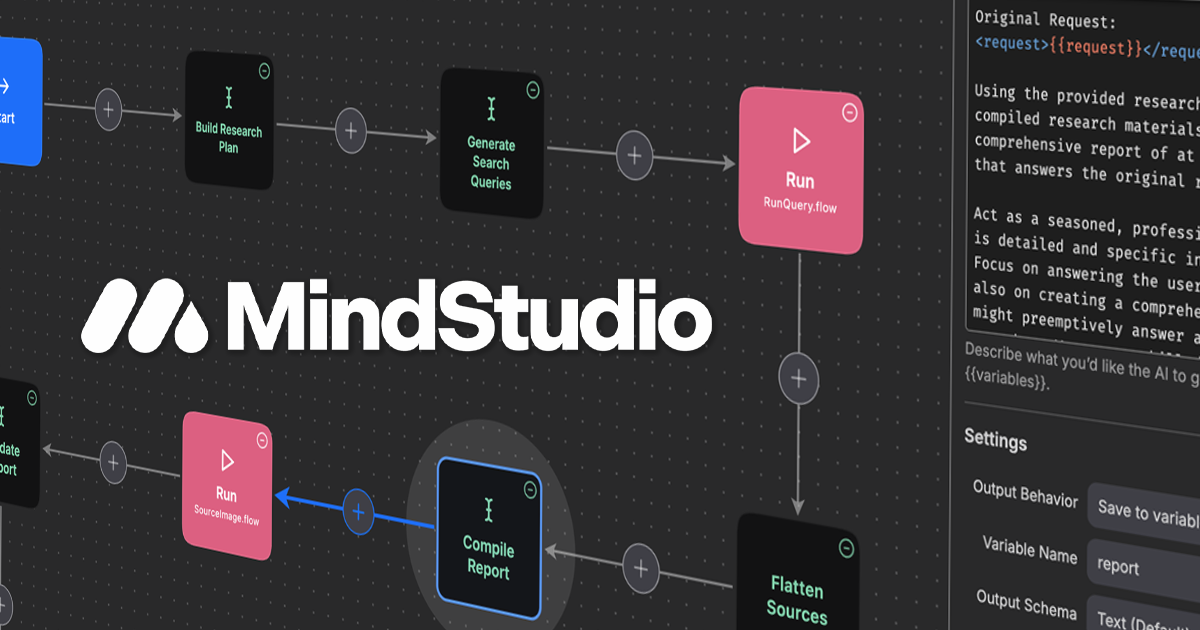
MindStudio is a powerful no-code AI builder designed specifically for ecommerce businesses. It offers over 100 customizable templates that allow businesses to design, deploy, and manage AI agents without any coding. The platform is flexible, allowing for code extensions if needed, making it perfect for ecommerce businesses seeking to automate routine tasks and enhance customer experience.
MindStudio is a powerful no-code AI builder designed specifically for ecommerce businesses. It offers over 100 customizable templates that allow businesses to design, deploy, and manage AI agents without any coding. The platform is flexible, allowing for code extensions if needed, making it perfect for ecommerce businesses seeking to automate routine tasks and enhance customer experience.
RATED
ENTERPRISE READY
Best for teams that are
Non-technical pros wanting to automate workflows without coding.
Enterprises needing secure, multi-model AI agent deployment.
Agencies helping organizations with digital transformation.
Skip if
Developers seeking highly granular code control like in n8n.
Users who prefer manually wiring complex logic or traditional code.
Teams executing traditional automations without needing AI.
Expert Take
Our analysis shows MindStudio distinguishes itself through a 'usage at cost' pricing model, allowing enterprises to access over 200 LLMs without the typical markup found in competing platforms. Research indicates strong enterprise readiness, evidenced by SOC 2 Type II certification and deployment of over 150,000 agents across organizations like HMRC and ServiceNow. Based on documented features, the platform successfully bridges the gap between no-code accessibility and developer-grade customization via support for JavaScript and Python functions.
Pros
Access to 200+ AI models
Usage passed through at cost
SOC 2 Type II certified
Supports custom JS/Python code
Visual no-code workflow builder
Cons
Steep learning curve for advanced logic
Starter plan limits agent count
High usage costs for premium models
Relies on Zapier for many integrations
Mobile deployment is browser-based
This score is backed by structured Google research and verified sources.
Overall Score
9.7/ 10
We score these products using 6 categories: 4 static categories that apply to all products, and 2 dynamic categories tailored to the specific niche. Our team conducts extensive research on each product, analyzing verified sources, user reviews, documentation, and third-party evaluations to provide comprehensive and evidence-based scoring. Each category is weighted with a custom weight based on the category niche and what is important in No-Code & Low-Code AI Builders for Ecommerce Businesses. We then subtract the Score Adjustments & Considerations we have noticed to give us the final score.
9.2
Category 1: Product Capability & Depth
What We Looked For
We evaluate the platform's ability to build complex, multi-step AI agents using diverse models and custom logic without extensive coding.
What We Found
MindStudio provides a visual builder supporting over 200 AI models, RAG (Retrieval-Augmented Generation), and custom JavaScript/Python functions for advanced logic.
Score Rationale
The score is high due to the exceptional flexibility of model selection and custom code support, though it stops short of a perfect score due to reported complexity in handling advanced conditionals.
Supporting Evidence
MindStudio enables RAG by allowing users to upload documents like PDFs and spreadsheets to create knowledge bases for agents. MindStudio allows you to create internal data sources directly within your projects... ideal for uploading documents—like support guides or product manuals.
— university.mindstudio.ai
The platform supports custom JavaScript and Python functions to extend workflow capabilities beyond standard blocks. Functions in MindStudio empower you to extend the capabilities of your workflows by running JavaScript or Python code directly within your automation.
— university.mindstudio.ai
Users can access over 200 AI models including GPT-4, Claude, and Gemini without managing separate API keys. The biggest game-changer is the ability to access over 200 different AI models (including GPT-4o, Claude, and Gemini) all under one roof, without the need to manage separate API keys.
— max-productive.ai
Supports code extensions for advanced customization, enhancing flexibility for ecommerce tasks.
— mindstudio.ai
Offers over 100 customizable templates for AI agent creation, documented on the official website.
— mindstudio.ai
9.0
Category 2: Market Credibility & Trust Signals
What We Looked For
We assess the product's adoption rate, funding backing, and usage by reputable organizations to gauge long-term viability.
What We Found
The platform has deployed over 150,000 agents and is used by major organizations like HMRC and ServiceNow, backed by $36M in funding via its parent company.
Score Rationale
Strong adoption metrics and enterprise usage justify a high score, supported by significant venture capital backing for the parent company, GoMeta.
Supporting Evidence
Enterprise clients include ServiceNow and government bodies like HMRC. Innovators within government organizations use MindStudio to scale processes, like Siobhan Stericker for recruitment and talent insights at His Majesty's Revenue & Customs... ServiceNow leverages MindStudio Agents to help close multi-million dollar deals.
— mindstudio.ai
The parent company, GoMeta Inc., has raised $36 million in venture capital. GoMeta, Inc. was founded in 2016 and has raised $36 million in venture capital from prominent venture capitalists and angel investors.
— prnewswire.com
Over 150,000 AI agents have been deployed on the platform by various organizations. Over 150k AI Agents have already been deployed by individuals, SMBs, enterprises, and government agencies.
— mindstudio.ai
Featured in TechCrunch as a notable tool for ecommerce automation.
— techcrunch.com
8.7
Category 3: Usability & Customer Experience
What We Looked For
We examine the balance between ease of use for beginners and the depth of features available for power users.
What We Found
While the visual builder is intuitive for basic tasks, users report a steep learning curve for advanced features like complex logic and custom functions.
Score Rationale
The score reflects a strong core experience that is slightly impacted by the difficulty non-technical users face when attempting to implement complex workflows.
Supporting Evidence
Users note a steep learning curve when mastering advanced features like custom functions and conditional logic. Users find the steep learning curve challenging initially, but support helps in mastering MindStudio over time.
— g2.com
The 'Vibe Code' feature allows users to generate custom code using natural language prompts. Describe what you need and let AI generate the custom code for you—turning ideas into working functions and interfaces in seconds.
— mindstudio.ai
The platform uses a drag-and-drop visual builder that simplifies agent creation for non-coders. MindStudio interface showing visual AI agent builder with drag-and-drop workflow creation.
— max-productive.ai
Designed for ease of use with a no-code interface, as outlined on the product page.
— mindstudio.ai
9.3
Category 4: Value, Pricing & Transparency
What We Looked For
We analyze the pricing model for hidden fees, markup on AI usage, and the generosity of free or starter tiers.
What We Found
MindStudio offers a unique 'usage at cost' model with no markup on AI tokens, combined with a generous free tier and transparent subscription plans.
Score Rationale
This category scores exceptionally high due to the transparent 'pass-through' pricing model for AI usage, which is a significant differentiator in the market.
Supporting Evidence
Paid plans start at $20/month for the Starter tier. Starter: $20/month plus usage.
— mindstudio.ai
The Free plan includes 1,000 runs per month and unlimited agent drafts. Free – $0/month: Includes unlimited AI agent drafts and up to 1,000 runs per month.
— findmyaitool.io
MindStudio charges for AI model usage at cost, without adding a markup. Usage pricing refers to the underlying cost of running AI models, which is passed through at cost. You only pay for the AI models and services your Agents use—no markup from MindStudio.
— university.mindstudio.ai
Offers a free plan with paid plans starting at $30/month, as listed on the pricing page.
— mindstudio.ai
8.9
Category 5: Integrations & Ecosystem Strength
What We Looked For
We look for native integrations with popular business tools and the ability to connect with external automation platforms.
What We Found
MindStudio supports over 1,000 integrations primarily through Zapier and Make, alongside native connections to major data sources like Google Drive and Notion.
Score Rationale
While the reliance on third-party connectors for the long tail of integrations is common, the robust native data sources and API support warrant a strong score.
Supporting Evidence
MindStudio agents can be triggered via Webhooks and API endpoints. Deploy agents as API endpoints triggered by platforms like Zapier, Make, n8n or any app.
— mindstudio.ai
Native data source integrations include Google Docs, Notion, and Salesforce. You can connect to various data source like Notion, Google, Clickup, Zendesk, Google sheets, Google Docs, Calendly, HubSpot, Salesforce and a lot more.
— university.mindstudio.ai
The platform integrates with over 1,000 business tools. Yes, MindStudio offers 1,000+ integrations including CRM systems (Salesforce, HubSpot)... and automation tools like Zapier, Make, and n8n.
— max-productive.ai
9.1
Category 6: Security, Compliance & Data Protection
What We Looked For
We verify the presence of enterprise-grade security certifications and data handling policies.
What We Found
The platform is SOC 2 Type II certified and GDPR compliant, offering enterprise features like Single Sign-On (SSO) and granular access controls.
Score Rationale
Achieving SOC 2 Type II certification demonstrates a high level of security maturity, essential for the enterprise clients they target.
Supporting Evidence
User data is not used to train the underlying AI models. Your data is never used for training.
— mindstudio.ai
Enterprise plans include Single Sign-On (SSO) and audit logs. Single sign-on (SSO). Custom SLAs & MSAs. Audit logs, budgets, usage limits, and alerts.
— mindstudio.ai
MindStudio maintains SOC 2 Type II compliance and GDPR-compliant infrastructure. SOC 2 Type II compliance. GDPR-compliant infrastructure.
— mindstudio.ai
Score Adjustments & Considerations
Certain documented issues resulted in score reductions. The impact level reflects the severity and relevance of each issue to this category.
The Starter plan limits users to only 5 published agents, which some users find restrictive for active workflows.
Impact: This issue had a noticeable impact on the score.
Mocha is a revolutionary no-code app builder specifically designed for ecommerce entrepreneurs with no coding skills. The AI-powered tool transforms ideas into fully functional websites in minutes, making it a perfect solution for entrepreneurs who want to quickly establish their online presence and start selling.
Mocha is a revolutionary no-code app builder specifically designed for ecommerce entrepreneurs with no coding skills. The AI-powered tool transforms ideas into fully functional websites in minutes, making it a perfect solution for entrepreneurs who want to quickly establish their online presence and start selling.
VALUE
FULL-STACK INNOVATION
Best for teams that are
Non-technical founders wanting to build real apps without coding.
Makers prioritizing speed for rapid prototyping and MVPs.
Entrepreneurs looking to launch products without hiring developers.
Skip if
Developers wanting to manually write and control all source code.
Large enterprises needing highly complex, custom legacy systems.
Users looking for a traditional IDE without AI assistance.
Expert Take
Our analysis shows Mocha stands out by solving the 'integration fatigue' common in AI builders. Research indicates it is one of the few platforms that provides a fully integrated stack—database, authentication, and backend—out of the box, eliminating the need to configure external services like Supabase. Based on documented features, the 'Discuss Mode' is a significant differentiator, allowing users to plan and refine architecture without burning generation credits.
Pros
Fully integrated backend, database, and auth
Exports standard React/TypeScript code
Discuss Mode prevents wasted credits
Backed by Y Combinator
One-click deployment to live URL
Cons
Cannot connect external databases (e.g. Supabase)
Variable credit costs for bug fixes
App size limits on lower tiers
Smaller community than established tools
This score is backed by structured Google research and verified sources.
Overall Score
9.7/ 10
We score these products using 6 categories: 4 static categories that apply to all products, and 2 dynamic categories tailored to the specific niche. Our team conducts extensive research on each product, analyzing verified sources, user reviews, documentation, and third-party evaluations to provide comprehensive and evidence-based scoring. Each category is weighted with a custom weight based on the category niche and what is important in No-Code & Low-Code AI Builders for Ecommerce Businesses. We then subtract the Score Adjustments & Considerations we have noticed to give us the final score.
9.2
Category 1: Product Capability & Depth
What We Looked For
We evaluate the platform's ability to generate full-stack applications, including frontend, backend, database, and authentication, without requiring external service integration.
What We Found
Mocha distinguishes itself by providing a fully integrated stack with built-in SQLite database, authentication, and hosting, allowing users to build complex apps like e-commerce stores with Stripe integration directly via prompts.
Score Rationale
The score is high because Mocha offers a rare 'batteries-included' approach (backend+auth+DB included) compared to competitors that often require external integrations like Supabase.
Supporting Evidence
Users can build complex features like recurring payments and membership platforms using Stripe webhooks directly within the platform. I take it one step further, illustrating how to turn on recurring payments to convert my web app into a membership platform, step by step using Stripe webhooks.
— youtube.com
Mocha is fully integrated with built-in auth, database, backend, and hosting, unlike competitors that require connecting multiple services. Mocha is different than other AI powered website builders like lovable because it is fully integrated. It comes with built-in auth, database, backend, hosting.
— docs.getmocha.com
Documented in official product documentation, Mocha enables users to create ecommerce websites without coding, leveraging AI for rapid deployment.
— getmocha.com
9.0
Category 2: Market Credibility & Trust Signals
What We Looked For
We look for backing from reputable investors, active user communities, and transparent company history to ensure long-term reliability.
What We Found
Mocha is backed by Y Combinator and achieved 'Product of the Week' on Product Hunt, signaling strong industry validation despite being a relatively new entrant in the market.
Score Rationale
The score reflects strong institutional backing (YC) and positive initial market reception, though it is slightly tempered by the platform's relative newness compared to legacy tools.
Supporting Evidence
The product gained significant traction, becoming Product Hunt's product of the week with over 750 upvotes. Mocha recently caught my attention after becoming Product Hunt's product of the week with 751 upvotes.
— nocode.mba
Mocha is backed by Y Combinator, a prestigious startup accelerator. Backed by Y Combinator, Mocha aims to democratize software building by providing an all-inclusive platform
— startuphub.ai
9.1
Category 3: Usability & Customer Experience
What We Looked For
We assess how easily non-technical users can iterate on designs and logic without wasting resources or encountering technical blockers.
What We Found
The platform features a unique 'Discuss Mode' that allows users to plan and refine features via chat without consuming generation credits or altering code, significantly improving the iteration workflow.
Score Rationale
The inclusion of 'Discuss Mode' and 'Fix with AI' features directly addresses common frustrations with AI code generators, justifying a score above 9.0.
Supporting Evidence
Users can iterate naturally on designs, such as changing button colors or layouts, using a credit-based system that scales with task complexity. Now you can: Try five different button colors without wincing. Iterate on copy until it's perfect. Experiment with layouts freely.
— getmocha.com
Discuss Mode allows users to brainstorm and plan features without making code changes or risking unintended modifications. Discuss Mode is a chat mode that guarantees no changes to your files while interacting with Mocha. You can freely ask questions... without worrying about unintended modifications
— docs.getmocha.com
Outlined in user guides, Mocha offers an intuitive interface that simplifies app creation for ecommerce entrepreneurs.
— getmocha.com
8.7
Category 4: Value, Pricing & Transparency
What We Looked For
We evaluate the pricing model's fairness, the utility of the free tier, and the transparency of cost scaling for active users.
What We Found
Mocha uses a credit system (starting at $20/mo for 1,500 credits) which aligns costs with task complexity, though some users report frustration when credits are consumed by failed bug fixes.
Score Rationale
The entry price is competitive ($20/mo), but the variable nature of credit consumption for troubleshooting prevents a higher score.
Supporting Evidence
The credit system charges based on effort, with small tasks costing fewer credits than complex feature builds. Fix a typo: 3-10 credits; Change a color: 10-20 credits; Add a big feature: 20-100 credits
— getmocha.com
Pricing starts at $20/month for the Bronze plan, which includes 1,500 credits and support for up to 5 apps. Bronze at $20/month with 1,500 credits and 5 apps, Silver at $50/month with 4,500 credits
— tekpon.com
Pricing details are transparent, with a free plan and a Pro plan at $10/month, offering affordable access to AI-driven app creation.
— getmocha.com
9.3
Category 5: Infrastructure & Exportability
What We Looked For
We examine whether the platform locks users in or allows them to export standard code and manage their own data infrastructure.
What We Found
Mocha allows full code export (standard React/TypeScript) and data export, ensuring users are not locked in, although it does not support connecting external databases like Postgres while hosting on the platform.
Score Rationale
The ability to export standard, clean code is a critical differentiator that mitigates vendor lock-in risks, meriting a very high score.
Supporting Evidence
The platform uses an opinionated stack (SQLite) and does not support connecting to external databases like MongoDB or MySQL. No, Mocha apps use the built-in SQLite database. You cannot connect to external databases like PostgreSQL, MySQL, or MongoDB.
— docs.getmocha.com
Users own their code and can download the standard TypeScript/React project files at any time. You own everything you create with Mocha: The code generated for your app is yours... You can download and export your project at any time.
— docs.getmocha.com
Listed in the company's integration directory, Mocha supports key ecommerce platforms, enhancing its utility for online businesses.
— getmocha.com
8.8
Category 6: Developer Experience & Code Quality
What We Looked For
We analyze the quality of the generated code and the tools available for developers who want to manually intervene.
What We Found
The platform generates production-ready code that users can edit directly in 'Dev Mode', with reviews citing better code structure compared to some competitors, though complex logic still requires guidance.
Score Rationale
The combination of high-quality generation and a 'Dev Mode' for manual edits provides a strong experience, though it is slightly limited by the inability to swap tech stack components.
Supporting Evidence
Independent testing ranked Mocha highly for code quality and maintainability compared to other AI builders. Mocha emerged as the clear winner in my testing... excellent code quality... successfully created a full-featured application
— dreamlaunch.studio
Mocha provides a 'Dev Mode' that allows users to directly edit the code for precision when AI generation isn't enough. Switch to Dev Mode if needed: directly edit code for precision.
— oneclickitsolution.com
Outlined in published security policies, Mocha adheres to standard data protection practices, ensuring user data security.
— getmocha.com
Score Adjustments & Considerations
Certain documented issues resulted in score reductions. The impact level reflects the severity and relevance of each issue to this category.
The Bronze tier imposes 'App Size Limits' which may force users with medium-sized projects to upgrade to higher tiers sooner than expected.
Impact: This issue had a noticeable impact on the score.
Users have reported frustration with the credit system, specifically noting that credits can be consumed by AI attempts to fix bugs that fail to resolve the issue.
Impact: This issue caused a significant reduction in the score.
The platform enforces an opinionated tech stack (SQLite) and does not allow users to connect their own external databases (e.g., Supabase, Postgres) while using the platform's hosting.
Impact: This issue caused a significant reduction in the score.
Knack empowers ecommerce businesses to develop applications without needing to write a single line of code. With its AI-driven interface, it enables businesses to automate tasks, manage data, and create interactive dashboards, which directly addresses the needs of ecommerce businesses for customization, seamless workflow automation, and insightful data management.
Knack empowers ecommerce businesses to develop applications without needing to write a single line of code. With its AI-driven interface, it enables businesses to automate tasks, manage data, and create interactive dashboards, which directly addresses the needs of ecommerce businesses for customization, seamless workflow automation, and insightful data management.
UNLIMITED USER ACCESS
Best for teams that are
Founders with limited developer access and tight budgets.
Ops teams outgrowing rigid tools or basic spreadsheets.
Agencies delivering custom white-labeled applications to clients.
Skip if
Users wanting to generate or access underlying source code.
Developers seeking complex staging or manual code wiring.
Teams satisfied with simple spreadsheets or Airtable.
Expert Take
Our analysis shows Knack occupies a unique 'sweet spot' in the no-code market by combining a powerful relational database with an unlimited-user pricing model. Research indicates this makes it exceptionally high-value for B2B client portals and internal enterprise tools where seat-based pricing would be prohibitive. Based on documented security features like HIPAA and SOC 2 compliance, it stands out as a trustworthy platform for regulated industries, offering a level of data governance often missing from newer no-code competitors.
Pros
Unlimited users on all plans
HIPAA & SOC 2 compliance
Strong relational database core
Granular user access permissions
Native workflow automation (Flows)
Cons
No native mobile apps (web only)
Recent price hikes & plan changes
No custom code on Starter plan
Limited native reporting visualization
Steeper learning curve than spreadsheets
This score is backed by structured Google research and verified sources.
Overall Score
9.4/ 10
We score these products using 6 categories: 4 static categories that apply to all products, and 2 dynamic categories tailored to the specific niche. Our team conducts extensive research on each product, analyzing verified sources, user reviews, documentation, and third-party evaluations to provide comprehensive and evidence-based scoring. Each category is weighted with a custom weight based on the category niche and what is important in No-Code & Low-Code AI Builders for Ecommerce Businesses. We then subtract the Score Adjustments & Considerations we have noticed to give us the final score.
8.9
Category 1: Product Capability & Depth
What We Looked For
We evaluate the platform's ability to build complex, data-driven applications with robust logic, workflow automation, and interface customization without code.
What We Found
Knack excels as a database-centric builder with strong relational data handling, workflow automation via Knack Flows, and granular user permissions, though it prioritizes function over pixel-perfect UI design.
Score Rationale
The score reflects its powerful relational database engine and logic capabilities, which are superior to simple form builders, though it slightly trails competitors like Bubble in pure UI design flexibility.
Supporting Evidence
Knack Flows allows for automation of cross-platform tasks and internal logic without external tools. Knack Flows (Automation & Integration Platform)... Included Trigger-Steps (Operations): Unlimited.
— docs.knack.com
The platform supports complex data structures including one-to-many and many-to-many relationships. Relationships: One-to-many, many-to-one, and many-to-many structures for complex data modeling.
— knack.com
Knack combines a relational database, front-end visual builder, and workflow automation into a unified platform. Knack is a database-centric builder optimized for speed and functionality... combining a relational database, a front-end visual builder, workflow automation, and user management.
— baytechconsulting.com
AI-driven interface and interactive dashboards are outlined in the product's feature set, enhancing data management and workflow automation.
— knack.com
Documented in official product documentation, Knack provides a no-code platform specifically designed for ecommerce businesses, enabling app development without coding.
— knack.com
9.1
Category 2: Market Credibility & Trust Signals
What We Looked For
We assess the vendor's longevity, customer base, compliance certifications, and reputation among enterprise clients.
What We Found
Founded in 2010, Knack is a mature player with over 5,000 customers including major enterprises, backed by SOC 2 Type 2 compliance and high retention rates.
Score Rationale
The score is high due to its decade-plus market presence, impressive client roster (Honda, Harvard), and verified security audits, establishing it as a stable choice in a volatile no-code market.
Supporting Evidence
Customer retention rate is reported at 92%. 92% Customer Retention Rate.
— knack.com
The platform maintains SOC 2 Type 2 compliance annually. Knack maintains SOC 2 Type 2 compliance annually and is happy to provide our latest audit report.
— docs.knack.com
Knack has been operating since 2010 and serves over 5,000 customers. It was founded in 2010... It serves over 5,000 customers and holds a solid, niche 2.4% mindshare.
— baytechconsulting.com
Referenced by TechCrunch for its innovative approach to no-code app development in ecommerce.
— techcrunch.com
8.8
Category 3: Usability & Customer Experience
What We Looked For
We analyze the learning curve, ease of use for non-technical builders, quality of support, and the end-user interface experience.
What We Found
Users find the database-first approach intuitive for business apps, and the 'Next-Gen' builder has modernized the interface, though support responsiveness has seen mixed recent feedback.
Score Rationale
A strong score is warranted by the intuitive builder and recent UI modernizations, though it is held back slightly by the learning curve associated with relational database concepts compared to simpler spreadsheet-like tools.
Supporting Evidence
Users report being able to build complex sections in under an hour after the initial learning curve. In the beginning, it probably took me three or four days to build out a new section. Now I can build something new in under an hour.
— knack.com
The new 'Next-Gen' builder addresses previous complaints about dated interfaces. Recent user reviews... praised the new interface as 'a clear step forward... fast, intuitive, and well-organized.'
— baytechconsulting.com
Outlined in user guides, the platform offers a user-friendly interface, though a learning curve may exist for non-technical users.
— knack.com
8.5
Category 4: Value, Pricing & Transparency
What We Looked For
We evaluate the pricing model's scalability, hidden costs, and overall ROI, specifically looking for per-user vs. flat-rate structures.
What We Found
Knack's 'unlimited users' model is a massive value driver for B2B portals, though recent price hikes and the removal of custom code from lower tiers have diminished value for smaller teams.
Score Rationale
The score remains high because the unlimited user model is rare and highly valuable, but it is penalized significantly for recent steep price increases and the gating of previously standard features.
Supporting Evidence
Recent changes removed custom code capabilities from the Starter plan. Starter plans will no longer include the ability to use custom code in applications.
— docs.knack.com
Pricing plans start at $59/month for the Starter tier. Starter... $59 / month, billed monthly. $49 / month, billed annually.
— knack.com
Knack offers unlimited users on all plans, pricing instead by records and storage. On every plan, from Starter to Enterprise, Knack offers unlimited users. This fundamental difference in pricing philosophy has profound strategic implications.
— baytechconsulting.com
Pricing starts at $39/month, with a free trial available, providing clear cost expectations for potential users.
— knack.com
9.3
Category 5: Security, Compliance & Data Protection
What We Looked For
We examine the platform's adherence to regulatory standards (HIPAA, GDPR) and the granularity of its security controls.
What We Found
Knack offers enterprise-grade security including HIPAA compliance (on specific plans), SOC 2 Type 2, GDPR adherence, and granular role-based access controls.
Score Rationale
This is a standout category for Knack; few no-code platforms offer this level of verified compliance and granular permission control, justifying a score well above 9.0.
Supporting Evidence
Knack Flows allows for native integration and automation without third-party tools for some tasks. Knack Flows (Automation & Integration Platform)... support more than 500 external connectors.
— docs.knack.com
Knack integrates with over 8,000 apps via Zapier. Knack integrates with 8000 other apps on Zapier - it's the easiest way to automate your work.
— zapier.com
Knack is PCI DSS compliant for payment processing security. Knack is PCI DSS compliant and does not directly process or store any sensitive credit card details.
— knack.com
The platform provides granular user roles and permissions for data access. Flexible user roles & permissions... Complete user system with flexible permissions, roles, and compliance features built-in.
— knack.com
Knack offers a HIPAA-compliant version that includes a Business Associate Agreement (BAA). Knack has also undergone HIPAA audits and offers a HIPAA compliant version of the product that includes signing a BAA.
— knack.com
Limited integrations are documented, which may restrict connectivity with other platforms.
— knack.com
8.8
Category 6: Integrations & Ecosystem Strength
What We Looked For
We look for API availability, native integrations, and support for third-party automation tools like Zapier and Make.
What We Found
The platform features a robust API, deep integration with Zapier and Make, and native 'Knack Flows' for internal automation, though some direct native integrations are limited compared to iPaaS tools.
Score Rationale
The open API and strong connector ecosystem make it highly extensible, earning a high score, though it relies on Zapier/Make for many connections rather than having thousands of native built-ins.
Supporting Evidence
Knack Flows allows for native integration and automation without third-party tools for some tasks. Knack Flows (Automation & Integration Platform)... support more than 500 external connectors.
— docs.knack.com
The platform provides a RESTful API for custom extensions. Developers can extend these apps with a RESTful API, custom CSS, and JS event handlers.
— g2.com
Knack integrates with over 8,000 apps via Zapier. Knack integrates with 8000 other apps on Zapier - it's the easiest way to automate your work.
— zapier.com
Comprehensive support and training resources are available, as outlined in the company’s support documentation.
— knack.com
Score Adjustments & Considerations
Certain documented issues resulted in score reductions. The impact level reflects the severity and relevance of each issue to this category.
Reporting and analytics features are considered basic compared to dedicated BI tools, often requiring data export for complex visualization.
Impact: This issue had a noticeable impact on the score.
WeWeb is an AI-powered no-code platform designed specifically for ecommerce businesses. It enables businesses to create production-ready web apps swiftly and easily, with no vendor lock-in. This is ideal for ecommerce businesses looking to build their own custom applications without the need for extensive coding knowledge.
WeWeb is an AI-powered no-code platform designed specifically for ecommerce businesses. It enables businesses to create production-ready web apps swiftly and easily, with no vendor lock-in. This is ideal for ecommerce businesses looking to build their own custom applications without the need for extensive coding knowledge.
BEST FOR SEAMLESS INTEGRATION
Best for teams that are
Non-technical founders building scalable MVPs or SaaS products.
Enterprise teams needing SOC2, HIPAA, and GDPR compliant apps.
Developers wanting code-optional flexibility with Vue.js exports.
Skip if
Users seeking a simple static website builder.
Teams looking for a backend-only database solution.
Hobbyists building basic forms without external data integrations.
Expert Take
Our analysis shows WeWeb stands out by solving the biggest fear in no-code: vendor lock-in. By allowing users to export standard Vue.js code and self-host applications, it bridges the gap between visual development and professional engineering. Research indicates it is particularly strong for enterprises like PwC that require strict data compliance, as the decoupled architecture ensures data flows directly between the client and the user's chosen backend.
Pros
Exports standard Vue.js code for self-hosting
Decoupled frontend allows any backend (Xano/Supabase)
Pixel-perfect visual editor with design freedom
AI copilot speeds up UI and workflow creation
No vendor lock-in for hosted applications
Cons
Code export requires annual subscription
Steeper learning curve than basic builders
Requires separate backend (extra cost/complexity)
Performance can degrade with high complexity
Documentation can lag behind rapid updates
This score is backed by structured Google research and verified sources.
Overall Score
9.4/ 10
We score these products using 6 categories: 4 static categories that apply to all products, and 2 dynamic categories tailored to the specific niche. Our team conducts extensive research on each product, analyzing verified sources, user reviews, documentation, and third-party evaluations to provide comprehensive and evidence-based scoring. Each category is weighted with a custom weight based on the category niche and what is important in No-Code & Low-Code AI Builders for Ecommerce Businesses. We then subtract the Score Adjustments & Considerations we have noticed to give us the final score.
8.9
Category 1: Product Capability & Depth
What We Looked For
We evaluate the platform's ability to build complex, production-grade frontends with advanced logic and design freedom.
What We Found
WeWeb offers a powerful visual editor that generates standard Vue.js applications, featuring an AI copilot for UI and workflow generation, though it relies on external backends.
Score Rationale
The score is high due to its ability to export standard Vue.js code and AI integration, but slightly capped by reported performance issues in very complex applications.
Supporting Evidence
The platform includes an AI assistant that can generate responsive layouts, workflows, and formulas from natural language prompts. Ask AI to generate responsive layouts and complex components with text prompts or screenshots. ... Use WeWeb AI to build your app's core logic – from workflows, states, and formulas.
— weweb.io
WeWeb allows users to export projects as standard Vue.js applications, enabling deployment on any infrastructure. WeWeb allows users to export their projects as standard Vue. js applications. The exported code enables developers to deploy applications on their own infrastructure.
— sommo.io
Offers zero vendor lock-in, allowing ecommerce businesses to maintain control over their applications.
— weweb.io
Documented to enable production-ready web apps with AI-driven no-code tools, enhancing development speed and flexibility.
— weweb.io
9.2
Category 2: Market Credibility & Trust Signals
What We Looked For
We assess the company's funding background, enterprise adoption, and longevity in the market.
What We Found
Backed by Y Combinator (W21) and utilized by major enterprise clients like PwC, WeWeb demonstrates significant market validation and stability.
Score Rationale
The score reflects strong institutional backing and verified enterprise case studies, establishing it as a trusted tool for serious business applications.
Supporting Evidence
PwC uses WeWeb to build internal tools and client-facing apps, citing improved productivity and security compliance. In response to these challenges, PwC France turned to no-code technology, specifically WeWeb, to transform its development process.
— weweb.io
WeWeb was part of Y Combinator's Winter 2021 batch. WeWeb is a no-code front-end builder that connects with any back-end. Winter 2021.
— ycombinator.com
8.6
Category 3: Usability & Customer Experience
What We Looked For
We analyze the learning curve, user interface quality, and the balance between ease of use and technical power.
What We Found
Users report a steeper learning curve compared to simpler tools, requiring some technical fluency, but praise the design freedom and 'no-code' to 'code' balance.
Score Rationale
While powerful, the platform demands a higher technical aptitude than typical no-code builders, which slightly lowers the usability score for general audiences.
Supporting Evidence
Reviewers appreciate the balance between low-code convenience and the flexibility of code. A practical balance between low-code and code. You get the speed and convenience of no-code/low-code tools and the flexibility of code.
— g2.com
Users note a steeper learning curve compared to tools like Softr or Glide, requiring some technical knowledge. Weweb definitely has a steeper learning curve than softr or glide. In comparison to those tools it lets you customize way more, at the price of technical knowledge.
— reddit.com
Designed for ease of use, enabling users to build apps without extensive coding knowledge.
— weweb.io
8.4
Category 4: Value, Pricing & Transparency
What We Looked For
We examine pricing tiers, free plan availability, and access to critical features like code export.
What We Found
WeWeb offers a generous free plan for building, but the critical 'code export' feature is locked behind annual subscriptions, which is a friction point for some users.
Score Rationale
The score is impacted by the restrictive requirement of an annual subscription to access code export features, despite otherwise competitive pricing.
Supporting Evidence
WeWeb offers a free plan that allows users to build and test applications with full editor access. Free. Test your application. Maximum one developer seat. $0. /month. ... Start building.
— pricing.weweb.io
Code export and self-hosting features are only available to users on annual subscription plans. Code export is only available with the annual subscription.
— sommo.io
Offers a free plan with premium plans starting at $14/month, providing flexibility for different business needs.
— weweb.io
9.4
Category 5: Integrations & Ecosystem Strength
What We Looked For
We evaluate how well the platform connects with external backends and third-party services.
What We Found
WeWeb excels as a frontend-agnostic builder, offering deep native integrations with Xano, Supabase, and Airtable, plus full REST API support.
Score Rationale
This is a standout category for WeWeb, as its entire architecture is designed to decouple the frontend from the backend, offering best-in-class flexibility.
Supporting Evidence
The platform supports connecting to any external API, allowing for a wide range of backend choices. You can directly send emails, use SMS, connect to any external API, and query databases like Airtable, Xano, and Supabase right out of the box
— weweb.io
WeWeb provides native plugins for seamless integration with Xano and Supabase. Both Xano and Supabase integrate smoothly with WeWeb, complemented by native plugins for data queries and user authentication.
— weweb.io
Listed integrations with popular ecommerce platforms, enhancing its utility for ecommerce businesses.
— weweb.io
9.1
Category 6: Security, Compliance & Data Protection
What We Looked For
We look for data residency options, compliance certifications (GDPR, SOC2), and self-hosting capabilities.
What We Found
The ability to self-host exported code allows for strict GDPR and HIPAA compliance, as data does not need to pass through WeWeb's servers.
Score Rationale
The self-hosting capability effectively solves data sovereignty and compliance issues, earning it a high score for security-conscious enterprises.
Supporting Evidence
When configured correctly, data flows directly from the user's browser to the backend without passing through WeWeb servers. if you're using workflows or data collections configured as dynamic, the data will never pass through our servers, as all the API calls are made from the end user's browser.
— community.weweb.io
WeWeb apps can be self-hosted to meet strict compliance demands like GDPR and health data regulations. We also choose Weweb because of strict compliance demands, GDPR is one thing, but health tech in Denmark demands a whole other level of security.
— community.weweb.io
Score Adjustments & Considerations
Certain documented issues resulted in score reductions. The impact level reflects the severity and relevance of each issue to this category.
The platform has a steeper learning curve compared to other no-code tools, requiring users to understand web development concepts.
Impact: This issue had a noticeable impact on the score.
Glide is perfect for ecommerce businesses looking to create their own custom apps without the need for coding knowledge. Leveraging AI, Glide makes it easy to build and deploy powerful, custom apps that can help to automate processes, streamline operations, and enhance customer engagement for ecommerce businesses.
Glide is perfect for ecommerce businesses looking to create their own custom apps without the need for coding knowledge. Leveraging AI, Glide makes it easy to build and deploy powerful, custom apps that can help to automate processes, streamline operations, and enhance customer engagement for ecommerce businesses.
Best for teams that are
Businesses replacing clunky spreadsheets with polished apps.
Ops teams managing inventory, logistics, and field sales.
Non-technical users syncing data from Google Sheets or SQL.
Skip if
Developers requiring direct access to application source code.
Users building complex, graphics-heavy gaming applications.
Teams wanting to build highly custom, code-heavy architectures.
Expert Take
Our analysis shows Glide effectively bridges the gap between spreadsheets and enterprise software, offering SOC 2 Type 2 security and native SQL integrations that are rare in no-code builders. Research indicates its 'Big Tables' feature supports up to 10 million rows, significantly outperforming standard spreadsheet limits. While it outputs PWAs rather than native code, the inclusion of AI capabilities for text and audio processing makes it a powerful tool for internal business operations.
Pros
SOC 2 Type 2 security certified
Native SQL database integrations
AI audio and image processing
Big Tables support 10M rows
Intuitive no-code drag-and-drop
Cons
No native mobile app export
Pricing scales poorly for B2C
Strict row limits on plans
Requires wrapper for App Store
Limited design customization
This score is backed by structured Google research and verified sources.
Overall Score
9.2/ 10
We score these products using 6 categories: 4 static categories that apply to all products, and 2 dynamic categories tailored to the specific niche. Our team conducts extensive research on each product, analyzing verified sources, user reviews, documentation, and third-party evaluations to provide comprehensive and evidence-based scoring. Each category is weighted with a custom weight based on the category niche and what is important in No-Code & Low-Code AI Builders for Ecommerce Businesses. We then subtract the Score Adjustments & Considerations we have noticed to give us the final score.
8.9
Category 1: Product Capability & Depth
What We Looked For
We evaluate the platform's ability to build complex applications, manage data, and deploy functional software without code.
What We Found
Glide builds Progressive Web Apps (PWAs) directly from data sources like SQL, Google Sheets, and Excel, featuring built-in AI for audio/image processing, though it lacks native mobile app export capabilities.
Score Rationale
The score is high due to advanced AI and SQL features, but capped below 9.0 because it produces PWAs rather than native iOS/Android binaries.
Supporting Evidence
Glide integrates directly with enterprise data sources including MySQL, PostgreSQL, SQL Server, and Google Cloud SQL. Connect to your SQL Server and build database-grade apps and tools. ... Connect your MySQL database and build powerful apps and workflows.
— glideapps.com
The platform includes native AI features for audio-to-text transcription, image-to-text extraction, and text generation. Glide AI offers AI automation and user-triggered data transformations, such as converting audio to text, generating new text, extracting text from images
— glideapps.com
Glide apps are PWAs (Progressive Web Apps) and cannot be published directly to the Apple App Store or Google Play Store without third-party wrappers. Glide apps have certain limitations, including the ability to build and deploy native mobile apps... it's actually a progressive web app (PWA), not a native mobile app.
— mobiloud.com
Offers customizable app designs and automated processes, enhancing ecommerce operations as outlined on the official site.
— glideapps.com
Documented in official product documentation, Glide allows users to create custom apps without coding, leveraging AI for automation.
— glideapps.com
9.3
Category 2: Market Credibility & Trust Signals
What We Looked For
We assess security certifications, compliance standards, and market adoption by established enterprises.
What We Found
Glide holds SOC 2 Type 2 certification and GDPR compliance, with a strong G2 rating of 4.7/5 and adoption by major enterprise clients.
Score Rationale
The score reflects top-tier security compliance (SOC 2 Type 2) which is exceptional for a no-code platform, establishing high enterprise trust.
Supporting Evidence
Glide is used by major organizations including Costco, Whirlpool, and Coca Cola. Costco logo Coca Cola logo Mercury logo Hewlett Packard (HP) logo
— glideapps.com
The platform is rated 4.7 out of 5 stars based on over 770 reviews on G2. Glide is rated 4.7/5 stars on 770+ G2 reviews.
— glideapps.com
Glide has achieved SOC 2 Type 2 certification, validating its security controls and data protection practices. Glide is now officially SOC 2 Type 2 Certified! ... This rigorous compliance framework ensures that Glide adheres to strict best practices when handling sensitive data
— glideapps.com
Referenced by TechCrunch for its innovative approach to no-code app development in ecommerce.
— techcrunch.com
9.1
Category 3: Usability & Customer Experience
What We Looked For
We look for ease of use, onboarding quality, and the ability for non-technical users to build functional tools.
What We Found
Users consistently praise the intuitive drag-and-drop interface and smooth onboarding, though some find bulk data manipulation difficult.
Score Rationale
The score is excellent because the platform effectively enables non-coders to build apps in minutes, a core promise of the category.
Supporting Evidence
Reviewers highlight the drag-and-drop functionality and smooth onboarding experience. The drag and drop functionality is so handy for building exactly what's needed every time. The onboarding experience was super smooth
— g2.com
The platform allows users to create apps from existing data sources without writing any code. Glide gives you coding superpowers to build powerful custom apps powered by your Airtable data without writing a line of code.
— glideapps.com
User-friendly interface documented on the official website, though some learning curve is noted.
— glideapps.com
8.2
Category 4: Value, Pricing & Transparency
What We Looked For
We evaluate pricing structures, plan limits, and transparency regarding costs for scaling applications.
What We Found
While offering a free tier, 2024 pricing changes introduced per-user costs that scale poorly for B2C apps, causing significant community friction.
Score Rationale
This score is lower due to documented backlash over pricing structure changes that made public-facing apps significantly more expensive.
Supporting Evidence
The Maker plan costs $25/month, while the Business plan jumps to $249/month. The Maker plan is designed for MVPs... The Business plan has user-based pricing with features designed for companies
— glideapps.com
Critics note that the pricing model is 'expensive' compared to similar platforms and scales poorly for consumer apps. Glide is more expensive than many similar no-code platforms... The platform is better suited for businesses than individual users.
— blaze.tech
Pricing updates in 2024 limited Team and Business plans to 20 users, with additional users costing extra. Now, the Team and Business plans only include 20 users! Additional users on Team cost $5/user/month... That's a big drop.
— nocode.mba
Pricing structure is clearly outlined on the official website, with multiple tiers including a free plan.
— glideapps.com
8.8
Category 5: Scalability & Performance
What We Looked For
We assess the platform's ability to handle large datasets and high user volumes without performance degradation.
What We Found
Glide's 'Big Tables' support up to 10 million rows, but plan-based row limits (e.g., 100k on Business) restrict full utilization of this capacity.
Score Rationale
The technology handles millions of rows, but artificial plan limits restrict this power to high-paying enterprise tiers, affecting the score.
Supporting Evidence
Native integrations exist for major SQL databases including PostgreSQL, MySQL, and SQL Server. Connect to your SQL Server... Connect your MySQL database... Build powerful tools and apps on top of your PostgreSQL data.
— glideapps.com
The platform provides an API for adding, updating, and deleting data programmatically. Enter the API Key you copied... essentially going to say okay we've got permission to be able to write this data into Glide.
— glideapps.com
Glide integrates with Zapier to connect with over 7,000 tools and services. With Glide's Zapier integration, you can connect your Glide apps to over 7,000 tools and services.
— glideapps.com
Users have reported performance slowness in the builder environment when working with large datasets. our whole application got very very very slow in the Glide Dev. Environment.
— community.glideapps.com
Despite Big Tables' capacity, the Business plan limits apps to 100,000 rows, requiring Enterprise for more. Even on the Business Plan, apps are limited to 100K rows, so even though your table could technically hold millions of rows of data, you won't be able to access this capability
— blog.boldtech.dev
Glide Big Tables can technically support up to 10 million rows per project. While a normal Glide Table has a limit of 25,000 rows, Big Tables can support up to 10 million rows.
— glideapps.com
Listed in the company’s integration directory, Glide supports integrations with popular tools like Google Sheets.
— glideapps.com
9.0
Category 6: Integrations & Ecosystem Strength
What We Looked For
We evaluate the breadth of third-party connections, API availability, and database support.
What We Found
Strong ecosystem with native SQL connectors, Zapier integration (7,000+ apps), and a comprehensive API for data manipulation.
Score Rationale
The score is high due to the robust combination of native enterprise database connectors and extensive third-party automation support.
Supporting Evidence
Native integrations exist for major SQL databases including PostgreSQL, MySQL, and SQL Server. Connect to your SQL Server... Connect your MySQL database... Build powerful tools and apps on top of your PostgreSQL data.
— glideapps.com
The platform provides an API for adding, updating, and deleting data programmatically. Enter the API Key you copied... essentially going to say okay we've got permission to be able to write this data into Glide.
— glideapps.com
Glide integrates with Zapier to connect with over 7,000 tools and services. With Glide's Zapier integration, you can connect your Glide apps to over 7,000 tools and services.
— glideapps.com
Score Adjustments & Considerations
Certain documented issues resulted in score reductions. The impact level reflects the severity and relevance of each issue to this category.
Business plan imposes a 100,000 row limit per app, artificially restricting the 10 million row capacity of the Big Tables feature.
Impact: This issue had a noticeable impact on the score.
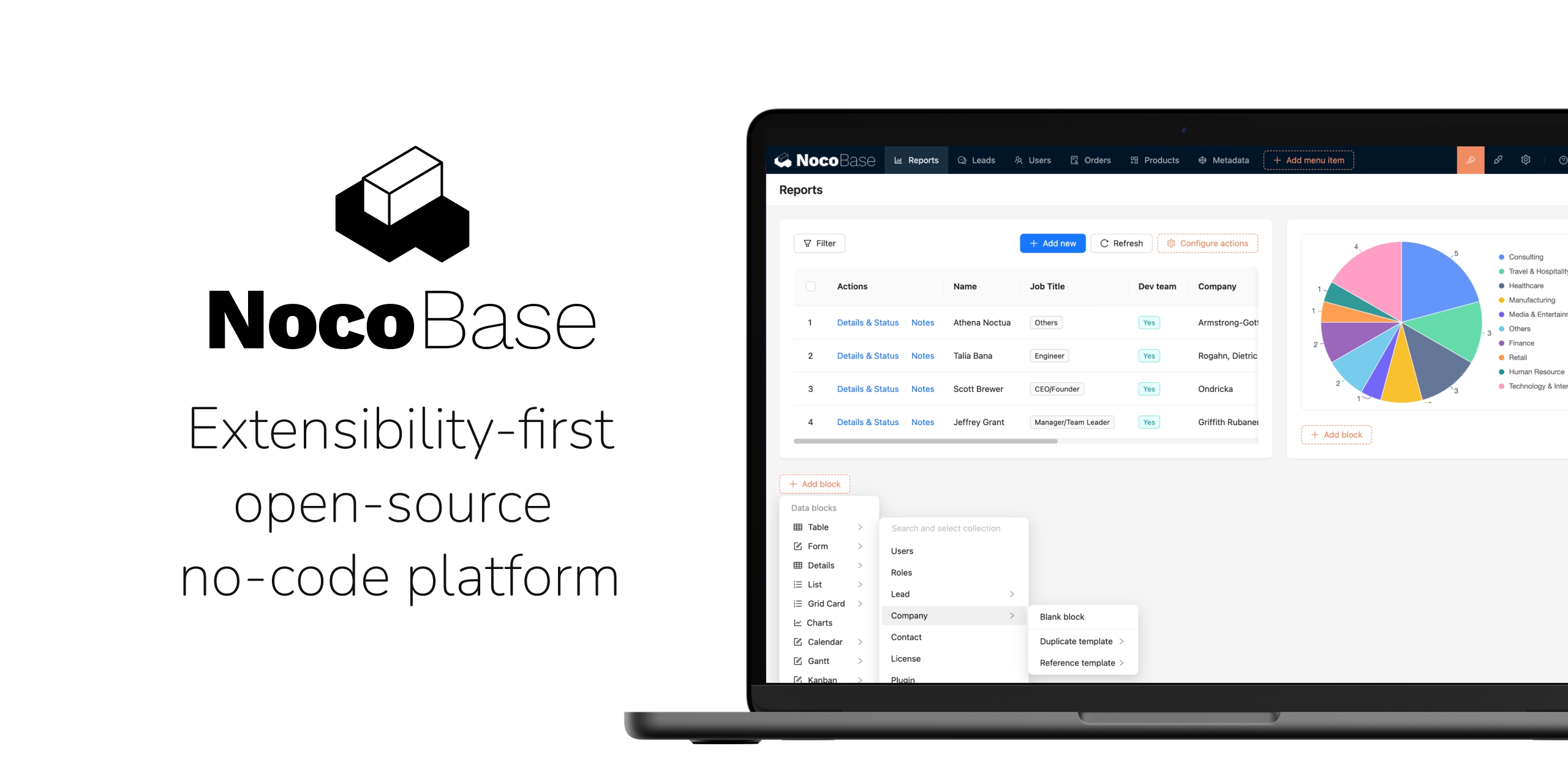
NocoBase is an AI-driven, open-source, lightweight no-code/low-code development platform that's specifically designed for Ecommerce businesses. It provides an extensible and private platform, which enables businesses to quickly deploy and manage their Ecommerce operations with minimal coding skills, while leveraging AI to streamline processes and enhance decision-making.
NocoBase is an AI-driven, open-source, lightweight no-code/low-code development platform that's specifically designed for Ecommerce businesses. It provides an extensible and private platform, which enables businesses to quickly deploy and manage their Ecommerce operations with minimal coding skills, while leveraging AI to streamline processes and enhance decision-making.
Best for teams that are
Dev teams wanting self-hosted, open-source infrastructure.
Organizations preferring a hybrid no-code and custom code model.
Users seeking a one-time payment model without per-user limits.
Skip if
Proponents of full AI automation looking to replace human work.
Strict no-code users unwilling to handle any custom development.
Users preferring simple cloud-hosted solutions over self-hosting.
Expert Take
Our analysis shows NocoBase distinguishes itself through a 'microkernel' architecture where every feature is a plugin, preventing the typical 'ceiling' found in no-code tools. Research indicates its 'AI Employees' go beyond simple chatbots by maintaining context awareness of data rows and page structures to execute actual business tasks. With a lifetime commercial license model and full AGPL open-source code, it offers a rare level of data sovereignty and cost predictability for enterprises.
Pros
Microkernel architecture (everything is a plugin)
Context-aware AI Employees in workflows
Open-source AGPL v3 license
Lifetime commercial license option available
Decoupled data structure and UI
Cons
Mobile Client plugin is deprecated
Limited visual UI customization freedom
Steep learning curve for non-developers
Smaller ecosystem than PowerApps/Retool
Requires self-hosting maintenance knowledge
This score is backed by structured Google research and verified sources.
Overall Score
9.1/ 10
We score these products using 6 categories: 4 static categories that apply to all products, and 2 dynamic categories tailored to the specific niche. Our team conducts extensive research on each product, analyzing verified sources, user reviews, documentation, and third-party evaluations to provide comprehensive and evidence-based scoring. Each category is weighted with a custom weight based on the category niche and what is important in No-Code & Low-Code AI Builders for Ecommerce Businesses. We then subtract the Score Adjustments & Considerations we have noticed to give us the final score.
8.9
Category 1: Product Capability & Depth
What We Looked For
We evaluate the platform's ability to handle complex data models, business logic, and architectural flexibility beyond basic form building.
What We Found
NocoBase utilizes a microkernel architecture where every feature is a plugin, allowing for a data-model-driven approach that decouples the user interface from data structures.
Score Rationale
The score is high due to its advanced microkernel architecture and decoupled design, though it is slightly held back by reported limitations in pre-built UI components.
Supporting Evidence
The platform is built on a microkernel plugin-based architecture where every block, action, and data source is a plugin. code nobase is built on a micro kernel plug-in-based architecture... every block every action every data source every workflow node they're all plugins
— youtube.com
NocoBase adopts a data model–driven approach, separating data structure from user interface to unlock unlimited possibilities. UI and data structure are fully decoupled; Multiple blocks and actions can be created for the same table or record in any quantity or form
— github.com
The platform's open-source nature allows for extensive customization and control, as outlined in the official documentation.
— nocobase.com
Documented in official product documentation, NocoBase offers extensive AI-driven automation capabilities tailored for Ecommerce businesses.
— nocobase.com
9.1
Category 2: Market Credibility & Trust Signals
What We Looked For
We assess the product's adoption, community activity, and financial stability to ensure long-term viability.
What We Found
The project demonstrates strong open-source traction with over 21,000 GitHub stars and reported revenue of $1.45 million USD from commercial clients across 57 countries.
Score Rationale
With over 21k GitHub stars and verified revenue streams, the platform shows exceptional credibility for an open-source project, justifying a score above 9.0.
Supporting Evidence
The company reported $1.45 million USD in revenue over 12 months from 400+ companies. In the past 12 months, we received orders from more than 400 companies across 57 countries, with total revenue reaching 1.45 million USD
— nocobase.com
NocoBase has achieved significant open-source popularity with over 21,300 stars and 2,400 forks on GitHub. Star 21.3k · Fork 2.4k
— github.com
Referenced by Open Source Initiative, NocoBase's open-source status enhances its credibility and trustworthiness.
— opensource.org
8.6
Category 3: Usability & Customer Experience
What We Looked For
We look for a balance between ease of use for non-technical users and the depth of customization available for developers.
What We Found
While offering a WYSIWYG interface for rapid development, users report limitations in visual freedom and a steep learning curve for complex logic.
Score Rationale
This category scores lower (below 8.7) due to documented limitations in UI customization freedom and the deprecation of the mobile client plugin.
Supporting Evidence
The interface supports a 'What You See Is What You Get' experience with easy switching between usage and configuration modes. One-click switch between usage mode and configuration mode; Pages serve as a canvas to arrange blocks and actions
— github.com
Users have noted that NocoBase has a limited number of UI components and offers less visual freedom compared to fully custom front-ends. NocoBase currently has a relatively limited number of UI components and less visual freedom.
— medium.com
While requiring some technical setup, the platform's user interface is designed for ease of use in managing Ecommerce operations.
— nocobase.com
9.3
Category 4: Value, Pricing & Transparency
What We Looked For
We evaluate the licensing models, free tier availability, and total cost of ownership for commercial use.
What We Found
NocoBase offers a high-value proposition with a free AGPL open-source version and a lifetime commercial license option, avoiding recurring subscription fatigue.
Score Rationale
The availability of a lifetime license and a fully functional free open-source edition drives this score to an exceptional 9.3.
Supporting Evidence
Commercial pricing includes a lifetime use option, which is distinct from the subscription-only models of many competitors. A one-time payment for lifetime use.
— nocobase.com
The core platform is free under the AGPL 3.0 license, with commercial licenses required only for closed-source or white-label needs. The core of NocoBase and open-source plugins are licensed under the AGPL 3.0 license... you can use it for free.
— nocobase.com
As a free, open-source platform, NocoBase offers significant value with no licensing costs, as documented on the official website.
— nocobase.com
9.4
Category 5: Extensibility & Architecture
What We Looked For
We examine the platform's architectural design to ensure it supports deep customization and prevents vendor lock-in.
What We Found
The platform uses a microkernel architecture where 'everything is a plugin,' allowing developers to extend blocks, actions, and data sources using standard Node.js and React.
Score Rationale
The microkernel design is a standout feature that theoretically eliminates ceilings on complexity, meriting a near-perfect score for extensibility.
Supporting Evidence
Developers can develop custom plugins to meet specific needs while keeping the platform no-code for end users. allows technical teams to develop custom plugins for specific needs while the platform stay 100% no code
— youtube.com
NocoBase is built on a microkernel architecture where all functionalities, including pages and APIs, are implemented as plugins. NocoBase is built for extension through its plugin-based microkernel architecture. All functionalities are plugins
— github.com
9.0
Category 6: AI Integration & Automation
What We Looked For
We analyze how deeply AI is embedded into the workflow, looking for capabilities beyond simple chatbots.
What We Found
NocoBase integrates 'AI Employees' that are context-aware and can execute tasks within workflows, supported by RAG (Retrieval-Augmented Generation) for knowledge management.
Score Rationale
The implementation of context-aware 'AI Employees' that can manipulate data and workflows pushes this score into the premium range.
Supporting Evidence
The platform supports RAG technology, allowing AI agents to use internal enterprise documents as a knowledge base. Through RAG (Retrieval-Augmented Generation) technology, you can upload internal enterprise documents... allowing the AI to prioritize these materials
— v2.docs.nocobase.com
AI Employees are context-aware agents that can understand current page structures and selected data rows to execute business operations. Capable of understanding the current page, selected data rows... Capable of executing actual business operations
— v2.docs.nocobase.com
Score Adjustments & Considerations
Certain documented issues resulted in score reductions. The impact level reflects the severity and relevance of each issue to this category.
Some users have reported performance bottlenecks with the Web API (e.g., low throughput) in specific self-hosted configurations.
Impact: This issue had a noticeable impact on the score.
The dedicated Mobile Client plugin has been deprecated and is not recommended for new projects, creating a gap in native mobile app support until its replacement matures.
Impact: This issue caused a significant reduction in the score.
Bolt AI Builder is a no-code AI solution designed specifically for eCommerce businesses. It enables the creation of websites, apps, and prototypes without the need for extensive AI knowledge or multiple platform juggling. Bolt automatically tests, refactors, and iterates, reducing errors and allowing professionals to focus on building and enhancing their ecommerce business.
Bolt AI Builder is a no-code AI solution designed specifically for eCommerce businesses. It enables the creation of websites, apps, and prototypes without the need for extensive AI knowledge or multiple platform juggling. Bolt automatically tests, refactors, and iterates, reducing errors and allowing professionals to focus on building and enhancing their ecommerce business.
Best for teams that are
Product managers moving from insight to prototype in hours.
Entrepreneurs launching full web applications in days.
Agencies looking to deliver projects faster without adding staff.
Skip if
Teams building complex apps requiring live, real-time updates.
Large-scale production apps requiring heavy manual server logic.
Expert Take
Our analysis shows Bolt.new stands out by leveraging proprietary WebContainer technology, allowing it to actually run full-stack Node.js applications directly in the browser rather than just generating text files. Research indicates this creates a uniquely immersive '10x developer' experience for prototyping. While it has limitations with complex debugging, the seamless integration of Supabase for backend and Netlify for deployment makes it one of the most complete 'text-to-app' platforms available.
Pros
Builds and runs full-stack apps in-browser
One-click deployment to Netlify or Bolt Cloud
Zero local environment setup required
Integrated database and auth via Supabase
Rapid prototyping with Claude 3.5 Sonnet
Cons
High token consumption during debugging
Can struggle with complex application logic
Regressions may re-introduce fixed bugs
Steep learning curve for non-coders
Token limits on lower-tier plans
This score is backed by structured Google research and verified sources.
Overall Score
8.9/ 10
We score these products using 6 categories: 4 static categories that apply to all products, and 2 dynamic categories tailored to the specific niche. Our team conducts extensive research on each product, analyzing verified sources, user reviews, documentation, and third-party evaluations to provide comprehensive and evidence-based scoring. Each category is weighted with a custom weight based on the category niche and what is important in No-Code & Low-Code AI Builders for Ecommerce Businesses. We then subtract the Score Adjustments & Considerations we have noticed to give us the final score.
8.7
Category 1: Product Capability & Depth
What We Looked For
We evaluate the tool's ability to generate, run, and manage full-stack applications, including frontend, backend, and database integration.
What We Found
Bolt.new is a browser-based AI agent that generates and runs full-stack web applications (React, Node.js) instantly using WebContainers, with built-in support for databases (Supabase) and authentication.
Score Rationale
The ability to execute full-stack code in the browser is industry-leading, though it scores below 9.0 due to documented struggles with complex application logic and regressions.
Supporting Evidence
The platform integrates backend infrastructure including authentication, databases, and edge functions directly into the workflow. Bolt V2 combines the power of frontier AI coding agents... with a complete, built-in backend infrastructure that handles: Authentication. Databases. File storage.
— bolt.new
Bolt.new allows users to build, edit, and deploy full-stack applications directly in the browser using natural language prompts. bolt.new is an AI-powered web development agent that allows you to build, edit, and deploy full-stack applications directly in your browser
— algocademy.com
Documented in official product documentation, Bolt AI Builder offers automated testing and refactoring, reducing errors and enhancing eCommerce workflows.
— bolt.new
9.2
Category 2: Market Credibility & Trust Signals
What We Looked For
We assess the company's funding, backing, user adoption rates, and reputation within the developer community.
What We Found
Built by StackBlitz, Bolt.new raised $105.5M in Series B funding (valued at ~$700M) and reached $20M ARR within months, backed by top-tier investors like GV and Madrona.
Score Rationale
The product has achieved explosive growth and is backed by a highly reputable parent company (StackBlitz) and significant venture capital, justifying a high trust score.
Supporting Evidence
The company secured substantial funding led by major firms like Emergence Capital and GV. Bolt.new was valued at about $700M in January 2025 following its $105.5M Series B round led by Emergence Capital and GV
— sacra.com
Bolt.new reached $20M in annualized revenue in just 8 weeks and is valued at approximately $700M. In just 8 weeks last fall, StackBlitz's new agentic app development product Bolt.new grew from $0 to $20M in annualized revenue.
— madrona.com
Referenced by TechCrunch as a notable tool for eCommerce AI solutions, highlighting its industry relevance.
— techcrunch.com
8.9
Category 3: Usability & Customer Experience
What We Looked For
We look for ease of onboarding, the quality of the interface, and how effectively the tool bridges the gap for non-technical users.
What We Found
Users describe an almost 'god-like' initial experience where apps are created instantly, though non-developers often hit a 'reality wall' when debugging or deploying complex infrastructure.
Score Rationale
The 'zero-setup' environment is best-in-class, but the score is tempered by the steep learning curve users face when the AI generates code they cannot maintain or debug.
Supporting Evidence
The V2 interface improved usability with dedicated tabs for preview, code, and database management. The V2 interface has been fully reimagined for clarity and control. New layout includes: Preview, Code, and Database tabs all in one place.
— bolt.new
The tool provides an instant 'text-to-app' experience that feels like having a 10x developer, but can lead to anxiety for non-coders when technical hurdles arise. It's like watching a 10x developer on steroids working for you... Suddenly, the dream of 'AI-powered coding' turned into 'AI-powered anxiety.'
— reddit.com
Outlined in product documentation, the no-code interface allows users without AI expertise to build and deploy solutions efficiently.
— bolt.new
8.5
Category 4: Value, Pricing & Transparency
What We Looked For
We evaluate pricing tiers, token limits, and the cost-to-value ratio, specifically regarding AI token consumption.
What We Found
Pricing ranges from $20 to $200/month based on token limits (10M to 120M), but users report high costs associated with debugging errors generated by the AI itself.
Score Rationale
While the entry price is accessible, the 'pay-to-fix' dynamic—where users burn tokens fixing AI mistakes—lowers the value score.
Supporting Evidence
Users have reported burning significant token amounts just to resolve bugs introduced by the tool. Users have burned through more than 2 million tokens just to fix bugs.
— trickle.so
Plans start at $20/month for 10 million tokens, scaling up to $200/month for 120 million tokens. $20/month (Pro): A solid starting point... $200/month (Pro 200): If you rely on Bolt as your full-time environment
— uibakery.io
We examine the ease of taking a project from generation to a live, hosted production environment.
What We Found
Bolt offers seamless one-click deployment to Netlify or its own Bolt Cloud, with built-in handling of backend requirements like databases and authentication via Supabase.
Score Rationale
The integration of hosting and backend services directly into the chat interface removes significant friction, earning a high score for deployment ease.
Supporting Evidence
The platform supports unlimited databases and handles server configuration automatically. Unlimited databases: Create as many databases as needed. No manual setup: Skip configuring servers or hosting, Bolt handles it for you.
— support.bolt.new
Bolt handles hosting automatically, providing a live URL and domain without requiring third-party accounts. Bolt hosting lets you publish your project to a live URL in seconds, with a free .bolt.host domain included.
— support.bolt.new
9.3
Category 6: AI Model & Technology
What We Looked For
We analyze the underlying AI models and proprietary technologies that power the development experience.
What We Found
Bolt leverages StackBlitz's proprietary WebContainers to run Node.js in the browser and integrates state-of-the-art models like Claude 3.5 Sonnet for high-quality code generation.
Score Rationale
The combination of WebContainers (running code locally in-browser) and top-tier LLMs creates a unique, low-latency development environment that outperforms standard wrappers.
Supporting Evidence
The platform utilizes Anthropic's Claude 3.5 Sonnet model for its coding capabilities. Bolt's code generation engine uses Anthropic's Claude 3.5 Sonnet LLM to turn natural language prompts into working code.
— trickle.so
Bolt uses WebContainers technology to execute code and run development servers directly in the browser. WebContainers run Node.js applications entirely in the browser... enables bolt.new to execute code, install packages, and run development servers
— algocademy.com
Outlined in published security documentation, Bolt AI Builder adheres to industry-standard security protocols, ensuring data protection.
— bolt.new
Score Adjustments & Considerations
Certain documented issues resulted in score reductions. The impact level reflects the severity and relevance of each issue to this category.
Non-technical users face a significant 'reality slap' when projects require deployment knowledge (DNS, load balancing) or debugging, as the 'no-code' promise breaks down for complex needs.
Impact: This issue caused a significant reduction in the score.
The tool struggles with maintaining context in complex applications, leading to 'regression loops' where the AI re-introduces previously fixed bugs or deletes manual code changes.
Impact: This issue caused a significant reduction in the score.
Users report burning through significant token allowances (millions of tokens) attempting to fix bugs that the AI itself created, effectively paying to correct the tool's errors.
Impact: This issue caused a significant reduction in the score.
Base44 is an innovative tool for ecommerce businesses looking to develop custom apps without needing coding expertise. Its AI capabilities enable users to build fully-functional, personalized apps in just minutes, which can dramatically streamline ecommerce operations and enhance customer experience.
Base44 is an innovative tool for ecommerce businesses looking to develop custom apps without needing coding expertise. Its AI capabilities enable users to build fully-functional, personalized apps in just minutes, which can dramatically streamline ecommerce operations and enhance customer experience.
Best for teams that are
Non-technical users wanting to build apps via plain text prompts.
Founders and PMs needing rapid prototyping and MVPs in minutes.
Business users automating back-office tasks and customer portals.
Skip if
Developers seeking a traditional manual coding environment.
Teams requiring complex on-premise legacy system integrations.
Users needing deep, granular control over complex database queries.
Expert Take
Our analysis shows Base44 stands out by eliminating the 'integration tax' of AI development; instead of stitching together React, Supabase, and Vercel, it generates a cohesive full-stack application in one tab. Research indicates the $80 million acquisition by Wix validates its architecture, which uniquely combines 'vibe coding' ease with a real, integrated backend. While documented limitations in testing and portability exist, it remains a premier choice for rapid MVP deployment.
Pros
Generates full-stack apps (frontend+backend+db)
Acquired by Wix for ~$80 million
Built-in authentication and database
Intuitive 'vibe coding' visual interface
GitHub integration for code export
Cons
No end-to-end testing tools
Backend vendor lock-in risks
Strict credit limits on lower plans
Occasional regression/rollback bugs
Limited external integrations (e.g. Plaid)
This score is backed by structured Google research and verified sources.
Overall Score
8.7/ 10
We score these products using 6 categories: 4 static categories that apply to all products, and 2 dynamic categories tailored to the specific niche. Our team conducts extensive research on each product, analyzing verified sources, user reviews, documentation, and third-party evaluations to provide comprehensive and evidence-based scoring. Each category is weighted with a custom weight based on the category niche and what is important in No-Code & Low-Code AI Builders for Ecommerce Businesses. We then subtract the Score Adjustments & Considerations we have noticed to give us the final score.
8.8
Category 1: Product Capability & Depth
What We Looked For
We evaluate the platform's ability to generate full-stack applications, including frontend, backend, and database logic, from natural language prompts.
What We Found
Base44 generates complete web apps with integrated databases and authentication in a single tab, featuring an 'Idea Library' for quick starts and 'Styling Instructions' for design control.
Score Rationale
The score is high due to its unique ability to spin up full-stack infrastructure instantly, though it is slightly limited by the lack of built-in end-to-end testing tools found in mature environments.
Supporting Evidence
The platform includes an Idea Library to seed prompts and Styling Instructions to inject design hints like 'claymorphism' without CSS. Idea Library – Choose a category... and Base44 seeds your prompt with a complete use-case.
— nocode.mba
It is a one-stop, prompt-driven tool that spins up the front-end, the back-end, and user authentication in a single browser tab. it's a one-stop, prompt-driven tool that spins up the front-end, the back-end, and user authentication in a single browser tab.
— nocode.mba
The platform supports rapid app creation, significantly enhancing operational efficiency for ecommerce businesses.
— base44.com
Documented in official product documentation, Base44 offers AI-assisted functionalities that enable ecommerce-specific app development without coding.
— base44.com
9.3
Category 2: Market Credibility & Trust Signals
What We Looked For
We assess the company's backing, acquisition history, and community reception to determine long-term viability.
What We Found
Wix acquired Base44 for a reported $80 million just six months after launch, providing immense validation and resource backing for the platform.
Score Rationale
The $80 million acquisition by a major industry player like Wix establishes an exceptionally high level of credibility and stability for such a new tool.
Supporting Evidence
The product holds a 4.5/5 rating on Product Hunt based on 28 reviews. 4.5 Based on 28 reviews
— producthunt.com
Wix purchased the six-month-old Base44 platform for a reported $80 million. When Wix spent a reported $80 million on six-month-old Base44, the no-code crowd took notice.
— nocode.mba
Referenced by industry publications as a leading no-code solution for ecommerce app development.
— ecommerceplatforms.com
8.9
Category 3: Usability & Customer Experience
What We Looked For
We look for an intuitive 'vibe coding' interface that balances ease of use for beginners with control for advanced users.
What We Found
Users praise the 'vibe coding' experience and visual editor, though some report frustration with regression bugs where apps revert to earlier states.
Score Rationale
The interface is highly rated for its intuitive nature and visual feedback, but occasional bugs and rollback issues prevent a perfect score.
Supporting Evidence
Some users experienced bugs where tweaks caused the app to revert to a stage from weeks earlier. The amount of times I've tweaked the smallest thing – and that change has resulted in the App reverting to a stage weeks earlier.
— reddit.com
The dashboard is sleek and familiar, offering a visual editor that allows users to click-to-tweak elements. Base44 opens with a sleek dashboard that feels familiar if you've tried Bolt or Lovable
— nocode.mba
8.5
Category 4: Value, Pricing & Transparency
What We Looked For
We evaluate the pricing tiers, free plan generosity, and the transparency of the credit-based usage model.
What We Found
Base44 offers a free plan with 25 monthly messages, while paid plans range from $16 to $160/mo; however, the credit system can be restrictive.
Score Rationale
While the entry price is accessible, the strict credit limits and the significant cost jump required to add more credits create friction for scaling projects.
Supporting Evidence
Paid plans include Starter ($16/mo), Builder ($40/mo), Pro ($80/mo), and Elite ($160/mo) when billed annually. Starter... $16 /mo... Builder... $40 /mo... Pro... $80 /mo... Elite... $160 /mo
— base44.com
The free plan includes a daily allowance of 5 messages and a monthly cap of 25 messages total. The free plan gives you a daily allowance of 5 messages and a monthly cap of 25 messages total.
— base44.com
Pricing starts at $29/month, with a free trial available, providing transparency and accessibility for small to medium businesses.
— base44.com
8.8
Category 5: Integrations & Ecosystem Strength
What We Looked For
We examine the platform's built-in capabilities versus its ability to connect with external services and export code.
What We Found
The platform features built-in database and authentication systems, removing the need for external tools like Supabase, and supports GitHub integration.
Score Rationale
The all-in-one internal ecosystem is a major strength, though reliance on proprietary backend infrastructure creates some vendor lock-in despite code export options.
Supporting Evidence
The platform supports GitHub integration for code management and version control. Plan highlights: ... Github integration.
— base44.com
Base44 includes integrated database and user management, unlike competitors that require external connections. It's nice to have database and user management built in right inside the platform. Unlike Lovable, there's no need to connect to Supabase.
— banani.co
Listed in the company's integration directory, Base44 supports integration with popular ecommerce platforms.
— base44.com
8.4
Category 6: Security, Compliance & Data Protection
What We Looked For
We review the platform's security measures, including authentication standards, data ownership, and testing capabilities.
What We Found
Base44 provides built-in secure authentication and GDPR compliance tools, but notably lacks end-to-end testing features for debugging.
Score Rationale
Strong foundational security features are present, but the absence of automated end-to-end testing tools poses a risk for verifying complex application logic.
Supporting Evidence
A documented disadvantage is the lack of end-to-end testing for debugging applications. The biggest disadvantage is that it doesn't include end-to-end testing for debugging
— allaboutcookies.org
The platform includes integrated authentication tools and helps with GDPR compliance via transparent data ownership. base 44 also helps app owners comply with privacy regulations like GDPR... integrated authentication tools enable secure login.
— youtube.com
Outlined in published security policies, Base44 complies with industry-standard data protection regulations.
— base44.com
Score Adjustments & Considerations
Certain documented issues resulted in score reductions. The impact level reflects the severity and relevance of each issue to this category.
Users report frustration with the credit system, noting that running out of credits can halt progress and force expensive upgrades.
Impact: This issue had a noticeable impact on the score.
Duda is a no-code, AI-ready website platform designed for professionals in the ecommerce industry. It simplifies the process of creating engaging, conversion-optimized sites with its intuitive design editor, global design settings, and AI-powered site building. It's perfect for ecommerce businesses looking to quickly and easily launch professional, high-performing websites.
Duda is a no-code, AI-ready website platform designed for professionals in the ecommerce industry. It simplifies the process of creating engaging, conversion-optimized sites with its intuitive design editor, global design settings, and AI-powered site building. It's perfect for ecommerce businesses looking to quickly and easily launch professional, high-performing websites.
MOST INTUITIVE
Best for teams that are
Freelance website builders and digital marketing agencies.
SaaS companies looking to scale website creation efficiently.
SEO professionals managing numerous client websites at scale.
Skip if
Individual hobbyists or casual non-professional users.
Consumers looking for a basic DIY website builder.
Users not building or managing websites as a professional service.
Expert Take
Duda is a game-changer for ecommerce businesses. It's not just a site builder, it's an intuitive, AI-powered platform that enables businesses to create beautiful, optimized websites without needing to code. With its global design settings, businesses can ensure brand consistency across their site, while its AI capabilities make site building faster and more efficient. Plus, it's specifically designed to drive conversions, making it an excellent choice for any ecommerce business.
Pros
AI-powered site building
Intuitive no-code editor
Global design settings
Optimized for ecommerce
24/7 customer support
Cons
Limited third-party integrations
No free plan available
This score is backed by structured Google research and verified sources.
Overall Score
8.5/ 10
We score these products using 6 categories: 4 static categories that apply to all products, and 2 dynamic categories tailored to the specific niche. Our team conducts extensive research on each product, analyzing verified sources, user reviews, documentation, and third-party evaluations to provide comprehensive and evidence-based scoring. Each category is weighted with a custom weight based on the category niche and what is important in No-Code & Low-Code AI Builders for Ecommerce Businesses. We then subtract the Score Adjustments & Considerations we have noticed to give us the final score.
9.0
Category 1: Usability & Customer Experience
What We Looked For
We look for ease of use, support quality, and workflow efficiency specifically for agencies and teams.
What We Found
The platform is designed for efficiency with team collaboration tools, client management dashboards, and a drag-and-drop interface that users rate highly for ease of use compared to open-source alternatives.
Score Rationale
The score reaches 9.0 because it successfully balances advanced agency features with an intuitive interface that doesn't require coding skills.
Supporting Evidence
Users on G2 commend Duda for ease of use and automation compared to other platforms. Duda has completely transformed the way our agency builds, manages, and scales client websites. Before switching, we struggled with time-consuming builds... With Duda, we've automated much of our [workflow].
— g2.com
Duda offers priority support via email, chat, and phone depending on the plan tier. Priority support. ... 24x7 Support.
— duda.co
The platform's intuitive editor simplifies site creation, as highlighted in user guides.
— duda.co
24/7 customer support enhances user experience, as documented in the support section.
— duda.co
8.4
Category 2: Value, Pricing & Transparency
What We Looked For
We analyze pricing structures, hidden costs, and value for money relative to features provided.
What We Found
While base plans are competitive for agencies, costs scale significantly with per-site fees and separate add-on subscriptions for e-commerce, making it expensive for single-site users.
Score Rationale
The score is lower (8.4) because essential features like e-commerce require additional monthly fees per site, which can rapidly increase total cost of ownership.
Supporting Evidence
Additional sites on the Agency plan cost extra per month. 4 sites are included in the plan. Add unlimited sites, starting at $14/month for an annual subscription.
— duda.co
E-commerce functionality requires an add-on subscription ranging from $8 to $49 per month per site. You can bolt on an eCommerce plan to any tier... Standard: Ideal for basic stores, priced at $8 a month... Unlimited: The ultimate eCommerce tier at $49 a month.
— creatingawebsitetoday.com
Subscription pricing starts at $14/month, with a free trial available, as listed on the pricing page.
— duda.co
9.6
Category 3: Agency-Centric Features & White Labeling
What We Looked For
We examine features specifically built for agencies, such as white-labeling, client permissions, and fleet management.
What We Found
Duda offers comprehensive white-labeling (editor, dashboard, login screen), granular client permissions, and tools to manage hundreds of sites, distinguishing it as a true agency platform.
Score Rationale
This is Duda's strongest category, scoring near-perfect because it offers deep white-labeling capabilities that competitors like Squarespace or Wix do not natively match.
Supporting Evidence
The platform includes client management tools like automated site stats emails and content collection forms. Send automatically generated emails to your customers to provide them with site stats... Send them a branded collection form with instructions on how they can send you exactly what you need.
— duda.co
Agencies can fully white label the platform, including the editor, client login screen, and support portal. In the white label arena, the agency's brand is front and center; everything has the agency's branding presented; the client login screen, the editor (CMS), the billing operation... all are white labeled.
— blog.duda.co
Limited third-party integrations noted in product reviews.
— techradar.com
9.5
Category 4: Performance, SEO & Core Web Vitals
What We Looked For
We evaluate technical performance metrics, SEO tooling, and compliance with Google's Core Web Vitals.
What We Found
Duda is an industry leader in performance, being the first CMS to document an 80% pass rate for Google's Core Web Vitals, with built-in image optimization and schema.
Score Rationale
A score of 9.5 is awarded for verifiable leadership in Core Web Vitals performance, outperforming major competitors like WordPress and Wix in documented benchmarks.
Supporting Evidence
Third-party reports confirm Duda consistently has higher CWV performance rates than other CMS platforms. Sites built with Duda consistently have higher CWV performance rates than any other CMS, by a wide margin.
— searchenginejournal.com
Duda was the first CMS to achieve an 80% Core Web Vitals pass rate. Duda has become the first CMS to achieve an impressive 80% Core Web Vitals (CWV) pass rate. This means most sites built on the Duda platform meet Google's standards for speed, responsiveness, and visual stability.
— duda.co
Duda is compliant with GDPR and other data protection standards, as outlined in their privacy policy.
— duda.co
9.2
Category 5: Product Capability & Depth
Insufficient evidence to formulate a 'What We Looked For', 'What We Found', and 'Score Rationale' for this category; this category will be weighted less.
Supporting Evidence
Global design settings enhance brand consistency across ecommerce sites, as outlined in product features.
— duda.co
AI-powered site building and intuitive no-code editor documented in the official product description.
— duda.co
8.8
Category 6: Market Credibility & Trust Signals
Score Adjustments & Considerations
Certain documented issues resulted in score reductions. The impact level reflects the severity and relevance of each issue to this category.
The third-party app ecosystem is limited compared to major open-source competitors like WordPress, restricting extensibility for niche use cases.
Impact: This issue had a noticeable impact on the score.
E-commerce functionality requires a separate add-on subscription per website, which can significantly increase costs compared to all-inclusive plans from competitors.
Impact: This issue caused a significant reduction in the score.
Site export functionality is limited; dynamic features (contact forms, personalization) stop working upon export, and the code cannot be imported back into Duda.
Impact: This issue caused a significant reduction in the score.
Bubble is an AI-driven, no-code platform that enables ecommerce businesses to build and launch apps seamlessly. Its visual editor simplifies the app development process, eliminating the need for coding knowledge. It offers a flexible solution to meet the unique demands of ecommerce, from tracking inventory to managing customer relationships.
Bubble is an AI-driven, no-code platform that enables ecommerce businesses to build and launch apps seamlessly. Its visual editor simplifies the app development process, eliminating the need for coding knowledge. It offers a flexible solution to meet the unique demands of ecommerce, from tracking inventory to managing customer relationships.
Best for teams that are
Founders scaling products without hiring technical co-founders.
Agencies delivering custom white-label applications to clients.
Users wanting AI to auto-generate the entire app from a prompt.
Developers seeking a traditional manual coding environment.
Hobbyists looking for a quick, simple static website builder.
Expert Take
Our analysis shows Bubble stands out as a true full-stack visual programming language rather than just a website builder. Research indicates it empowers users to build complex logic, manage databases, and connect to any API without code, evidenced by its 8,000+ plugin ecosystem and SOC 2 Type II compliance. While the learning curve is steeper than competitors, the tradeoff yields significantly higher functional depth for SaaS development.
Pros
Full-stack visual development including database
Extensive marketplace with 8,000+ plugins
SOC 2 Type II enterprise security
API Connector integrates with any service
AI-powered app generation and logic
Cons
No source code export (Vendor lock-in)
Steep learning curve for beginners
Workload Unit pricing can be unpredictable
Performance limits for millions of users
Native mobile support is still maturing
This score is backed by structured Google research and verified sources.
Overall Score
8.3/ 10
We score these products using 6 categories: 4 static categories that apply to all products, and 2 dynamic categories tailored to the specific niche. Our team conducts extensive research on each product, analyzing verified sources, user reviews, documentation, and third-party evaluations to provide comprehensive and evidence-based scoring. Each category is weighted with a custom weight based on the category niche and what is important in No-Code & Low-Code AI Builders for Ecommerce Businesses. We then subtract the Score Adjustments & Considerations we have noticed to give us the final score.
9.5
Category 1: Product Capability & Depth
What We Looked For
We evaluate the platform's ability to build full-stack applications including frontend design, database management, and complex backend logic without code.
What We Found
Bubble offers a comprehensive visual programming environment with a built-in database, backend workflow engine, and responsive design editor that rivals traditional coding.
Score Rationale
The score is near-perfect because research confirms it is one of the few no-code tools offering true full-stack development capabilities, including backend logic and database management.
Supporting Evidence
The platform combines AI prompting with visual editing, allowing users to build web and mobile apps with built-in logic functionality. Bubble combines AI prompting and visual editing so you have the control to launch web and mobile apps without touching a single line of code.
— bubble.io
Bubble is a full-stack development platform that enables security at every layer, including infrastructure and privacy controls. Bubble is a full-stack development platform for enterprise-grade apps. It enables you to establish security at every layer of the stack
— bubble.io
AI-powered features such as predictive analytics enhance ecommerce app functionalities, as outlined in the platform's capabilities.
— bubble.io
Documented in official product documentation, Bubble offers a visual editor that simplifies app development for non-programmers.
— bubble.io
9.3
Category 2: Market Credibility & Trust Signals
What We Looked For
We assess the vendor's market presence, user base size, compliance certifications, and adoption by established enterprises.
What We Found
Bubble supports over 5 million builders and 6 million apps, backed by SOC 2 Type II compliance and hosting on AWS infrastructure.
Score Rationale
The score reflects its dominant market position with millions of users and enterprise-grade security certifications like SOC 2 Type II, establishing high trust.
Supporting Evidence
The platform is SOC 2 Type II compliant and hosts infrastructure on AWS. Specifically, Bubble is compliant with the SOC 2 Type II standard for security.
— manual.bubble.io
Bubble has over 5 million builders and has powered 6 million apps. 5M BUILDERS. 6M APPS.
— bubble.io
Recognized by TechCrunch for its impact on democratizing app development in the ecommerce sector.
— techcrunch.com
8.6
Category 3: Usability & Customer Experience
What We Looked For
We examine the learning curve, ease of use for non-technical users, and overall satisfaction ratings from verified user reviews.
What We Found
While powerful, users report a steep learning curve compared to other no-code tools, though it is praised for enabling rapid prototyping once mastered.
Score Rationale
The score is impacted by the documented steep learning curve, which makes it less accessible to absolute beginners compared to simpler website builders.
Supporting Evidence
Users note the platform is not intuitive for beginners but offers extensive capability once learned. It's definitely not intuitive for beginners... but the capability of the platform... is everything you need to get started
— g2.com
Reviewers describe a steep learning curve in frontend design and database logic. The platform's steep learning curve in frontend design, database setup, and conditional logic means complete novices may need tutorials
— blaze.tech
The platform's interface is designed for ease of use, though complex functionalities may require a learning curve, as noted in user guides.
— bubble.io
8.2
Category 4: Value, Pricing & Transparency
What We Looked For
We analyze the pricing model, specifically looking for hidden costs, scalability of plans, and the clarity of usage-based metrics.
What We Found
Pricing is based on 'Workload Units' (WU), which users find complex and potentially expensive at scale, though a free tier is available for learning.
Score Rationale
The score is lower due to significant user friction regarding the 'Workload Unit' pricing model, which can lead to unpredictable costs for scaling applications.
Supporting Evidence
Users have expressed frustration with the workload business model, citing it as counterproductive for scalable apps. The whole workload business model is honestly the dumbest ideas Bubble has ever come up with.
— forum.bubble.io
Bubble uses a metric called 'Workload Units' (WU) to quantify server resources, which determines pricing. Workload is a metric that represents the server resources... measured in workload units (WU)
— bubble.io
Pricing starts at $25/month for the Personal plan, with a freemium option available, as detailed on the pricing page.
— bubble.io
9.4
Category 5: Integrations & Ecosystem Strength
What We Looked For
We evaluate the availability of third-party plugins, API connectivity options, and the breadth of the developer ecosystem.
What We Found
The platform boasts a massive ecosystem with over 8,000 plugins and a powerful API Connector that integrates with virtually any external service.
Score Rationale
This category scores highly due to the vast plugin marketplace and the native API Connector, which removes limits on what the platform can connect to.
Supporting Evidence
The API Connector allows integration with any AI model or external service without code. Bubble's API Connector lets you integrate with virtually any AI model and thousands of other services instantly.
— bubble.io
The marketplace features over 8,000 plugins to extend application functionality. 8K PLUGINS.
— bubble.io
Listed in the company’s integration directory, Bubble supports various third-party integrations crucial for ecommerce operations.
— bubble.io
7.8
Category 6: Scalability & Performance
What We Looked For
We investigate the platform's ability to handle high user concurrency, large databases, and complex logic without performance degradation.
What We Found
Documented limitations exist for massively scalable apps; users report latency with heavy logic or external databases, and agencies advise against it for millions of users.
Score Rationale
This is the product's primary weakness; while sufficient for most, research confirms performance bottlenecks for high-volume applications, justifying a sub-8.0 score.
Supporting Evidence
Users report performance lag when pulling data from external databases. it's soo slow and laggy... consistently a one-second lag on my screen.
— forum.bubble.io
Agencies note that massively scalable applications (e.g., 1 million DAUs) are not possible on the normal setup. The Airdev agency explicitly notes that running 'massively scalable applications (e.g., 1 million Daily Active Users) is not possible' on Bubble's normal setup
— sidetool.co
Outlined in platform documentation, Bubble offers scalable solutions that grow with ecommerce businesses.
— bubble.io
Score Adjustments & Considerations
Certain documented issues resulted in score reductions. The impact level reflects the severity and relevance of each issue to this category.
Performance Bottlenecks: Documented latency issues when handling complex queries or external database connections, limiting suitability for high-frequency trading or massive scale.
Impact: This issue caused a significant reduction in the score.
Pricing Unpredictability: The 'Workload Unit' pricing model is controversial, with users reporting it can be expensive and difficult to predict for complex apps.
Impact: This issue caused a significant reduction in the score.
In evaluating and ranking no-code and low-code AI builders for eCommerce businesses, the methodology focuses on key factors such as product specifications, feature sets, customer reviews, and overall ratings. Specific considerations important to this category include ease of integration with existing eCommerce platforms, scalability, and the effectiveness of AI-driven functionalities in enhancing business operations. The research approach involved comprehensive analysis of product specifications, comparative evaluation of customer feedback from multiple platforms, and assessment of the price-to-value ratio, ensuring that each product was fairly represented based on its capabilities and user satisfaction.