Revenue Analytics & Sales Intelligence Software

These are the specialized categories within Revenue Analytics & Sales Intelligence Software. Looking for something broader? See all Business Intelligence & Analytics Software categories.

1

SaaSGrid: Metrics & Reporting

Best for Revenue Analytics Platforms for SaaS Companies

Score
9.8 / 10
SaaSGrid: Metrics & Reporting

SaaSGrid is designed specifically for SaaS companies looking to unify their metrics and revenue data into one comprehensive dashboard. By seamlessly integrating with platforms like Stripe, HubSpot, and ERP, it provides real-time insights, making it an essential tool for revenue analytics.

Best for Revenue Analytics Platforms for SaaS Companies

Expert Take

SaaSGrid excels in providing comprehensive revenue analytics for SaaS companies, integrating seamlessly with major platforms like Stripe and HubSpot. The product's real-time tracking and unified dashboard are highly valued, though its custom pricing and setup complexity may present challenges.
Pros

  • Free for <$1M ARR
  • Standardizes 70+ SaaS metrics
  • Real-time CRM/ERP syncing
  • Investor-grade dashboards
  • Backed by Craft Ventures

Cons

  • No monthly account churn metric
  • Lacks forecasting features
  • Steep price jump ($5k/yr)
  • Occasional slow performance
  • Less mature than ChartMogul

Best for teams that are

  • B2B SaaS finance teams reconciling data across CRM, billing, and ERP systems
  • RevOps leaders needing a single source of truth for pipeline and cash flow
  • SaaS companies looking to replace complex spreadsheets with automated reporting

Skip if

  • Non-SaaS businesses, as the platform is purpose-built for B2B SaaS metrics
  • Large enterprises requiring highly mature, feature-complete BI platforms
  • Teams needing deep user behavior tracking rather than financial data aggregation

Best for teams that are

  • B2B SaaS finance teams reconciling data across CRM, billing, and ERP systems
  • RevOps leaders needing a single source of truth for pipeline and cash flow
  • SaaS companies looking to replace complex spreadsheets with automated reporting

Skip if

  • Non-SaaS businesses, as the platform is purpose-built for B2B SaaS metrics
  • Large enterprises requiring highly mature, feature-complete BI platforms
  • Teams needing deep user behavior tracking rather than financial data aggregation

Pros

  • Free for <$1M ARR
  • Standardizes 70+ SaaS metrics
  • Real-time CRM/ERP syncing
  • Investor-grade dashboards
  • Backed by Craft Ventures

Cons

  • No monthly account churn metric
  • Lacks forecasting features
  • Steep price jump ($5k/yr)
  • Occasional slow performance
  • Less mature than ChartMogul

Expert Take

SaaSGrid excels in providing comprehensive revenue analytics for SaaS companies, integrating seamlessly with major platforms like Stripe and HubSpot. The product's real-time tracking and unified dashboard are highly valued, though its custom pricing and setup complexity may present challenges.

2

Syncari RevOps Data Platform

Best for Revenue Analytics Platforms for RevOps Teams

Score
9.8 / 10
Syncari RevOps Data Platform

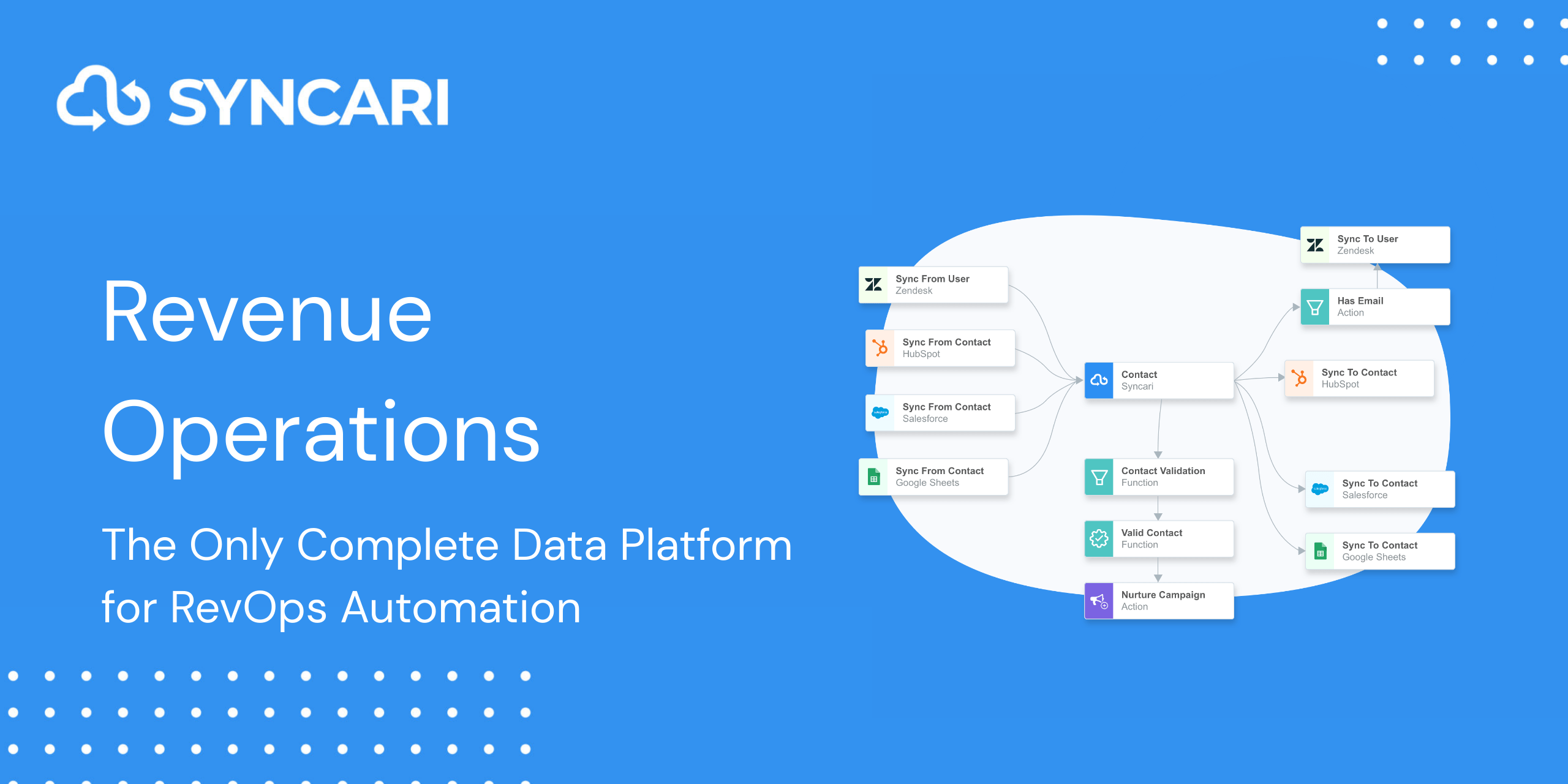
Syncari’s RevOps platform is specifically designed to cater to the needs of revenue operations leaders, offering a comprehensive solution to drive predictable revenue and accelerate growth. With its versatile data automation capabilities, it ensures efficient and error-free operations in a demanding RevOps environment.

Best for Revenue Analytics Platforms for RevOps Teams

Expert Take

Syncari RevOps Data Platform excels in offering a unified data view and automation capabilities tailored for RevOps teams. Its integration capabilities and advanced analytics provide significant value, though the need for technical knowledge and lack of explicit pricing are considerations. Overall, it stands out as a premium solution in its category.

Pros

  • Patented stateful multi-directional sync engine
  • Predictable pricing based on unified records
  • SOC 2 Type II and HIPAA compliant
  • No-code 'Agentic MDM' capabilities
  • Real-time data consistency across systems

Cons

  • Steep initial learning curve for users
  • Complex implementation requires significant planning
  • High starting price ($995/mo) for SMBs
  • Requires understanding of data modeling concepts
  • Smaller connector library than massive iPaaS

Best for teams that are

  • Mid-to-large enterprises needing stateful data sync across complex stacks
  • RevOps teams struggling with data quality, unification, and Customer 360
  • Organizations requiring multi-directional sync beyond simple triggers

Skip if

  • Small startups or businesses with simple, linear data integration needs
  • Teams looking for a low-cost, simple automation tool like Zapier
  • Organizations without a dedicated RevOps function or data complexity

Best for teams that are

  • Mid-to-large enterprises needing stateful data sync across complex stacks
  • RevOps teams struggling with data quality, unification, and Customer 360
  • Organizations requiring multi-directional sync beyond simple triggers

Skip if

  • Small startups or businesses with simple, linear data integration needs
  • Teams looking for a low-cost, simple automation tool like Zapier
  • Organizations without a dedicated RevOps function or data complexity

Pros

  • Patented stateful multi-directional sync engine
  • Predictable pricing based on unified records
  • SOC 2 Type II and HIPAA compliant
  • No-code 'Agentic MDM' capabilities
  • Real-time data consistency across systems

Cons

  • Steep initial learning curve for users
  • Complex implementation requires significant planning
  • High starting price ($995/mo) for SMBs
  • Requires understanding of data modeling concepts
  • Smaller connector library than massive iPaaS

Expert Take

Syncari RevOps Data Platform excels in offering a unified data view and automation capabilities tailored for RevOps teams. Its integration capabilities and advanced analytics provide significant value, though the need for technical knowledge and lack of explicit pricing are considerations. Overall, it stands out as a premium solution in its category.

3

SplashBI Pipeline Forecasting

Best for Forecast Accuracy and Pipeline Analytics Tools

Score
9.8 / 10
SplashBI Pipeline Forecasting

SplashBI offers a data-driven, real-time approach to sales pipeline forecasting. This software is specifically designed for sales teams seeking an accurate and predictable forecasting solution. It provides actionable insights that replace assumptions with data, addressing the industry's need for reliable data to drive growth.

Best for Forecast Accuracy and Pipeline Analytics Tools

Expert Take

SplashBI Pipeline Forecasting excels in providing real-time, data-driven insights specifically tailored for sales teams, enhancing forecast accuracy and predictability. Its integration capabilities and focus on actionable insights make it a valuable tool for enterprises seeking reliable sales analytics. Despite its enterprise-level pricing, it remains a top choice for those prioritizing data accuracy and integration ease.

Pros

  • 100+ pre-built sales reports & dashboards
  • SOC1, SOC2 Type 2 & ISO 27001 certified
  • Deep integration with Salesforce & Oracle
  • Conversational AI 'SplashAI' for queries
  • Excel plugin for familiar user interface

Cons

  • Steep learning curve for non-technical users
  • Limited to one application per workspace
  • Less customization than Power BI/Tableau
  • Fewer data sources than market giants
  • Requires technical know-how for setup

Best for teams that are

  • Organizations needing to blend sales data with HR, finance, or ERP data
  • Teams that rely heavily on Excel for reporting and analysis
  • Companies wanting a broad BI solution for ad-hoc reporting across depts

Skip if

  • Sales teams seeking a specialized, AI-first revenue intelligence platform
  • Users demanding a cutting-edge, modern SaaS user interface
  • Organizations needing only simple CRM reporting without cross-system blending

Best for teams that are

  • Organizations needing to blend sales data with HR, finance, or ERP data
  • Teams that rely heavily on Excel for reporting and analysis
  • Companies wanting a broad BI solution for ad-hoc reporting across depts

Skip if

  • Sales teams seeking a specialized, AI-first revenue intelligence platform
  • Users demanding a cutting-edge, modern SaaS user interface
  • Organizations needing only simple CRM reporting without cross-system blending

Pros

  • 100+ pre-built sales reports & dashboards
  • SOC1, SOC2 Type 2 & ISO 27001 certified
  • Deep integration with Salesforce & Oracle
  • Conversational AI 'SplashAI' for queries
  • Excel plugin for familiar user interface

Cons

  • Steep learning curve for non-technical users
  • Limited to one application per workspace
  • Less customization than Power BI/Tableau
  • Fewer data sources than market giants
  • Requires technical know-how for setup

Expert Take

SplashBI Pipeline Forecasting excels in providing real-time, data-driven insights specifically tailored for sales teams, enhancing forecast accuracy and predictability. Its integration capabilities and focus on actionable insights make it a valuable tool for enterprises seeking reliable sales analytics. Despite its enterprise-level pricing, it remains a top choice for those prioritizing data accuracy and integration ease.

4

Qrvey SaaS Analytics

Best for Revenue Analytics Platforms for SaaS Companies

Score
9.8 / 10
Qrvey SaaS Analytics

Qrvey provides a full stack, multi-tenant SaaS analytics solution specifically designed for SaaS companies. It offers customer-facing analytics that not only provides more value to customers but also helps engineering teams in shipping products faster. It serves as a crucial tool for revenue analytics, accelerating the growth of SaaS businesses.

Best for Revenue Analytics Platforms for SaaS Companies

Expert Take

Qrvey SaaS Analytics stands out as a comprehensive analytics solution tailored for SaaS companies. Its full-stack capabilities and customer-facing analytics provide significant value, while its focus on revenue analytics supports business growth. Despite potential complexity for non-technical users, it remains a top choice for its target market.

Pros

  • Flat-rate pricing with unlimited users
  • Deploys directly to your AWS account
  • All-in-one data lake and analytics
  • Native multi-tenant security model
  • Exceptional customer support ratings

Cons

  • Steep learning curve for setup
  • Performance lags with massive datasets
  • Limited customization vs. code-first SDKs
  • No public pricing transparency
  • Requires AWS environment

Best for teams that are

  • SaaS product teams building white-labeled, embedded analytics for their own customers
  • Engineering teams on AWS requiring a serverless, multi-tenant analytics layer
  • B2B SaaS companies needing secure, customizable dashboards for end-users

Skip if

  • Internal teams seeking a turnkey tool to analyze their own business performance
  • Companies not using AWS, as deployment requires an AWS environment
  • Small startups needing a simple dashboard without engineering implementation

Best for teams that are

  • SaaS product teams building white-labeled, embedded analytics for their own customers
  • Engineering teams on AWS requiring a serverless, multi-tenant analytics layer
  • B2B SaaS companies needing secure, customizable dashboards for end-users

Skip if

  • Internal teams seeking a turnkey tool to analyze their own business performance
  • Companies not using AWS, as deployment requires an AWS environment
  • Small startups needing a simple dashboard without engineering implementation

Pros

  • Flat-rate pricing with unlimited users
  • Deploys directly to your AWS account
  • All-in-one data lake and analytics
  • Native multi-tenant security model
  • Exceptional customer support ratings

Cons

  • Steep learning curve for setup
  • Performance lags with massive datasets
  • Limited customization vs. code-first SDKs
  • No public pricing transparency
  • Requires AWS environment

Expert Take

Qrvey SaaS Analytics stands out as a comprehensive analytics solution tailored for SaaS companies. Its full-stack capabilities and customer-facing analytics provide significant value, while its focus on revenue analytics supports business growth. Despite potential complexity for non-technical users, it remains a top choice for its target market.

5

ChartMogul | SaaS Metrics & Growth

Best for Revenue Analytics Platforms for SaaS Companies

Score
9.7 / 10
ChartMogul | SaaS Metrics & Growth

ChartMogul is a comprehensive SaaS metrics and growth platform tailored to meet the unique needs of SaaS companies. By integrating analytics, engagement, and benchmarks, it provides real-time insights into performance, helping drive growth and profitability. It's the 'Bloomberg of SaaS', making sense of complex data and transforming it into actionable insights.

Best for Revenue Analytics Platforms for SaaS Companies

Expert Take

ChartMogul stands out as a top-tier revenue analytics platform for SaaS companies due to its comprehensive feature set tailored specifically for SaaS metrics, real-time analytics capabilities, and integration with multiple billing systems. Its market credibility is supported by third-party recognitions and partnerships, making it a reliable choice for businesses seeking detailed revenue insights.

Pros

  • Generous free tier (<$120k ARR)
  • Beautiful, easy-to-interpret visualizations
  • SOC 2 Type II Certified
  • Exports to Snowflake & BigQuery
  • Handles complex multi-currency logic

Cons

  • No native revenue recovery (dunning)
  • Occasional data sync discrepancies
  • Support can be slow
  • Pricing jumps as ARR grows
  • Limited predictive analytics features

Best for teams that are

  • Subscription businesses needing automated MRR, Churn, and LTV tracking
  • Early-stage SaaS startups qualifying for the free tier (<$10k MRR)
  • Finance and RevOps teams needing automated billing data reconciliation

Skip if

  • Non-subscription businesses (e.g., e-commerce) lacking recurring billing data
  • Product teams seeking deep behavioral insights like heatmaps or session replays
  • Enterprise teams needing complex, custom BI visualization beyond standard SaaS metrics

Best for teams that are

  • Subscription businesses needing automated MRR, Churn, and LTV tracking
  • Early-stage SaaS startups qualifying for the free tier (<$10k MRR)
  • Finance and RevOps teams needing automated billing data reconciliation

Skip if

  • Non-subscription businesses (e.g., e-commerce) lacking recurring billing data
  • Product teams seeking deep behavioral insights like heatmaps or session replays
  • Enterprise teams needing complex, custom BI visualization beyond standard SaaS metrics

Pros

  • Generous free tier (<$120k ARR)
  • Beautiful, easy-to-interpret visualizations
  • SOC 2 Type II Certified
  • Exports to Snowflake & BigQuery
  • Handles complex multi-currency logic

Cons

  • No native revenue recovery (dunning)
  • Occasional data sync discrepancies
  • Support can be slow
  • Pricing jumps as ARR grows
  • Limited predictive analytics features

Expert Take

ChartMogul stands out as a top-tier revenue analytics platform for SaaS companies due to its comprehensive feature set tailored specifically for SaaS metrics, real-time analytics capabilities, and integration with multiple billing systems. Its market credibility is supported by third-party recognitions and partnerships, making it a reliable choice for businesses seeking detailed revenue insights.

6

Clari Enterprise Revenue Orchestration

Best for Revenue Analytics Platforms for RevOps Teams

Score
9.7 / 10
Clari Enterprise Revenue Orchestration

Clari is a SaaS solution specifically designed for RevOps teams needing detailed revenue analytics. It leverages AI to manage the complexity of modern enterprise revenue, providing comprehensive insights to drive proactive decision-making and revenue growth. Its Revenue Orchestration Platform provides a holistic view of the entire revenue process, enabling better forecasting and deal tracking.

Best for Revenue Analytics Platforms for RevOps Teams

Expert Take

Clari Enterprise Revenue Orchestration is a leading solution in the Revenue Analytics Platforms for RevOps Teams category, offering AI-driven insights and a comprehensive view of the revenue process. It excels in product capability and market credibility, supported by industry recognition and robust documentation.

Pros

  • Claims 95%+ forecast accuracy
  • Manages over $4 trillion in revenue
  • SOC 2 Type II & ISO 27001 certified
  • Unified forecasting and sales engagement
  • Documented 398% ROI over 3 years

Cons

  • Mobile app lacks offline mode
  • Long implementation (8-16 weeks)
  • High estimated cost ($100+/user/mo)
  • Opaque pricing structure
  • Heavy admin setup for lean teams

Best for teams that are

  • Enterprises with complex sales cycles requiring precise forecasting
  • Revenue leaders needing rigorous pipeline inspection and risk visibility
  • Organizations looking to consolidate forecasting and deal execution

Skip if

  • Small businesses or early-stage startups due to high cost and complexity
  • Teams primarily seeking simple call recording without forecasting needs
  • Companies without a structured sales process or CRM discipline

Best for teams that are

  • Enterprises with complex sales cycles requiring precise forecasting
  • Revenue leaders needing rigorous pipeline inspection and risk visibility
  • Organizations looking to consolidate forecasting and deal execution

Skip if

  • Small businesses or early-stage startups due to high cost and complexity
  • Teams primarily seeking simple call recording without forecasting needs
  • Companies without a structured sales process or CRM discipline

Pros

  • Claims 95%+ forecast accuracy
  • Manages over $4 trillion in revenue
  • SOC 2 Type II & ISO 27001 certified
  • Unified forecasting and sales engagement
  • Documented 398% ROI over 3 years

Cons

  • Mobile app lacks offline mode
  • Long implementation (8-16 weeks)
  • High estimated cost ($100+/user/mo)
  • Opaque pricing structure
  • Heavy admin setup for lean teams

Expert Take

Clari Enterprise Revenue Orchestration is a leading solution in the Revenue Analytics Platforms for RevOps Teams category, offering AI-driven insights and a comprehensive view of the revenue process. It excels in product capability and market credibility, supported by industry recognition and robust documentation.

7

Sales Forecasting by Snowflake

Best for Forecast Accuracy and Pipeline Analytics Tools

Score
9.7 / 10
Sales Forecasting by Snowflake

This SaaS solution specifically addresses the needs of industry professionals by enhancing accuracy in sales predictions. It employs machine learning for refined results, and provides a clear understanding of the sales pipeline which is crucial for business planning and decision-making in the sales and revenue analytics industry.

Best for Forecast Accuracy and Pipeline Analytics Tools

Expert Take

Sales Forecasting by Snowflake excels in providing accurate sales predictions through machine learning, enhancing decision-making in sales and revenue analytics. Its integration capabilities and market credibility are supported by Snowflake's established reputation in the data warehousing and analytics space.

Pros

  • Native SQL integration (no Python needed)
  • Zero data movement ensures security
  • Scales to thousands of concurrent series
  • Automatic handling of seasonality and trends
  • Supports exogenous variables for better accuracy

Cons

  • Cannot customize or tune ML algorithms
  • Consumption pricing can be unpredictable
  • Requires minimum 12 data points per series
  • Limited to specific supported algorithms (GBM)
  • Prediction intervals cannot be manually adjusted

Best for teams that are

  • Data engineers building custom forecasting models directly on Snowflake data
  • Organizations with a mature data team wanting to avoid data movement/ETL
  • Technical teams comfortable using SQL or Python for predictive modeling

Skip if

  • Non-technical sales leaders looking for a ready-to-use, out-of-the-box interface
  • Organizations without a dedicated data engineering or data science team
  • Teams needing immediate visual dashboards without development effort

Best for teams that are

  • Data engineers building custom forecasting models directly on Snowflake data
  • Organizations with a mature data team wanting to avoid data movement/ETL
  • Technical teams comfortable using SQL or Python for predictive modeling

Skip if

  • Non-technical sales leaders looking for a ready-to-use, out-of-the-box interface
  • Organizations without a dedicated data engineering or data science team
  • Teams needing immediate visual dashboards without development effort

Pros

  • Native SQL integration (no Python needed)
  • Zero data movement ensures security
  • Scales to thousands of concurrent series
  • Automatic handling of seasonality and trends
  • Supports exogenous variables for better accuracy

Cons

  • Cannot customize or tune ML algorithms
  • Consumption pricing can be unpredictable
  • Requires minimum 12 data points per series
  • Limited to specific supported algorithms (GBM)
  • Prediction intervals cannot be manually adjusted

Expert Take

Sales Forecasting by Snowflake excels in providing accurate sales predictions through machine learning, enhancing decision-making in sales and revenue analytics. Its integration capabilities and market credibility are supported by Snowflake's established reputation in the data warehousing and analytics space.

8

Gong - Revenue AI OS

Best for Revenue Analytics Platforms for RevOps Teams

Score
9.6 / 10
Gong - Revenue AI OS

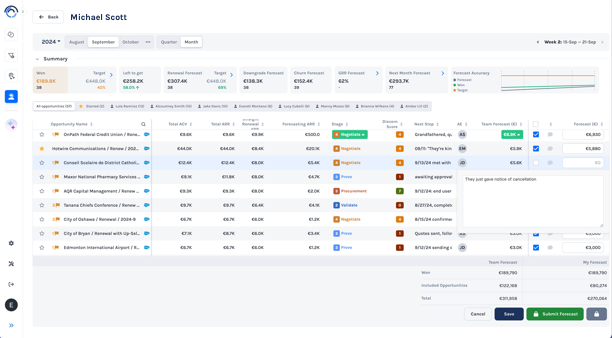
Gong is a revenue analytics platform specifically designed for RevOps teams. It focuses on enhancing revenue generation by providing predictive insights to identify potential opportunities and optimize sales strategies. The solution also offers features for deal tracking and forecasting, making it a robust tool for revenue teams to consistently achieve and surpass their targets.

Best for Revenue Analytics Platforms for RevOps Teams

Expert Take

Gong excels in providing AI-driven revenue insights and predictive analytics, making it a top choice for RevOps teams. Its integration capabilities with major CRM platforms and detailed forecasting features further enhance its value proposition. While enterprise-level pricing and initial setup requirements may present challenges, the platform's robust capabilities justify its premium positioning.
Pros

  • AI-driven revenue insights
  • Real-time deal tracking
  • Sales strategy optimization
  • Accurate forecasting
  • Integration with major CRM platforms

Cons

  • Requires initial setup and integration
  • May be over-complex for small businesses
  • Enterprise-level pricing

Best for teams that are

  • Mid-to-large sales organizations focused on coaching and deal execution
  • Revenue leaders needing deep conversation analytics and pipeline visibility
  • Teams with complex sales cycles requiring AI-driven deal insights

Skip if

  • Small teams or startups with limited budgets due to high entry costs
  • Teams only needing basic meeting transcription or simple note-taking
  • Organizations not ready for deep analysis of every customer interaction

Best for teams that are

  • Mid-to-large sales organizations focused on coaching and deal execution
  • Revenue leaders needing deep conversation analytics and pipeline visibility
  • Teams with complex sales cycles requiring AI-driven deal insights

Skip if

  • Small teams or startups with limited budgets due to high entry costs
  • Teams only needing basic meeting transcription or simple note-taking
  • Organizations not ready for deep analysis of every customer interaction

Pros

  • AI-driven revenue insights
  • Real-time deal tracking
  • Sales strategy optimization
  • Accurate forecasting
  • Integration with major CRM platforms

Cons

  • Requires initial setup and integration
  • May be over-complex for small businesses
  • Enterprise-level pricing

Expert Take

Gong excels in providing AI-driven revenue insights and predictive analytics, making it a top choice for RevOps teams. Its integration capabilities with major CRM platforms and detailed forecasting features further enhance its value proposition. While enterprise-level pricing and initial setup requirements may present challenges, the platform's robust capabilities justify its premium positioning.

9

Discern Sales Forecasting

Best for Forecast Accuracy and Pipeline Analytics Tools

Score
9.6 / 10
Discern Sales Forecasting

Discern Sales Forecasting is an AI-powered SaaS solution made specifically for sales leaders aiming to manage their sales pipeline more effectively and improve forecast accuracy. This tool is designed to cater to the unique needs of the industry, allowing sales professionals to optimize their operations, enhance sales performance, and make data-driven decisions.

Best for Forecast Accuracy and Pipeline Analytics Tools

Expert Take

Discern Sales Forecasting is a specialized tool for sales leaders, leveraging AI to enhance forecast accuracy and pipeline management. Its capabilities are well-documented, and it is recognized for its integration potential and data-driven approach. The product's premium positioning is supported by its focus on sales performance optimization.

Pros

  • Dual forecasting combines AI and human input
  • Unlimited free licenses for leadership viewers
  • Rapid implementation in 1-3 days
  • 200+ pre-built SaaS metric calculations
  • Backed by top-tier investor Insight Partners

Cons

  • Steep learning curve for non-technical users
  • Reports of data inaccuracy from some users
  • Customization limits for out-of-box dashboards
  • Requires clean CRM data for best results
  • Complex usage for those lacking metric knowledge

Best for teams that are

  • B2B SaaS companies focused on subscription metrics like ARR and MRR
  • Revenue leaders needing a "dual approach" combining AI and human intuition
  • Startups to mid-market firms needing investor-grade board reporting

Skip if

  • Non-subscription businesses that do not track recurring revenue metrics
  • Companies looking for a generic, industry-agnostic sales forecasting tool
  • Teams wanting a standalone tool without connecting multiple data silos

Best for teams that are

  • B2B SaaS companies focused on subscription metrics like ARR and MRR
  • Revenue leaders needing a "dual approach" combining AI and human intuition
  • Startups to mid-market firms needing investor-grade board reporting

Skip if

  • Non-subscription businesses that do not track recurring revenue metrics
  • Companies looking for a generic, industry-agnostic sales forecasting tool
  • Teams wanting a standalone tool without connecting multiple data silos

Pros

  • Dual forecasting combines AI and human input
  • Unlimited free licenses for leadership viewers
  • Rapid implementation in 1-3 days
  • 200+ pre-built SaaS metric calculations
  • Backed by top-tier investor Insight Partners

Cons

  • Steep learning curve for non-technical users
  • Reports of data inaccuracy from some users
  • Customization limits for out-of-box dashboards
  • Requires clean CRM data for best results
  • Complex usage for those lacking metric knowledge

Expert Take

Discern Sales Forecasting is a specialized tool for sales leaders, leveraging AI to enhance forecast accuracy and pipeline management. Its capabilities are well-documented, and it is recognized for its integration potential and data-driven approach. The product's premium positioning is supported by its focus on sales performance optimization.

10

Scoop Analytics for RevOps

Best for Revenue Analytics Platforms for RevOps Teams

Score
9.6 / 10
Scoop Analytics for RevOps

Scoop Analytics is a revolutionary SaaS solution for RevOps teams. It consolidates data and provides real-time, AI-driven insights, tailored to the unique needs of revenue analytics. Its streamlined reporting and customizable features make it an ideal choice for businesses looking to maximize their revenue operations.

Best for Revenue Analytics Platforms for RevOps Teams

Expert Take

Scoop Analytics for RevOps stands out in the revenue analytics space with its AI-driven insights and real-time data consolidation. Its tailored features for RevOps teams and customizable reporting capabilities make it a top choice for businesses seeking to enhance their revenue operations. Despite the lack of public pricing, its strengths in usability and market credibility justify its premium positioning.

Pros

  • Agentic AI performs multi-step investigations autonomously
  • Connects to 100+ sources including Salesforce/HubSpot
  • SOC 2 Type 2 Certified security architecture
  • No SQL or coding required for deep analysis
  • Generates presentation-ready slide decks automatically

Cons

  • Presentation canvas reported as buggy/clunky
  • Restrictive AI request limits on some plans
  • Real-time analysis capabilities are limited
  • Early-stage stability issues with some integrations

Best for teams that are

  • RevOps teams wanting AI insights without SQL or data engineering skills
  • Business users needing quick answers from Salesforce via plain English
  • Teams needing to blend spreadsheet data with CRM data instantly

Skip if

  • Large enterprises requiring complex, custom BI dashboards or streaming
  • Teams needing a fully mature, proven enterprise BI solution
  • Organizations requiring strict on-premise data handling

Best for teams that are

  • RevOps teams wanting AI insights without SQL or data engineering skills
  • Business users needing quick answers from Salesforce via plain English
  • Teams needing to blend spreadsheet data with CRM data instantly

Skip if

  • Large enterprises requiring complex, custom BI dashboards or streaming
  • Teams needing a fully mature, proven enterprise BI solution
  • Organizations requiring strict on-premise data handling

Pros

  • Agentic AI performs multi-step investigations autonomously
  • Connects to 100+ sources including Salesforce/HubSpot
  • SOC 2 Type 2 Certified security architecture
  • No SQL or coding required for deep analysis
  • Generates presentation-ready slide decks automatically

Cons

  • Presentation canvas reported as buggy/clunky
  • Restrictive AI request limits on some plans
  • Real-time analysis capabilities are limited
  • Early-stage stability issues with some integrations

Expert Take

Scoop Analytics for RevOps stands out in the revenue analytics space with its AI-driven insights and real-time data consolidation. Its tailored features for RevOps teams and customizable reporting capabilities make it a top choice for businesses seeking to enhance their revenue operations. Despite the lack of public pricing, its strengths in usability and market credibility justify its premium positioning.

How We Rank Products

Our Evaluation Process

Products in the Sales & Revenue Analytics Software category are evaluated based on their documented features, such as data visualization tools and reporting capabilities. Pricing transparency and the extent of software integrations with existing business systems are crucial for assessment. Additionally, third-party customer feedback provides insights into user satisfaction and software reliability, further informing the evaluation process.

Verification

  • Products evaluated through comprehensive research and analysis of sales and revenue metrics.
  • Selection criteria focus on key performance indicators and user satisfaction ratings in the analytics software category.
  • Comparison methodology analyzes customer feedback and expert reviews to determine the best sales and revenue analytics solutions.

Score Breakdown

0.0 / 10

About Revenue Analytics & Sales Intelligence Software

What is Revenue Analytics & Sales Intelligence Software?

This category covers software used to analyze revenue streams, optimize sales execution, and forecast future performance across the entire commercial lifecycle: capturing buyer signals, analyzing pipeline health, predicting forecast outcomes, and guiding seller behavior. It sits above the CRM (which serves as the system of record) and feeds into ERP systems (which handle financial reconciliation). It includes both general-purpose platforms capable of serving diverse B2B sales teams and vertical-specific tools built for complex industries like medical devices, financial services, and high-volume retail.

The core problem this software solves is the "insight gap" left by traditional Customer Relationship Management (CRM) systems. While CRMs excel at storing data, they often fail to interpret it. Revenue Analytics & Sales Intelligence Software transforms static data into dynamic guidance. It aggregates fragmented signals—email exchanges, calendar invites, call transcripts, and historical win rates—to answer not just "what happened?" but "what will happen?" and "what should we do next?"

The user base has expanded beyond sales leadership and operations. Today, these tools are critical for Chief Revenue Officers (CROs) managing board-level forecasts, frontline managers conducting pipeline reviews, and individual account executives seeking to prioritize their daily outreach. In mature organizations, Finance and Customer Success teams also leverage these platforms to align bookings forecasts with revenue recognition and capacity planning.

History of Revenue Analytics & Sales Intelligence

The evolution of Revenue Analytics & Sales Intelligence helps explain why the category exists in its current form. In the 1990s, the sales technology landscape was dominated by on-premise Contact Management systems and early Sales Force Automation (SFA) tools. These systems, pioneered by vendors who introduced the concept of database marketing, were essentially digital Rolodexes. The primary expectation from buyers was data storage: a place to log a name, a phone number, and a deal size. Analytics were limited to basic, retrospective reporting—telling leadership what sold last month, but offering little visibility into active deal risks.

The late 1990s and early 2000s marked the shift from on-premise software to the cloud. This era democratized access to sales data, allowing teams to collaborate in real-time. However, as cloud adoption exploded, a new problem emerged: the "database of lies." Because these early cloud systems relied entirely on manual data entry by sales representatives, the data was often incomplete, outdated, or optimistic. Sales leaders found themselves with a centralized database that was accessible from anywhere but trusted by no one. This created a functional gap between the CRM (the system of record) and the actual truth of the business.

From 2010 to 2015, the market saw a wave of vertical SaaS and point solutions attempting to fix specific parts of this broken process. Tools emerged specifically for predictive lead scoring, others for email tracking, and others for call recording. This fragmentation forced buyers to assemble "Franken-stacks"—disjointed collections of software that didn't talk to each other. Buyers began demanding consolidation. They no longer wanted a database; they wanted intelligence. They moved from asking "where do I store this contact?" to "which contact should I call first?"

The modern era, defined by the consolidation waves of 2018–2024, saw the rise of the "Revenue Platform." This shift was driven by the integration of Artificial Intelligence (AI) and Machine Learning (ML) directly into the workflow. Acquisitions shaped a landscape where standalone forecasting tools, conversation intelligence recorders, and engagement platforms merged. Today, the expectation is that the software automates data capture (solving the manual entry problem of the 2000s) and provides prescriptive guidance. The modern buyer assumes the software will listen to calls, read emails, and mathematically calculate the probability of a deal closing, replacing human intuition with data science.

What to Look For

When evaluating Revenue Analytics & Sales Intelligence Software, buyers must look beyond the user interface and scrutinize the underlying data architecture. The most critical evaluation criterion is automated activity capture. A system that relies on sales representatives to manually log emails, meetings, and contact details will inherently fail to provide accurate intelligence. You must verify that the platform connects directly to email servers (Exchange, Gmail) and calendar systems to scrape and associate activity with opportunities automatically, without human intervention.

Another critical factor is the granularity of the forecasting model. Generic tools often use simple weighted averages based on deal stage (e.g., "Stage 2 = 20% probability"). Sophisticated platforms utilize time-series analysis and AI that looks at behavioral signals—such as the number of days since the last executive engagement or the sentiment of recent email replies—to generate a "propensity to close" score. Ask vendors to demonstrate how their model handles "stalled" deals versus "lost" deals, and whether the model can be retrained on your specific historical data or if you are forced to use a generic industry model.

Red flags during evaluation include vendors who cannot explain their "black box" algorithms. If a system predicts a forecast number but cannot show the specific deal-level drivers contributing to that number (e.g., "Deal X increased by 15% probability because the CFO attended the demo"), adoption will suffer because sales leaders will not trust the output. Additionally, be wary of "platform lock-in" where the intelligence data is difficult to export back into your data warehouse or BI tools. The insights generated should be accessible to your broader data ecosystem, not trapped within the vendor's proprietary interface.

Key questions to ask vendors:

  • "How does your system handle 'orphan' data points, such as emails from contacts that do not yet exist in our CRM?" (The best systems create the contact; the worst ignore the data).
  • "Can we create custom forecast hierarchies that differ from our CRM reporting structure, such as overlaying product specialists or matrixed territories?"
  • "Does your conversation intelligence transcribe and analyze non-English languages natively, or does it rely on translation layers that may lose sentiment context?"
  • "What is the historical accuracy variance of your AI predictions for customers with similar deal volumes to ours after six months of deployment?"

Industry-Specific Use Cases

Retail & E-commerce

In the retail and e-commerce sector, Revenue Analytics software operates at a velocity and volume distinct from B2B environments. The primary focus here is not on managing a sales pipeline of negotiated contracts, but on high-volume churn prediction and customer lifetime value (CLV) maximization. E-commerce businesses use these tools to analyze thousands of micro-interactions—returns, support tickets, browsing behavior, and purchase frequency—to identify cohorts at risk of defecting. Unlike B2B tools that track "deal stages," retail analytics must track "recency, frequency, and monetary" (RFM) value changes in real-time.

Seasonality is a massive factor for this industry. A generic sales analytics tool might flag a post-holiday sales dip as a performance failure, whereas specialized retail intelligence software incorporates seasonal adjustment models. For example, robust tools in this space can differentiate between a structural decline in brand affinity versus a standard Q1 seasonal trough. According to research on e-commerce churn, seasonality can cause significant variations in customer base stability, and tools that fail to account for holiday spikes versus baseline sales will produce false alarms regarding revenue health [1].

Evaluation priorities for retail buyers should focus on identity resolution capabilities—the software's ability to stitch together a user's behavior across mobile apps, desktop browsing, and in-store point-of-sale systems into a single revenue profile. The unique consideration here is data volume; the platform must process millions of rows of transaction data without latency, a requirement that often breaks platforms designed for lower-volume B2B contract sales.

Healthcare

Healthcare and Life Sciences organizations face a unique "compliance-first" sales environment. Revenue analytics in this sector must handle complex buying committees that include physicians, hospital administrators, and procurement departments, often with conflicting incentives. The software here is less about "closing speed" and more about territory coverage effectiveness and complying with regulations like the Sunshine Act. Sales intelligence tools for medical devices, for example, often map referral networks to identify which physicians influence purchasing decisions at specific Integrated Delivery Networks (IDNs).

A critical unique consideration is HIPAA compliance and data privacy. Standard revenue intelligence tools that record calls and transcribe meetings may inadvertently capture Protected Health Information (PHI). Healthcare-specific solutions offer "redaction engines" that automatically detect and scrub patient names or medical details from sales conversations before the data is stored or analyzed. Additionally, the sales cycle in MedTech is often tied to capital equipment budget cycles, requiring forecasting models that can accommodate 12-to-24-month durations.

Evaluation priorities must include the ability to integrate with Electronic Health Record (EHR) proxy data (where legal) and specialized CRM verticals like Veeva. The focus is on maximizing the "share of wallet" within a hospital system rather than net-new logo acquisition. As noted in industry analyses, tracking the sheer complexity of multiple stakeholders and regulatory constraints makes general-purpose tools insufficient for high-stakes medical sales [2].

Financial Services

For Financial Services, particularly in wealth management and investment banking, revenue analytics is inextricably linked to regulatory recording and surveillance. Regulations such as MiFID II in Europe and Dodd-Frank in the US require rigorous record-keeping of all client communications. Consequently, Sales Intelligence software in this sector often serves a dual purpose: revenue optimization and compliance monitoring. The software must index every interaction not just for "deal sentiment" but for "risk detection," flagging phrases that might indicate promissory guarantees or insider trading risks.

The "product" in financial services is often relationship-based advice or complex financial instruments, meaning the "deal" is rarely a static SKU. Revenue analytics tools here use propensity modeling to identify cross-sell opportunities—for example, signaling that a commercial banking client has triggered a wealth management need based on a liquidity event. Research indicates that wealth managers using analytics for granular client insights can boost assets under management by significant margins by personalizing these offers [3].

When evaluating vendors, financial institutions prioritize on-premise or "private cloud" deployment options that guarantee data sovereignty. They also look for relationship mapping features that can visualize the complex web of intermediaries, advisors, and beneficiaries involved in institutional finance. The ability to integrate with legacy core banking platforms and trade order management systems is a mandatory technical requirement.

Manufacturing

Manufacturing revenue analytics differs fundamentally because it must bridge the gap between commercial demand and supply chain capacity. A sales forecast in manufacturing is not just a revenue prediction; it is a production order. If the sales team over-forecasts, the company accumulates excess inventory; if they under-forecast, they face stockouts and reputational damage. Therefore, Sales Intelligence software in this sector often functions as a demand planning interface, integrating heavily with ERP systems (like SAP or Oracle) rather than just the CRM.

Specific needs include "run-rate" analytics. Unlike software sales which deal in discrete contracts, manufacturers often have agreements for ongoing volume. Intelligence tools must track deviations in order patterns (e.g., "Client X usually orders 500 units/month but only ordered 200 this month") to flag revenue risks early. This concept of "account health" is tied to logistical performance as much as relationship sentiment.

AI-driven demand forecasting is transforming this space by incorporating external signals—raw material pricing, shipping lane disruptions, and weather patterns—into the sales forecast. Reports highlight that AI-enabled forecasting helps manufacturers reduce inventory levels and minimize waste by anticipating these shifts better than manual spreadsheets [4]. Evaluators should prioritize tools that support "product-level" forecasting hierarchies, allowing sales reps to forecast by SKU or product family, which is essential for production planning.

Professional Services

In Professional Services (consulting, legal, agencies), revenue is a function of time and talent. Revenue Analytics software here focuses on Billable Utilization and Project Profitability. The sales forecast must translate "closed deals" into "resource requirements." If the sales team closes three large projects starting next month, the software needs to flag if the firm lacks the consultants to staff them. This tight coupling of sales pipeline and resource management is unique to the sector.

A key metric tracked is the "realization rate"—the difference between the billable work sold and the revenue actually collected. Intelligence tools analyze historical project data to guide pricing strategies, warning partners if they are discounting a project type that historically runs over budget. This prevents the "winner's curse" of winning deals that are unprofitable to deliver.

Evaluation priorities should focus on services quoting automation (CPQ for services) and integration with Time & Materials tracking systems. As noted by industry experts, managing utilization is critical because it impacts revenue, profitability, and employee retention simultaneously; overworking staff to hit revenue targets leads to burnout, while underutilization destroys margins [5].

Subcategory Overview

Forecast Accuracy and Pipeline Analytics Tools

This subcategory is distinct from general revenue analytics because of its singular obsession with precision and probability modeling. While general tools might offer a dashboard showing total open pipeline, Forecast Accuracy tools provide a rigorous "sandboxing" environment where sales leaders can test different scenarios (e.g., "What happens to our Q4 number if we push all deals currently in negotiation to next quarter?").

One workflow that ONLY this specialized tool handles well is the hierarchical forecast rollup and adjustment process. In large enterprises, a forecast moves from a rep, to a manager, to a VP, to the CRO. At each level, the leader applies their own "judgment" or "override" to the number without changing the underlying CRM data. This tool maintains an audit trail of who changed the number and why, separating the "official" CRM data from the "committed" forecast number reported to the board. General tools rarely support this multi-layer judgment workflow with such auditability.

The pain point driving buyers here is the "spreadsheet chaos" before board meetings. Organizations find that their CRM data is too messy to trust, so they revert to Excel to build their commit numbers. They buy these specialized tools to digitize that specific aggregation workflow and apply AI "reality checks" against the human submissions. For a deeper look at the solutions dominating this space, refer to our guide to Forecast Accuracy and Pipeline Analytics Tools.

Revenue Analytics Platforms for SaaS Companies

SaaS companies face a unique revenue physics defined by recurring revenue (ARR/MRR) and retention cohorts. Generic analytics tools struggle to visualize the "waterfall" of SaaS revenue—tracking how a single cohort of customers expands, contracts, or churns over time. This subcategory is genuinely different because it natively understands concepts like Net Revenue Retention (NRR) and deferred revenue recognition (ASC 606) without requiring extensive custom coding.

A workflow that ONLY this specialized tool handles well is cohort analysis tied to subscription metrics. For example, it can instantly generate a "layer cake" chart showing how much of 2025's revenue is coming from the 2023 vintage of customers versus the 2024 vintage. It automates the calculation of complex SaaS metrics like CAC:LTV ratios and Magic Number, which require blending sales spend data with recognized revenue—a calculation that often breaks generic BI tools.

The specific pain point driving buyers to this niche is the inability of standard CRMs to handle subscription amendments. When a customer upgrades mid-term, a standard CRM might double-count the booking or fail to pro-rate the revenue. SaaS-specific platforms are built to handle these subscription lifecycle events accurately. To explore tools optimized for subscription economies, see our page on Revenue Analytics Platforms for SaaS Companies.

Revenue Analytics Platforms for RevOps Teams

RevOps (Revenue Operations) platforms are broader than sales tools; they are designed to unify data across the entire funnel—Marketing, Sales, and Customer Success. What makes this niche different is its focus on "full-funnel" attribution and data hygiene. Unlike sales-only tools that start when a lead becomes an opportunity, RevOps platforms ingest marketing engagement signals (web visits, ad clicks) and post-sale usage data to provide a holistic view of the customer journey.

One workflow unique to these tools is automated data orchestration and hygiene. These platforms often act as a "self-healing" layer that detects when a contact has moved companies (using external data signals) and automatically updates the CRM record, or identifies duplicate accounts across marketing and sales systems and merges them. They enable RevOps teams to build complex "lead-to-cash" process maps that trigger actions across different departments.

The pain point driving adoption here is the "silo effect." Marketing reports one number, Sales reports another, and Success reports a third. RevOps leaders buy these platforms to create a "single source of truth" that mathematically aligns these departments, ensuring that a "marketing qualified lead" is defined and tracked consistently through to a "renewed customer." For comprehensive solutions in this operational space, check out Revenue Analytics Platforms for RevOps Teams.

Integration & API Ecosystem

The success of Revenue Analytics software is entirely dependent on its ability to ingest data from your existing ecosystem. A tool that cannot seamlessly read your email traffic, calendar metadata, and CRM fields is effectively useless. In 2025, data silos remain the single biggest barrier to automation and AI success, with 80% of organizations citing them as a primary challenge [6]. Buyers must prioritize platforms with pre-built, bi-directional connectors to their specific "stack"—typically a CRM (Salesforce, HubSpot), an email provider (Google Workspace, Office 365), and often a sales engagement platform (Outreach, Salesloft).

Expert insight highlights that the real challenge isn't just connectivity, but data quality and API governance. As MuleSoft reports, while the average enterprise uses nearly 900 applications, only 29% are integrated, leading to fragmented customer views [7]. A robust Revenue Analytics tool acts as a hub, pulling these fragments together.

Scenario: Consider a 50-person professional services firm. They track deals in a CRM, but project hours are in a separate time-tracking tool, and invoices are in an accounting system. If they implement a Revenue Analytics tool that only connects to the CRM, they will see "closed won" revenue but will be blind to the actual billing reality. A poorly designed integration might sync the "deal value" once upon closing, but fail to update it when the project scope changes in the accounting system three months later. This leads to a forecast variance where the sales team thinks they delivered $1M, but Finance only sees $800k recognized. The integration must support ongoing synchronization of post-sale data to be effective.

Security & Compliance

Revenue Analytics platforms store your most sensitive commercial data: customer lists, pricing strategies, discount structures, and often verbatim recordings of negotiations. Security cannot be an afterthought. The financial stakes are massive; according to the 2024 IBM Cost of a Data Breach Report, the average cost of a data breach has reached $4.88 million globally, with healthcare and financial sectors facing even higher costs due to regulatory penalties [8].

Buyers must scrutinize the vendor's SOC 2 Type II attestation, ensuring it is recent and covers all relevant trust principles. Beyond standard encryption, look for Role-Based Access Control (RBAC) granularity. Can you ensure that a mid-level sales manager can only see revenue data for their territory, while the CRO sees the global view? In industries like financial services, you must also verify data residency options—can the vendor guarantee that your data stays within EU borders to comply with GDPR, or within the US for specific federal contracts?

Scenario: A healthcare technology company is evaluating a Conversation Intelligence tool to record sales calls. The sales team is excited about the AI coaching features. However, during the security audit, the CISO discovers that the vendor processes voice data using a third-party sub-processor that retains the right to use anonymized data to train its public AI models. This is a massive compliance violation for the healthcare firm, potentially exposing patient-related discussions to the public domain. The deal halts. A secure vendor would offer a "private tenant" model where data is isolated and never used to train shared models without explicit consent.

Pricing Models & TCO

Pricing in this category has evolved from simple per-user licenses to complex hybrid models. The most common structure is a per-seat subscription, typically ranging from $30/user/month for basic tools to over $250/user/month for comprehensive enterprise platforms [9] [10]. However, Total Cost of Ownership (TCO) often includes hidden "platform fees" (mandatory base costs ranging from $5k to $50k/year), implementation fees, and premium support costs.

Experts warn that buyers often underestimate the cost of "add-ons." Features like advanced AI forecasting, conversation intelligence recording hours, or additional API calls often come with surcharges. For enterprise deployments, the TCO can exceed the license cost by 25-35% when factoring in the internal resources required to manage and optimize the tool [11].

Scenario: Let's calculate the TCO for a 25-person sales team buying a mid-market Revenue Intelligence platform.

  • Licenses: 25 users @ $100/user/mo = $30,000/year.
  • Platform Base Fee: Mandatory fee for API access and security features = $5,000/year.
  • Implementation: One-time "Quick Start" package = $8,000.
  • CRM Storage Overage: The tool writes heavy data back to the CRM, pushing the team over their CRM's storage limits = $2,000/year additional to the CRM vendor.
  • Total Year 1 Cost: $45,000.
A buyer looking only at the "$100/month" list price might budget $30k and be surprised by the 50% variance. Always ask for a fully loaded multi-year quote.

Implementation & Change Management

The primary cause of failure in this category is not software bugs, but adoption resistance. Sales representatives are notoriously skeptical of tools that feel like "big brother" surveillance. If the implementation focuses solely on "management visibility" rather than "seller value," the tool will be rejected. 64% of organizations cite data quality as a top challenge, and without clean data, the AI insights will be hallucinations, further eroding trust [7].

Successful implementation requires a "give to get" strategy. You must demonstrate to the sales team that by allowing the tool to auto-capture their activity, they are saved 2-4 hours of manual data entry per week. Forrester and other analysts emphasize that investing in data literacy programs is essential; sellers need to understand how the signals are captured and why the AI is making specific recommendations [12].

Scenario: A global manufacturing firm rolls out a new forecasting tool. The Ops team spends three months configuring the backend but only one hour training the sales reps. The reps, confused by the new "AI Score," continue to forecast in their offline spreadsheets and paste the final number into the new tool just before the deadline. The result? The company is paying for an expensive AI platform, but the data inside it is just a copy-paste of manual spreadsheet math. The implementation failed because the workflow wasn't changed, only the interface was. A successful rollout would have involved "champions" from the sales team piloting the tool and proving that the AI score helped them spot risky deals they would have otherwise missed.

Vendor Evaluation Criteria

When creating your shortlist, move beyond feature checklists and evaluate the vendor's roadmap and partnership viability. The market is consolidating rapidly. Gartner predicts that by 2025, 75% of B2B sales organizations will replace traditional playbooks with AI-based guided selling solutions [13]. You want a vendor that is driving this shift, not one playing catch-up.

Critically, assess the vendor's "Time to Value." Ask for customer references specifically in your industry and size range. Ask those references: "How long after signing did you trust the forecast number?" A red flag is a vendor who promises "instant AI insights" without acknowledging the 4-8 week "learning period" the model needs to ingest your historical data and calibrate to your sales cycle. Beware of "black box" AI that cannot be tuned to your specific business logic.

Scenario: A buyer evaluates Vendor A and Vendor B. Vendor A has a slicker UI but refuses to do a Proof of Concept (POC) using the buyer's real data, citing "complexity." Vendor B has a steeper learning curve but agrees to a 2-week POC where they ingest 6 months of historical CRM data to show how their model would have predicted the last two quarters. Vendor B's willingness to be tested on your reality is a massive trust signal. Vendor A is likely hiding the fact that their "AI" requires pristine data that you don't have.

Emerging Trends and Contrarian Take

Emerging Trends 2025-2026: The dominance of Agentic AI is the next frontier. While 2023-2024 was about "Copilots" (assistants that summarize calls), 2025 is shifting toward autonomous agents that can execute tasks—updating the CRM, drafting emails, and even negotiating scheduling—without human prompting. Gartner predicts that by 2028, 60% of B2B seller work will be executed through conversational user interfaces via GenAI sales technologies [14]. Additionally, expect convergence: the distinct lines between "Sales Engagement," "Conversation Intelligence," and "Revenue Intelligence" will dissolve as platforms become all-in-one "Revenue Operating Systems."

Contrarian Take: Revenue Intelligence is often a band-aid for poor sales management. Many organizations buy expensive intelligence software hoping it will fix a broken sales culture. They believe that if they just have enough data, the "right answer" will appear. The uncomfortable truth is that for 80% of mid-market companies, the ROI of a $50k/year platform is lower than the ROI of hiring a single, competent Sales Operations analyst who enforces basic CRM discipline. The software excels at optimizing a working process, but it rarely fixes a broken one. If your reps don't know how to qualify a deal, no amount of AI sentiment analysis will save your quarter. The "intelligence" often gives false confidence to leaders who are managed by dashboards rather than being involved in deals.

Common Mistakes

Buying for the Executive, Not the Rep: The most fatal error is purchasing a tool that provides great dashboards for the CRO but adds friction for the Account Executive. If the tool doesn't make the rep's life easier (e.g., by automating data entry or summarizing calls), they will sabotage the data quality.

Underestimating Data Hygiene Requirements: "Garbage in, garbage out" applies tenfold to AI. Implementing a predictive model on top of a CRM full of duplicates and expired opportunities will yield confident but completely wrong predictions. Teams often skip the "data cleaning" phase in their rush to launch.

Ignoring Change Management: Rolling out a new platform without adjusting the sales cadence (e.g., how pipeline reviews are run) leads to tool abandonment. The software should replace the spreadsheet in the weekly meeting, not exist alongside it.

Overbuying Features: Paying for the "Enterprise" tier for features like "advanced attribution modeling" when the marketing team isn't even tracking UTM codes correctly is a waste of budget. Start with the core functionality and expand.

Questions to Ask in a Demo

  1. "Can you show me exactly what the sales rep sees and does daily? I want to see the workflow, not just the manager dashboard."
  2. "How does your model handle seasonality or anomalies? If we had a one-off huge deal last year, will that skew our baseline forecast forever?"
  3. "Show me how to override a forecast number. Does that override write back to the CRM, or does it only live in your tool?"
  4. "What specific signals do you use for the 'propensity to buy' score? Can we weight those signals differently (e.g., we value executive meetings more than email opens)?"
  5. "How do you handle 'multi-threaded' deals? Can the system group activity from 10 different stakeholders at one prospect account automatically?"
  6. "What is the process for exporting this data if we decide to leave your platform in two years?"

Before Signing the Contract

Final Decision Checklist:

  • Validation: Have we run a POC or seen a demo using our data structure?
  • Security: Has InfoSec approved the data handling and sub-processor list?
  • Stack Fit: Is the bi-directional sync with our specific CRM version confirmed (e.g., Salesforce Classic vs. Lightning, HubSpot Enterprise)?
  • Resource Check: Do we have a designated Admin/RevOps person to own this tool? (If the answer is "the VP of Sales will figure it out," do not sign).

Deal-Breakers to Watch For:

  • Data Hostage Clauses: Ensure the contract states that your data (including derived insights) belongs to you and can be exported in a usable format upon termination.
  • Auto-Renewal with Uplift: Strike out clauses that allow for automatic renewal with uncapped price increases. Cap annual uplifts at a reasonable CPI + percentage.
  • "AI Training" Rights: Be extremely cautious of clauses that grant the vendor a perpetual, royalty-free license to use your confidential sales data to "improve their services" (i.e., train models for your competitors).

Closing

Revenue Analytics & Sales Intelligence Software has shifted from a "nice-to-have" add-on to a critical infrastructure layer for modern sales organizations. By moving beyond simple data storage to active intelligence, these tools offer the promise of predictable growth—but only if selected and implemented with rigor. Avoid the hype, focus on the data architecture, and ensure the tool serves your sellers first.

If you have specific questions about how these tools fit your unique stack or need guidance on a specific vendor negotiation, feel free to reach out.

Email: albert@whatarethebest.com