
Employee Engagement & Pulse Survey Platforms

These are the specialized categories within Employee Engagement & Pulse Survey Platforms. Looking for something broader? See all HR & People Management Software categories.

1

CultureMonkey Engagement Platform

Best for Employee Engagement & Feedback Platforms for Recruitment Agencies
Score
9.9 / 10
CultureMonkey Engagement Platform

CultureMonkey is a perfect fit for recruitment agencies, as it aids in automating employee surveys and capturing feedback effectively. This SaaS solution is designed to enhance the employee engagement process, a crucial aspect for recruitment agencies aiming to attract and retain high-quality candidates.

Best for Employee Engagement & Feedback Platforms for Recruitment Agencies

Expert Take

CultureMonkey excels as a premium employee engagement platform tailored for recruitment agencies. It offers robust automation and analytics capabilities, enhancing employee feedback processes. While its enterprise pricing may limit transparency, its strong market credibility and usability justify its position as a top-tier solution.

Pros

  • Exceptional customer support rated 9.5/10 on G2
  • Omni-channel delivery via WhatsApp, Slack, and SMS
  • Deep sentiment analysis with AI-driven insights
  • Strong enterprise security (SOC 2, ISO 27001)
  • Seamless integration with Workday and other HRIS

Cons

  • Lacks native performance management or rewards modules
  • Exported reports may lose visual fidelity
  • Pricing is not transparent on the official site
  • Navigation can become complex for new admins
  • Focused solely on 'listening' vs full HR suite

Best for teams that are

  • Enterprises with large deskless or frontline workforces
  • Global companies requiring multilingual survey support
  • Organizations needing WhatsApp or SMS-based feedback

Skip if

  • Small businesses looking for a free, basic tool
  • Companies seeking a full-suite HRIS replacement
  • Teams that do not need mobile-first distribution

Best for teams that are

  • Enterprises with large deskless or frontline workforces
  • Global companies requiring multilingual survey support
  • Organizations needing WhatsApp or SMS-based feedback

Skip if

  • Small businesses looking for a free, basic tool
  • Companies seeking a full-suite HRIS replacement
  • Teams that do not need mobile-first distribution

Pros

  • Exceptional customer support rated 9.5/10 on G2
  • Omni-channel delivery via WhatsApp, Slack, and SMS
  • Deep sentiment analysis with AI-driven insights
  • Strong enterprise security (SOC 2, ISO 27001)
  • Seamless integration with Workday and other HRIS

Cons

  • Lacks native performance management or rewards modules
  • Exported reports may lose visual fidelity
  • Pricing is not transparent on the official site
  • Navigation can become complex for new admins
  • Focused solely on 'listening' vs full HR suite

Expert Take

CultureMonkey excels as a premium employee engagement platform tailored for recruitment agencies. It offers robust automation and analytics capabilities, enhancing employee feedback processes. While its enterprise pricing may limit transparency, its strong market credibility and usability justify its position as a top-tier solution.

2

Workvivo Employee Experience Platform

Best for Employee Engagement & Feedback Platforms for Private Equity Firms

Score
9.9 / 10
Workvivo Employee Experience Platform

Workvivo offers a unique combination of employee engagement and feedback tools specifically designed for private equity firms. It allows firms to measure and boost employee engagement, gather feedback through automated surveys, and gain deeper insights into the workforce. This platform is particularly beneficial for private equity firms where employee engagement directly influences productivity and deal sourcing efforts.

Best for Employee Engagement & Feedback Platforms for Private Equity Firms

Expert Take

Workvivo excels in providing tailored employee engagement and feedback tools for private equity firms, enhancing productivity and communication. Its market credibility is supported by third-party validations, while usability and value are well-documented. Limited customization and onboarding requirements are notable tradeoffs.

Pros

  • Tailored for private equity firms
  • Intuitive employee engagement metrics
  • Automated feedback collection
  • Actionable insights
  • Streamlined communication

Cons

  • Limited customization
  • Requires onboarding process
  • Higher price point

Best for teams that are

  • Mid-to-large enterprises (250+ employees) needing a social intranet and communication hub.
  • Organizations with deskless or frontline workers requiring mobile-first connectivity.

Skip if

  • Small businesses with fewer than 250 employees due to high minimum cost.
  • Teams seeking a dedicated performance management system rather than a communication tool.

Best for teams that are

  • Mid-to-large enterprises (250+ employees) needing a social intranet and communication hub.
  • Organizations with deskless or frontline workers requiring mobile-first connectivity.

Skip if

  • Small businesses with fewer than 250 employees due to high minimum cost.
  • Teams seeking a dedicated performance management system rather than a communication tool.

Pros

  • Tailored for private equity firms
  • Intuitive employee engagement metrics
  • Automated feedback collection
  • Actionable insights
  • Streamlined communication

Cons

  • Limited customization
  • Requires onboarding process
  • Higher price point

Expert Take

Workvivo excels in providing tailored employee engagement and feedback tools for private equity firms, enhancing productivity and communication. Its market credibility is supported by third-party validations, while usability and value are well-documented. Limited customization and onboarding requirements are notable tradeoffs.

3
Score
9.8 / 10
3
9.8 / 10
Culture Amp

Culture Amp is a leading SaaS solution specifically designed for companies seeking to enhance employee engagement and feedback. It offers a range of features such as AI analysis, customizable surveys, and integrated recommendations that address the unique needs of SaaS industry professionals, helping them to streamline HR tasks and optimize workforce management.

Best for Employee Engagement & Feedback Platforms for SaaS Companies

Expert Take

Culture Amp excels in providing a comprehensive employee engagement platform tailored for SaaS companies. Its AI-driven insights and customizable surveys enhance HR efficiency and workforce management. The product's strong market credibility and usability make it a top choice for organizations seeking to improve employee experiences.

Pros

  • Unified engagement and performance platform
  • Predictive analytics for turnover risk
  • Strong Slack and MS Teams integrations
  • SOC 2 Type II and ISO 27001 certified
  • Science-backed survey templates

Cons

  • High minimum annual cost (~$4,500)
  • Opaque pricing requires sales contact
  • Steep learning curve for analytics
  • HRIS integrations often gated
  • Navigation can be complex

Best for teams that are

  • Mid-to-large companies prioritizing data-backed culture insights
  • HR teams needing science-based survey templates
  • Organizations focused on retention and DE&I analytics

Skip if

  • Small teams with limited budgets or simple needs
  • Companies prioritizing performance management over engagement
  • Users seeking a highly flexible, custom-built survey tool

Best for teams that are

  • Mid-to-large companies prioritizing data-backed culture insights
  • HR teams needing science-based survey templates
  • Organizations focused on retention and DE&I analytics

Skip if

  • Small teams with limited budgets or simple needs
  • Companies prioritizing performance management over engagement
  • Users seeking a highly flexible, custom-built survey tool

Pros

  • Unified engagement and performance platform
  • Predictive analytics for turnover risk
  • Strong Slack and MS Teams integrations
  • SOC 2 Type II and ISO 27001 certified
  • Science-backed survey templates

Cons

  • High minimum annual cost (~$4,500)
  • Opaque pricing requires sales contact
  • Steep learning curve for analytics
  • HRIS integrations often gated
  • Navigation can be complex

Expert Take

Culture Amp excels in providing a comprehensive employee engagement platform tailored for SaaS companies. Its AI-driven insights and customizable surveys enhance HR efficiency and workforce management. The product's strong market credibility and usability make it a top choice for organizations seeking to improve employee experiences.

4
Score
9.8 / 10
4
9.8 / 10
Culture Amp Engage

Culture Amp Engage is a powerful employee engagement platform specifically designed for recruitment agencies. It offers deep insights into employee motivation, helping to foster engagement and act on survey feedback, thus addressing the unique needs of this industry where employee satisfaction and retention are key.

Best for Employee Engagement & Feedback Platforms for Recruitment Agencies

Expert Take

Culture Amp Engage stands out as a leading employee engagement platform tailored for recruitment agencies. It provides comprehensive insights into employee motivation and satisfaction, crucial for retention in this sector. The platform is recognized for its intuitive interface and actionable feedback capabilities, making it a preferred choice for industry professionals.

Pros

  • Backed by PhD-level I/O psychology research
  • Massive benchmarking dataset (1.5B+ data points)
  • ISO 42001 certified for AI governance
  • Deep integrations with Slack, Teams, and HRIS
  • Predictive analytics for employee retention

Cons

  • Opaque pricing with high minimum spend
  • Expensive for small teams (<100 employees)
  • Steep learning curve for advanced admin tools
  • Limited customization for complex survey logic
  • Support access can be tiered/limited

Best for teams that are

  • Data-driven HR teams in mid-to-large enterprises
  • Companies needing deep psychometric benchmarks
  • Organizations combining engagement with performance data

Skip if

  • Small startups with limited budgets
  • Teams wanting a simple, lightweight pulse tool
  • Organizations with no dedicated HR analyst resources

Best for teams that are

  • Data-driven HR teams in mid-to-large enterprises
  • Companies needing deep psychometric benchmarks
  • Organizations combining engagement with performance data

Skip if

  • Small startups with limited budgets
  • Teams wanting a simple, lightweight pulse tool
  • Organizations with no dedicated HR analyst resources

Pros

  • Backed by PhD-level I/O psychology research
  • Massive benchmarking dataset (1.5B+ data points)
  • ISO 42001 certified for AI governance
  • Deep integrations with Slack, Teams, and HRIS
  • Predictive analytics for employee retention

Cons

  • Opaque pricing with high minimum spend
  • Expensive for small teams (<100 employees)
  • Steep learning curve for advanced admin tools
  • Limited customization for complex survey logic
  • Support access can be tiered/limited

Expert Take

Culture Amp Engage stands out as a leading employee engagement platform tailored for recruitment agencies. It provides comprehensive insights into employee motivation and satisfaction, crucial for retention in this sector. The platform is recognized for its intuitive interface and actionable feedback capabilities, making it a preferred choice for industry professionals.

5
Score
9.8 / 10
Great Place To Work Surveys

Great Place To Work's Employee Survey Software is a dynamic tool for staffing agencies seeking to gauge the pulse of their workforce. It goes beyond just measuring engagement, capturing the full employee experience to help the agency understand their staff better, improve their workplace environment, and ultimately enhance their service delivery.

Best for Employee Engagement & Feedback Platforms for Staffing Agencies

Expert Take

Great Place To Work Surveys excels in providing comprehensive employee insights and benchmarking capabilities, making it a valuable tool for staffing agencies. While it lacks pricing transparency and has limited third-party integrations, its strengths in employee engagement and feedback collection justify its premium positioning.

Pros

  • Global standard for workplace culture benchmarking
  • Certified companies show ~4x stock market returns
  • Rigorous, research-backed Trust Index™ methodology
  • Strong employer branding and recruitment benefits
  • SOC 2 and GDPR compliant platform

Cons

  • Entry-level package lacks heatmaps and comments
  • No customization allowed in 'Assess' tier
  • Can be perceived as 'pay-to-play' for badges
  • Less flexible than modern pulse survey tools
  • Pricing transparency requires custom quotes

Best for teams that are

  • Companies seeking external employer branding and certification
  • Organizations prioritizing industry benchmarking against top peers

Skip if

  • Teams wanting continuous, real-time pulse feedback tools
  • Budget-conscious startups not interested in awards/certification

Best for teams that are

  • Companies seeking external employer branding and certification
  • Organizations prioritizing industry benchmarking against top peers

Skip if

  • Teams wanting continuous, real-time pulse feedback tools
  • Budget-conscious startups not interested in awards/certification

Pros

  • Global standard for workplace culture benchmarking
  • Certified companies show ~4x stock market returns
  • Rigorous, research-backed Trust Index™ methodology
  • Strong employer branding and recruitment benefits
  • SOC 2 and GDPR compliant platform

Cons

  • Entry-level package lacks heatmaps and comments
  • No customization allowed in 'Assess' tier
  • Can be perceived as 'pay-to-play' for badges
  • Less flexible than modern pulse survey tools
  • Pricing transparency requires custom quotes

Expert Take

Great Place To Work Surveys excels in providing comprehensive employee insights and benchmarking capabilities, making it a valuable tool for staffing agencies. While it lacks pricing transparency and has limited third-party integrations, its strengths in employee engagement and feedback collection justify its premium positioning.

6
Score
9.7 / 10
Lattice Employee Engagement

Lattice offers a comprehensive solution for SaaS companies looking to boost employee engagement and foster continuous improvement. Its centralized platform is tailored to the needs of HR teams in the SaaS industry, offering robust performance management, real-time feedback, and engagement tracking tools.

Best for Employee Engagement & Feedback Platforms for SaaS Companies

Expert Take

Lattice Employee Engagement is a specialized platform designed for SaaS companies, offering robust tools for performance management and real-time feedback. Its focus on the SaaS industry and comprehensive feature set make it a leading choice in its category, despite some limitations in advanced analytics.

Pros

  • Unified engagement and performance data
  • Deep Slack and Microsoft Teams integration
  • AI-powered sentiment and driver analysis
  • Robust anonymity and privacy controls
  • Extensive library of survey templates

Cons

  • $4,000 minimum annual contract
  • Reporting can be rigid/complex
  • Steep learning curve for admins
  • Not a standalone HRIS solution
  • Mobile app has limited admin features

Best for teams that are

  • Companies combining performance management with engagement
  • Growth-stage companies focused on continuous feedback
  • HR teams wanting a unified people success platform

Skip if

  • Organizations seeking a standalone survey-only tool
  • Very small businesses sensitive to per-user pricing
  • Teams needing complex, academic-grade survey customization

Best for teams that are

  • Companies combining performance management with engagement
  • Growth-stage companies focused on continuous feedback
  • HR teams wanting a unified people success platform

Skip if

  • Organizations seeking a standalone survey-only tool
  • Very small businesses sensitive to per-user pricing
  • Teams needing complex, academic-grade survey customization

Pros

  • Unified engagement and performance data
  • Deep Slack and Microsoft Teams integration
  • AI-powered sentiment and driver analysis
  • Robust anonymity and privacy controls
  • Extensive library of survey templates

Cons

  • $4,000 minimum annual contract
  • Reporting can be rigid/complex
  • Steep learning curve for admins
  • Not a standalone HRIS solution
  • Mobile app has limited admin features

Expert Take

Lattice Employee Engagement is a specialized platform designed for SaaS companies, offering robust tools for performance management and real-time feedback. Its focus on the SaaS industry and comprehensive feature set make it a leading choice in its category, despite some limitations in advanced analytics.

7

Yourco Employee Engagement

Best for Employee Engagement & Feedback Platforms for Contractors

Score
9.7 / 10
Yourco Employee Engagement

Yourco's SMS-based platform is designed specifically for the construction industry, providing managers with an effective and immediate way to connect with field workers. The platform facilitates real-time communication, enabling managers to send shift reminders, safety alerts, and company updates, thereby addressing the industry's need for efficient communication and increased employee engagement.

Best for Employee Engagement & Feedback Platforms for Contractors

Expert Take

Yourco Employee Engagement excels in providing industry-specific communication tools for the construction sector, enhancing real-time engagement and safety. Its market credibility is supported by its niche focus, though reliance on mobile connectivity and potential training needs are noted limitations.

Pros

  • No app download required
  • Free plan for 50 users
  • AI translation (135+ languages)
  • SOC 2 Type II certified
  • 98% message read rate

Cons

  • SMS character limits apply
  • Integrations gated to Enterprise
  • Not for desk-based workflows
  • Limited rich media features
  • No native video conferencing

Best for teams that are

  • Construction and manufacturing companies with non-desk crews.
  • Workforces with low smartphone data adoption (uses SMS, no app required).
  • Managers needing to send safety alerts and polls via text message.

Skip if

  • Corporate office environments where email or Slack is dominant.
  • Companies needing complex, long-form surveys or social feeds.
  • Organizations requiring a mobile app with rich media content.

Best for teams that are

  • Construction and manufacturing companies with non-desk crews.
  • Workforces with low smartphone data adoption (uses SMS, no app required).
  • Managers needing to send safety alerts and polls via text message.

Skip if

  • Corporate office environments where email or Slack is dominant.
  • Companies needing complex, long-form surveys or social feeds.
  • Organizations requiring a mobile app with rich media content.

Pros

  • No app download required
  • Free plan for 50 users
  • AI translation (135+ languages)
  • SOC 2 Type II certified
  • 98% message read rate

Cons

  • SMS character limits apply
  • Integrations gated to Enterprise
  • Not for desk-based workflows
  • Limited rich media features
  • No native video conferencing

Expert Take

Yourco Employee Engagement excels in providing industry-specific communication tools for the construction sector, enhancing real-time engagement and safety. Its market credibility is supported by its niche focus, though reliance on mobile connectivity and potential training needs are noted limitations.

8
Score
9.7 / 10
WorkBuzz HR Platform

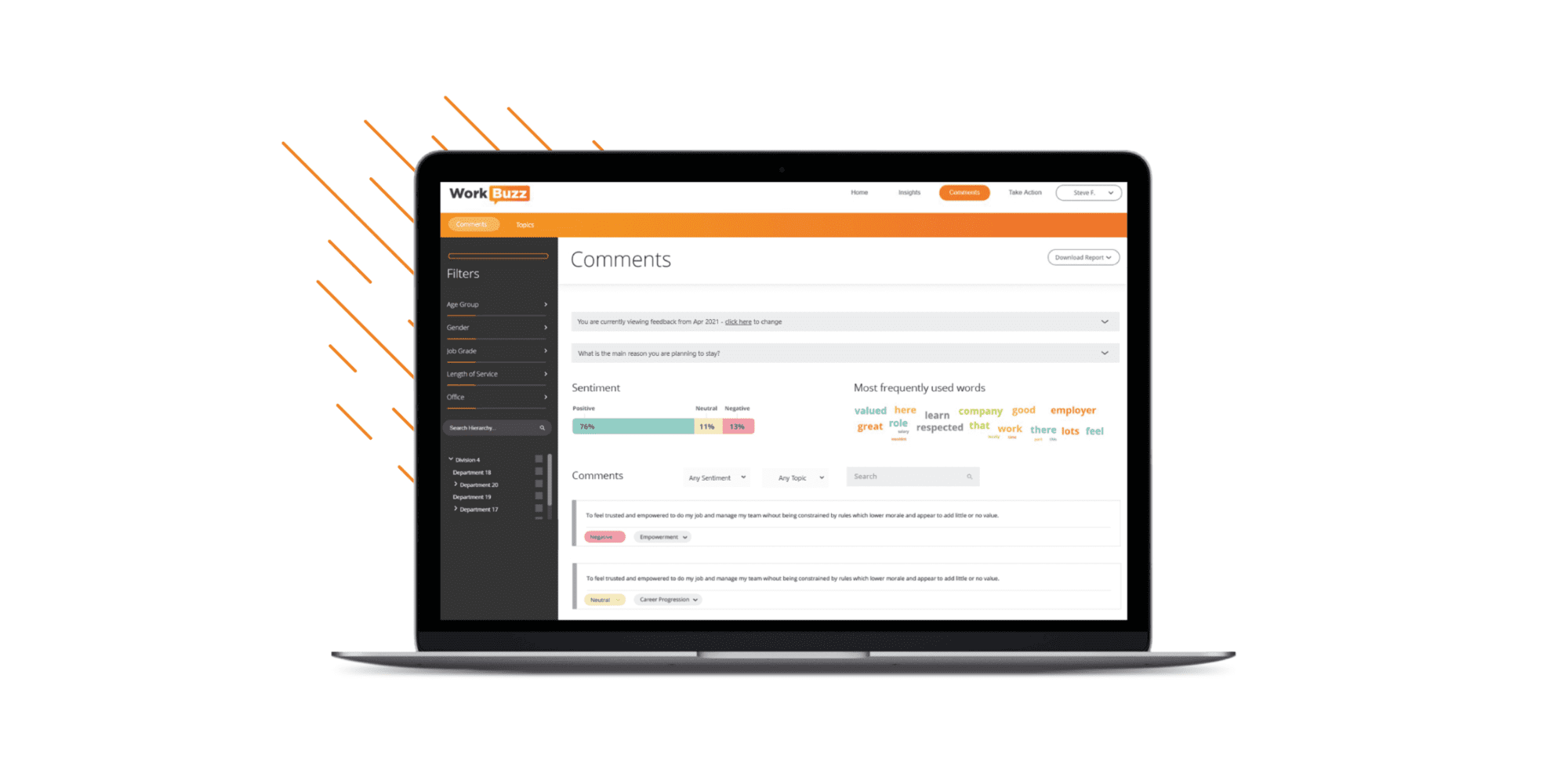
WorkBuzz is an HR platform specifically designed to drive employee engagement in private equity firms. Through this platform, HR leaders can deploy engaging surveys, analyze workforce sentiment in real time, and adapt their strategies based on actionable insights. Its value for private equity firms lies in its ability to foster a positive work environment, which in turn can boost productivity and profitability.

Best for Employee Engagement & Feedback Platforms for Private Equity Firms
Expert Take

WorkBuzz HR Platform excels in providing real-time workforce sentiment analysis and engaging survey creation, specifically tailored for private equity firms. Its ability to deliver actionable insights and adapt strategies effectively positions it as a leading solution in its niche, despite some customization limitations.

Pros

  • 98% client retention rate
  • Kiosk mode for deskless workers
  • ISO 27001 & Cyber Essentials certified
  • Dedicated People Science consultancy
  • NPS score of 83

Cons

  • Minimum 12-month contract
  • Reporting limits for complex enterprises
  • Basic integrations vs. enterprise peers
  • Pricing requires quote request
  • Setup takes 4-6 weeks

Best for teams that are

  • Mid-to-large organizations (500+ employees) with significant frontline or deskless workforces.
  • Companies needing flexible, accessible surveys (QR codes, kiosk mode) for remote staff.

Skip if

  • Very small businesses or teams (under 50 employees) looking for a lightweight tool.
  • Global enterprises requiring complex, seamless integration with niche global HR systems.

Best for teams that are

  • Mid-to-large organizations (500+ employees) with significant frontline or deskless workforces.
  • Companies needing flexible, accessible surveys (QR codes, kiosk mode) for remote staff.

Skip if

  • Very small businesses or teams (under 50 employees) looking for a lightweight tool.
  • Global enterprises requiring complex, seamless integration with niche global HR systems.

Pros

  • 98% client retention rate
  • Kiosk mode for deskless workers
  • ISO 27001 & Cyber Essentials certified
  • Dedicated People Science consultancy
  • NPS score of 83

Cons

  • Minimum 12-month contract
  • Reporting limits for complex enterprises
  • Basic integrations vs. enterprise peers
  • Pricing requires quote request
  • Setup takes 4-6 weeks

Expert Take

WorkBuzz HR Platform excels in providing real-time workforce sentiment analysis and engaging survey creation, specifically tailored for private equity firms. Its ability to deliver actionable insights and adapt strategies effectively positions it as a leading solution in its niche, despite some customization limitations.

9

ClearCompany Engagement Software

Best for Employee Engagement & Feedback Platforms for Staffing Agencies
Score
9.6 / 10
ClearCompany Engagement Software

ClearCompany's Employee Engagement Software is a comprehensive solution specifically designed to improve workplace culture in staffing agencies. It facilitates critical feedback and engagement using targeted surveys and robust analytics, addressing the unique needs of managing and engaging a diverse workforce.

Best for Employee Engagement & Feedback Platforms for Staffing Agencies

Expert Take

ClearCompany Engagement Software excels in providing tailored solutions for staffing agencies, with strong capabilities in analytics and survey tools. Its market credibility is supported by industry-specific features and integrations, although pricing transparency is limited due to custom quotes.

Pros

  • Unified platform connecting engagement, performance, and hiring
  • Strong bi-directional integration with ADP Workforce Now
  • SOC 2 Type II and CCPA compliant security
  • Mobile-friendly surveys and peer recognition tools
  • Includes pre-built templates for eNPS and DEIB

Cons

  • Reporting features can be rigid or limited
  • Support response times can lag (2-3 days)
  • Interface described as outdated by some users
  • Pricing is not publicly transparent
  • Template editing can be clunky

Best for teams that are

  • Mid-market firms needing a unified ATS and engagement suite
  • High-volume hiring industries like healthcare and manufacturing

Skip if

  • Small teams wanting a standalone, lightweight survey tool
  • Organizations not looking to replace their current ATS

Best for teams that are

  • Mid-market firms needing a unified ATS and engagement suite
  • High-volume hiring industries like healthcare and manufacturing

Skip if

  • Small teams wanting a standalone, lightweight survey tool
  • Organizations not looking to replace their current ATS

Pros

  • Unified platform connecting engagement, performance, and hiring
  • Strong bi-directional integration with ADP Workforce Now
  • SOC 2 Type II and CCPA compliant security
  • Mobile-friendly surveys and peer recognition tools
  • Includes pre-built templates for eNPS and DEIB

Cons

  • Reporting features can be rigid or limited
  • Support response times can lag (2-3 days)
  • Interface described as outdated by some users
  • Pricing is not publicly transparent
  • Template editing can be clunky

Expert Take

ClearCompany Engagement Software excels in providing tailored solutions for staffing agencies, with strong capabilities in analytics and survey tools. Its market credibility is supported by industry-specific features and integrations, although pricing transparency is limited due to custom quotes.

10

Officevibe Employee Feedback Solution

Best for Employee Engagement & Feedback Platforms for Recruitment Agencies

Score
9.6 / 10
Officevibe Employee Feedback Solution

Officevibe is a dedicated SaaS-based solution designed for recruitment agencies. It centralizes anonymous feedback, team insights, and pulse survey data to help managers grasp team sentiment and respond effectively. Its robust features align with the unique needs of this industry, assisting in improving employee engagement and retention.

Best for Employee Engagement & Feedback Platforms for Recruitment Agencies

Expert Take

Officevibe excels in providing a comprehensive employee feedback platform tailored for recruitment agencies. Its strengths lie in real-time feedback capabilities, intuitive user experience, and competitive pricing. While customization options are somewhat limited, its overall value and market credibility position it as a top-tier solution.

Pros

  • Seamless Slack and Teams integration
  • Strict anonymity builds employee trust
  • Intuitive and user-friendly interface
  • Automated weekly pulse surveys
  • Strong security (SOC 2, ISO 27001)

Cons

  • Performance features cost extra ($6/user)
  • Reporting can be surface-level
  • Limited customization for complex needs
  • Free plan has limited history
  • Support response times vary

Best for teams that are

  • SMBs and managers wanting quick team insights
  • Teams heavily using Slack or Microsoft Teams
  • Organizations focusing on manager-led engagement

Skip if

  • Large enterprises requiring deep custom surveys
  • Organizations needing complex offline survey methods
  • Companies wanting a centralized, top-down only tool

Best for teams that are

  • SMBs and managers wanting quick team insights
  • Teams heavily using Slack or Microsoft Teams
  • Organizations focusing on manager-led engagement

Skip if

  • Large enterprises requiring deep custom surveys
  • Organizations needing complex offline survey methods
  • Companies wanting a centralized, top-down only tool

Pros

  • Seamless Slack and Teams integration
  • Strict anonymity builds employee trust
  • Intuitive and user-friendly interface
  • Automated weekly pulse surveys
  • Strong security (SOC 2, ISO 27001)

Cons

  • Performance features cost extra ($6/user)
  • Reporting can be surface-level
  • Limited customization for complex needs
  • Free plan has limited history
  • Support response times vary

Expert Take

Officevibe excels in providing a comprehensive employee feedback platform tailored for recruitment agencies. Its strengths lie in real-time feedback capabilities, intuitive user experience, and competitive pricing. While customization options are somewhat limited, its overall value and market credibility position it as a top-tier solution.

How We Rank Products

Our Evaluation Process

Products in the Employee Engagement & Feedback Platforms category are evaluated based on documented features such as survey customization, reporting capabilities, and user management. Pricing transparency is critical, as is the platform's ability to integrate with other HR tools. Compatibility with existing systems is a significant factor, alongside third-party customer feedback, which provides insights into user satisfaction and real-world performance.

Verification

  • Products evaluated through comprehensive research and analysis of employee engagement metrics.
  • Selection criteria focus on key features such as feedback mechanisms, user experience, and integration capabilities.
  • Comparison methodology analyzes customer feedback and expert reviews to ensure reliable insights into platform effectiveness.

Score Breakdown

0.0 / 10

About Employee Engagement & Pulse Survey Platforms

What Is Employee Engagement & Pulse Survey Platforms?

This category covers software designed to measure, analyze, and improve the emotional commitment and psychological investment employees have in their organization across their full tenure. Unlike traditional HR systems that record status (hired, promoted, terminated), these platforms track sentiment and experience. Their operational lifecycle encompasses the continuous collection of feedback through pulse surveys, the analysis of open-text responses via natural language processing (NLP), the distribution of recognition and rewards, and the facilitation of action planning for managers. They provide the "voice of the employee" data layer that informs leadership decisions regarding culture, retention, and productivity.

It sits between Core HR/HRIS (which focuses on administrative records and compliance) and Performance Management (which focuses on individual output and appraisal). While Performance Management asks "how well is this employee working for the company?", Employee Engagement platforms ask "how well is the company working for this employee?". It is broader than simple survey tools (like SurveyMonkey) because it includes benchmarking, hierarchical reporting, and nudges for behavioral change, yet narrower than a full Employee Experience (EX) Platform, which often includes intranet, learning management (LMS), and benefits administration. The category includes both general-purpose platforms suitable for any office environment and vertical-specific tools built for complex workforce dynamics in industries like manufacturing, healthcare, and retail.

The core problem these platforms solve is the "feedback latency" gap. In the past, annual engagement surveys provided a autopsy of company culture—delivering insights months after employees had already disengaged or resigned. Modern pulse survey platforms solve this by treating engagement as a fluctuating metric rather than a static score, allowing leaders to diagnose burnout, lack of clarity, or management issues in real-time. Who uses it? While HR leaders own the system, the primary active users are people managers who need data to lead their teams effectively, and executives who monitor "cultural health" alongside financial KPIs.

History of the Category

The concept of "employee engagement" as a distinct management science is surprisingly young. In the 1990s, academic William Kahn formally coined the term "personal engagement," defining it as the harnessing of organization members' selves to their work roles [1]. Before this, the corporate world relied on the "job satisfaction" model from the 1930s—a passive measure of whether an employee was content, rather than psychologically invested. The 1990s marked the shift from viewing employees as inputs to be managed to assets to be motivated, yet the technology lagged behind the theory. For most of the decade, "measuring engagement" meant expensive, consultant-led annual paper surveys that took months to process. The gap that created this software category was the inability of ERP and early HRIS systems to capture qualitative human data; they could tell you an employee was present, but not if they were productive or flight risks.

The 2000s saw the rise of the first digital survey tools, but they were largely "database" solutions—digitized versions of the paper survey. The real inflection point arrived with the explosion of Vertical SaaS and the cloud transition in the early 2010s. As the "War for Talent" intensified post-recession, companies realized that annual data was insufficient. This led to the "Pulse" revolution—short, frequent check-ins designed to capture the heartbeat of the organization. Buyer expectations evolved drastically during this period: the demand shifted from "give me a report" to "give me actionable intelligence." It was no longer enough to know engagement was low; software had to tell a manager exactly why (e.g., lack of recognition, poor tools) and what to do about it.

Recent market consolidation has seen these standalone engagement tools being snapped up by larger Human Capital Management (HCM) suites, yet the standalone market remains vibrant due to the depth of analytics required. Today, the frontier has moved beyond simple surveys to "continuous listening" and AI-driven sentiment analysis. We are currently witnessing a shift where the "survey" itself is becoming secondary to passive data collection—analyzing communication patterns (metadata from Slack/Teams/Email) to predict burnout before an employee even answers a question. This evolution reflects a broader trend in enterprise software: the move from systems of record to systems of insight.

What to Look For

When evaluating Employee Engagement and Pulse Survey platforms, buyers must look beyond the user interface and scrutinize the validity of the data model. A critical evaluation criterion is the platform's Industrial-Organizational (I/O) Psychology backing. Does the vendor utilize a scientifically validated question set? Many flashy tools allow you to create custom questions easily, but without a validated framework, you risk gathering "vanity metrics" that look good but do not correlate with business outcomes like retention or profitability. You want a tool that benchmarks your data against relevant peers (e.g., "Tech companies with 500-1000 employees") rather than a generic global average.

Another crucial factor is hierarchy management and data isolation. In complex organizations, an employee might report to a functional manager, a project lead, and a regional director. The platform must handle matrixed reporting lines so that the right managers see the right feedback without compromising anonymity. Red flags include vendors that are vague about their "anonymity thresholds." If a team has only three people, the software should automatically suppress results or roll them up to the next level to prevent identifying respondents. A vendor that allows you to drill down to individual responses in small groups is a liability, not an asset.

Actionability is the final differentiator. The market is flooded with tools that are great at diagnosing illness but terrible at prescribing the cure. Look for platforms that offer "nudges" or "suggested actions" for managers based on survey results. If a team scores low on "Recognition," the system should prompt the manager with specific, bite-sized actions to take, or even integrate with a recognition module to facilitate immediate change.

Key questions to ask vendors:

  • "What is your k-anonymity threshold, and can it be customized by department?" (Standard is usually 5 responses; anything lower risks privacy violations).
  • "Does your benchmark data come from your own customer base, or do you purchase third-party data? How often is it refreshed?"
  • "How does the platform handle historical data if we restructure our teams? Do we lose the trend line?"
  • "Can the system correlate engagement scores with performance data from our HRIS to show proof of impact?"

Industry-Specific Use Cases

Retail & E-commerce

In retail, the primary challenge is the "deskless" workforce. Store associates do not sit in front of computers, so engagement platforms must be mobile-first and capable of functioning via SMS, QR codes, or kiosk modes. Evaluation priorities shift heavily toward ease of access and speed of completion; a survey that takes more than 3 minutes will see abandonment rates skyrocket. Retailers specifically look for correlations between engagement and shrinkage (theft) or customer satisfaction scores (CSAT). Research indicates that highly engaged retail teams can see up to 28% less shrinkage [2]. A unique consideration here is the high turnover rate; the platform must be able to deploy "exit surveys" automatically and analyze why staff are leaving in near real-time to stem the bleeding during peak seasons.

Healthcare

For healthcare organizations, employee engagement is literally a matter of life and death. The Magnet Recognition Program® by the ANCC requires hospitals to empirically demonstrate higher nurse satisfaction and engagement to achieve designation [3]. Therefore, healthcare buyers need platforms that offer specific "Magnet-compliant" reporting templates and benchmarks against other nursing units, not just generic companies. Burnout prediction is the top evaluation priority; with 46% of healthcare workers reporting burnout [4], systems must identify early warning signs like emotional exhaustion before they lead to patient safety incidents. Data privacy is also heightened; the platform must be HIPAA-compliant even if it doesn't store patient data, as it operates within a regulated environment.

Financial Services

In the financial sector, engagement is closely tied to Conduct Risk and compliance culture. Regulators increasingly view poor culture as a precursor to misconduct. Platforms here are used to measure "psychological safety"—do employees feel safe speaking up about errors or unethical behavior? Financial services firms prioritize longitudinal trend analysis to detect cultural erosion during mergers and acquisitions, which are frequent in the sector. A unique consideration is the "protected" nature of some employee groups; firewalls must exist between investment banking and research arms, and the survey platform must respect these "Chinese walls" in its reporting structures to prevent data leakage or conflicts of interest.

Manufacturing

Manufacturing environments share the "deskless" challenge of retail but add a critical layer: Safety. There is a documented correlation where top-quartile engaged teams see 70% fewer safety incidents [5]. Consequently, manufacturing buyers look for platforms that can integrate safety "pulse checks" alongside engagement questions (e.g., "Do you have the equipment you need to do your job safely?"). The "Blue Collar" vs. "White Collar" divide is a specific pain point; the tool must be able to segment data distinctly between the shop floor and the corporate office, as the drivers of engagement for these two groups are often diametrically opposed. Kiosk integration for clock-in/clock-out areas is a standard requirement.

Professional Services

For law firms, consultancies, and agencies, the inventory is the people. High billable utilization rates often lead to burnout, so firms use these platforms to monitor the delicate balance between productivity and fatigue. An 80% utilization rate is often cited as a red line for burnout [6]. These buyers value 360-degree feedback mechanisms heavily, as feedback often comes from project peers rather than a single direct manager. The "Project-Based" survey is a unique workflow here: instead of surveying everyone quarterly, the system surveys a team immediately after a client engagement concludes to capture sentiment while it is fresh. This requires deep integration with Project Management software to trigger surveys based on project milestones.

Subcategory Overview

Employee Engagement & Feedback Platforms for Recruitment Agencies This niche serves agencies where the "employees" are recruiters driven by high-commission structures. What makes this distinct is the focus on incentive alignment and burnout related to KPIs. General tools measure "happiness," but tools in this space specifically measure satisfaction with commission structures and placement targets. One workflow ONLY this tool handles well is the correlation of engagement data with redeployment rates (the ability to place a candidate again). The pain point driving buyers here is the high turnover of top-billing recruiters; general tools fail to capture the specific frustrations of a sales-driven, high-pressure recruitment desk. For more, see our guide to Employee Engagement & Feedback Platforms for Recruitment Agencies.

Employee Engagement & Feedback Platforms for Contractors This subcategory deals with a non-permanent workforce, often involving distinct legal constraints. The defining difference is the mitigation of co-employment risk. General platforms treat everyone as an employee, but surveying contractors about "company culture" or "career growth" can be used as evidence of employment status in legal battles. Specialized tools phrase questions to focus on project clarity and resource availability rather than belonging. The specific pain point is "blended workforce visibility"—managers need to know if contractors are disengaged (risking project failure) without crossing legal lines into managing them like employees. Read more about Employee Engagement & Feedback Platforms for Contractors.

Employee Engagement & Feedback Platforms for Private Equity Firms These platforms are designed not for a single company, but for a portfolio of companies. The differentiator is the "Operating Partner Dashboard," which aggregates engagement scores across 20-30 different companies to identify leadership risks before they impact EBITDA. A workflow unique to this niche is the Value Creation Plan alignment—surveying portfolio leadership specifically on their alignment with the PE firm's 100-day plan. The driving pain point is "blind spots" in asset performance; PE firms buy this software to avoid being surprised by the resignation of a key CEO or a toxic culture that could devalue an exit. Explore Employee Engagement & Feedback Platforms for Private Equity Firms.

Employee Engagement & Feedback Platforms for SaaS Companies While SaaS companies use general tools, this niche focuses on engineering culture and product velocity. These tools often integrate with Jira or GitHub to correlate developer sentiment ("I feel blocked") with code output. A specific workflow is the "Sprint Retrospective" pulse—automating feedback cycles to align with agile development sprints rather than calendar quarters. The pain point driving this purchase is the fierce competition for technical talent; general tools don't capture the nuances of "developer experience" (DevEx) or technical debt frustration that causes engineers to quit. Check out Employee Engagement & Feedback Platforms for SaaS Companies.

Employee Engagement & Feedback Platforms for Staffing Agencies Distinct from recruitment agencies (which place permanent staff), staffing agencies manage large volumes of temporary workers deployed to client sites. The critical differentiator is remote/off-site connectivity. The tool must engage workers who physically work for a different company (the client) but are paid by the agency. A workflow unique to this is Net Promoter Score (NPS) for Candidates—measuring the temp's satisfaction with the client site to predict assignment completion. The pain point is "assignment abandonment"; agencies lose revenue when temps ghost, so they need tools to detect dissatisfaction with a client placement immediately. Learn more at Employee Engagement & Feedback Platforms for Staffing Agencies.

Deep Dive: Integration & API Ecosystem

The days of standalone engagement islands are over. A platform's value is now directly proportional to its ability to ingest context from other systems. The gold standard is a bi-directional sync with the HRIS (Human Resource Information System). This ensures that demographic data—tenure, gender, department, performance rating—is automatically updated. Without this, you are analyzing "anonymous" data with no context.

According to Gartner, by 2025, 60% of large enterprises will integrate their employee engagement data with performance and retention data to derive actionable insights [7]. Expert Josh Bersin has also noted that the market is moving toward "integrated employee listening," where survey data is combined with operational data.

Example Scenario: Consider a 50-person professional services firm. They use an engagement tool that doesn't integrate with their Project Management (PM) software or Invoicing system. An employee, "Sarah," reports low engagement scores on her pulse survey. The HR manager sees this but doesn't know why. If the systems were integrated, the engagement platform could ingest data from the PM tool showing Sarah has logged 60 hours a week for three weeks straight on a difficult client account. The "break" here is the lack of context—HR might try to "engage" Sarah with a gift card, when the actual solution (visible in the integrated data) is to staff a junior associate to help her. Poor integration leads to "solution mismatch," where management solves the wrong problem.

Deep Dive: Security & Compliance

Security in this category goes beyond encryption; it centers on Anonymity and Pseudo-Anonymity. The concept of "k-anonymity" is the industry standard, usually set to a threshold of 5. This means no data is reported unless at least 5 unique individuals have responded. European GDPR regulations complicate this further, as "employee sentiment" can be considered personal data if it can be reverse-engineered to identify a person.

The GDPR explicitly acknowledges that complete absence of re-identification risk is impossible, but requires "state of the art" measures to mitigate it [8]. A breach here isn't just a fine; it's a total collapse of employee trust. If employees believe their "anonymous" survey is being read by their boss, response rates drop to near zero, rendering the software useless.

Example Scenario: A mid-sized healthcare provider with 200 employees runs a "Diversity & Inclusion" survey. The platform is SOC2 compliant, but the HR administrator sets the reporting threshold to 3 instead of 5. A specific department has only one Black female employee. When the report is generated, filtering by "Demographic: Female" + "Ethnicity: Black" + "Department: Radiology" isolates her responses perfectly. She mentioned feeling marginalized by her manager. The manager reads the report, identifies her, and retaliates. The "security" of the software (encryption) held up, but the compliance logic failed, leading to a legal liability for the firm and a destroyed culture.

Deep Dive: Pricing Models & TCO

Pricing typically falls into two camps: Per Employee Per Month (PEPM) or Annual Flat Fee tiers. PEPM is standard for the mid-market and enterprise, ranging from $3 to $10 per user/month depending on the feature set (e.g., adding "Performance" modules usually doubles the cost) [9]. Small business tools often use tiered buckets (e.g., "$200/month for up to 50 users").

Hidden costs are the killer in TCO (Total Cost of Ownership). These often include "Implementation Fees" (consulting hours to set up the hierarchy), "Custom Benchmarking" fees, and "Manager Training" workshops. Gartner notes that organizations often underestimate the TCO of HR tech by 20-30% due to these professional services add-ons.

Example Scenario: A 150-person tech company evaluates two vendors. Vendor A offers $4/user/month ($7,200/year). Vendor B offers $7/user/month ($12,600/year). They choose Vendor A. However, Vendor A charges for every "Admin" user ($500/year) and requires a $3,000 "onboarding package." Furthermore, Vendor A does not automate the HRIS sync, requiring an HR admin to spend 5 hours a month manually updating CSV files. If the HR admin's time is valued at $50/hour, that’s $3,000/year in labor. The True TCO of Vendor A is $7,200 + $3,000 + $3,000 = $13,200. Vendor B included the integration and unlimited admins. The "cheaper" option was actually more expensive and less efficient.

Deep Dive: Implementation & Change Management

Software implementation is easy; cultural implementation is hard. The technical setup involves whitelisting emails, syncing the HRIS, and configuring the hierarchy. The failure point is almost always Change Management—preparing managers to receive feedback. If you launch a survey tool without training managers on how to have "post-survey conversations," you will decrease engagement, not increase it. This is known as the "Feedback Void."

McKinsey research highlights that companies successful in transformation are 1.5 times more likely to have clear change-management goals [10]. In the context of engagement software, this means defining who is responsible for the score.

Example Scenario: A manufacturing firm rolls out a new pulse app to 500 factory workers. They put up posters and send one email. Participation in the first month is 80%. The results show deep dissatisfaction with shift scheduling. Management ignores this because "we can't change the schedule right now." They do not communicate why they can't change it; they just stay silent. By month 3, participation drops to 15%. The implementation "technically" worked (the app functions), but the initiative failed because the loop was not closed. The workers now feel more ignored than before they were asked.

Deep Dive: Vendor Evaluation Criteria

When selecting a vendor, look for Partnership vs. Product. At the enterprise level, you are buying the benchmark data and the I/O psychology expertise as much as the software. Does the vendor offer "Executive Readouts" where an organizational psychologist presents the findings to your C-Suite? This is often critical for getting executive buy-in for action plans.

Forrester emphasizes that the differentiator in the Employee Experience (EX) market is "deep research" capabilities—tools that go beyond surveys to include virtual focus groups and interaction analysis [11]. A vendor that only offers a library of templates is a commodity; a vendor that offers predictive intelligence (e.g., "Team B is at risk of turnover in 3 months based on current trends") is a strategic partner.

Example Scenario: A rapidly scaling SaaS company evaluates Vendor X and Vendor Y. Vendor X has a beautiful, Apple-like interface but standard question banks. Vendor Y has a clunkier interface but offers "Predictive Attrition Modeling" based on 10 million data points from the tech industry. The buyer chooses Vendor X for the UI. Six months later, key engineers quit. The exit interviews reveal issues that Vendor Y's model would have flagged as "risk factors" months earlier (e.g., perceived lack of career movement). The buyer optimized for User Experience (UX) when they should have optimized for Data Science validity.

Emerging Trends and Contrarian Take

Emerging Trends 2025-2026: The next frontier is Passive Listening and AI Agents. We are moving away from asking employees "How are you?" to inferring it from their digital exhaust. "AI Agents" will soon act as personal career coaches within these platforms, nudging employees to take time off or suggesting learning modules based on their sentiment [12]. Another trend is "Structured Flexibility"—using these tools to manage the hybrid work tension by coordinating in-office days based on team sentiment rather than top-down mandates [13].

Contrarian Take: Engagement is a lagging indicator; "Energy" is the leading one. Most platforms measure sentiment that has already crystallized. The industry is obsessed with "Engagement Scores" (eNPS) as the holy grail, but by the time a score drops, the damage is done. The contrarian insight is that organizations should stop optimizing for "Happiness" and start optimizing for "Friction Removal." High-performers don't leave because they aren't "happy" (a vague emotion); they leave because operational friction (bad tools, slow approvals, unclear goals) prevents them from doing their best work. Buying an engagement platform to fix a friction problem is like buying a thermometer to cure a fever. The mid-market is particularly guilty of over-surveying and under-fixing; most would get higher ROI from canceling the subscription and hiring one "Operations Fixer" to remove the blockers identified in the very first survey.

Common Mistakes

The "Launch and Abandon" Cycle: The most fatal mistake is treating the survey as the deliverable. A survey is a diagnostic; the deliverable is the action. Organizations often spend 3 months designing the perfect survey, 1 month collecting data, and 0 days taking action. This teaches employees that their feedback is a waste of time.

Over-Surveying (Survey Fatigue): Launching weekly pulses without the operational capacity to respond to weekly issues. If you ask a question, you incur a debt to answer it. If you can't pay that debt (fix the issue), don't ask the question. A quarterly cadence with high action is infinitely superior to a weekly cadence with low action.

Weaponizing the Data: Using engagement scores as a KPI for manager bonuses. This inevitably leads to "score gaming," where managers pressure teams to "score us a 10 so we get our bonus." This destroys the data integrity. The score should be a flashlight for the manager to see where to improve, not a baton to beat them with.

Questions to Ask in a Demo

  • "Show me the 'Manager View.' How does a frontline supervisor see their data versus a VP?"
  • "Can I see your library of 'Action Plans'? If a manager scores low on 'Trust,' what specifically does the system recommend they do?"
  • "How do you handle 'small n' reporting? If a team has 4 responses, what exactly does the report look like?"
  • "Can we benchmark our data against specifically [Industry X] companies of [Size Y], or is the benchmark just a general 'Global Average'?"
  • "What is the process for exporting raw data if we want to run our own regression analysis?" (If they say no, it's a red flag).
  • "Show me the mobile experience for a user without a corporate email address." (Crucial for frontline/retail).

Before Signing the Contract

Final Decision Checklist: Ensure you have a committed "Executive Sponsor" (not just HR). Without a C-level leader validating the importance of the tool, managers will ignore the "nudges." Verify the implementation timeline—vendors often promise "2 weeks" but complex integrations take 8-12 weeks. Check the Data Processing Addendum (DPA) for GDPR compliance if you have any EU staff.

Negotiation Points: Most vendors will negotiate on implementation fees and admin licenses. Push for "unlimited admins" so you aren't penalized for growing your HR team. Ask for a "Pilot Clause"—the ability to break the contract after 6 months if adoption thresholds aren't met. Deal-breakers should include: lack of SSO (Single Sign-On), vague data retention policies, or refusal to define clear anonymity thresholds in writing.

Closing

If you have specific questions about fitting these platforms into your unique tech stack or culture, I’m happy to offer a more tailored perspective. Reach out to me at albert@whatarethebest.com.