
AI Content & Copywriting Tools
These are the specialized categories within AI Content & Copywriting Tools. Looking for something broader? See all AI, Automation & Machine Learning Tools categories.
AutogenAI Proposal Writing
Best for AI Writing & Content Generation Tools for Contractors
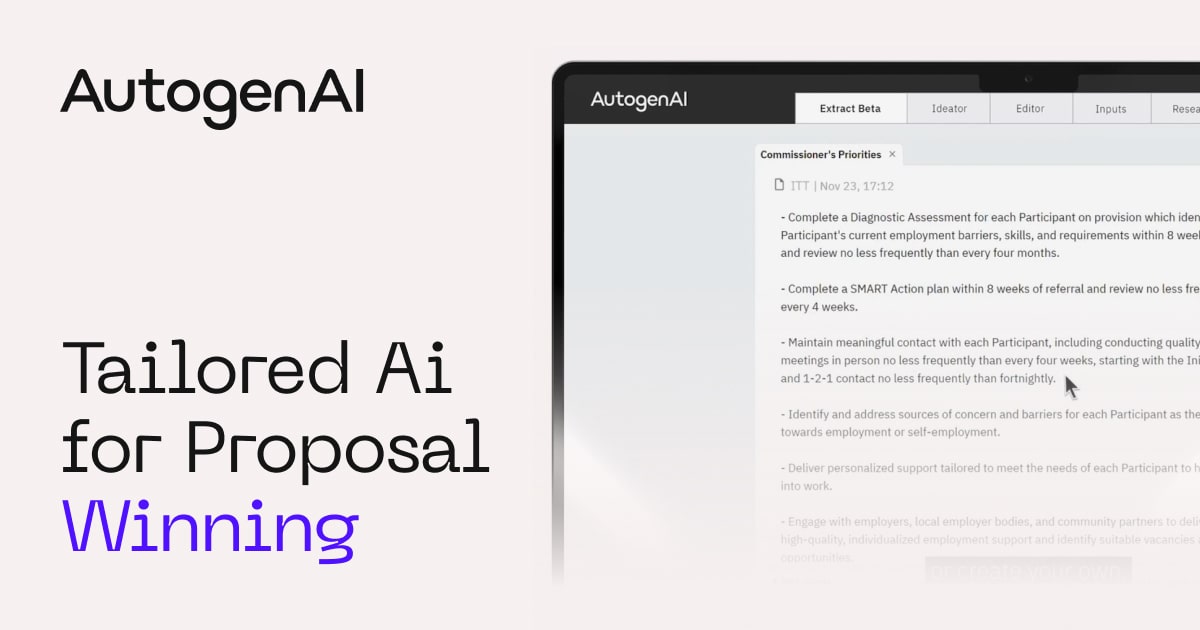
AutogenAI provides AI-driven solutions tailored to help contractors write winning proposals faster and with less effort. It's a revolutionary tool that understands the unique needs and language of the contracting industry, helping professionals create industry-specific content that boosts their success rate.
Best for AI Writing & Content Generation Tools for Contractors
Expert Take
AutogenAI Proposal Writing excels in providing AI-driven solutions tailored for the contracting industry, enhancing proposal success rates. Its user-friendly interface and industry-specific features make it a valuable tool for contractors. However, pricing transparency and customization options are areas with room for improvement.
Pros
- Custom language engines trained on client data
- DoD IL5 and FedRAMP High security controls
- Backed by Salesforce Ventures and Spark Capital
- Dedicated 'Federal' version for government contractors
- Claims 70% faster drafting speed
Cons
- High estimated entry cost ($30k+/year)
- No public pricing or self-service option
- Steep learning curve for some users
- Limited native integrations vs. competitors
- Minimum seat requirement (5+ licenses)
Best for teams that are
- Enterprises managing high-volume, complex bid responses
- Government contractors requiring strict security compliance
- Large teams needing scalable proposal automation
Skip if
- Small businesses or freelancers with limited budgets
- Users needing simple, creative marketing content
- Teams looking for a low-cost, self-service tool
Best for teams that are
- Enterprises managing high-volume, complex bid responses
- Government contractors requiring strict security compliance
- Large teams needing scalable proposal automation
Skip if
- Small businesses or freelancers with limited budgets
- Users needing simple, creative marketing content
- Teams looking for a low-cost, self-service tool
Pros
- Custom language engines trained on client data
- DoD IL5 and FedRAMP High security controls
- Backed by Salesforce Ventures and Spark Capital
- Dedicated 'Federal' version for government contractors
- Claims 70% faster drafting speed
Cons
- High estimated entry cost ($30k+/year)
- No public pricing or self-service option
- Steep learning curve for some users
- Limited native integrations vs. competitors
- Minimum seat requirement (5+ licenses)
Expert Take
AutogenAI Proposal Writing excels in providing AI-driven solutions tailored for the contracting industry, enhancing proposal success rates. Its user-friendly interface and industry-specific features make it a valuable tool for contractors. However, pricing transparency and customization options are areas with room for improvement.
WRITER Enterprise AI Platform
Best for AI Writing & Content Generation Tools for Marketing Agencies
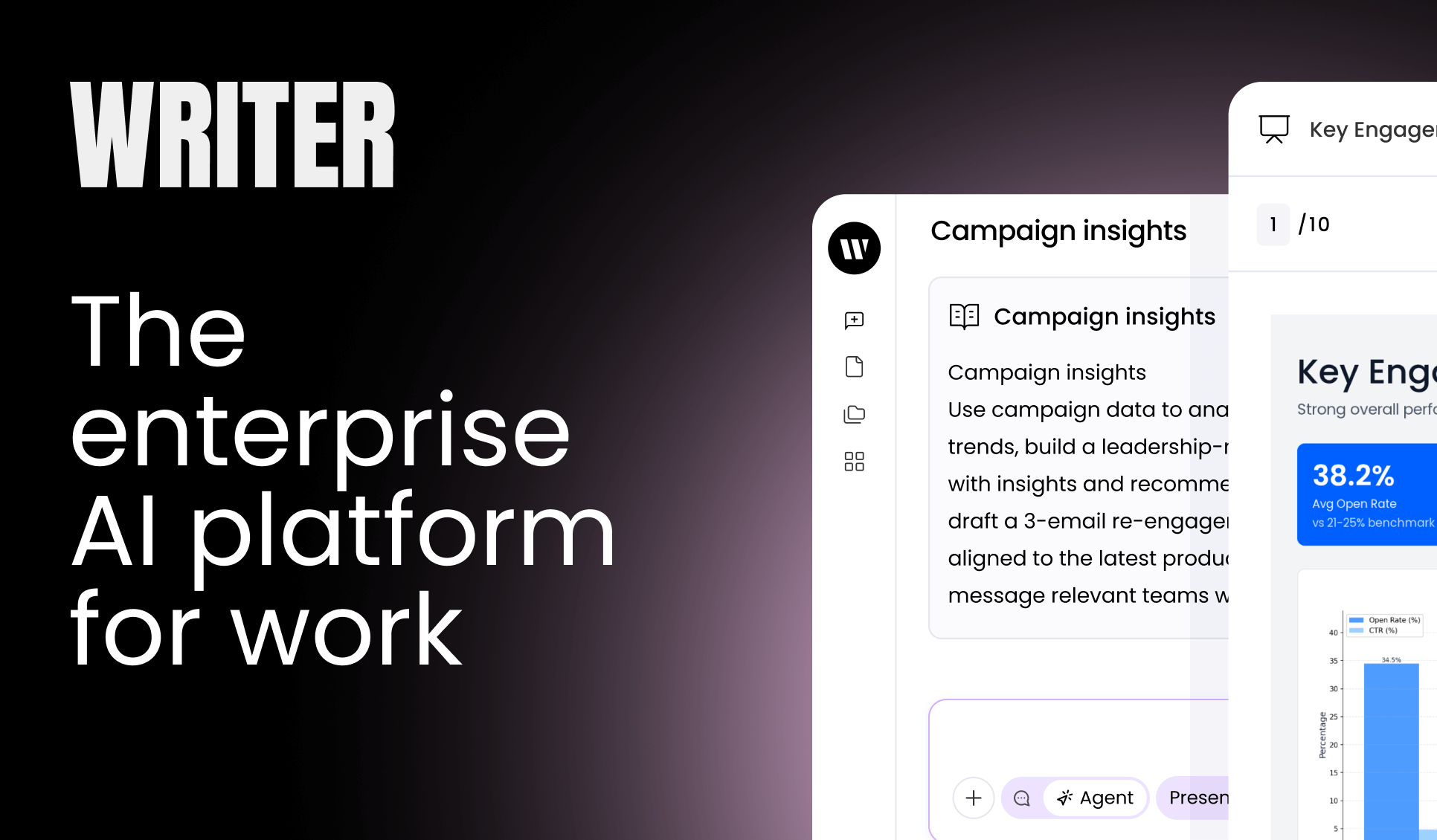
WRITER is a robust SaaS solution designed specifically for marketing agencies. It leverages AI to automate content generation, from campaigns and RFPs to personalized customer communications, helping agencies streamline their content production process and maintain brand consistency.
Best for AI Writing & Content Generation Tools for Marketing Agencies
Expert Take
WRITER Enterprise AI Platform excels in automating content generation for marketing agencies, ensuring brand consistency and supporting multiple languages. It offers robust API integration options, enhancing its adaptability within diverse agency environments. While it requires initial setup and training, its comprehensive capabilities justify its premium positioning.
Pros
- Proprietary Palmyra LLMs (Med, Fin, Creative)
- Zero data retention & ISO/SOC2 compliance
- Graph-based RAG for high accuracy
- No-code Agent Builder for business users
- Trusted by Uber, Vanguard, and Accenture
Cons
- Opaque enterprise pricing with hidden costs
- Steep learning curve for advanced features
- Starter plan has limited API access
- Support response times can be slow
- Implementation requires significant setup time
Best for teams that are
- Large enterprises in regulated industries like healthcare or finance
- Teams requiring strict adherence to brand style guides and terminology
- Organizations needing custom AI models trained on proprietary data
Skip if
- Individual freelancers seeking a creative writing assistant
- Small businesses with limited budgets and simple content needs
- Users looking for a magic button generator without setup or training
Best for teams that are
- Large enterprises in regulated industries like healthcare or finance
- Teams requiring strict adherence to brand style guides and terminology
- Organizations needing custom AI models trained on proprietary data
Skip if
- Individual freelancers seeking a creative writing assistant
- Small businesses with limited budgets and simple content needs
- Users looking for a magic button generator without setup or training
Pros
- Proprietary Palmyra LLMs (Med, Fin, Creative)
- Zero data retention & ISO/SOC2 compliance
- Graph-based RAG for high accuracy
- No-code Agent Builder for business users
- Trusted by Uber, Vanguard, and Accenture
Cons
- Opaque enterprise pricing with hidden costs
- Steep learning curve for advanced features
- Starter plan has limited API access
- Support response times can be slow
- Implementation requires significant setup time
Expert Take
WRITER Enterprise AI Platform excels in automating content generation for marketing agencies, ensuring brand consistency and supporting multiple languages. It offers robust API integration options, enhancing its adaptability within diverse agency environments. While it requires initial setup and training, its comprehensive capabilities justify its premium positioning.
Blaze AI Marketing
Best for AI Writing & Content Generation Tools for Marketing Agencies
Blaze is a unique SaaS solution that utilizes AI to automate and optimize marketing strategies for agencies. It's designed to fulfill the industry's need for efficient, effective, and scalable marketing strategies by creating, auto-posting, and learning from content to drive growth.
Best for AI Writing & Content Generation Tools for Marketing Agencies
Expert Take
Blaze AI Marketing excels in automating and optimizing marketing strategies for agencies. Its AI-driven features and scalability make it a top choice for marketing agencies looking to enhance efficiency and effectiveness. Despite the lack of pricing transparency, its robust capabilities and continuous learning features position it as a best-of-the-best product in its category.
Pros
- Automates 60+ content types
- Maintains consistent brand voice
- Multi-channel scheduling included
- High-quality customer support
- Cost-effective vs. agencies
Cons
- Limited native video creation
- Requires manual editing
- Occasional integration glitches
- Pricing increased recently
- Internet connection required
Best for teams that are
- Solopreneurs and small teams needing an all-in-one marketing workflow
- Marketers wanting to repurpose content across multiple channels quickly
- Users seeking brand voice consistency without complex enterprise setups
Skip if
- Large enterprises with complex, established marketing workflows
- Creators needing advanced video editing or robust graphic design tools
- Users looking for a free or very low-cost tool for occasional use
Best for teams that are
- Solopreneurs and small teams needing an all-in-one marketing workflow
- Marketers wanting to repurpose content across multiple channels quickly
- Users seeking brand voice consistency without complex enterprise setups
Skip if
- Large enterprises with complex, established marketing workflows
- Creators needing advanced video editing or robust graphic design tools
- Users looking for a free or very low-cost tool for occasional use
Pros
- Automates 60+ content types
- Maintains consistent brand voice
- Multi-channel scheduling included
- High-quality customer support
- Cost-effective vs. agencies
Cons
- Limited native video creation
- Requires manual editing
- Occasional integration glitches
- Pricing increased recently
- Internet connection required
Expert Take
Blaze AI Marketing excels in automating and optimizing marketing strategies for agencies. Its AI-driven features and scalability make it a top choice for marketing agencies looking to enhance efficiency and effectiveness. Despite the lack of pricing transparency, its robust capabilities and continuous learning features position it as a best-of-the-best product in its category.
Kiroku - Clinical Record Automation

Kiroku is a unique SaaS solution designed specifically for dental professionals. It uses advanced AI technology to transform voice into clinical notes, enhancing efficiency and ensuring compliance with automated audits. The software easily integrates with existing dental practice management applications, streamlining workflow and reducing administrative burden.
Best for AI Writing & Content Generation Tools for Dentists
Expert Take
Kiroku excels in transforming clinical documentation for dental professionals through AI-driven automation, ensuring compliance and efficiency. Its integration capabilities and industry-specific focus make it a standout solution in its niche.
Pros
- Registered Class 1 Medical Device
- 60% faster clinical note-taking
- Chrome extension for side-by-side workflow
- Does not store sensitive audio
- 50+ customizable dental templates
Cons
- Premium pricing vs free competitors
- Manual copy-paste for desktop PMS
- No audio playback for verification
- One-click insert limited to 3 apps
- Pro features locked behind $150/mo
Best for teams that are
- Dentists using cloud PMS like Dentally who want a browser extension overlay
- Clinicians who prefer clickable templates over pure voice dictation
- Budget-conscious practitioners seeking affordable note-taking automation
Skip if
- Practices wanting a fully hands-free, ambient listening experience
- Users needing deep server-side integration with legacy on-premise PMS
- Those wanting a mobile-app based solution rather than a browser tool
Best for teams that are
- Dentists using cloud PMS like Dentally who want a browser extension overlay
- Clinicians who prefer clickable templates over pure voice dictation
- Budget-conscious practitioners seeking affordable note-taking automation
Skip if
- Practices wanting a fully hands-free, ambient listening experience
- Users needing deep server-side integration with legacy on-premise PMS
- Those wanting a mobile-app based solution rather than a browser tool
Pros
- Registered Class 1 Medical Device
- 60% faster clinical note-taking
- Chrome extension for side-by-side workflow
- Does not store sensitive audio
- 50+ customizable dental templates
Cons
- Premium pricing vs free competitors
- Manual copy-paste for desktop PMS
- No audio playback for verification
- One-click insert limited to 3 apps
- Pro features locked behind $150/mo
Expert Take
Kiroku excels in transforming clinical documentation for dental professionals through AI-driven automation, ensuring compliance and efficiency. Its integration capabilities and industry-specific focus make it a standout solution in its niche.
AI Blogging Tool for Insurance
Best for AI Writing & Content Generation Tools for Insurance Agents

Tosten Marketing's AI Blogging Tool specifically caters to the wants and needs of insurance agencies. It streamlines the process of content creation by automatically generating quality blog content, freeing up valuable time for insurance agents to focus on other important aspects of their business.
Best for AI Writing & Content Generation Tools for Insurance Agents
Expert Take
The AI Blogging Tool by Tosten Marketing is a specialized solution for insurance agents, providing automated content creation tailored to the industry's needs. Its focus on industry-specific content and time-saving features positions it as a valuable asset for insurance agencies. However, the lack of transparent pricing and potential limitations in personalization are noted.
Pros
- Optimized for AI search (ChatGPT/Gemini)
- Hyper-localized state-specific content
- Includes AI-generated images/infographics
- Automated posting to agency website
- Managed by insurance industry experts
Cons
- Requires 1-year contract commitment
- Only for Tosten Marketing website clients
- Capped at 8 articles per month
- Exact tool pricing not public
Best for teams that are
- Agencies wanting fully automated, 'done-for-you' SEO blog posts
- Insurance agents who lack time to write or manage content manually
- Users looking for content specifically tailored to insurance niches
Skip if
- DIY marketers who want full granular control over the writing process
- Agents not looking for a managed service or website package
- Users needing content for social media or ads, rather than blogs
Best for teams that are
- Agencies wanting fully automated, 'done-for-you' SEO blog posts
- Insurance agents who lack time to write or manage content manually
- Users looking for content specifically tailored to insurance niches
Skip if
- DIY marketers who want full granular control over the writing process
- Agents not looking for a managed service or website package
- Users needing content for social media or ads, rather than blogs
Pros
- Optimized for AI search (ChatGPT/Gemini)
- Hyper-localized state-specific content
- Includes AI-generated images/infographics
- Automated posting to agency website
- Managed by insurance industry experts
Cons
- Requires 1-year contract commitment
- Only for Tosten Marketing website clients
- Capped at 8 articles per month
- Exact tool pricing not public
Expert Take
The AI Blogging Tool by Tosten Marketing is a specialized solution for insurance agents, providing automated content creation tailored to the industry's needs. Its focus on industry-specific content and time-saving features positions it as a valuable asset for insurance agencies. However, the lack of transparent pricing and potential limitations in personalization are noted.
GravityWrite: AI Content Writer
Best for AI Writing & Content Generation Tools for Freelance Marketers
GravityWrite is a game-changer for freelance marketers looking to optimize their content creation process. It not only helps generate high-quality content for blogs, SEO, and marketing at a fast pace but also ensures the content is SEO-friendly, both of which are crucial for digital marketing efforts.
Best for AI Writing & Content Generation Tools for Freelance Marketers
Expert Take
GravityWrite excels in providing AI-driven content generation tailored for freelance marketers. It offers high-quality, SEO-optimized content creation with a user-friendly interface. While it has some limitations in customization and reliance on internet connectivity, its strengths in content quality and speed make it a top choice in its category.
Pros
- Access to 250+ specialized AI writing templates
- Includes AI Text Humanizer to bypass detection
- Supports content generation in 30+ to 70+ languages
- Affordable entry pricing at $8/month (billed yearly)
- All-in-one platform includes image and website builders
Cons
- Restrictive word count limits on free/starter plans
- Fewer integrations than competitors like Jasper
- AI image quality is average compared to dedicated tools
- Long-form content often requires manual editing
- No dark mode available in the interface
Best for teams that are
- Budget-conscious freelancers needing a vast library of content templates
- Creators managing multiple formats like YouTube scripts and blogs
- Users looking for AI Humanizer tools to bypass detection
Skip if
- Enterprises requiring deep software integrations or advanced security
- Users expecting publish-ready long-form content without manual editing
- Teams needing advanced collaboration and project management features
Best for teams that are
- Budget-conscious freelancers needing a vast library of content templates
- Creators managing multiple formats like YouTube scripts and blogs
- Users looking for AI Humanizer tools to bypass detection
Skip if
- Enterprises requiring deep software integrations or advanced security
- Users expecting publish-ready long-form content without manual editing
- Teams needing advanced collaboration and project management features
Pros
- Access to 250+ specialized AI writing templates
- Includes AI Text Humanizer to bypass detection
- Supports content generation in 30+ to 70+ languages
- Affordable entry pricing at $8/month (billed yearly)
- All-in-one platform includes image and website builders
Cons
- Restrictive word count limits on free/starter plans
- Fewer integrations than competitors like Jasper
- AI image quality is average compared to dedicated tools
- Long-form content often requires manual editing
- No dark mode available in the interface
Expert Take
GravityWrite excels in providing AI-driven content generation tailored for freelance marketers. It offers high-quality, SEO-optimized content creation with a user-friendly interface. While it has some limitations in customization and reliance on internet connectivity, its strengths in content quality and speed make it a top choice in its category.

Denti.AI Scribe is a software solution designed specifically for dentists, leveraging AI to generate structured clinical notes from patient-clinician conversations in real-time. It greatly simplifies note-taking and ensures comprehensive, accurate documentation, addressing the industry's need for efficient record-keeping.
Best for AI Writing & Content Generation Tools for Dentists
Expert Take
AI Dental Scribe excels in providing a specialized solution for dentists, leveraging AI to streamline clinical documentation. Its real-time transcription and tailored note-taking capabilities address specific industry needs, making it a top choice for dental professionals. While it requires high-quality audio and internet connectivity, its benefits in accuracy and efficiency are significant.
Pros
- Direct write-back to 10+ PMS
- FDA-cleared radiograph analysis available
- Supports 50+ languages
- Includes Voice Perio charting
- SOC 2 Type 1 certified
Cons
- No self-serve free trial
- Requires demo for onboarding
- Higher entry price than basic scribes
- Desktop setup needed for full sync
Best for teams that are
- Hygiene departments needing hands-free, voice-activated perio charting
- Dental practices seeking a combined solution for notes and perio charts
- Clinics using major PMS like Dentrix or Eaglesoft needing direct integration
Skip if
- Practices looking for a free or very low-cost basic dictation tool
- Users who only need simple text generation without PMS integration
- Solo dentists who do not perform periodontal charting
Best for teams that are
- Hygiene departments needing hands-free, voice-activated perio charting
- Dental practices seeking a combined solution for notes and perio charts
- Clinics using major PMS like Dentrix or Eaglesoft needing direct integration
Skip if
- Practices looking for a free or very low-cost basic dictation tool
- Users who only need simple text generation without PMS integration
- Solo dentists who do not perform periodontal charting
Pros
- Direct write-back to 10+ PMS
- FDA-cleared radiograph analysis available
- Supports 50+ languages
- Includes Voice Perio charting
- SOC 2 Type 1 certified
Cons
- No self-serve free trial
- Requires demo for onboarding
- Higher entry price than basic scribes
- Desktop setup needed for full sync
Expert Take
AI Dental Scribe excels in providing a specialized solution for dentists, leveraging AI to streamline clinical documentation. Its real-time transcription and tailored note-taking capabilities address specific industry needs, making it a top choice for dental professionals. While it requires high-quality audio and internet connectivity, its benefits in accuracy and efficiency are significant.
FormWise Dental AI Suite
FormWise offers a specialized AI writing and content generation solution specifically designed to meet the needs of dental professionals. The tool aids in generating patient-friendly treatment explanations, FAQs, and front desk scripts, enhancing patient communication and experience.
Best for AI Writing & Content Generation Tools for Dentists
Expert Take
FormWise Dental AI Suite excels in providing AI-driven content generation specifically for dental professionals, enhancing patient communication. Its market credibility is supported by its specialization, although the lack of transparent pricing is a noted limitation. The product's usability and industry-specific capabilities make it a strong contender in its niche.
Pros
- Native GoHighLevel integration
- White-label branding capabilities
- No-code AI tool builder
- Verified market traction ($104k MRR)
- Monetization via 'Login Mode'
Cons
- No documented HIPAA compliance
- Requires prompt engineering skills
- Monthly credit limits on plans
- No direct clinical software integration
- Platform dependency for hosting
Best for teams that are
- Marketing agencies wanting to resell white-label AI tools to dental clients
- SaaS entrepreneurs building custom dental lead magnets or internal tools
- Consultants creating proprietary AI toolkits for their coaching clients
Skip if
- Individual dentists looking for a ready-to-use clinical charting tool
- Practices without technical or marketing staff to configure the tools
- Clinicians seeking FDA-cleared diagnostic tools out of the box
Best for teams that are
- Marketing agencies wanting to resell white-label AI tools to dental clients
- SaaS entrepreneurs building custom dental lead magnets or internal tools
- Consultants creating proprietary AI toolkits for their coaching clients
Skip if
- Individual dentists looking for a ready-to-use clinical charting tool
- Practices without technical or marketing staff to configure the tools
- Clinicians seeking FDA-cleared diagnostic tools out of the box
Pros
- Native GoHighLevel integration
- White-label branding capabilities
- No-code AI tool builder
- Verified market traction ($104k MRR)
- Monetization via 'Login Mode'
Cons
- No documented HIPAA compliance
- Requires prompt engineering skills
- Monthly credit limits on plans
- No direct clinical software integration
- Platform dependency for hosting
Expert Take
FormWise Dental AI Suite excels in providing AI-driven content generation specifically for dental professionals, enhancing patient communication. Its market credibility is supported by its specialization, although the lack of transparent pricing is a noted limitation. The product's usability and industry-specific capabilities make it a strong contender in its niche.
Gradient AI: Insurance AI Solution
Best for AI Writing & Content Generation Tools for Insurance Agents

Gradient AI provides comprehensive AI solutions specifically tailored for the insurance industry. The platform offers advanced claims software and underwriting software that help manage risk effectively, making it a valuable tool for insurance professionals eager to leverage AI in their day-to-day operations.
Best for AI Writing & Content Generation Tools for Insurance Agents
Expert Take
Gradient AI excels in providing tailored AI solutions for the insurance industry, offering advanced capabilities in claims and underwriting. Its integration ease and predictive analytics are well-documented, making it a top choice for insurance professionals. However, the need for training and enterprise pricing may limit accessibility for smaller businesses.
Pros
- Vast data lake of tens of millions of policies
- Pre-built integrations with Duck Creek & Guidewire
- HITRUST certified and SOC 2 Type 2 compliant
- Documented ROI including 500% faster claim duration
- Specialized solutions for Health and Workers' Comp
Cons
- Active patent and trade secret litigation
- Pricing is not publicly available
- Mixed employee sentiment on management
- Requires integration for maximum workflow value
- Specialized focus limits utility outside insurance
Best for teams that are
- Insurance carriers needing AI for risk assessment and underwriting
- Claims departments automating cost prediction and triage
- Underwriters seeking data-driven decision support tools
Skip if
- Agents looking for marketing copy or blog content generation
- Small agencies needing creative writing assistance
- Users seeking social media management tools
Best for teams that are
- Insurance carriers needing AI for risk assessment and underwriting
- Claims departments automating cost prediction and triage
- Underwriters seeking data-driven decision support tools
Skip if
- Agents looking for marketing copy or blog content generation
- Small agencies needing creative writing assistance
- Users seeking social media management tools
Pros
- Vast data lake of tens of millions of policies
- Pre-built integrations with Duck Creek & Guidewire
- HITRUST certified and SOC 2 Type 2 compliant
- Documented ROI including 500% faster claim duration
- Specialized solutions for Health and Workers' Comp
Cons
- Active patent and trade secret litigation
- Pricing is not publicly available
- Mixed employee sentiment on management
- Requires integration for maximum workflow value
- Specialized focus limits utility outside insurance
Expert Take
Gradient AI excels in providing tailored AI solutions for the insurance industry, offering advanced capabilities in claims and underwriting. Its integration ease and predictive analytics are well-documented, making it a top choice for insurance professionals. However, the need for training and enterprise pricing may limit accessibility for smaller businesses.
Narrato AI Content Suite
Best for AI Writing & Content Generation Tools for Freelance Marketers

Narrato is a comprehensive AI-powered content creation and marketing software explicitly designed for freelance marketers. Its innovative features cater to the specific needs of this industry, encompassing everything from idea generation, content creation, optimization, team management to publishing. It is designed to streamline marketing workflows, enhance content quality, and boost productivity.
Best for AI Writing & Content Generation Tools for Freelance Marketers
Expert Take
Narrato AI Content Suite stands out in the AI writing and content generation space for freelance marketers by offering a comprehensive suite of tools that enhance productivity and streamline workflows. Its capabilities in content creation, optimization, and team management are well-documented, making it a top choice in its category.
Pros
- All-in-one content workspace
- AI Content Genie autopilot
- Built-in SEO content briefs
- Strong team collaboration tools
- Affordable starting price
Cons
- Basic social media scheduling
- AI output requires editing
- Character limits on plans
- Sparse native integrations
- No mobile app found
Best for teams that are
- Content agencies and teams needing end-to-end workflow management
- SEO experts looking to consolidate planning, creation, and briefs
- Teams managing high volumes of structured content like product descriptions
Skip if
- Brands seeking highly creative thought leadership without editing
- Users wanting a simple text generator without project management features
- Those needing deep native integrations with enterprise software
Best for teams that are
- Content agencies and teams needing end-to-end workflow management
- SEO experts looking to consolidate planning, creation, and briefs
- Teams managing high volumes of structured content like product descriptions
Skip if
- Brands seeking highly creative thought leadership without editing
- Users wanting a simple text generator without project management features
- Those needing deep native integrations with enterprise software
Pros
- All-in-one content workspace
- AI Content Genie autopilot
- Built-in SEO content briefs
- Strong team collaboration tools
- Affordable starting price
Cons
- Basic social media scheduling
- AI output requires editing
- Character limits on plans
- Sparse native integrations
- No mobile app found
Expert Take
Narrato AI Content Suite stands out in the AI writing and content generation space for freelance marketers by offering a comprehensive suite of tools that enhance productivity and streamline workflows. Its capabilities in content creation, optimization, and team management are well-documented, making it a top choice in its category.