


Ask any tradesperson or homeowner, and they'll tell you the same thing: our nation is in a shortage of willing, qualified workers. There aren't enough plumbers, electricians, HVAC technicians, and other skilled tradespeople to meet demand, and the gap is growing wider each day. A generation of experienced workers is retiring, training pipelines take years to produce replacements, and the businesses trying to hire can't find qualified candidates. What we're left with are businesses and independent handyworkers stretched beyond capacity, homeowners waiting months for essential repairs, and costs climbing on both sides. To learn more about this ongoing predicament, WhatAreTheBest.com surveyed 2,000 homeowners and 500 tradespeople, then combined their responses with Bureau of Labor Statistics (BLS) employment data, Google Trends search analysis, and federal workforce statistics to map where the shortage hits hardest and how it's reshaping the experience of maintaining a home.
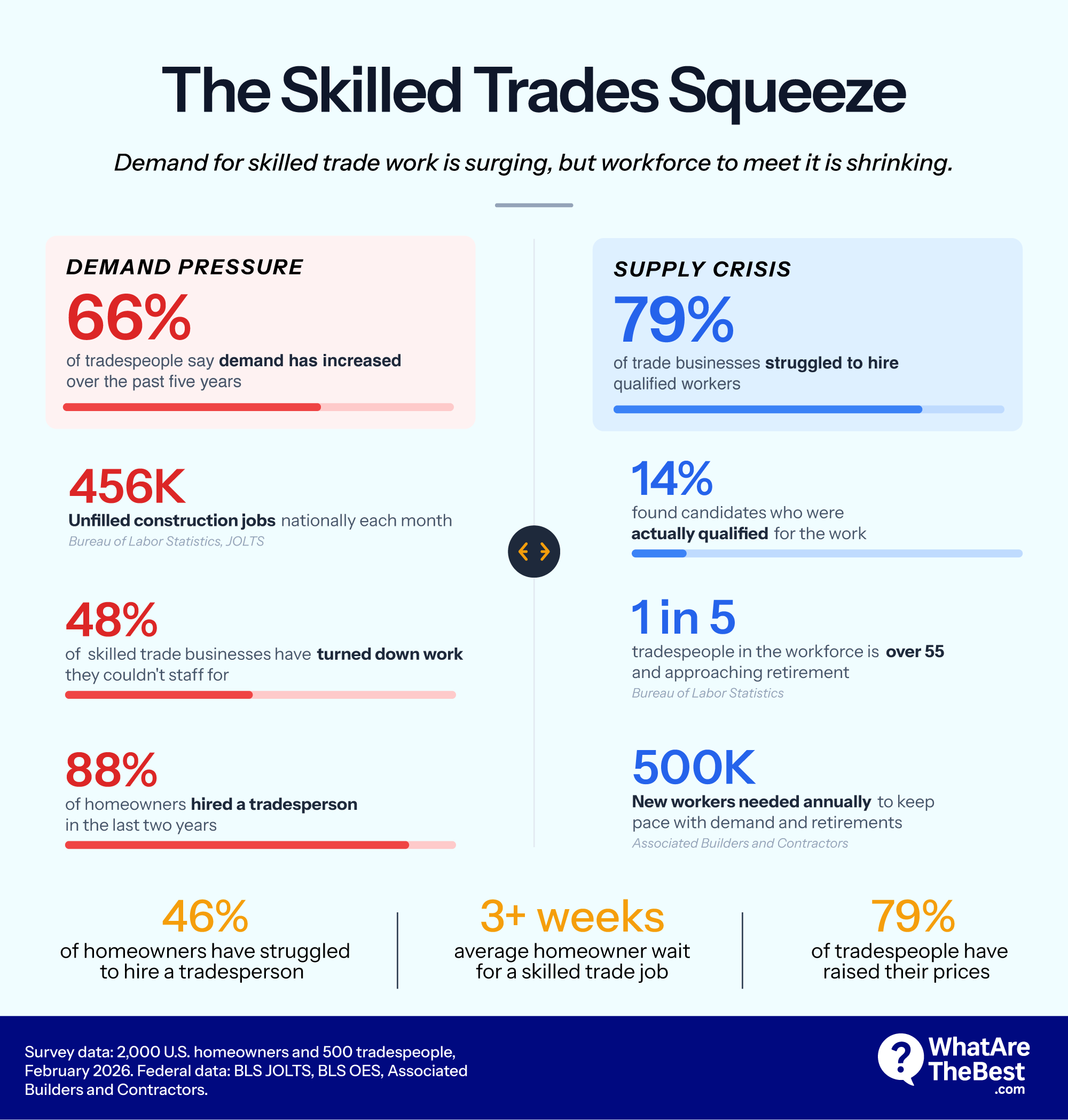
The United States is in the grip of a trade labor shortage that has been building for years and shows few signs of easing. According to the Bureau of Labor Statistics, there were more than 456,000 unfilled construction jobs in early 2024, and the Associated Builders and Contractors projects the industry needs to attract roughly 500,000 new workers annually just to keep pace with demand. The pipeline of new tradespeople cannot replace those leaving: more than 20% of the current construction workforce is over 55, and workforce growth has declined for three consecutive years.
Over 65% of those operating in the trades have reported that the demand for their services has increased in the past two years. But nearly eight in ten of those trying to hire have struggled to find qualified workers in the last two years.
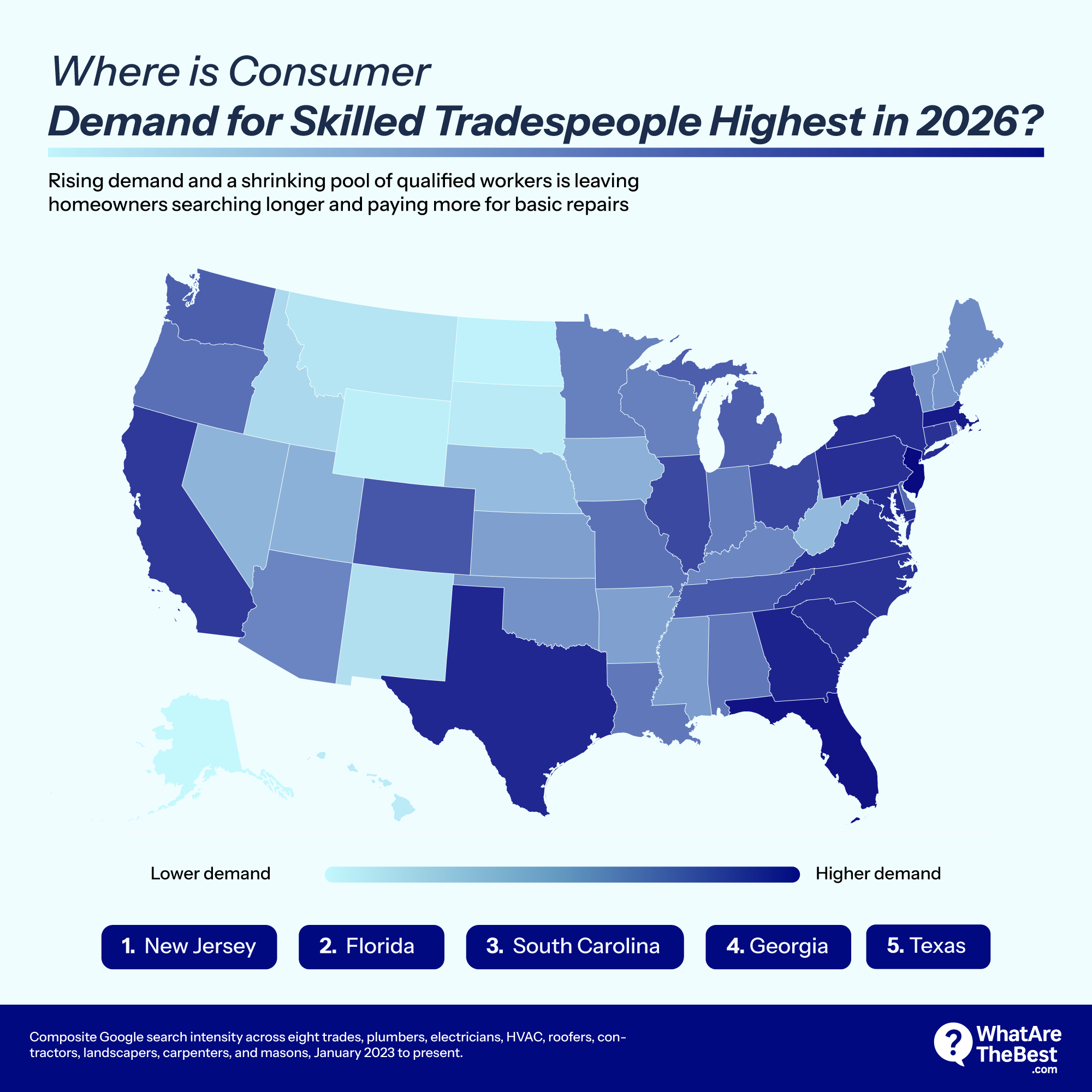
WhatAreTheBest.com's analysis of BLS employment data, Google Trends search patterns, and survey results from 2,000 homeowners reveals where the gap between supply and demand is widest. States with an aging housing stock, where homes are older and require more maintenance, face compounding pressure. In New York, the median home is 62 years old. In Rhode Island, 58. In Massachusetts, 57. These states consistently rank among the highest for consumer search interest in plumbers, electricians, and HVAC technicians, yet their per-capita tradesperson employment often falls short of national benchmarks.
Google Trends data for the period January 2023 through early 2026 illustrate where consumers are searching hardest for help. When search interest is averaged across all eight trade categories, New Jersey ranks first in the country, followed closely by Florida, South Carolina, Georgia, and Texas. The Southeast dominates the top ten, with North Carolina, Virginia, and Maryland all ranking among the highest-demand states. Notably, California, despite having the largest population in the country, ranks just 14th. Overall, states with older housing stock, dense suburban footprints, and high homeownership rates appear to generate the most consistent demand across trades.
On the other end of the spectrum, fast-growing Sun Belt states like Florida, Texas, and Georgia generate enormous demand through new construction and population growth, even though their housing stock is relatively young. The result is a nationwide squeeze: whether your home is 80 years old or 8, finding a qualified tradesperson has become a challenge.
The tradespeople shortage is self-reinforcing. Existing professionals are stretched thin, but they cannot hire their way out of the problem. Of the tradespeople in our survey who attempted to hire in the past two years, 79% either struggled to find qualified candidates or were unable to find anyone suitable at all. Only 14% reported finding qualified hires without significant difficulty.
The barriers are structural, not incidental. The most commonly cited challenge was a lack of applicants entirely (27%), followed by applicants who lack the necessary skills or certifications (22%) and candidates who expect higher pay than the business can offer (17%). Reliability was also a persistent concern, with 11% citing unreliable candidates as a top barrier.
These findings align with broader industry data. The Bureau of Labor Statistics reports that more than 20% of the current construction workforce is over 55, creating an accelerating retirement wave. Becoming a licensed plumber or electrician takes four to five years. HVAC apprenticeship programs typically last three to five years. The training pipeline simply cannot produce new tradespeople fast enough to replace those leaving, let alone keep up with growing demand.
To combat this, forward-thinking business owners are moving away from traditional classifieds and adopting Recruiting & Talent Acquisition Platforms for Contractors. By using specialized software to automatically distribute job postings across trade-specific boards and filter for required certifications, companies are attempting to cast a wider net and capture the fleeting attention of the few qualified apprentices and journeymen entering the market.
The National Association of Home Builders has found that finished carpentry faces a 65% labor shortage, making it one of the most strained specialties in residential construction. Only 37% of U.S. metro areas have above-average labor availability when measured by tradespeople per 1,000 households. The demographic math is working against the industry, even as interest in trade careers has shown encouraging signs: search traffic for trade schools increased 27% in 2024, according to industry data.
If the hiring numbers explain why the shortage exists, the day-to-day reality for tradespeople shows how it plays out. Our survey of 500 tradespeople across eight trades found that two-thirds (66%) report that demand for their services has increased over the past two years, with 35% describing the increase as significant.
That rising demand has created capacity problems. Nearly 2 in 5 (39.8%) of tradespeople say they have turned down work because they could not take on more, with 17% saying it happens monthly or more often. Among those experiencing increased demand, the figure is even higher. The downstream effects ripple through their businesses: 53% have raised prices to manage demand, 53% report working significantly more hours, and 49% have delayed projects or extended timelines for existing customers.
As demand outpaces capacity, something has to give. We asked tradespeople what has suffered most during high-demand periods. The answers paint a picture of an industry running on fumes.
Work-life balance was the #1 casualty, cited by 52% of respondents. Response time to new customer inquiries came second (34%), followed by communication with existing customers (30%) and administrative tasks (25%). Only 17% said quality of work had suffered, suggesting tradespeople are protecting their output standards at the expense of their personal time and customer communication.
To reclaim capacity and maximize the number of jobs they can complete in a day, a growing number of trade businesses are adopting Field Service Management (FSM) Platforms. These tools optimize routing, track technician locations, and manage digital work orders—operational changes that industry adoption data and our survey both reflect as a response to stretched capacity.
Part of the problem is operational. When asked how they manage scheduling and dispatching, 46% of tradespeople reported using no dedicated software. More than one in four (27%) rely entirely on pen and paper or memory. Another 18% use spreadsheets. Only 20% use dedicated field service or dispatching software, while 22% use general business tools like calendar apps.
For an industry where the average professional is juggling more jobs than ever, managing them with analog tools creates a compounding inefficiency. Missed inquiries, scheduling conflicts, and poor communication with customers are not just annoyances, they are lost revenue and eroded trust. The 34% of tradespeople who say response time has suffered are likely losing potential customers before they ever get a chance to bid on the work.
The operational strain on trade businesses has a direct consequence for the people trying to hire them. Our survey of 2,000 U.S. homeowners found that 88% had hired at least one tradesperson in the past two years, with plumbers (34%), electricians (32%), and HVAC technicians (30%) being the most commonly needed. These are essential, often urgent services; a burst pipe or a failed air conditioner in August is not something that can wait.
Yet nearly half of homeowners (46%) reported struggling to find an available tradesperson, with one in five saying this has happened multiple times. When asked which trade was hardest to find, plumbers topped the list (34% of those who struggled), followed closely by HVAC technicians (31%) and electricians (30%). Bloomberg has estimated the U.S. will be short 550,000 plumbers alone by 2027.
The wait times tell the story in practical terms. 41% of homeowners reported waiting three weeks or longer for a tradesperson, or being unable to find anyone at all. Nearly 4% said they simply could not find a single available professional. Meanwhile, 29% of homeowners have been turned down by a tradesperson who was too busy to take on their job, a situation that was virtually unheard of a decade ago.
Word-of-mouth remains the single most powerful channel for finding trade services, with 44% of homeowners relying on personal recommendations. Online search (47%) has effectively pulled even, while online marketplaces like Angi and Thumbtack are used by 19%. Social media accounts for just 10%.
That last finding is significant. For years, the conventional wisdom held that price was the primary driver of hiring decisions. Our data suggests the shortage has flipped that calculus. When you cannot find anyone to fix your furnace in January, cost becomes a secondary concern. Availability now edges out affordability as the factor homeowners value most.
One of the most striking findings in our research concerns the simple act of reaching a tradesperson by phone. When homeowners were asked about their experience calling tradespeople, 65% said they could not reach someone directly. Nearly 39% said their calls went to voicemail with no answer. Another 12% reached a third-party answering service instead of the tradesperson or their team, and 16% reported experiencing both.
For tradespeople who are on a job site, answering every call is impractical. But the consumer experience of not being able to reach anyone creates a real friction point. Among homeowners who were routed to a third-party answering service, the reactions were overwhelmingly negative:
75% of homeowners who reached an answering service had a negative reaction, either finding it frustrating, saying it made them less likely to hire the company, or hanging up entirely. Only 25% found the experience acceptable.
Because independent contractors are often on a job site and cannot answer the phone, the friction of booking a quote has become a primary pain point. In response to that dynamic—and to the 75% negative experience homeowners report when routed to an answering service—many trade businesses are adopting Appointment Scheduling & Booking Tools for Contractors, allowing homeowners to select an available time slot online and reducing reliance on phone tag.
From the trade's side, awareness of this problem is growing. Our survey found that 20% of tradespeople currently use some form of answering service (either third-party or AI-based), and an additional 31% have considered it. Among those using a service, results are mixed: 35% say it has helped them capture more leads, but 32% report a tradeoff between volume and customer satisfaction. When tradespeople are too busy to take on a job, 35% refer the customer to another tradesperson, 25% add them to a waitlist, 30% let them know they are unavailable, and 10% simply miss the inquiry entirely.
The economics of the shortage follow a predictable path: limited supply plus rising demand equals higher prices. Our data confirms it from both sides.
79% of tradespeople say they have raised their prices in the past two years. Of those, 24% describe the increase as significant (20% or more), 30% as moderate (10-20%), and 25% as slight (under 10%). On the consumer side, 89% of homeowners say hiring a tradesperson costs more than it did a few years ago, with 30% describing the increase as significant and 36% calling it moderate.
BLS data shows that average hourly earnings for residential building workers reached $38.76 in March 2025, representing a 4.5% year-over-year increase. While this marks a deceleration from the peak wage growth of 9.3% observed in mid-2024, wages remain on a sustained upward trajectory. For small trade businesses, the choice is straightforward: raise prices to match the rising cost of labor and materials, or risk running the business at unsustainable margins while demand continues to climb.
The price increases are not uniform across trades or geographies. BLS wage data shows significant state-by-state variation. Plumbers in Illinois earn a mean annual wage above $80,000, while those in Mississippi earn closer to $43,000. Electricians in New York average $77,000, compared to $45,000 in Arkansas. These disparities reflect not just cost-of-living differences, but localized supply-and-demand dynamics. In states where the shortage is most acute, wages, and consumer prices, have risen fastest.
This study combines original survey research with publicly available government data and search trend analysis.
Consumer Survey: A February 2026 survey of 2,000 U.S. homeowners was conducted regarding their experiences hiring tradespeople over the previous two years. Respondents were screened to confirm current homeownership. The survey covered hiring behavior, difficulty finding tradespeople, wait times, DIY attempts, communication experiences, and perceived cost changes. Demographic data including age, gender, household income, and state of residence was collected for each respondent.
Tradespeople Survey: A February 2026 survey of 500 U.S. tradespeople across eight trades (plumbers, electricians, HVAC technicians, roofers, general contractors, landscapers, carpenters, and masons) was conducted about demand changes, capacity constraints, hiring challenges, operational practices, and pricing. Respondents were weighted toward the most commonly hired trades (plumbers, electricians, general contractors) while ensuring representation across all eight categories.
Associated Builders and Contractors (ABC), 2024 Workforce Shortage Analysis. Home Builders Institute (HBI), Spring 2024 Construction Labor Market Report. American Home Shield, November 2024 Homeowner Survey. Hippo Insurance, 2024 Housepower Report. Bloomberg / Lixil, Plumber shortage economic impact analysis. National Association of Home Builders (NAHB), Labor availability and housing data.