


| Year | Content Revenue ($M) | Data & Services Revenue ($M) |
|---|---|---|
| 2022 | 793 | 39 |
| 2023 | 737 | 137 |
| 2024 | 760 | 175 |
| 2025 | 787 | 203 |
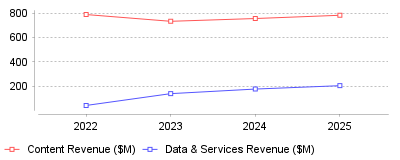
This data illustrates a dual transformation in the stock media category: the explosive adoption of AI asset generation alongside a strategic pivot toward B2B data licensing. While Adobe Firefly scaled from 1 billion to 24 billion generated assets in just two years [1], Shutterstock's "Data, Distribution, and Services" revenue soared from $39 million in 2022 to over $203 million in 2025 [2, 3].
On a micro level, individual stock contributors face a shifting landscape where traditional image royalty payments are under pressure from AI-generated alternatives. However, a new creator economy is forming around ethical data licensing, compensating artists whose aggregate work is used to train these AI models [4]. On a macro industry scale, legacy stock libraries are effectively transitioning into high-margin data infrastructure companies. The core value proposition of these platforms is shifting from providing ready-to-use creative assets to supplying the massive, curated metadata datasets required to build enterprise-grade generative systems.
This evolution secures the financial survival of traditional stock asset companies that might otherwise be rendered obsolete by text-to-image AI generators. Furthermore, it establishes a crucial framework for "commercially safe" AI generation, directly addressing the massive copyright concerns that have previously hindered large-scale enterprise adoption [5]. As an estimated 75% of Fortune 500 companies integrate tools like Adobe Firefly into their workflows [1], legally cleared training datasets have become an indispensable corporate commodity.
The primary catalyst was the viral explosion of early generative AI models, which disrupted creative workflows but quickly faced intense legal scrutiny over pervasive copyright infringement. In response to these legal risks, large enterprise clients demanded AI generation tools trained exclusively on properly licensed, ethical content. Stock libraries recognized they possessed exactly what the technology giants lacked: billions of high-quality, legally cleared images accompanied by rich, descriptive text metadata. By capitalizing on this unique asset, companies like Shutterstock transformed an existential threat into a highly lucrative, rapidly growing licensing opportunity [6].
The stock media category is no longer simply about licensing pre-made visuals to designers; it has fundamentally evolved into providing the foundational data layers for the world's generative AI platforms. As AI tools continue to generate tens of billions of digital assets, the enterprise demand for ethically sourced, legally vetted training data will only accelerate. Ultimately, the future profitability of stock media platforms lies not just in the final creative output, but in the raw data that teaches artificial intelligence how to create it.
Visual content libraries reached $6.73 billion in market value during 2024. Analysts project this sector will grow to $10.66 billion by 2032, representing a 6.05% compound annual growth rate [1]. Commercial stock media platforms face immediate pressure to diversify their revenue streams. Licensing basic photography no longer guarantees market dominance.
Shutterstock generated $935.3 million in 2024 revenue. The company saw a distinct division in performance across its product lines. Content revenue grew 3% to $760.0 million [2]. Meanwhile, its data and services division expanded 28% to $175.3 million. Data deals generated $120.3 million of that total. Buyers clearly prioritize algorithmic training data over traditional image downloads.
Getty Images reported $939.3 million in 2024 revenue [3]. Creative imagery licensing dropped 4.5% year over year to $552.8 million. Editorial revenue climbed 7.9% to $345.9 million. Subscriptions now account for 53.8% of Getty's total earnings. These figures highlight a structural transition within media operations. Corporate buyers want predictable monthly costs.
High-volume users reject restrictive pricing structures. Technology vendors rely on backend integrations to supply user interfaces with instant visuals. Product managers embed media libraries supporting software vendors directly into application programming interfaces. This invisible distribution model removes individual purchase friction.
The United States Copyright Office released Part 2 of its artificial intelligence report on January 29, 2025 [4]. Federal regulators denied copyright protection for media generated entirely by machine learning models. Text prompts do not demonstrate sufficient human authorship. The agency reviewed more than 10,000 public comments before finalizing this decision.
Officials will grant protection only when a human author determines the "expressive elements" of the final output [5]. The ruling relied heavily on the precedent set by Thaler v. Perlmutter. District courts previously upheld the Office's refusal to register images created autonomously by computer algorithms. Existing copyright principles remain flexible enough to handle technological innovations without new congressional legislation [6].
Legal teams must review digital assets carefully. Organizations risk publishing unprotectable content. Corporate advisors use asset repositories used by consulting teams to guarantee intellectual property compliance across international borders. Human modifications to artificial outputs may qualify for legal protection.
The Copyright Office provided three distinct examples where human authorship applies. First, users can copyright compilations that arrange machine-generated materials alongside human-authored content. Second, humans can copyright iterative modifications applied to artificial outputs. Third, humans retain authorship over original drawings fed into machine learning systems if the original work remains perceptible in the final output.

Licensing image datasets for machine learning models is highly profitable. Shutterstock secured $138 million in artificial intelligence data contracts during 2024 [7]. Technology firms purchase these indemnified libraries to train proprietary algorithms. This practice generates immediate cash flow.
Adobe restructured its compensation models to acquire training data. The company issued Firefly bonus payments to platform contributors throughout late 2024 and 2025 [8]. The 2025 distribution accounted for media approved between June 3, 2024, and June 2, 2025. Adobe reduced its minimum payout threshold from $25 to $1 to accelerate contributor disbursements [9]. These incentive programs secure the raw materials necessary for commercial algorithm development.
Vendors require vast quantities of cleared media to prevent future infringement lawsuits. Platform operators now hedge between present licensing opportunities and future risks. Supplying training data funds current operations but accelerates the development of algorithms that could eventually replace human photography.
Mattel deployed generative tools to accelerate product ideation during 2024. The toy manufacturer created four times as many concept images using automated systems compared to traditional methods [10]. This velocity introduces severe storage challenges. Creative teams struggle to catalog thousands of daily image variations.
Basic cloud folders fail under these volume loads. Modern design and media production software must include automated categorization features. Without algorithmic assistance, metadata tagging requires thousands of manual labor hours. Human errors compound rapidly across large digital archives.
Content moderation workflows break down quickly. Outdated product disclaimers or expired licenses damage brand credibility [11]. Manual review queues grow longer while publishing timelines stretch unnecessarily. Machine learning scanners now review assets continuously to enforce governance rules. Platforms use post-moderation models to detect region-specific violations immediately after publication.
Stock media sites face identical moderation hurdles. Independent filmmakers and marketing directors upload millions of files monthly. Platform administrators use automated review systems to block copyright infringement before assets reach the public marketplace. Scalable security requires complex architectural planning.
Digital asset management platforms orchestrate media distribution across international markets. Forrester Research describes these modern tools as "systems of action" rather than static repositories [12]. Platforms execute content transformations automatically. Software agents crop images for specific social networks without human intervention.
Enterprise clients demand specific integrations. Connectivity with product information systems is mandatory. Retailers configure visual content systems for online retail operations to push lifestyle videos directly to consumer storefronts. Conversion rates rely entirely on differentiated product photography.
Adobe Experience Manager and Storyteq lead this software category [13]. Vendors must provide external access to sync media files with external project management tools. Distributed teams use centralized portals to track brand consistency. Brand compliance requires strict access controls.
Artificial intelligence generates massive financial returns for marketing departments. McKinsey analysts estimate these tools could add $463 billion in annual productivity value to global marketing budgets [14]. Technology automates repetitive editing tasks. Overall marketing productivity could increase between 5% and 15%.
Agencies no longer wait weeks for localized campaign assets. Art directors deploy creative asset solutions deployed in agency environments to generate audience-specific visuals in real time. Costly location shoots face substitution from synthetic environments.
Michaels Stores increased its email personalization from 20% to 95% using automated content generation [15]. This operational shift resulted in a 41% higher text message click-through rate. The retailer achieved a 25% improvement across standard email campaigns. High-volume personalization requires massive underlying asset libraries to prevent visual fatigue.
Kellogg's scanned trending recipe data to launch social campaigns. The food manufacturer paired automated text analytics with rapid visual generation to capture consumer attention. Speed determines campaign success.
Subscription pricing dominates visual media procurement. Independent creators face extreme pricing pressure from algorithmic generation tools. Mid-market vendors struggle to maintain the infrastructure required to host high-resolution video files.
Market consolidation will accelerate through 2026. Smaller providers must specialize in editorial photography or highly technical illustrations to survive. Large archives possess the scale necessary to negotiate lucrative algorithm training contracts. Size dictates market survival.
Technology continues to drive production costs toward zero. Companies will redirect their visual budgets from asset acquisition to distribution strategy. Asset libraries will transition from simple search engines into active workflow participants.
| Year | Content Revenue ($M) | Data & Services Revenue ($M) |
|---|---|---|
| 2022 | 793 | 39 |
| 2023 | 737 | 137 |
| 2024 | 760 | 175 |
| 2025 | 787 | 203 |
This data illustrates a dual transformation in the stock media category: the explosive adoption of AI asset generation alongside a strategic pivot toward B2B data licensing. While Adobe Firefly scaled from 1 billion to 24 billion generated assets in just two years [1], Shutterstock's "Data, Distribution, and Services" revenue soared from $39 million in 2022 to over $203 million in 2025 [2, 3].
On a micro level, individual stock contributors face a shifting landscape where traditional image royalty payments are under pressure from AI-generated alternatives. However, a new creator economy is forming around ethical data licensing, compensating artists whose aggregate work is used to train these AI models [4]. On a macro industry scale, legacy stock libraries are effectively transitioning into high-margin data infrastructure companies. The core value proposition of these platforms is shifting from providing ready-to-use creative assets to supplying the massive, curated metadata datasets required to build enterprise-grade generative systems.
This evolution secures the financial survival of traditional stock asset companies that might otherwise be rendered obsolete by text-to-image AI generators. Furthermore, it establishes a crucial framework for "commercially safe" AI generation, directly addressing the massive copyright concerns that have previously hindered large-scale enterprise adoption [5]. As an estimated 75% of Fortune 500 companies integrate tools like Adobe Firefly into their workflows [1], legally cleared training datasets have become an indispensable corporate commodity.
The primary catalyst was the viral explosion of early generative AI models, which disrupted creative workflows but quickly faced intense legal scrutiny over pervasive copyright infringement. In response to these legal risks, large enterprise clients demanded AI generation tools trained exclusively on properly licensed, ethical content. Stock libraries recognized they possessed exactly what the technology giants lacked: billions of high-quality, legally cleared images accompanied by rich, descriptive text metadata. By capitalizing on this unique asset, companies like Shutterstock transformed an existential threat into a highly lucrative, rapidly growing licensing opportunity [6].
The stock media category is no longer simply about licensing pre-made visuals to designers; it has fundamentally evolved into providing the foundational data layers for the world's generative AI platforms. As AI tools continue to generate tens of billions of digital assets, the enterprise demand for ethically sourced, legally vetted training data will only accelerate. Ultimately, the future profitability of stock media platforms lies not just in the final creative output, but in the raw data that teaches artificial intelligence how to create it.