


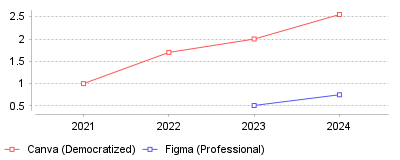
The data reveals a massive bifurcation and acceleration in the "Creative Collaboration" market over the last three years, driven by the integration of Generative AI. While professional-grade tools like Figma are seeing robust growth (reaching ~$749M in 2024), the "democratized" design market led by Canva is operating at a vastly different scale, surpassing $2.5 billion in annual recurring revenue
| Year | Canva (Democratized) | Figma (Professional) |
|---|---|---|
| 2021 | 1 | |
| 2022 | 1.7 | |
| 2023 | 2 | 0.51 |
| 2024 | 2.55 | 0.75 |
The data highlights a divergence in the creative software market between "democratized" visual communication tools and specialized professional interfaces. While professional UI/UX platform Figma has demonstrated impressive 48% year-over-year growth, reaching nearly $750 million in revenue in 2024 [1], Canva's broader platform has scaled to over $2.5 billion in annualized revenue as of late 2024 [2]. This indicates that while the market for technical design is healthy, the market for general business visual communication is expanding at a much larger volume.
We are witnessing the transition of "creative tools" from a vertical niche (software for designers) to a horizontal layer (software for everyone). The scale of Canva’s revenue—more than triple that of the leading professional interface design tool—suggests that organizations are now budgeting for visual collaboration tools alongside standard productivity suites like Microsoft Office or Workspace [3]. Concurrently, the 87% adoption rate of AI tools among creative professionals suggests that the barrier to entry for creating high-fidelity assets is collapsing [4]. This creates a dual-stack environment in the enterprise: specialized tools for product teams (Figma) and AI-assisted visual platforms for marketing, HR, and sales teams (Canva).
This trend validates the thesis that visual communication is becoming the dominant form of business literacy, displacing text-heavy workflows. As companies like Adobe and Canva integrate Generative AI (e.g., Firefly and Magic Studio), the review and approval process is shifting from "correcting" human output to "curating" AI output [4]. For software buyers and investors, it signals that the "Total Addressable Market" for creative collaboration is significantly larger than previously estimated, encompassing virtually every knowledge worker rather than just the design department.
The primary driver is the "efficiency imperative" triggered by the economic climate of 2023-2024, combined with the capabilities of Generative AI. As organizations sought to do more with less, tools that allowed non-designers to create marketing assets (Canva) or product teams to prototype rapidly without coding (Figma) became essential [5]. Furthermore, the persistence of remote and hybrid work models necessitates asynchronous "review and approve" loops, forcing companies to move away from local file management (saving files to a desktop) toward cloud-native, collaborative URLs [6]. The explosion of AI features has specifically fueled Canva's recent growth, with over 11 billion uses of their AI tools reported, driving a price increase and revenue surge [2].
The creative collaboration market is not a winner-take-all battle, but a split ecosystem where "Pro" and "Prosumer" tiers are both surging, driven by distinct use cases. The key takeaway for the coming year is that Generative AI is acting as a massive adoption accelerant, turning casual users into daily creators and pushing annualized revenues for platforms like Canva to heights previously reserved for legacy enterprise giants. Organizations must now strategize for a workforce where visual creation is a standard expectation for all roles, not just the creative department.
The global creative economy is currently navigating a period of significant friction. While digital transformation has democratized content creation, the operational machinery required to manage, review, and approve that content is under immense strain. We are witnessing an "efficiency paradox" where the proliferation of productivity tools has coincided with a decline in creative impact and a rise in operational bottlenecks. Recent data indicates that while global marketing spend surged by 33% between 2023 and 2024, the actual impact on consumer purchase intent rose by only 17%, creating a widening "impact gap" that threatens the ROI of creative departments worldwide [1].
This report analyzes the current landscape of Creative Collaboration & Review Tools, examining the operational challenges driving the adoption of specialized software, the disruptive role of artificial intelligence, and the business implications of fragmented workflows.
The market for creator collaboration tools is expanding rapidly, projected to grow from $6.58 billion in 2024 to $7.70 billion in 2025, representing a compound annual growth rate (CAGR) of 17.0% [2]. This growth is not merely a function of increased software licensing but reflects a fundamental structural shift in how organizations categorize creative work. Creative operations have evolved from a subset of general project management into a distinct discipline requiring specialized infrastructure.
Historically, creative teams utilized generic project management platforms or disjointed email threads to manage approvals. However, the complexity of modern media formats—ranging from high-resolution RAW photography to 3D rendering and 8K video—has rendered generalist tools insufficient. The wider category of Design, Creative & Media Production Software is seeing a bifurcation: creation tools (like the Adobe suite) are becoming increasingly distinct from the orchestration layer (review and approval platforms), yet the integration between the two is becoming more critical.
The operational reality is that volume is outpacing capacity. As brands attempt to maintain an omnichannel presence, the sheer quantity of assets required has exploded. However, efficiency in asset generation—often aided by GenAI—has bottlenecked at the review stage. Without robust Creative Collaboration & Review Tools, the speed gained in creation is lost in approval cycles, leading to what industry analysts identify as a crisis of "creative fatigue" and diminished returns on ad spend.

The primary driver for the adoption of sophisticated review tools is the high cost of inefficiency. Operational friction in the creative process is no longer just an annoyance; it is a measurable financial liability.
Delayed feedback is a silent revenue killer in creative agencies and internal marketing teams. Industry data reveals that more than 50% of campaigns face delays specifically due to operational challenges, with 81% of respondents in a recent survey indicating that they waste ad spend due to these delays [3]. When feedback is delayed, creative teams are forced to context-switch, a cognitive tax that drains productivity and creative quality.
Furthermore, the financial implications extend to cash flow. A staggering 97% of marketing and creative agencies report dealing with late payments, often tied to delayed project sign-offs. For 63% of these agencies, delays in the review and approval process make cash flow unpredictable, directly impacting their ability to scale or invest in new technology [4].
As asset volume increases, maintaining version control becomes mathematically complex. Creative operations leaders at the 2025 Creative Operations Summit highlighted "Chaos Content"—the fragmentation of assets across disjointed systems—as a primary threat to brand consistency [5]. When stakeholders review outdated versions of a file, or when feedback is scattered across Slack, email, and PDF annotations, the risk of compliance errors increases. This is particularly acute in regulated industries like pharma or finance, but equally damaging in high-velocity sectors like fashion or tech.
Nowhere is the need for specialized tools more evident than in photography workflows. Unlike text-based documents or low-res social tiles, professional photography involves massive data transfers and intricate selection processes (culling) that break standard file-sharing tools.
Generic cloud storage solutions often strip metadata or fail to render RAW files correctly, frustrating both the photographer and the client. This has necessitated the rise of Creative Collaboration & Review Tools for Photography Studios, which are designed to handle the specific bandwidth and visualization needs of high-resolution imagery. Professional photographers report that standard tools like Google Drive or Dropbox are insufficient because they do not allow for efficient "star rating" or specific culling workflows required to narrow down thousands of raw shots to a final delivery set [6].
The operational bottleneck here is physical transfer speed and the client interface. If a client cannot easily view, comment on, and approve specific shots within a gallery view, the project stalls. Specialized Creative Collaboration & Review Tools for Photography Studios bridge this gap by integrating heavy file management with an intuitive, visual front-end for clients, effectively decoupling the backend storage complexity from the user experience [7].
Artificial Intelligence has moved beyond a buzzword to become a structural component of creative workflows, though its integration presents new challenges regarding transparency and workflow governance.
A significant trend in 2024-2025 is the undisclosed use of AI by creative professionals. A comprehensive study of 1,780 professionals found that nearly half utilize AI daily, yet 58% have used AI in client work without disclosing it [8]. This "Shadow AI" usage creates liability risks for agencies and brands, particularly regarding copyright and intellectual property. Review tools are increasingly expected to include detection features or "content credentials" to verify the provenance of assets, ensuring that what is being approved aligns with the client's legal and ethical guidelines.
Moving beyond simple content generation, the industry is shifting toward "Agentic AI"—systems capable of executing multi-step workflows autonomously. Unlike a chatbot that answers a query, an AI agent can plan, execute, and iterate on tasks. For creative collaboration, this means AI agents could autonomously route assets for approval based on content analysis, nudge reviewers who are delaying the process, or even perform preliminary compliance checks before a human ever sees the work [9].
This shift promises to alleviate the administrative burden on creative producers. By 2025, it is predicted that AI agents will handle significant portions of the logistical "busy work" in creative operations—scheduling, file tagging, and version management—allowing human creatives to focus on high-value strategic decision-making [10].
The disconnect between increased spending and stagnant impact creates a precarious environment for creative leaders. The data suggests that volume-based marketing strategies are failing. With purchase intent lagging behind spend, businesses are scrutinizing the ROI of their creative operations stacks more closely.
The speed of the review cycle directly correlates to media performance. "Creative fatigue"—where an audience becomes desensitized to an ad—sets in quickly. If the production and review pipeline is too slow to refresh creatives, brands are forced to run fatigued ads, which drives up Cost Per Acquisition (CPA) and wastes budget. Research indicates that purchase intent drops by approximately 16% once a user has seen the same ad six or more times [11].
Therefore, efficient Creative Collaboration & Review Tools are not just administrative utilities; they are performance marketing engines. By reducing the time-to-market for fresh creatives, these tools help sustain high Return on Ad Spend (ROAS). The inability to approve and launch new assets quickly is a primary reason why 41% of overall ad spend is considered "wasted" in some analyses [12].
The operational friction described also has a human cost. Creative burnout is often driven not by the act of creation, but by the administrative chaos surrounding it—chasing approvals, interpreting vague feedback, and managing version conflicts. Agencies that fail to implement streamlined review workflows face higher turnover rates. The 2024 freelancer report highlighted that 90% of creative freelancers experienced a crisis of confidence, exacerbated by poor feedback loops and administrative friction [13].
To address these challenges, organizations must select the right category of solution. The market has segmented into generalist and specialist tools.
Successful implementation requires a "systems thinking" approach. It is not enough to buy a tool; organizations must define the "handshake" moments between creation, review, and distribution. Leading organizations are moving toward integrated ecosystems where the review tool automatically triggers the next step in the workflow, reducing manual handoffs.
An emerging consideration in the selection of creative tools is digital sustainability. The carbon footprint of generative AI and 3D rendering is significant. Training a single large AI model can emit as much carbon as five cars over their lifetimes, and the energy required for constant rendering and inference is substantial [14].
Creative operations teams are beginning to track the carbon intensity of their production pipelines. 3D rendering and virtual production can actually *reduce* carbon footprints by eliminating the need for physical photo shoots and travel, provided the rendering is done efficiently [15]. Future review tools may include "carbon cost" metrics alongside financial costs, helping teams choose the most sustainable production methods.
Looking ahead, the Creative Collaboration & Review Tools market will be defined by three key trajectories:
In conclusion, the trends in creative collaboration software highlight a critical pivot point for the industry. Organizations that continue to rely on manual, disjointed review processes will face increasing costs, talent attrition, and diminished market impact. The winners will be those who adopt intelligent, integrated, and specialized tooling that respects the nuances of the creative process while enforcing operational rigor.
The data reveals a massive bifurcation and acceleration in the "Creative Collaboration" market over the last three years, driven by the integration of Generative AI. While professional-grade tools like Figma are seeing robust growth (reaching ~$749M in 2024), the "democratized" design market led by Canva is operating at a vastly different scale, surpassing $2.5 billion in annual recurring revenue
| Year | Canva (Democratized) | Figma (Professional) |
|---|---|---|
| 2021 | 1 | |
| 2022 | 1.7 | |
| 2023 | 2 | 0.51 |
| 2024 | 2.55 | 0.75 |
The data highlights a divergence in the creative software market between "democratized" visual communication tools and specialized professional interfaces. While professional UI/UX platform Figma has demonstrated impressive 48% year-over-year growth, reaching nearly $750 million in revenue in 2024 [1], Canva's broader platform has scaled to over $2.5 billion in annualized revenue as of late 2024 [2]. This indicates that while the market for technical design is healthy, the market for general business visual communication is expanding at a much larger volume.
We are witnessing the transition of "creative tools" from a vertical niche (software for designers) to a horizontal layer (software for everyone). The scale of Canva’s revenue—more than triple that of the leading professional interface design tool—suggests that organizations are now budgeting for visual collaboration tools alongside standard productivity suites like Microsoft Office or Workspace [3]. Concurrently, the 87% adoption rate of AI tools among creative professionals suggests that the barrier to entry for creating high-fidelity assets is collapsing [4]. This creates a dual-stack environment in the enterprise: specialized tools for product teams (Figma) and AI-assisted visual platforms for marketing, HR, and sales teams (Canva).
This trend validates the thesis that visual communication is becoming the dominant form of business literacy, displacing text-heavy workflows. As companies like Adobe and Canva integrate Generative AI (e.g., Firefly and Magic Studio), the review and approval process is shifting from "correcting" human output to "curating" AI output [4]. For software buyers and investors, it signals that the "Total Addressable Market" for creative collaboration is significantly larger than previously estimated, encompassing virtually every knowledge worker rather than just the design department.
The primary driver is the "efficiency imperative" triggered by the economic climate of 2023-2024, combined with the capabilities of Generative AI. As organizations sought to do more with less, tools that allowed non-designers to create marketing assets (Canva) or product teams to prototype rapidly without coding (Figma) became essential [5]. Furthermore, the persistence of remote and hybrid work models necessitates asynchronous "review and approve" loops, forcing companies to move away from local file management (saving files to a desktop) toward cloud-native, collaborative URLs [6]. The explosion of AI features has specifically fueled Canva's recent growth, with over 11 billion uses of their AI tools reported, driving a price increase and revenue surge [2].
The creative collaboration market is not a winner-take-all battle, but a split ecosystem where "Pro" and "Prosumer" tiers are both surging, driven by distinct use cases. The key takeaway for the coming year is that Generative AI is acting as a massive adoption accelerant, turning casual users into daily creators and pushing annualized revenues for platforms like Canva to heights previously reserved for legacy enterprise giants. Organizations must now strategize for a workforce where visual creation is a standard expectation for all roles, not just the creative department.