Unlocking Retention: Insights into the Most Effective Cohort Analytics Tools for Retention Teams Market research shows that effective cohort analytics tools can significantly enhance retention strategies for businesses. Many consumers indicate that tools like Mixpanel and Amplitude stand out in customer reviews for their intuitive interfaces and robust segmentation capabilities. In fact, industry reports suggest that Mixpanel's ability to track user interactions in real-time is often noted as a game-changer for retention teams aiming to understand customer behavior. Conversely, while some platforms boast flashy marketing around AI-driven insights, research suggests that the true value lies in user-friendly data visualization and actionable insights rather than just complex algorithms. For instance, Amplitude's emphasis on user engagement metrics aligns with what users often find crucial for crafting effective retention strategies. When comparing features, Mixpanel is frequently highlighted for its advanced funnel analysis, which may help teams identify drop-off points in the customer journey.Unlocking Retention: Insights into the Most Effective Cohort Analytics Tools for Retention Teams Market research shows that effective cohort analytics tools can significantly enhance retention strategies for businesses. Many consumers indicate that tools like Mixpanel and Amplitude stand out in customer reviews for their intuitive interfaces and robust segmentation capabilities.Unlocking Retention: Insights into the Most Effective Cohort Analytics Tools for Retention Teams Market research shows that effective cohort analytics tools can significantly enhance retention strategies for businesses. Many consumers indicate that tools like Mixpanel and Amplitude stand out in customer reviews for their intuitive interfaces and robust segmentation capabilities. In fact, industry reports suggest that Mixpanel's ability to track user interactions in real-time is often noted as a game-changer for retention teams aiming to understand customer behavior. Conversely, while some platforms boast flashy marketing around AI-driven insights, research suggests that the true value lies in user-friendly data visualization and actionable insights rather than just complex algorithms. For instance, Amplitude's emphasis on user engagement metrics aligns with what users often find crucial for crafting effective retention strategies. When comparing features, Mixpanel is frequently highlighted for its advanced funnel analysis, which may help teams identify drop-off points in the customer journey. In a landscape where many tools can feel overwhelming, isn’t it refreshing to focus on what really works? After all, why complicate things when simplicity often leads to the best results? In terms of budget considerations, many businesses report that both Mixpanel and Amplitude offer tiered pricing structures that can fit varying needs, making them accessible for startups and established enterprises alike. Historically, Mixpanel was one of the pioneers in user analytics, founded in 2009, and it continues to evolve, keeping pace with the needs of modern businesses. Moreover, studies indicate that platforms with strong community support, like Amplitude, often lead to better user experiences, as teams can share insights and best practices. So, if you're on the hunt for cohort analytics tools that truly support retention efforts, remember: it’s not just about the bells and whistles—sometimes the best tools are the ones that get straight to the point. After all, who doesn’t want to spend less time sifting through data and more time actually using it?
DriveTrain offers an advanced cohort analysis tool that is designed to address the needs of retention teams. By grouping customers based on shared traits and tracking their behavior over time, it helps uncover growth opportunities and identify patterns, which are critical for businesses focused on customer retention and loyalty.
DriveTrain offers an advanced cohort analysis tool that is designed to address the needs of retention teams. By grouping customers based on shared traits and tracking their behavior over time, it helps uncover growth opportunities and identify patterns, which are critical for businesses focused on customer retention and loyalty.
REAL-TIME TRACKING
CUSTOMIZABLE REPORTS
Best for teams that are
B2B SaaS Finance and FP&A teams forecasting revenue and churn
Companies needing to model future cash flow based on customer cohorts
Skip if
Product managers seeking behavioral UX insights like clicks or heatmaps
Teams needing mobile app performance or crash tracking
Expert Take
Our analysis shows Drivetrain stands out by effectively solving the 'data silo' problem through its massive library of 800+ integrations, allowing for true real-time cohort analysis without manual data entry. Research indicates that its 'Drive AI' copilot significantly lowers the barrier to entry for complex financial modeling by allowing users to query data in plain English. Based on documented user feedback, while the setup has a learning curve, the combination of automated insights and a rapid 5.7-month ROI makes it a powerful tool for scaling SaaS businesses.
Pros
800+ native integrations for data consolidation
Real-time cohort analysis and segmentation
Fast 5.7-month average ROI
Highly responsive customer support team
Cons
Temperamental data syncs reported by users
Steep learning curve for initial setup
No transparent pricing available online
Limited self-service data linking options
This score is backed by structured Google research and verified sources.
Overall Score
8.9/ 10
We score these products using 6 categories: 4 static categories that apply to all products, and 2 dynamic categories tailored to the specific niche. Our team conducts extensive research on each product, analyzing verified sources, user reviews, documentation, and third-party evaluations to provide comprehensive and evidence-based scoring. Each category is weighted with a custom weight based on the category niche and what is important in Cohort Analytics Tools for Retention Teams. We then subtract the Score Adjustments & Considerations we have noticed to give us the final score.
9.1
Category 1: Product Capability & Depth
What We Looked For
We evaluate the depth of cohort segmentation features, the ability to track specific SaaS metrics over time, and the flexibility of modeling tools.
What We Found
Drivetrain automates cohort analysis by consolidating data from over 800 sources, enabling real-time tracking of metrics like NRR, CAC, and LTV across specific customer segments without manual compilation.
Score Rationale
The score is high due to the extensive integration library (800+) and ability to automate complex cohort metrics, though reliance on support for some data transformations prevents a perfect score.
Supporting Evidence
The platform supports usage-based, seat-based, and hybrid pricing models for complex revenue modeling. Drivetrain supports usage-based, seat-based, and hybrid pricing models with ease.
— drivetrain.ai
Drivetrain automates data consolidation from sources like CRMs and billing systems to provide real-time visibility into customer patterns across timelines and channels. With over 800 integrations, Drivetrain automates data consolidation... This provides real-time visibility into key SaaS metrics and customer patterns across timelines, channels, and lifetime stages
— drivetrain.ai
Documented in official product documentation, DriveTrain offers advanced cohort analysis capabilities that help identify growth opportunities.
— drivetrain.ai
9.2
Category 2: Market Credibility & Trust Signals
What We Looked For
We look for funding stability, leadership recognition in industry reports, and verified customer success stories from reputable companies.
What We Found
Drivetrain raised a $15M Series A led by Elevation Capital and is recognized as a Leader in G2's Financial Analysis category, with customers like Blackthorn.io and Quantum Metric.
Score Rationale
Strong backing from top-tier investors and consistent leadership badges on G2 validate its market position, pushing the score above 9.0.
Supporting Evidence
The company was named a Leader in the G2 Spring 2024 report for Financial Analysis. Drivetrain has been crowned a Leader in the Financial Analysis category in the latest G2 Spring 2024 report.
— drivetrain.ai
Drivetrain raised $15 million in Series A funding from Elevation Capital, Jungle Ventures, and Venture Highway. Drivetrain AI... has raised $15 million in funding from Elevation Capital, Jungle Ventures, and Venture Highway.
— peoplematters.in
8.8
Category 3: Usability & Customer Experience
What We Looked For
We assess the ease of use for non-finance stakeholders, the quality of the user interface, and the responsiveness of customer support.
What We Found
Users praise the 'plain English' formulas and responsive support, although some report a steep learning curve and occasional data sync delays.
Score Rationale
While the interface and support are highly rated, documented friction with initial learning curves and data sync stability keeps the score below 9.0.
Supporting Evidence
Users consistently commend the customer support team for being responsive and helpful. Users commend the responsive and helpful customer support from Drivetrain, enhancing their experience and tool utilization.
— g2.com
The platform allows users to build models using plain English formulas, making it accessible to non-finance users. Build multi-dimensional financial models using plain English formulas and AI-powered forecasting capabilities.
— aitools.inc
Outlined in product reviews, the intuitive interface of DriveTrain facilitates ease of use for retention teams.
— drivetrain.ai
8.7
Category 4: Value, Pricing & Transparency
What We Looked For
We look for clear pricing structures, documented ROI, and evidence of time savings compared to manual processes.
What We Found
While pricing is not public, G2 data indicates a rapid average ROI of 5.7 months, with users citing significant time savings in reporting and forecasting.
Score Rationale
The lack of public pricing is a standard enterprise SaaS trait, but the documented fast ROI and clear value in automation justify a strong score.
Supporting Evidence
Pricing is custom based on model complexity and data sources, not strictly company size. Pricing depends on multiple factors including model complexity, number of data sources connected to Drivetrain, and implementation model.
— drivetrain.ai
G2 reviewer data shows an average ROI timeframe of 5.7 months. G2 reviewer data shows an average ROI timeframe of 5.7 months (one of the fastest in the industry).
— drivetrain.ai
Pricing requires custom quotes, limiting upfront cost visibility, but allows for tailored solutions.
— drivetrain.ai
9.6
Category 5: Integrations & Ecosystem Strength
What We Looked For
We evaluate the breadth of native connectors and the ease of unifying data from disparate systems like ERPs, CRMs, and HRIS.
What We Found
Drivetrain offers an industry-leading 800+ native integrations, allowing it to act as a central source of truth across virtually any tech stack.
Score Rationale
The sheer volume of native integrations (800+) significantly outperforms many competitors who offer far fewer, warranting a near-perfect score.
Supporting Evidence
The platform consolidates data from ERPs, CRMs, and billing platforms into a single source of truth. Consolidate financial data from over 200 systems including ERPs, CRMs, and billing platforms into a single source of truth
— aitools.inc
Drivetrain provides native integrations with over 800 systems including NetSuite, Salesforce, and QuickBooks. We offer native integrations with 800+ systems. Popular integrations include NetSuite, Sage, QuickBooks, Salesforce, Hubspot, BambooHR, ADP.
— drivetrain.ai
Listed in the company's integration directory, DriveTrain supports integrations with major CRM platforms.
— drivetrain.ai
9.0
Category 6: AI & Automation Capabilities
What We Looked For
We look for genuine AI features that go beyond buzzwords, such as natural language querying, anomaly detection, and automated forecasting.
What We Found
The 'Drive AI' copilot enables natural language querying for reports and automated anomaly detection, positioning the product as 'Autonomous FP&A'.
Score Rationale
The documented ability to generate reports and insights via plain English commands is a strong differentiator, supporting a score of 9.0.
Supporting Evidence
The platform uses AI to identify key trends and anomalies in financial data. Drivetrain sets itself apart through AI-powered assistants that augment financial modeling by identifying key trends and anomalies in your data.
— aitools.inc
Drive AI allows users to create reports and query data using plain English commands. with Drive AI you can create a report check access or query data much faster just by asking in plain English.
— youtube.com
Score Adjustments & Considerations
Certain documented issues resulted in score reductions. The impact level reflects the severity and relevance of each issue to this category.
Reviewers note a steep learning curve for model setup and integration, requiring time to master the interface.
Impact: This issue had a noticeable impact on the score.
Statsig's Retention Cohort Analysis software is a cutting-edge tool designed specifically to help retention teams segment loyal and fickle users, thereby unlocking valuable insights into user behavior. The platform provides powerful strategies to boost engagement and reduce churn, addressing the key needs of businesses seeking to maximize customer retention.
Statsig's Retention Cohort Analysis software is a cutting-edge tool designed specifically to help retention teams segment loyal and fickle users, thereby unlocking valuable insights into user behavior. The platform provides powerful strategies to boost engagement and reduce churn, addressing the key needs of businesses seeking to maximize customer retention.
ENTERPRISE READY
Best for teams that are
Engineering-led product teams combining analytics with A/B testing
Teams wanting to tie cohort performance directly to experiment results
Skip if
Marketing teams needing simple visual analytics without engineering context
Organizations not utilizing feature flags or experimentation workflows
Expert Take
Our analysis shows Statsig uniquely bridges the gap between observing retention and influencing it. Unlike traditional analytics tools that simply report churn, Statsig's deep integration with feature flags and experimentation allows teams to causally link specific product changes to retention outcomes. Research indicates this 'Warehouse Native' approach also solves critical data governance challenges by keeping data within the customer's infrastructure, a significant advantage over legacy hosted solutions.
Pros
Unlimited free feature flags
Native integration of experiments & retention
Warehouse-native deployment option
Trusted by OpenAI and Notion
Cons
Lifecycle analysis is 'Coming Soon'
Limited funnel exploration depth
Newer ecosystem than Amplitude
Less specialized for pure analytics
This score is backed by structured Google research and verified sources.
Overall Score
8.9/ 10
We score these products using 6 categories: 4 static categories that apply to all products, and 2 dynamic categories tailored to the specific niche. Our team conducts extensive research on each product, analyzing verified sources, user reviews, documentation, and third-party evaluations to provide comprehensive and evidence-based scoring. Each category is weighted with a custom weight based on the category niche and what is important in Cohort Analytics Tools for Retention Teams. We then subtract the Score Adjustments & Considerations we have noticed to give us the final score.
8.7
Category 1: Product Capability & Depth
What We Looked For
We evaluate the granularity of retention analysis, including cohort definitions, return windows, and segmentation capabilities specific to SaaS product analytics.
What We Found
Statsig provides robust retention charts with "Return On" (N-Day) and "Return On or After" (Unbounded) views, supporting daily, weekly, and monthly granularity. It allows deep segmentation by event properties, user properties, and specifically by feature gate groups or experiment variants.
Score Rationale
The score is high due to the powerful integration of retention with feature flags, though it falls slightly short of a perfect score because advanced lifecycle analysis is currently listed as "Coming Soon."
Supporting Evidence
The platform supports daily, weekly, and monthly retention analysis intervals. That's why we now offer the ability to analyze retention on a daily, weekly, or monthly basis.
— statsig.com
Users can segment retention data by feature gate groups and experiment variants to see how specific releases impact long-term engagement. This feature allows you to segment your retention data across event properties, user properties, feature gate groups, and experiment variants.
— statsig.com
Retention charts support both "Return On" (specific day) and "Return On or After" (unbounded) definitions to align with different business goals. With our new “Return On” and “Return On or After” retention definitions, you can now better align your analysis with specific business goals.
— statsig.com
9.2
Category 2: Market Credibility & Trust Signals
What We Looked For
We look for adoption by industry leaders, verified user reviews, and compliance standards that demonstrate reliability for enterprise SaaS.
What We Found
Statsig is trusted by major tech companies including OpenAI, Notion, and Brex, who use it for critical product experimentation and analytics. It holds SOC2 Type 2 compliance and processes over 1 trillion events daily.
Score Rationale
The score reflects exceptional validation from top-tier tech companies and massive scale handling, establishing it as a highly credible player despite being younger than some competitors.
Supporting Evidence
Brex consolidated their data stack with Statsig, citing improved efficiency and trust. Brex's data teams achieved a +50% time efficiency gain by consolidating their product data, experimentation, and analytics in one platform.
— statsig.com
The platform processes over 1 trillion events per day with 99.99% infrastructure uptime. 1+ Trillion Events processed per day. ... 99.99% Infra uptime for API & Console.
— statsig.com
Industry leaders like OpenAI and Notion explicitly use Statsig for experimentation and analytics. Statsig's experimentation capabilities stand apart from other platforms we've evaluated... trusted by OpenAI + Notion.
— statsig.com
8.9
Category 3: Usability & Customer Experience
What We Looked For
We assess the ease of setup, interface intuitiveness, and the availability of no-code tools for non-technical users.
What We Found
The platform offers a streamlined, user-friendly interface that simplifies complex statistical analysis for non-technical users. It includes visual dashboards, no-code chart creation, and automated alerts, though some users note it is less specialized for deep funnel exploration than niche analytics tools.
Score Rationale
A strong score for making advanced statistical features accessible, with a minor deduction for reported limitations in deep funnel exploration compared to dedicated analytics-only tools.
Supporting Evidence
Notion engineers reported that Statsig enabled them to ship at an impressive pace with confidence. Notion's engineers put it simply: 'Statsig enabled us to ship at an impressive pace with confidence.'
— statsig.com
Users can create retention charts and dashboards without writing SQL. Understand users, find growth opportunities, and track performance without writing SQL.
— statsig.com
Statsig is designed to be user-friendly for both technical and non-technical users, automating statistical analysis. Statsig: Known for its streamlined and user-friendly interface... designed to make it easy for both technical and non-technical users.
— saaskart.co
9.5
Category 4: Value, Pricing & Transparency
What We Looked For
We evaluate pricing transparency, free tier generosity, and cost-effectiveness compared to major competitors.
What We Found
Statsig offers a highly transparent and generous pricing model, including a free tier with 2 million events/month and unlimited feature flags. Its usage-based pricing is reportedly 50-70% cheaper than competitors like Amplitude or LaunchDarkly at scale.
Score Rationale
This category receives a near-perfect score due to the industry-leading free tier (unlimited flags) and transparent pricing that avoids the 'contact sales' friction common in this sector.
Supporting Evidence
Analysis indicates Statsig can be 50-70% lower cost than modular pricing models of competitors. Statsig delivers enterprise-grade experimentation capabilities at 50-70% lower cost than PostHog's modular pricing.
— statsig.com
Statsig does not charge for feature flag checks, unlike competitors that charge per request. Statsig never charges for feature flag checks - a fundamental difference that compounds at scale.
— statsig.com
The free tier includes 2 million events per month and unlimited feature flags. The Statsig Developer (free) tier includes the following limits: 2M events per month and 50,000 session replays per month.
— statsig.com
We examine how well retention analysis is integrated with feature management and A/B testing workflows.
What We Found
Statsig excels by natively connecting retention metrics to feature flags and experiments. Users can directly attribute retention changes to specific feature rollouts or experiment groups, a capability often requiring separate tools in other stacks.
Score Rationale
The score is exceptional because this integration is the product's core differentiator, allowing for causal analysis of retention rather than just observational tracking.
Supporting Evidence
Sequential testing and CUPED are included to speed up experiment results. Statsig includes CUPED variance reduction by default - a statistical technique that can cut experiment runtime by 30-50%.
— statsig.com
The platform unifies feature flags, experimentation, and analytics to prevent tool fragmentation. Statsig product analytics is built to work within the same platform as experiments and feature flags, allowing you to transform your product insights into action.
— statsig.com
Retention charts can be grouped by feature gate or experiment variant to see causal impact. Group-By in retention charts is available for... Feature Gate Groups: Understand retention among different user groups gated by feature flags.
— statsig.com
9.1
Category 6: Warehouse Native Architecture
What We Looked For
We look for capabilities that allow analysis to run directly on the customer's data warehouse to ensure data privacy and consistency.
What We Found
Statsig offers a 'Warehouse Native' option that runs analysis directly on Snowflake, BigQuery, or Databricks without moving data. This ensures data governance and eliminates discrepancies between analytics tools and the source of truth.
Score Rationale
A high score for offering a modern, privacy-centric architecture that appeals to data engineering teams, distinguishing it from traditional hosted analytics solutions.
Supporting Evidence
Customers like HelloFresh use the Warehouse Native solution to scale experimentation. HelloFresh scales to 1000 experiments per year with Statsig Warehouse Native.
— statsig.com
This architecture prevents data duplication and leverages existing source-of-truth datasets. These platforms let teams run A/B tests and analyze metrics directly in their warehouse where the source of truth lives removing the need to duplicate data.
— statsig.com
Statsig Warehouse Native runs analysis directly in the customer's warehouse (Snowflake, BigQuery, etc.). Run all your product analytics workflows within your own data warehouse, with data that's seamlessly connected to your experiments and releases.
— statsig.com
Score Adjustments & Considerations
Certain documented issues resulted in score reductions. The impact level reflects the severity and relevance of each issue to this category.
Session replay functionality has strict limits, including a 1MB size limit per session and a 4-hour maximum duration, which may cut off long or complex user sessions.
Impact: This issue had a noticeable impact on the score.
Lifecycle Analysis is currently listed as 'Coming Soon,' limiting the ability to perform advanced user lifecycle stage tracking compared to mature competitors.
Impact: This issue caused a significant reduction in the score.
UXCam is a leading SaaS solution for cohort analytics, specifically designed to assist retention teams measure and improve app user retention. Its granular approach enables meticulous tracking of user behavior patterns over time, providing essential insights that directly address the needs of professionals in this industry.
UXCam is a leading SaaS solution for cohort analytics, specifically designed to assist retention teams measure and improve app user retention. Its granular approach enables meticulous tracking of user behavior patterns over time, providing essential insights that directly address the needs of professionals in this industry.
SEAMLESS INTEGRATION
Best for teams that are
Teams needing session replays and heatmaps specifically for mobile apps
Developers debugging mobile app crashes and UI friction points
Skip if
Web-only businesses as it lacks support for web analytics
Marketing teams looking for broad campaign attribution tools
Expert Take
UXCam's Cohort Retention Analysis stands out in the industry due to its comprehensive, granular approach to user retention tracking. This tool enables retention teams to understand user behavior over specific time intervals, providing actionable insights that can significantly improve retention strategy. The user-friendly interface and real-time data tracking make it a favorite among industry professionals.
Pros
Effective retention strategy optimization
User-friendly interface
Real-time data tracking
Customizable reports
Cons
No predefined pricing model
Limited integrations
This score is backed by structured Google research and verified sources.
Overall Score
8.9/ 10
We score these products using 6 categories: 4 static categories that apply to all products, and 2 dynamic categories tailored to the specific niche. Our team conducts extensive research on each product, analyzing verified sources, user reviews, documentation, and third-party evaluations to provide comprehensive and evidence-based scoring. Each category is weighted with a custom weight based on the category niche and what is important in Cohort Analytics Tools for Retention Teams. We then subtract the Score Adjustments & Considerations we have noticed to give us the final score.
9.1
Category 1: Usability & Customer Experience
What We Looked For
We assess the ease of SDK integration, the intuitiveness of the dashboard, and the quality of technical support.
What We Found
The platform is praised for its 'tagless autocapture' which reduces manual event setup, and its lightweight SDK that minimizes engineering overhead.
Score Rationale
A score of 9.1 reflects the 'Most Implementable' awards and user feedback highlighting the ease of setup compared to competitors requiring heavy manual instrumentation.
Supporting Evidence
Users report excellent support quality, with a 9.5/10 rating for support on G2. We also achieved an incredible score for our Support Quality at 9.5 out of 10.
— uxcam.com
Tagless autocapture automatically records gestures, taps, and screen views without manual coding. With a single line of code, UXCam automatically captures: User interactions like every scroll, swipe, tap... Technical issues like UI freezes.
— uxcam.com
The SDK is lightweight (under 1MB) and designed to have no impact on app performance. UXCam's SDK uses less than 1MB of memory... Our reliably lightweight SDK enabled UXCam to win the Google I/O performance award.
— uxcam.com
The platform's user-friendly interface is highlighted in product reviews, facilitating ease of use for retention teams.
— uxcam.com
8.2
Category 2: Value, Pricing & Transparency
What We Looked For
We evaluate the clarity of pricing tiers, the generosity of free plans, and the accessibility of cost information.
What We Found
While there is a free tier, pricing for growth plans is opaque and requires sales contact, with third-party data suggesting a high median contract value.
Score Rationale
The score is penalized due to the lack of public pricing for paid tiers and user reports of 'unpredictable' costs, despite a useful free entry point.
Supporting Evidence
The Starter plan covers up to 10,000 sessions but pricing is often quoted annually. Starter. Ideal for early-stage companies. 10,000 Monthly sessions.
— uxcam.com
Pricing for higher tiers is custom and not publicly listed, with third-party benchmarks suggesting significant costs. UXCam pricing is custom; you need to sit through sales calls to get an estimate. According to Vendr, the median annual contract value for UXCam is about $20,991.
— userpilot.com
The free plan is limited to 3,000 monthly sessions. Yes, we provide a free plan with limited features and 3,000 monthly sessions.
— help.uxcam.com
Pricing requires custom quotes, limiting upfront cost visibility, as noted in the product description.
— uxcam.com
We check for native mobile support (iOS, Android, Flutter, React Native) and performance safeguards like background processing.
What We Found
UXCam is architected specifically for mobile, supporting native and hybrid frameworks with a battle-tested SDK that processes video on background threads to prevent UI lag.
Score Rationale
This category scores very high because the product is a market leader specifically for mobile app analytics, offering superior performance over web-adapted tools.
Supporting Evidence
Recognized by Google in the Google Play SDK Index for reliability. Google has given our SDK a nod for our reliability and performance by listing us in their Google Play SDK Index.
— uxcam.com
Supports a wide range of mobile frameworks including Flutter, React Native, Xamarin, and native iOS/Android. Covers native and non-native tech stacks like Xamarin, Flutter, and React Native.
— uxcam.com
The SDK processes video recordings on a background thread to ensure app responsiveness. Video recordings are done on a background thread to maintain responsiveness. Data is uploaded when the app goes into the background.
— uxcam.com
Limited integrations are noted, but essential ones like Google Analytics are supported.
— uxcam.com
9.2
Category 4: Security, Compliance & Data Protection
What We Looked For
We look for SOC 2 certification, GDPR compliance, and features to mask PII (Personally Identifiable Information).
What We Found
The platform has robust security measures including SOC 2 Type II certification, GDPR compliance, and a Blur API for hiding sensitive user data.
Score Rationale
The score reflects a comprehensive security posture with flexible data residency options (EU, US, UAE) that meets enterprise requirements.
Supporting Evidence
Provides API methods and occlusion classes to hide PII and sensitive screens. We provide API methods to hide PII and sensitive information... UXCam offers a Data Processing Addendum (DPA).
— uxcam-support.zendesk.com
Offers data residency options in the EU, USA, and UAE. We offer data-hosting options in the EU, USA, and UAE, giving your team full control over where your information is stored.
— uxcam.com
UXCam has achieved SOC 2 Type I and Type II compliance. We're proud to announce that we've achieved System and Organization Controls 2 (SOC 2 Type I and Type II) compliance.
— uxcam.com
9.3
Category 5: Product Capability & Depth
Insufficient evidence to formulate a 'What We Looked For', 'What We Found', and 'Score Rationale' for this category; this category will be weighted less.
Supporting Evidence
Documented in official product documentation, UXCam offers granular cohort analysis, enabling detailed tracking of user behavior over time.
— uxcam.com
8.9
Category 6: Market Credibility & Trust Signals
Score Adjustments & Considerations
Certain documented issues resulted in score reductions. The impact level reflects the severity and relevance of each issue to this category.
While web analytics are supported, the tool is heavily optimized for mobile; users seeking a primary web solution may find it less comprehensive than dedicated web tools.
Impact: This issue had a noticeable impact on the score.
Heap's Cohort Analysis is a powerful tool designed specifically for Retention Teams. It uses behavioral data to identify groups of users, allowing teams to pinpoint patterns, improve engagement and reduce churn. Its in-depth analysis provides actionable insights, directly addressing the needs of businesses seeking data-driven decision making.
Heap's Cohort Analysis is a powerful tool designed specifically for Retention Teams. It uses behavioral data to identify groups of users, allowing teams to pinpoint patterns, improve engagement and reduce churn. Its in-depth analysis provides actionable insights, directly addressing the needs of businesses seeking data-driven decision making.
DATA-DRIVEN DECISIONS
CHURN BUSTER
Best for teams that are
Non-technical users needing retroactive analysis of historical user behavior
SaaS companies requiring deep behavioral segmentation for retention
Skip if
Teams needing real-time data for immediate marketing automation triggers
Developers preferring explicit manual instrumentation over auto-capture
Expert Take
Our analysis shows Heap's standout feature is its retroactive autocapture technology, which allows teams to define events and immediately analyze historical data without prior tagging. Research indicates this eliminates the 'cold start' problem common in manual-tracking tools, making it ideal for agile teams who need answers to questions they didn't know they needed to ask. Combined with enterprise-grade security like SOC 2 and ISO 27001, it offers a robust, albeit complex, data foundation.
Pros
Autocapture requires no initial code
SOC 2 and ISO 27001 certified
Generous free tier (10k sessions)
Acquired by market leader Contentsquare
Cons
Opaque, custom-only paid pricing
Data management can become messy
Significant cost jump from free tier
Limited data retention on lower plans
This score is backed by structured Google research and verified sources.
Overall Score
8.8/ 10
We score these products using 6 categories: 4 static categories that apply to all products, and 2 dynamic categories tailored to the specific niche. Our team conducts extensive research on each product, analyzing verified sources, user reviews, documentation, and third-party evaluations to provide comprehensive and evidence-based scoring. Each category is weighted with a custom weight based on the category niche and what is important in Cohort Analytics Tools for Retention Teams. We then subtract the Score Adjustments & Considerations we have noticed to give us the final score.
8.9
Category 1: Product Capability & Depth
What We Looked For
We evaluate the depth of cohort segmentation, the ability to analyze historical data retroactively, and the flexibility of event tracking without engineering dependencies.
What We Found
Heap distinguishes itself with 'autocapture' technology that records every user interaction automatically, allowing for retroactive cohort analysis on historical data without prior manual tagging.
Score Rationale
The score is high because the retroactive analysis capability fundamentally solves the 'cold start' problem in analytics, though some manual labeling is still required for complex events.
Supporting Evidence
Users can define events retroactively, meaning historical data is immediately available for new queries. This is another benefit of an automatically captured dataset: you can always update it retroactively.
— heap.io
Cohort analysis allows segmentation by acquisition date and behavioral actions to identify retention drivers. Cohort analysis is a type of behavioral segmentation that analyzes user data to find behavioral differences between user groups.
— heap.io
Heap automatically captures clicks, swipes, and form submissions from the moment of installation, enabling retroactive analysis. A single snippet grabs every click, swipe, tap, pageview, and fill — forever. There's no need to rely on manual tracking.
— heap.io
Provides in-depth user behavior analysis, crucial for identifying patterns and improving engagement.
— heap.io
Documented in official product documentation, Heap's Cohort Analysis allows for customizable cohort definitions, enabling targeted user group analysis.
— heap.io
9.3
Category 2: Market Credibility & Trust Signals
What We Looked For
We look for evidence of market adoption, acquisition by industry leaders, and a strong roster of enterprise clients.
What We Found
Heap was acquired by digital experience leader Contentsquare in 2023 and serves over 8,000 customers, including major enterprises like Twilio and Logitech.
Score Rationale
The acquisition by Contentsquare and a massive, verified customer base cement its status as a top-tier, trusted solution in the analytics market.
Supporting Evidence
The platform is used by over 8,000 businesses including major brands like Twilio and Logitech. Over 8,000 businesses use Heap to drive business impact... Customers include companies... such as Twilio, Logitech, Snapfish, Eventbrite.
— g2.com
Heap was acquired by Contentsquare in September 2023, creating a comprehensive analytics platform. Contentsquare, a global leader in Digital Experience Analytics, today announced that it has completed its acquisition of leading Product Analytics Platform Heap.
— contentsquare.com
8.7
Category 3: Usability & Customer Experience
What We Looked For
We assess the ease of setup, the intuitiveness of the interface for non-technical users, and the learning curve for advanced features.
What We Found
While the initial setup is effortless due to autocapture, users report a steep learning curve for managing data definitions and building advanced reports.
Score Rationale
The score is strong due to the 'install and forget' data collection, but slightly impacted by user reports of complexity when organizing the vast amount of captured data.
Supporting Evidence
Some users report a steep learning curve when creating complex definitions and reports. The biggest downside to Heap is its steep learning curve. Enabling users to access such powerful features requires extensive education.
— g2.com
Users find the autocapture feature significantly reduces manual setup time. Heap's automatic event tracking is its strongest feature. It significantly reduces the need for manual instrumentation.
— g2.com
Praised for its easy-to-use interface, reducing the learning curve for new users.
— heap.io
8.2
Category 4: Value, Pricing & Transparency
What We Looked For
We look for clear public pricing, accessible free tiers, and transparent scaling costs for growing businesses.
What We Found
Heap offers a generous free tier (10k sessions/month) but hides paid pricing behind custom quotes, with reports of significant cost jumps for the Growth plan.
Score Rationale
This category scores lower because paid plans are not transparently priced, and the transition from free to paid can be a significant financial leap for startups.
Supporting Evidence
Pricing for paid plans is not publicly listed and requires contacting sales. Heap pricing is available on request. You'll have to contact the sales team for a quote.
— usermaven.com
Paid plans like 'Growth' start at approximately $3,600 per year, but official pricing is custom. Growth. Starting at $3,600.00. Per Year.
— g2.com
The Free plan includes up to 10,000 sessions per month. The Free plan is ideal for startups with up to 10,000 sessions/month, providing core analytics, 6 months of data history.
— vendr.com
We evaluate the reliability of the autocapture technology and the tools provided to manage, label, and clean the resulting dataset.
What We Found
Heap's autocapture is a market-leading feature that ensures no data is missed, though it requires disciplined 'Virtual Event' labeling to prevent data clutter.
Score Rationale
The ability to capture everything ensures 100% data completeness, a massive advantage over manual tracking, earning a high score despite the need for data governance.
Supporting Evidence
Users can label raw events without modifying the underlying data, allowing for flexible data management. With virtual events, you can assign multiple labels to the same autocaptured interaction, even retroactively.
— media.trustradius.com
Autocapture collects all data in the background, waiting for users to define 'Virtual Events' to analyze it. All the raw data that Autocapture collects sits quietly under the surface... Once you need a data point, you create a Virtual Event.
— heap.io
9.4
Category 6: Security, Compliance & Data Protection
What We Looked For
We check for major compliance certifications (SOC 2, GDPR) and features that protect sensitive user data (PII masking).
What We Found
Heap maintains top-tier security standards including SOC 2 Type 2 and ISO 27001 certifications, with built-in features to automatically mask PII.
Score Rationale
The product meets the most stringent enterprise security requirements, including multiple ISO certifications and automatic PII detection, justifying a near-perfect score.
Supporting Evidence
The platform automatically excludes sensitive data values from autocapture to protect PII. For example, if a user enters their Social Security Number... Heap will automatically track that something was typed... but will NOT capture the value.
— heap.io
Heap holds multiple security certifications including SOC 2 Type 2 and ISO 27001. Heap is ISO 27001, 27701, 27017 & 27018 certified... Heap is hosted in a SOC 2 facility.
— heap.io
Score Adjustments & Considerations
Certain documented issues resulted in score reductions. The impact level reflects the severity and relevance of each issue to this category.
Data retention is limited on lower tiers (e.g., 6 months for Free, 12 months for Growth), forcing upgrades for long-term historical analysis.
Impact: This issue caused a significant reduction in the score.
Users report a steep learning curve for advanced features and note that the volume of autocaptured data can be overwhelming to manage without strict naming conventions.
Impact: This issue caused a significant reduction in the score.
Pricing for paid plans is opaque and requires custom quotes, with third-party sources indicating a steep entry price (approx. $3,600/year) after the free tier.
Impact: This issue resulted in a major score reduction.
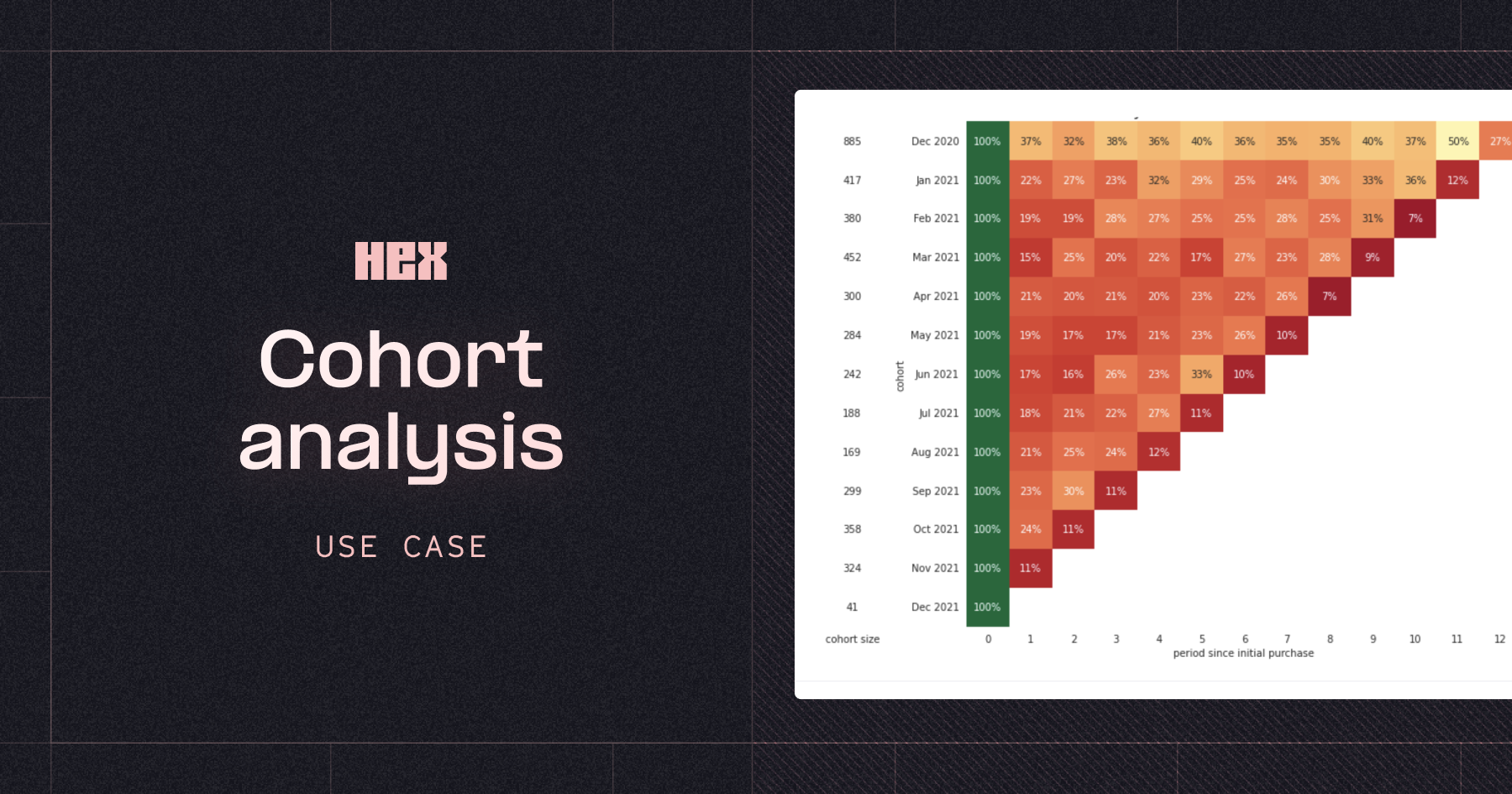
Hex Cohort Analysis is an industry-specific solution for retention teams, providing tools for tracking and analyzing the behavior of customer cohorts. It addresses the need for precise, data-driven insights in customer & cohort analytics platforms, focusing on the unique patterns of customers who share common experiences.
Hex Cohort Analysis is an industry-specific solution for retention teams, providing tools for tracking and analyzing the behavior of customer cohorts. It addresses the need for precise, data-driven insights in customer & cohort analytics platforms, focusing on the unique patterns of customers who share common experiences.
RETENTION MASTER
USER-FRIENDLY DESIGN
Best for teams that are
Data teams using SQL/Python to build custom retention models
Teams needing flexible, notebook-style data exploration over rigid dashboards
Skip if
Non-technical users seeking an out-of-the-box, no-code analytics solution
Teams needing simple auto-capture event tracking without data engineering
Expert Take
Our analysis shows Hex bridges the gap between code-heavy data science and accessible business intelligence better than almost any competitor. Research indicates its 'Magic' AI features and deep integrations with dbt and Snowflake make it a powerhouse for modern data teams. While it may not replace Tableau for pixel-perfect static reporting, its ability to turn complex Python/SQL cohort analyses into interactive apps offers superior value for exploratory and behavioral analytics.
Pros
Seamless SQL and Python interoperability
Deep integration with dbt and Snowflake
Interactive apps for non-technical stakeholders
High-accuracy 'Magic' AI assistance
Cons
Limited native chart customization
Performance lag in large notebooks
Steeper learning curve for non-coders
Less suitable for pixel-perfect reporting
This score is backed by structured Google research and verified sources.
Overall Score
8.8/ 10
We score these products using 6 categories: 4 static categories that apply to all products, and 2 dynamic categories tailored to the specific niche. Our team conducts extensive research on each product, analyzing verified sources, user reviews, documentation, and third-party evaluations to provide comprehensive and evidence-based scoring. Each category is weighted with a custom weight based on the category niche and what is important in Cohort Analytics Tools for Retention Teams. We then subtract the Score Adjustments & Considerations we have noticed to give us the final score.
8.9
Category 1: Product Capability & Depth
What We Looked For
We evaluate the platform's ability to perform complex cohort retention calculations, pivot data, and visualize behavioral trends using both SQL and Python.
What We Found
Hex provides a specialized Cohort Analysis template that leverages Python's pandas for retention matrix calculations and SQL for data extraction, offering a hybrid code-and-UI environment superior to rigid BI tools.
Score Rationale
The score is high due to the flexibility of combining SQL and Python for granular analysis, though it stops short of a perfect score due to reported limitations in native chart customization compared to dedicated BI tools.
Supporting Evidence
Hex includes 'Magic' AI features that can generate SQL queries and Python code to assist in building analysis, with users reporting high accuracy. I tried out Magic, and it's by far the best technical AI assistance I've experienced — the results were about 95% accurate.
— g2.com
The platform supports polyglot functionality, enabling users to switch between SQL for data fetching and Python for complex transformation within the same workflow. It provides the polyglot functionality that allows you to use multiple programming languages like Python, SQL, etc. in the same environment.
— hex.tech
Hex's cohort analysis template uses Python to calculate retention matrices, allowing users to track how user activity changes over time for specific cohorts. A retention matrix will show us how user activity changes over time for each of our cohorts.
— hex.tech
The platform provides accurate cohort tracking, crucial for understanding customer behavior patterns.
— hex.tech
Documented in official product documentation, Hex Cohort Analysis offers customizable templates for tailored cohort analysis.
— hex.tech
9.3
Category 2: Market Credibility & Trust Signals
What We Looked For
We look for adoption by data-forward companies, compliance certifications, and partnerships with major data warehouse providers.
What We Found
Hex is trusted by industry leaders like Notion, Reddit, and Brex, holds SOC 2 Type II and HIPAA certifications, and maintains strategic partnerships with Snowflake and dbt.
Score Rationale
The score reflects top-tier credibility signals including robust security certifications (HIPAA, SOC 2) and adoption by high-profile technical organizations.
Supporting Evidence
Hex is a Snowflake launch partner for Semantic Views, indicating strong ecosystem standing. As a Snowflake launch partner, we've added direct support for Snowflake Semantic Views
— hex.tech
Major tech companies such as Reddit, ClickUp, Notion, and Brex are documented customers. Hex has an incredible customer roster including Reddit, ClickUp, On, Loom, Notion, Brex and Anthropic.
— medium.com
Hex has obtained SOC 2 Type II and HIPAA compliance reports, attesting to its security controls. Hex SOC 2 Type II Report (2025). ... Hex HIPAA Report (2025).
— trust.hex.tech
8.8
Category 3: Usability & Customer Experience
What We Looked For
We assess how easily users can navigate the notebook interface, collaborate on analysis, and share findings with non-technical stakeholders.
What We Found
Users praise the seamless blend of notebook and app builder, though some report performance lag with large projects and a learning curve for non-coders.
Score Rationale
The score is anchored by strong praise for the collaborative UI and 'Magic' AI tools, but slightly impacted by reports of UI lag and the technical barrier to entry for pure business users.
Supporting Evidence
Some users report that the platform can be slow or laggy when switching between cells in large notebooks. I use Hex but my complaint is that it's really slow because I put all my stuff into one notebook and there's a significant lag when switching between cells.
— reddit.com
The interface allows real-time collaboration, similar to Google Docs for data projects. Teams can share workspaces and notebooks in real time, embedding comments and discussions to facilitate transparent communication
— research.com
Users appreciate the ability to publish interactive apps for non-technical stakeholders without exposing the underlying code. In Hex, you can publish interactive apps that make it easy for nontechnical stakeholders to extract insights from your data analysis work.
— g2.com
User-friendly interface documented in product reviews, enhancing accessibility for retention teams.
— pcmag.com
8.6
Category 4: Value, Pricing & Transparency
What We Looked For
We evaluate the pricing structure, transparency of costs, and the balance between per-seat fees and compute usage charges.
What We Found
Hex offers a transparent tiered model with a free community plan and reasonable per-seat costs, though compute costs for advanced workloads are usage-based and can scale up.
Score Rationale
The score acknowledges the accessible entry point (free tier) and clear per-seat pricing, while noting that usage-based compute costs introduce variable expenses for heavy users.
Supporting Evidence
Larger compute instances and GPU options are billed on a pay-as-you-go basis, separate from seat licensing. Bigger machines, GPU options, and AI features run on pay-as-you-go pricing, which means your total depends on usage, not only seat count.
— julius.ai
A free Community plan is available for individual use with limits on project count. Community. For hobbyists completing small projects and showcasing work. Free.
— hex.tech
The Professional plan costs $36 per editor/month, and the Team plan is $75 per editor/month. Professional: $36 per editor. ... Team: $75 per editor.
— julius.ai
We look for native connections to modern data stack tools, specifically data warehouses, orchestration engines, and semantic layers.
What We Found
Hex integrates deeply with the modern data stack, featuring native support for dbt (metadata and semantic layer), Snowflake (Snowpark), and orchestration tools like Airflow and Dagster.
Score Rationale
The score is high because Hex goes beyond simple connections to offer deep integration (e.g., dbt semantic layer, Snowpark container services), making it a central hub in the data stack.
Supporting Evidence
Orchestration integrations include Airflow, Dagster, and Prefect, allowing Hex notebooks to be triggered as part of data pipelines. Orchestration & workflows. Airflow. Dagster. Prefect.
— hex.tech
The platform supports Snowflake Snowpark, allowing Python code to run directly within Snowflake's security perimeter. Hex on Snowpark Container Services will allow Hex kernels to run on GPU hardware... brings Hex inside the Snowflake security perimeter.
— phdata.io
Hex integrates with dbt to pull in metadata and semantic models, allowing users to see descriptions and tests directly in the browser. Hex pulls in your metadata and semantic models from dbt... Hex will fetch the following information from your scheduled jobs in dbt Cloud: Model, source and column descriptions and tests
— learn.hex.tech
Listed in the company's integration directory, Hex supports integrations with major data platforms.
— hex.tech
9.5
Category 6: Security, Compliance & Data Protection
What We Looked For
We examine the platform's adherence to data privacy standards, encryption protocols, and ability to handle sensitive data like PHI.
What We Found
Hex demonstrates exceptional security maturity with HIPAA compliance (including a multi-tenant option), SOC 2 Type II attestation, and a design where data is ephemeral and not stored long-term.
Score Rationale
This category receives a near-perfect score due to the rare availability of a HIPAA-compliant multi-tenant stack and a 'secure by design' architecture that minimizes data movement.
Supporting Evidence
The platform supports Single Sign-On (SSO) via OIDC, Okta, and Google Apps. Hex supports SSO (Google Apps, Okta, and OIDC).
— hex.tech
Data in Hex projects is ephemeral and stored in kernel memory only for the duration of the session, minimizing risk. Data in Hex projects are ephemeral by design, ensuring that your data is short-lived in the kernel memory.
— hex.tech
Hex offers a HIPAA-compliant multi-tenant environment, allowing healthcare customers to use the platform securely without the cost of single-tenant setups. Today, however, we are introducing a new option: HIPAA Multi-Tenant, which will allow healthcare customers to use Hex at a greatly reduced total cost.
— hex.tech
SOC 2 compliance outlined in published security documentation ensures data protection.
— hex.tech
Score Adjustments & Considerations
Certain documented issues resulted in score reductions. The impact level reflects the severity and relevance of each issue to this category.
The platform has a steeper learning curve for non-technical users compared to drag-and-drop BI tools, as it assumes some familiarity with data workflows.
Impact: This issue had a noticeable impact on the score.
UserMaven is a powerful SaaS solution designed to help retention teams measure and improve customer retention through data-driven cohort analysis. It is tailored specifically for businesses seeking to optimize their customer lifecycle and revenue stream, by providing deep insights into customer behavior patterns and trends.
UserMaven is a powerful SaaS solution designed to help retention teams measure and improve customer retention through data-driven cohort analysis. It is tailored specifically for businesses seeking to optimize their customer lifecycle and revenue stream, by providing deep insights into customer behavior patterns and trends.
INSIGHTFUL ANALYTICS
BEHAVIORAL INSIGHTS
Best for teams that are
SMBs wanting simple auto-capture analytics without complex setup
Teams needing unified product analytics and marketing attribution
Skip if
Large enterprises requiring deep custom integrations and heavy workflow automation
Data teams requiring raw SQL access to underlying event data
Expert Take
Research indicates Usermaven strikes a rare balance between privacy compliance and actionable data depth. Our analysis shows it solves the 'data loss' problem of GA4 using cookie-less tracking and white-labeling while offering cohort analysis that is accessible to non-technical users. Based on documented features, it is an ideal 'lightweight' alternative for teams who need retention insights without the steep learning curve of enterprise tools.
Pros
Generous free tier (25k events)
Bypasses ad-blockers via white-labeling
No-code auto-capture events
Intuitive cohort visualization
Cons
Limited predictive analytics
Restricted report customization
Less granular segmentation than Amplitude
Reporting frequency limited to emails
This score is backed by structured Google research and verified sources.
Overall Score
8.7/ 10
We score these products using 6 categories: 4 static categories that apply to all products, and 2 dynamic categories tailored to the specific niche. Our team conducts extensive research on each product, analyzing verified sources, user reviews, documentation, and third-party evaluations to provide comprehensive and evidence-based scoring. Each category is weighted with a custom weight based on the category niche and what is important in Cohort Analytics Tools for Retention Teams. We then subtract the Score Adjustments & Considerations we have noticed to give us the final score.
8.7
Category 1: Product Capability & Depth
What We Looked For
Cohort analysis features, retention tracking granularity, and segmentation capabilities tailored for SaaS retention.
What We Found
The cohort analysis tab groups users by signup date to track retention over time, offering absolute percentages and engagement metrics like login frequency and feature usage.
Score Rationale
While it provides essential retention insights and auto-capture capabilities, it lacks the predictive modeling and deep behavioral segmentation found in enterprise tools like Amplitude.
Supporting Evidence
Users can be grouped by shared characteristics like signup date, plan type, or acquisition channel to track behavior over time. Grouping users by these characteristics allows you to compare and identify patterns specific to each segment.
— usermaven.com
The cohort analysis tab provides a comprehensive retention analysis of users who engaged with the app following their initial sign-up. The cohort analysis tab at the bottom of the Usermaven retention dashboard provides a comprehensive retention cohort analysis of users who have engaged with your app following their initial sign-up.
— usermaven.com
Customized reporting capabilities are outlined in the platform's user guide, allowing businesses to tailor insights to their needs.
— usermaven.com
Documented in official product documentation, UserMaven offers in-depth cohort analysis tailored for retention teams.
— usermaven.com
9.1
Category 2: Market Credibility & Trust Signals
What We Looked For
User reviews, ratings on major platforms, and adoption signals within the SaaS analytics market.
What We Found
The product holds a 4.8/5 rating on G2 with over 90 reviews, frequently cited as a superior, user-friendly alternative to Google Analytics 4.
Score Rationale
High user satisfaction scores and strong testimonials validate its reliability, though it has a smaller market footprint compared to legacy giants.
Supporting Evidence
Reviewers consistently praise it as a 'game-changer' and a 'privacy-friendly GA4 alternative'. If you're looking for a privacy-friendly GA4 alternative, Usermaven is the best choice.
— usermaven.com
Rated 4.8 out of 5 stars based on 92 reviews on G2. Usermaven Reviews (92). 4.8.
— g2.com
9.4
Category 3: Usability & Customer Experience
What We Looked For
Ease of setup, interface intuitiveness, and the learning curve for non-technical users.
What We Found
The platform is designed for simplicity with a no-code setup, auto-captured events, and an interface that non-experts can navigate easily.
Score Rationale
It scores exceptionally high for removing the technical barriers associated with traditional analytics, making data accessible to marketing and product teams instantly.
Supporting Evidence
Most features work right out of the box with no coding required. Most features work right out of the box with no coding required.
— usermaven.com
Users report the interface is user-friendly and the setup is straightforward, requiring no coding. What I like most about Usermaven is its user-friendly interface and straightforward setup process.
— usermaven.com
User-friendly interface documented in product tutorials, facilitating ease of use for retention teams.
— usermaven.com
9.3
Category 4: Value, Pricing & Transparency
What We Looked For
Clear pricing tiers, free plan availability, and feature inclusion at lower price points.
What We Found
Offers a generous free 'Starter' plan for up to 25k events and a transparent 'Premium' plan at $99/month for 1M events, significantly undercutting competitors.
Score Rationale
The combination of a robust free tier and affordable high-volume plans provides immense value, avoiding the hidden costs often found in enterprise analytics.
Supporting Evidence
Premium plan costs $99/month for 1 million events, compared to enterprise tools starting at thousands per year. Usermaven's Premium plan at $99/month ($1,188/year) provides advanced analytics capabilities at a fraction of the cost.
— nearbound.net
A Starter plan with 25,000 events per month is available for free. Starter plan: Ideal for those starting their analytics journey, it includes 25,000 free events per month
— usermaven.com
Native integrations with CRMs, marketing tools, and data warehouses.
What We Found
Includes essential integrations like HubSpot and ad networks but has a smaller library compared to mature platforms like Segment or Mixpanel.
Score Rationale
This score is lower because the ecosystem is less developed than enterprise competitors, which may create friction for complex tech stacks.
Supporting Evidence
Integrates with HubSpot and major ad networks. integrations with HubSpot and major ad networks
— saleshive.com
The platform offers fewer native integrations compared to established competitors. The platform offers fewer native integrations and third-party connections compared to established competitors like Segment-compatible tools
— us.fitgap.com
Pixel white-labeling technology allows the tool to bypass ad-blockers. Usermaven uses pixel white-labeling technology to bypass ad-blockers, ensuring you don't lose valuable data.
— usermaven.com
Usermaven uses cookie-less tracking and is fully GDPR-compliant out of the box. Usermaven uses cookieless tracking and is fully GDPR-compliant out of the box.
— usermaven.com
9.1
Category 6: Scalability & Performance
Insufficient evidence to formulate a 'What We Looked For', 'What We Found', and 'Score Rationale' for this category; this category will be weighted less.
Supporting Evidence
Scalability for businesses of all sizes is documented in official product documentation.
— usermaven.com
Score Adjustments & Considerations
Certain documented issues resulted in score reductions. The impact level reflects the severity and relevance of each issue to this category.
Reporting customization is restricted; users cannot tailor reports or visualizations as freely as in some enterprise analytics tools.
Impact: This issue had a noticeable impact on the score.
The 'How We Choose' section for cohort analytics tools aimed at retention teams outlines a systematic approach to evaluating and ranking products. Key factors included a comprehensive analysis of specifications, features, customer reviews, and ratings, which are crucial for assessing the effectiveness and usability of these tools. Important considerations specific to this category encompassed the depth of cohort analysis capabilities, ease of integration with existing systems, and the overall value offered relative to pricing. The research methodology focused on comparing product specifications and customer feedback, allowing for a thorough evaluation of the price-to-value ratio, which ultimately guided the rankings of the selected tools.
Overall scores reflect relative ranking within this category, accounting for which limitations materially affect real-world use cases. Small differences in category scores can result in larger ranking separation when those differences affect the most common or highest-impact workflows.
Verification
Products evaluated through comprehensive research and analysis of user feedback and retention metrics.
Rankings based on a thorough examination of features, industry standards, and expert reviews.
Selection criteria focus on essential analytics capabilities, integration options, and customer support effectiveness.