
Developer Documentation & Portal Tools

These are the specialized categories within Developer Documentation & Portal Tools. Looking for something broader? See all Business Intelligence & Analytics Software categories.

1

PartnerFleet Developer Portal

Best for Developer Documentation & Portal Tools for Marketing Agencies

Score
9.9 / 10
PartnerFleet Developer Portal

PartnerFleet Developer Portal is a SaaS solution designed to foster seamless integration with sales and marketing tools for marketing agencies. It drives developer and integration data into CRM, PRM, and marketing automation systems, enabling agencies to better highlight adoption and streamline processes.

Best for Developer Documentation & Portal Tools for Marketing Agencies

Expert Take

PartnerFleet Developer Portal excels in providing a specialized solution for marketing agencies, integrating seamlessly with sales and marketing tools. Its capability to drive developer data into CRM and marketing systems enhances process efficiency and decision-making. However, the need for technical knowledge and custom pricing may limit its accessibility for smaller agencies.

Pros

  • SOC 2 Type II certified security
  • No-code setup in weeks not months
  • Kanban-style app development tracking
  • Native HubSpot and Salesforce integrations
  • Highly responsive customer support team

Cons

  • No public pricing transparency
  • Manual tasks required (no managed service)
  • Reporting features historically limited
  • Smaller user review volume than giants
  • Sandbox environment not hosted natively

Best for teams that are

  • SaaS companies building a public marketplace for third-party apps and integrations
  • Partnership teams managing external developer submissions and approval workflows
  • Companies wanting to monetize their ecosystem through a branded app store

Skip if

  • Engineering teams needing an internal developer portal for microservices
  • Companies only needing simple hosting for API reference documentation
  • Early-stage startups with no external partners or third-party developers

Best for teams that are

  • SaaS companies building a public marketplace for third-party apps and integrations
  • Partnership teams managing external developer submissions and approval workflows
  • Companies wanting to monetize their ecosystem through a branded app store

Skip if

  • Engineering teams needing an internal developer portal for microservices
  • Companies only needing simple hosting for API reference documentation
  • Early-stage startups with no external partners or third-party developers

Pros

  • SOC 2 Type II certified security
  • No-code setup in weeks not months
  • Kanban-style app development tracking
  • Native HubSpot and Salesforce integrations
  • Highly responsive customer support team

Cons

  • No public pricing transparency
  • Manual tasks required (no managed service)
  • Reporting features historically limited
  • Smaller user review volume than giants
  • Sandbox environment not hosted natively

Expert Take

PartnerFleet Developer Portal excels in providing a specialized solution for marketing agencies, integrating seamlessly with sales and marketing tools. Its capability to drive developer data into CRM and marketing systems enhances process efficiency and decision-making. However, the need for technical knowledge and custom pricing may limit its accessibility for smaller agencies.

2
Score
9.8 / 10
BigCommerce Developer Portal

BigCommerce Developer Portal is a comprehensive solution specifically tailored for ecommerce businesses. It provides robust APIs, SDKs, and toolkits, enabling developers to build custom apps that can be seamlessly integrated into BigCommerce stores, meeting the unique needs of the ecommerce industry.

Best for Developer Documentation & Portal Tools for Ecommerce Businesses

Expert Take

BigCommerce Developer Portal stands out as a top-tier solution for ecommerce developers due to its comprehensive APIs and SDKs, which facilitate seamless app integration into BigCommerce stores. Its robust developer resources and support for multiple coding languages further enhance its appeal, making it a valuable tool for customizing ecommerce platforms.

Pros

  • Robust REST & GraphQL APIs
  • Free non-transactional developer sandboxes
  • ISO 27001 & PCI DSS Level 1
  • Catalyst framework for headless builds
  • Strong B2B-specific API capabilities

Cons

  • Steeper learning curve for Stencil
  • Strict API limits on lower plans
  • Smaller app ecosystem than Shopify
  • CLI performance reported as slow
  • Complex legacy vs. modern API mix

Best for teams that are

  • Mid-market to enterprise brands needing scalable SaaS
  • Developers building apps for a large B2B/B2C ecosystem
  • Teams wanting API flexibility without managing hosting

Skip if

  • Small hobbyists with zero budget for monthly fees
  • Developers wanting full backend database access or self-hosting
  • Those needing a fully open-source environment

Best for teams that are

  • Mid-market to enterprise brands needing scalable SaaS
  • Developers building apps for a large B2B/B2C ecosystem
  • Teams wanting API flexibility without managing hosting

Skip if

  • Small hobbyists with zero budget for monthly fees
  • Developers wanting full backend database access or self-hosting
  • Those needing a fully open-source environment

Pros

  • Robust REST & GraphQL APIs
  • Free non-transactional developer sandboxes
  • ISO 27001 & PCI DSS Level 1
  • Catalyst framework for headless builds
  • Strong B2B-specific API capabilities

Cons

  • Steeper learning curve for Stencil
  • Strict API limits on lower plans
  • Smaller app ecosystem than Shopify
  • CLI performance reported as slow
  • Complex legacy vs. modern API mix

Expert Take

BigCommerce Developer Portal stands out as a top-tier solution for ecommerce developers due to its comprehensive APIs and SDKs, which facilitate seamless app integration into BigCommerce stores. Its robust developer resources and support for multiple coding languages further enhance its appeal, making it a valuable tool for customizing ecommerce platforms.

3

Mintlify - Intelligent Documentation

Best for Developer Documentation & Portal Tools for Marketing Agencies
Score
9.7 / 10
Mintlify - Intelligent Documentation

Mintlify is a next-gen, AI-native documentation platform designed specifically for developers in marketing agencies. It provides an out-of-the-box, user-friendly interface for creating, organizing, and sharing technical documents, making it easier to manage complex projects and collaborate with team members.

Best for Developer Documentation & Portal Tools for Marketing Agencies

Expert Take

Mintlify excels as a documentation platform with its AI-driven features tailored for developers in marketing agencies. It offers a user-friendly interface and collaborative tools that enhance project management and team collaboration. While customization options are limited, its strengths in usability and innovation make it a top choice in its category.

Pros

  • Beautiful, modern design out-of-the-box
  • Seamless Git and GitHub integration
  • AI-powered search and maintenance tools
  • Trusted by industry leaders like Anthropic
  • Fast page load speeds

Cons

  • Steep price jump to Pro plan
  • AI features are expensive and metered
  • API playground has reported usability issues
  • Seat-based pricing increases costs
  • Less customizable than open-source alternatives

Best for teams that are

  • Engineering teams who prefer "docs-as-code" workflows using Markdown and GitHub
  • Startups wanting beautiful, high-converting documentation design out of the box
  • API-first companies needing interactive API playgrounds and automatic SDK generation

Skip if

  • Non-technical writers uncomfortable with Git workflows or JSON configuration
  • Small teams with limited budgets needing advanced AI features (high cost for Pro)
  • Enterprises requiring on-premise hosting or complete control over the rendering pipeline

Best for teams that are

  • Engineering teams who prefer "docs-as-code" workflows using Markdown and GitHub
  • Startups wanting beautiful, high-converting documentation design out of the box
  • API-first companies needing interactive API playgrounds and automatic SDK generation

Skip if

  • Non-technical writers uncomfortable with Git workflows or JSON configuration
  • Small teams with limited budgets needing advanced AI features (high cost for Pro)
  • Enterprises requiring on-premise hosting or complete control over the rendering pipeline

Pros

  • Beautiful, modern design out-of-the-box
  • Seamless Git and GitHub integration
  • AI-powered search and maintenance tools
  • Trusted by industry leaders like Anthropic
  • Fast page load speeds

Cons

  • Steep price jump to Pro plan
  • AI features are expensive and metered
  • API playground has reported usability issues
  • Seat-based pricing increases costs
  • Less customizable than open-source alternatives

Expert Take

Mintlify excels as a documentation platform with its AI-driven features tailored for developers in marketing agencies. It offers a user-friendly interface and collaborative tools that enhance project management and team collaboration. While customization options are limited, its strengths in usability and innovation make it a top choice in its category.

4
Score
9.7 / 10
commercetools Documentation

commercetools Documentation is a highly specialized SaaS solution for ecommerce businesses. It offers a comprehensive suite of resources to manage and scale modern commerce experiences, addressing the need for robust, adaptable, and user-friendly developer tools within the ecommerce industry.

Best for Developer Documentation & Portal Tools for Ecommerce Businesses

Expert Take

commercetools Documentation excels in providing comprehensive and user-friendly resources tailored for ecommerce businesses. Its adaptability and scalability make it a top choice for managing modern commerce experiences. While the pricing model lacks transparency, the product's strengths in documentation and usability position it as a leading solution in its category.

Pros

  • True MACH architecture (Microservices, API-first, Cloud-native, Headless)
  • Order-based pricing model avoids revenue penalties
  • Leader in Gartner Magic Quadrant for 5+ years
  • SOC 2 Type II and HIPAA compliant
  • Highly scalable for enterprise-level volume

Cons

  • Steep learning curve for non-technical users
  • High implementation and maintenance costs
  • Requires significant developer resources
  • No public pricing transparency
  • Limited out-of-the-box frontend features

Best for teams that are

  • Large enterprises with high digital maturity and tech teams
  • Companies needing complex, custom omnichannel experiences
  • Businesses adopting a MACH (Microservices, API-first) strategy

Skip if

  • Small businesses with limited technical resources
  • Companies seeking an all-in-one, out-of-the-box solution
  • Teams with limited budget for implementation

Best for teams that are

  • Large enterprises with high digital maturity and tech teams
  • Companies needing complex, custom omnichannel experiences
  • Businesses adopting a MACH (Microservices, API-first) strategy

Skip if

  • Small businesses with limited technical resources
  • Companies seeking an all-in-one, out-of-the-box solution
  • Teams with limited budget for implementation

Pros

  • True MACH architecture (Microservices, API-first, Cloud-native, Headless)
  • Order-based pricing model avoids revenue penalties
  • Leader in Gartner Magic Quadrant for 5+ years
  • SOC 2 Type II and HIPAA compliant
  • Highly scalable for enterprise-level volume

Cons

  • Steep learning curve for non-technical users
  • High implementation and maintenance costs
  • Requires significant developer resources
  • No public pricing transparency
  • Limited out-of-the-box frontend features

Expert Take

commercetools Documentation excels in providing comprehensive and user-friendly resources tailored for ecommerce businesses. Its adaptability and scalability make it a top choice for managing modern commerce experiences. While the pricing model lacks transparency, the product's strengths in documentation and usability position it as a leading solution in its category.

5

Swagger: API Design & Documentation

Best for Developer Documentation & Portal Tools for Ecommerce Businesses

Score
9.6 / 10
Swagger: API Design & Documentation

Swagger is an industry-leading solution for eCommerce businesses that need a comprehensive, reliable API design and documentation toolset. Its open source nature allows customization for specific needs, while professional tools help streamline development, reduce errors, and enhance collaboration among development teams.

Best for Developer Documentation & Portal Tools for Ecommerce Businesses

Expert Take

Swagger stands out as a leading solution in the eCommerce sector for API design and documentation. Its open-source flexibility, comprehensive toolset, and support for numerous API standards make it highly valuable for developers. Despite a learning curve, its capabilities justify its position as a best-of-the-best product.

Pros

  • Industry standard for OpenAPI design
  • Centralized style guide enforcement
  • Strong collaboration and commenting tools
  • Auto-mocking via VirtServer integration
  • Robust code generation for SDKs

Cons

  • SSO requires extra cost/add-on
  • Steeper learning curve for beginners
  • Testing features less robust than Postman
  • UI can be complex for simple tasks
  • Performance issues with very large specs

Best for teams that are

  • API architects designing RESTful APIs (contract-first)
  • Teams needing standardized OpenAPI documentation
  • Developers collaborating on API specifications

Skip if

  • Non-technical users looking for a store builder
  • Teams prioritizing complex automated testing over design
  • Those needing a full backend implementation tool

Best for teams that are

  • API architects designing RESTful APIs (contract-first)
  • Teams needing standardized OpenAPI documentation
  • Developers collaborating on API specifications

Skip if

  • Non-technical users looking for a store builder
  • Teams prioritizing complex automated testing over design
  • Those needing a full backend implementation tool

Pros

  • Industry standard for OpenAPI design
  • Centralized style guide enforcement
  • Strong collaboration and commenting tools
  • Auto-mocking via VirtServer integration
  • Robust code generation for SDKs

Cons

  • SSO requires extra cost/add-on
  • Steeper learning curve for beginners
  • Testing features less robust than Postman
  • UI can be complex for simple tasks
  • Performance issues with very large specs

Expert Take

Swagger stands out as a leading solution in the eCommerce sector for API design and documentation. Its open-source flexibility, comprehensive toolset, and support for numerous API standards make it highly valuable for developers. Despite a learning curve, its capabilities justify its position as a best-of-the-best product.

6

Theneo - Developer Documentation Software

Best for Developer Documentation & Portal Tools for Marketing Agencies
Score
9.6 / 10
Theneo - Developer Documentation Software

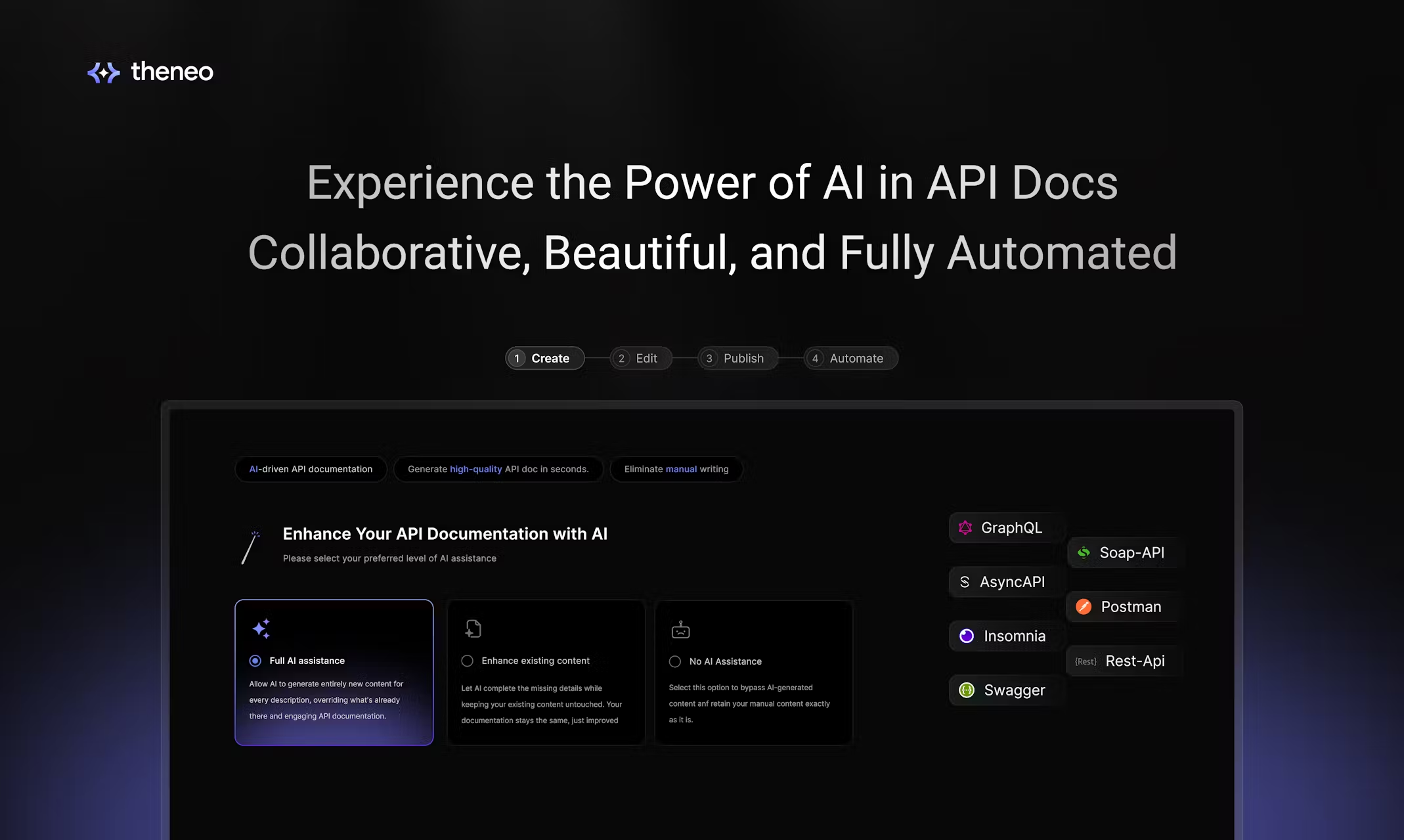
Theneo is designed specifically for marketing agencies that deal with developer documentation. It offers AI-native docs and portals for API, SDK, and product documents, with features like AI search, automatic changelogs, and interactive references that cater to the unique needs of this industry. Its ability to import OpenAPI/Markdown and provide custom branding options makes it an ideal tool for marketing agencies working on software products.

Best for Developer Documentation & Portal Tools for Marketing Agencies
Expert Take

Theneo excels in providing AI-native documentation tools tailored for marketing agencies, offering features like automatic changelogs and interactive references. Its ability to import OpenAPI/Markdown and provide custom branding options enhances its appeal. However, pricing transparency is limited, and technical expertise may be required.

Pros

  • Generates Stripe-quality docs instantly
  • Supports OpenAPI, Postman, GraphQL
  • Interactive API Explorer for testing
  • Notion-like collaborative editor
  • Automated sync via GitHub Actions

Cons

  • Steep price jump to paid tier
  • AI output requires manual verification
  • Advanced branding locked to Enterprise
  • Limited support for non-code diagrams
  • Learning curve for advanced features

Best for teams that are

  • Teams wanting to auto-generate interactive API docs from Postman or OpenAPI specs
  • Technical writers and PMs needing a visual editor to collaborate without coding
  • Companies wanting an AI-powered assistant to automate documentation maintenance

Skip if

  • "Docs-as-code" purists who prefer managing documentation strictly via CLI/Git
  • Teams seeking a completely free, open-source solution for self-hosting
  • Developers who want to build their documentation site entirely from scratch

Best for teams that are

  • Teams wanting to auto-generate interactive API docs from Postman or OpenAPI specs
  • Technical writers and PMs needing a visual editor to collaborate without coding
  • Companies wanting an AI-powered assistant to automate documentation maintenance

Skip if

  • "Docs-as-code" purists who prefer managing documentation strictly via CLI/Git
  • Teams seeking a completely free, open-source solution for self-hosting
  • Developers who want to build their documentation site entirely from scratch

Pros

  • Generates Stripe-quality docs instantly
  • Supports OpenAPI, Postman, GraphQL
  • Interactive API Explorer for testing
  • Notion-like collaborative editor
  • Automated sync via GitHub Actions

Cons

  • Steep price jump to paid tier
  • AI output requires manual verification
  • Advanced branding locked to Enterprise
  • Limited support for non-code diagrams
  • Learning curve for advanced features

Expert Take

Theneo excels in providing AI-native documentation tools tailored for marketing agencies, offering features like automatic changelogs and interactive references. Its ability to import OpenAPI/Markdown and provide custom branding options enhances its appeal. However, pricing transparency is limited, and technical expertise may be required.

7
Score
9.5 / 10
HubSpot Developers Platform

HubSpot Developers is a comprehensive developer platform specifically tailored for marketing agencies. It equips developers with APIs, SDKs, tooling, and sample apps to craft unique marketing solutions, with the support of a world-class builder community. It's perfect for agencies looking to create customised, integrated marketing solutions for their clients.

Best for Developer Documentation & Portal Tools for Marketing Agencies

Expert Take

HubSpot Developers Platform is a leading tool for marketing agencies, offering comprehensive APIs, SDKs, and community support. Its robust documentation and integration capabilities make it a top choice for creating customized marketing solutions. Despite some complexity in initial setup, its value and market credibility are well-supported by external validations.

Pros

  • 0% revenue share for marketplace apps
  • Unified 'Developer Projects' build framework
  • Massive customer base of 248k+ users
  • Modern React-based UI extensions
  • Strong CLI and local dev tools

Cons

  • Breaking changes in core APIs (List IDs)
  • Built-in serverless functions deprecated in v2025.2
  • Documentation inconsistencies and gaps
  • Strict API burst rate limits
  • Expensive API limit increase add-on

Best for teams that are

  • Developers building custom apps and integrations specifically for the HubSpot ecosystem
  • Agencies creating custom CMS themes and websites for HubSpot clients
  • Teams needing to distribute apps via the HubSpot App Marketplace

Skip if

  • SaaS companies looking to host documentation for their own non-HubSpot APIs
  • Developers seeking a general-purpose cloud hosting provider for full-stack apps
  • Teams wanting to build websites with a CMS that can be hosted on external servers

Best for teams that are

  • Developers building custom apps and integrations specifically for the HubSpot ecosystem
  • Agencies creating custom CMS themes and websites for HubSpot clients
  • Teams needing to distribute apps via the HubSpot App Marketplace

Skip if

  • SaaS companies looking to host documentation for their own non-HubSpot APIs
  • Developers seeking a general-purpose cloud hosting provider for full-stack apps
  • Teams wanting to build websites with a CMS that can be hosted on external servers

Pros

  • 0% revenue share for marketplace apps
  • Unified 'Developer Projects' build framework
  • Massive customer base of 248k+ users
  • Modern React-based UI extensions
  • Strong CLI and local dev tools

Cons

  • Breaking changes in core APIs (List IDs)
  • Built-in serverless functions deprecated in v2025.2
  • Documentation inconsistencies and gaps
  • Strict API burst rate limits
  • Expensive API limit increase add-on

Expert Take

HubSpot Developers Platform is a leading tool for marketing agencies, offering comprehensive APIs, SDKs, and community support. Its robust documentation and integration capabilities make it a top choice for creating customized marketing solutions. Despite some complexity in initial setup, its value and market credibility are well-supported by external validations.

8
Score
9.5 / 10
8
9.5 / 10
Ecwid Developers

Ecwid Developers is a robust SaaS solution dedicated to ecommerce businesses seeking to develop custom storefronts, personalize shopping experiences, or integrate external services. It provides a comprehensive developer documentation and portal tools, addressing the industry-specific needs for seamless integration, customization, and improved customer interaction.

Best for Developer Documentation & Portal Tools for Ecommerce Businesses

Expert Take

Ecwid Developers offers a comprehensive suite of tools tailored for ecommerce businesses, allowing for significant customization and integration capabilities. Its developer documentation is robust, supporting the creation of personalized shopping experiences. While the free plan has limitations, the platform's overall capabilities position it as a top choice for ecommerce developers.

Pros

  • Generous 80% revenue share for developers
  • Native apps embed directly in admin panel
  • Strong headless commerce capabilities
  • Backed by Lightspeed with 200k+ stores
  • Comprehensive API Playground available

Cons

  • No API access on Free merchant plans
  • Strict rate limits (600 req/min)
  • Documentation inconsistencies reported
  • Smaller market share than Shopify
  • Requires paid plan for API usage

Best for teams that are

  • Small businesses adding commerce to existing websites
  • Developers building widgets for SMBs and social selling
  • Merchants needing a simple, embeddable store solution

Skip if

  • Large enterprises with complex B2B or high-volume needs
  • Users needing deep backend customization or open source
  • Businesses requiring advanced multi-store architecture

Best for teams that are

  • Small businesses adding commerce to existing websites
  • Developers building widgets for SMBs and social selling
  • Merchants needing a simple, embeddable store solution

Skip if

  • Large enterprises with complex B2B or high-volume needs
  • Users needing deep backend customization or open source
  • Businesses requiring advanced multi-store architecture

Pros

  • Generous 80% revenue share for developers
  • Native apps embed directly in admin panel
  • Strong headless commerce capabilities
  • Backed by Lightspeed with 200k+ stores
  • Comprehensive API Playground available

Cons

  • No API access on Free merchant plans
  • Strict rate limits (600 req/min)
  • Documentation inconsistencies reported
  • Smaller market share than Shopify
  • Requires paid plan for API usage

Expert Take

Ecwid Developers offers a comprehensive suite of tools tailored for ecommerce businesses, allowing for significant customization and integration capabilities. Its developer documentation is robust, supporting the creation of personalized shopping experiences. While the free plan has limitations, the platform's overall capabilities position it as a top choice for ecommerce developers.

9
Score
9.3 / 10
HawkSearch Developer Portal

HawkSearch Developer Portal is a comprehensive SaaS solution designed specifically for ecommerce developers. Offering a range of features and fundamental concepts, this tool aids in setting up a personalized HawkSearch project, addressing industry-specific needs such as improving site search, boosting conversions, and enhancing customer experiences.

Best for Developer Documentation & Portal Tools for Ecommerce Businesses

Expert Take

HawkSearch Developer Portal excels in providing a specialized solution for ecommerce developers, with strong integration capabilities and comprehensive support. While pricing transparency is limited, its industry-specific features and usability make it a top choice in its category.

Pros

  • Comprehensive platform
  • Ecommerce specific features
  • Easy integration with various platforms
  • 24/7 support

Cons

  • Might need technical knowledge
  • No stated free plan
  • Pricing details not readily available

Best for teams that are

  • B2B distributors with large, complex product catalogs
  • Developers integrating AI search and merchandising
  • Sites needing advanced unit conversion and part search

Skip if

  • Small stores with small catalogs or limited budgets
  • Simple B2C retailers satisfied with basic native search
  • Businesses not needing complex filtering or personalization

Best for teams that are

  • B2B distributors with large, complex product catalogs
  • Developers integrating AI search and merchandising
  • Sites needing advanced unit conversion and part search

Skip if

  • Small stores with small catalogs or limited budgets
  • Simple B2C retailers satisfied with basic native search
  • Businesses not needing complex filtering or personalization

Pros

  • Comprehensive platform
  • Ecommerce specific features
  • Easy integration with various platforms
  • 24/7 support

Cons

  • Might need technical knowledge
  • No stated free plan
  • Pricing details not readily available

Expert Take

HawkSearch Developer Portal excels in providing a specialized solution for ecommerce developers, with strong integration capabilities and comprehensive support. While pricing transparency is limited, its industry-specific features and usability make it a top choice in its category.

10
Score
9.3 / 10
OrderCloud Developer Tools

OrderCloud Developer Tools is a robust SaaS solution designed to streamline ecommerce operations for developers. The platform offers extensive documentation and a plethora of tools that cater specifically to the needs of ecommerce businesses, such as Javascript SDK, .NET Catalyst Middleware, and .NET C# SDK, which are pivotal in developing and managing ecommerce platforms.

Best for Developer Documentation & Portal Tools for Ecommerce Businesses
Expert Take

OrderCloud Developer Tools excels in providing comprehensive resources for ecommerce developers, with extensive documentation and integration capabilities. It is recognized for its strong developer support and integration with major platforms, making it a top choice for ecommerce development. However, its steep learning curve and limited customization options slightly impact its usability score.

Pros

  • API-first headless architecture for maximum flexibility
  • Strong support for complex B2B/B2X models
  • SOC 2 Type 2 and HIPAA compliant
  • Free fully-functional sandbox environment
  • Extensible data model via Extended Properties (XP)

Cons

  • Steep learning curve for new developers
  • Requires significant development resources
  • High enterprise licensing and implementation costs
  • No out-of-the-box storefront (pure headless)
  • Limited pre-built UI components for end-users

Best for teams that are

  • Complex B2B/B2X businesses with unique logic needs
  • Developers building custom headless commerce apps
  • Organizations needing flexible data models and hierarchies

Skip if

  • Simple B2C retailers wanting a quick, out-of-the-box store
  • Organizations without a strong in-house development team
  • Those preferring pre-built themes over custom frontends

Best for teams that are

  • Complex B2B/B2X businesses with unique logic needs
  • Developers building custom headless commerce apps
  • Organizations needing flexible data models and hierarchies

Skip if

  • Simple B2C retailers wanting a quick, out-of-the-box store
  • Organizations without a strong in-house development team
  • Those preferring pre-built themes over custom frontends

Pros

  • API-first headless architecture for maximum flexibility
  • Strong support for complex B2B/B2X models
  • SOC 2 Type 2 and HIPAA compliant
  • Free fully-functional sandbox environment
  • Extensible data model via Extended Properties (XP)

Cons

  • Steep learning curve for new developers
  • Requires significant development resources
  • High enterprise licensing and implementation costs
  • No out-of-the-box storefront (pure headless)
  • Limited pre-built UI components for end-users

Expert Take

OrderCloud Developer Tools excels in providing comprehensive resources for ecommerce developers, with extensive documentation and integration capabilities. It is recognized for its strong developer support and integration with major platforms, making it a top choice for ecommerce development. However, its steep learning curve and limited customization options slightly impact its usability score.

How We Rank Products

Our Evaluation Process

Our Evaluation Process

For developer documentation and portal tools, we evaluate API reference generation, code example management, search quality, versioning, and customization options. We assess integrations with API gateways, CI/CD workflows, and authentication systems. Performance, language support, and developer-friendly UX are essential. At the Level 3 perspective, we highlight platforms that excel across Level 4 categories—API portals, documentation managers, and developer experience hubs—to showcase the best systems for developer enablement.

Verification

Categories reflect standard developer experience (DX) and API lifecycle practices. Our taxonomy aligns with how platform teams structure developer portals. Level 3 recommendations come from deeper Level 4 analyses across developer ecosystem needs.

Verification

  • Products evaluated through comprehensive research and analysis of developer documentation and portal tools.
  • Rankings based on analysis of specifications, user reviews, and expert ratings in the developer tools category.
  • Selection criteria focus on usability, integration features, and community support for documentation and portal tools.

Score Breakdown

0.0 / 10

About Developer Documentation & Portal Tools

What Is Developer Documentation & Portal Tools?

This category covers software designed to centralize, manage, and present technical documentation and API resources for internal engineering teams and external partners. It spans the full knowledge lifecycle: from automated reference generation (e.g., from OpenAPI specs) and interactive "try-it-now" sandboxes to governance, versioning, and community management. It sits between API Management (which focuses on gateway traffic and security policies) and Knowledge Management (which focuses on general wiki-style content). It includes both general-purpose internal developer portals (IDPs) meant to reduce tool sprawl and vertical-specific external portals designed to monetize data or enable partner integrations in industries like fintech and healthcare.

At its core, a Developer Documentation & Portal Tool solves the "discovery and consumption" problem. As software architectures shifted from monoliths to microservices, the number of APIs and internal services exploded. Developers—whether internal employees or third-party integrators—can no longer rely on tribal knowledge to find the right endpoint or understand how a service works. These tools provide a structured, searchable, and interactive interface that bridges the gap between raw code and human understanding. They transform static text into a functional workspace where developers can authenticate, test calls, manage keys, and view live status updates, effectively treating documentation as a product rather than an afterthought.

The primary users are software engineers, technical writers, and product managers. For engineers, these tools reduce the "time-to-first-call" (TTFC) by providing accurate, testable examples. For product managers, they offer analytics on which parts of the API are actually being used, identifying churn risks or expansion opportunities. Why does this matter? Because in a digital economy driven by integration, the quality of the developer experience (DX) is often the primary differentiator between a platform that gains adoption and one that is abandoned. Bad documentation is not just an annoyance; it is a bottleneck that costs enterprises millions in lost productivity and failed integrations.

History

The evolution of developer portals mirrors the shift from software as a product to software as a service. In the 1990s and early 2000s, "developer documentation" largely meant static PDFs, man pages, or sprawling HTML directories generated by tools like Javadoc. Documentation was a post-release artifact, often disconnected from the actual code and frequently outdated the moment it was published. The primary distribution method was physical media or FTP sites, and "portals" were essentially file repositories.

The mid-2000s and the rise of Service-Oriented Architecture (SOA) introduced complexity that static files couldn't handle. The reliance on heavy protocols like SOAP required complex WSDL files for definition. This era saw the first wave of "registries" and "repositories," but these were IT-centric governance tools, not developer-friendly portals. They were built for control, not consumption, often requiring manual approval processes just to view a schema.

The pivotal shift occurred around 2010 with the explosion of RESTful APIs and the "API Economy." Companies like Twilio and Stripe demonstrated that developer experience could be a competitive moat. They didn't just offer APIs; they offered beautiful, interactive portals where developers could paste code and see a result in seconds. This created a new standard: "Docs as Code" and the interactive console. Simultaneously, the specification battle settled with the emergence of the OpenAPI Specification (formerly Swagger), allowing documentation to be auto-generated from code, ensuring accuracy.

Between 2015 and 2020, the market saw massive consolidation as major players acquired API management capabilities to capture this layer. Google acquired Apigee, Salesforce acquired MuleSoft, and Visa acquired various fintech infrastructure plays. These acquisitions shifted the focus from standalone portals to integrated "API Lifecycle Management" suites. However, this often led to bloated, expensive platforms suited for enterprise gatekeeping rather than developer agility.

Today, we are in the "Internal Developer Portal" (IDP) era, driven largely by the open-sourcing of Spotify's Backstage in 2020. The challenge has shifted from managing external partners to managing internal microservices sprawl. Modern tools are now expected to be "single panes of glass" that integrate documentation with CI/CD status, cloud costs, and ownership metadata, moving beyond simple text to become the operating system for engineering teams.

What to Look For

When evaluating Developer Documentation & Portal Tools, buyers must look beyond the aesthetic layer. A pretty interface cannot compensate for a portal that drifts out of sync with production code. The most critical evaluation criterion is automation and synchronization. Does the tool auto-generate documentation from your CI/CD pipeline using standards like OpenAPI, AsyncAPI, or GraphQL introspection? If a tool relies on manual updates by technical writers for parameter changes, it is effectively dead on arrival. Real-time synchronization ensures that the documentation developers read matches the API behavior they experience.

Interactive Functionality (The "Try-It-Now" Experience): Static text is no longer sufficient. Leading tools provide interactive consoles where developers can input their own API keys (or use sandbox credentials), manipulate parameters, and execute calls directly within the browser. Look for robust support for multiple authentication methods (OAuth 2.0, API Key, JWT) within this test environment. If a developer has to leave your portal to run a cURL command in their terminal, friction has been introduced.

Governance and Role-Based Access Control (RBAC): For enterprise use, granular control is non-negotiable. Can you expose certain endpoints to internal teams while hiding them from public partners? Can you segment documentation by tier (e.g., Gold vs. Bronze partners)? The ability to manage visibility at the method or field level—not just the page level—is a key differentiator for mature platforms.

Red Flags and Warning Signs: Be wary of vendors that treat the "portal" as a purely cosmetic skin over a legacy gateway. A major red flag is a proprietary schema lock-in. If the vendor requires you to define your APIs in their custom format rather than standard OpenAPI or Markdown, migration will be painful. Another warning sign is the lack of "Docs-as-Code" support. If the only way to edit content is through a WYSIWYG editor in their web dashboard, you lose the ability to version control your documentation alongside your code, leading to inevitable drift.

Key Questions to Ask Vendors:

  • How does the platform handle versioning? Can users easily toggle between v1 and v2 docs, and does it support "sunsetting" notices?
  • Does the search functionality index code snippets and error codes, or just text headers?
  • Can we host the portal on our own custom domain with full SSL/TLS control?
  • What is the process for importing existing Markdown files from GitHub/GitLab repositories?
  • Does the analytics suite track "Time to First Hello World" (TTFHW) or failed search queries?

Industry-Specific Use Cases

Retail & E-commerce

In the retail sector, developer portals are the engine room of headless commerce strategies. Retailers use these tools to expose inventory, pricing, and cart functionality to a myriad of front ends—from mobile apps to social media "buy" buttons. Unlike general APIs, commerce APIs must handle extreme bursts of traffic and complex schema dependencies (e.g., product variants). Evaluation priorities here focus heavily on SDK generation. Retailers need portals that can automatically generate client libraries in Swift, Kotlin, and React to speed up the work of frontend teams building shopping experiences.

A unique consideration for e-commerce is the management of multi-tenant documentation. Large retailers often operate multiple brands or regional storefronts under one umbrella. The portal tool must support creating distinct views or "sub-portals" for different brands while pulling from a shared backend API definition. This ensures consistency in core logic (like checkout) while allowing for brand-specific customization in the documentation.

Healthcare

Healthcare developer portals are dominated by interoperability and compliance. The gold standard here is support for HL7 FHIR (Fast Healthcare Interoperability Resources). A generic documentation tool is often insufficient because it lacks the specialized rendering required for complex FHIR resources and profiles. Healthcare buyers prioritize tools that can validate schemas against regulatory standards and provide clear visibility into data privacy scopes.

Security documentation is paramount. In this industry, the "Getting Started" guide isn't just about code; it's about the legal and compliance steps required to access patient data. Portals must integrate deeply with identity management systems to document and enforce strict OAuth scopes. A common use case is providing a "Sandbox" environment that uses synthetic patient data, allowing third-party developers to build and test applications without ever touching Protected Health Information (PHI).

Financial Services

For banks and fintechs, the developer portal is a compliance necessity driven by Open Banking mandates (like PSD2 in Europe). These portals must serve two distinct masters: the regulator and the fintech partner. Evaluation focuses on security-grade onboarding. The portal must handle complex certificate exchange workflows (mTLS) and dynamic client registration documentation. Unlike a casual API, financial APIs often require multiparty consent flows, and the documentation must walk developers through these intricate security dances step-by-step.

Financial institutions also prioritize monetization capabilities within the portal. They look for tools that can document rate limits and pricing tiers clearly. The "red flag" in this sector is a portal that cannot handle "spec-driven" development where the documentation serves as the legal contract for the API's behavior. Accuracy here is not just a preference; it is a regulatory requirement.

Manufacturing

In manufacturing, developer portals are increasingly used to document Digital Twins and IoT (Internet of Things) interfaces. The challenge here is volume and protocol diversity. Manufacturing APIs often aren't just REST; they include MQTT, AMQP, and WebSocket streams for real-time sensor data. A standard REST-focused portal tool will fail here. Buyers need tools that can document event-driven architectures (using AsyncAPI) and visualize complex equipment hierarchies.

These portals often serve an internal audience of data scientists and process engineers rather than external app developers. Therefore, the documentation needs to focus heavily on data schemas, units of measurement, and physical asset mapping. A critical need is the ability to document "edge" vs. "cloud" endpoints, helping developers understand which APIs interact with local machinery versus centralized analytics platforms.

Professional Services

Agencies and consultancies use developer portals as a client delivery mechanism. When a firm builds a custom platform for a client, handing over a PDF manual is no longer acceptable. They use portal tools to deliver a "living manual" that the client's internal team can use to maintain the software. The priority here is white-labeling. The portal must look exactly like the client's brand, not the vendor's.

Unique to this sector is the need for "handover" workflows. The tool must allow for easy transfer of ownership and administrative rights at the end of a project. Additionally, agencies often manage multiple distinct portals for different clients from a single account. They require multi-tenant management features that ensure strict data separation—Client A must never stumble upon Client B's API keys or documentation.

Subcategory Overview

Developer Documentation & Portal Tools for Ecommerce Businesses

This niche is distinct because it must bridge the gap between technical complexity and merchandising reality. Unlike generic tools that simply list endpoints, specialized e-commerce developer portals are designed to document composable commerce architectures. They specifically handle the complexities of "headless" integrations, where the backend logic (inventory, cart) is decoupled from the frontend presentation layer. A generic tool often struggles to document the complex relationships between Product Information Management (PIM) systems and storefront APIs, whereas tools in this subcategory excel at visualizing these dependencies.

One workflow that ONLY this specialized tool handles well is the multi-storefront schema management. An enterprise retailer might have one API that behaves differently depending on whether the caller is the US store, the UK store, or a B2B portal. Specialized tools allow developers to toggle between these "contexts" in the documentation, instantly updating available fields, currency formats, and tax calculation rules in the reference docs. A generic tool would likely force the team to maintain three separate, redundant documentation sites.

The pain point driving buyers here is the need for context-aware SDK generation. Generic tools might generate a raw API client, but e-commerce developers need SDKs that understand "carts" and "checkouts" as native concepts, not just abstract resources. Buyers gravitate toward Developer Documentation & Portal Tools for Ecommerce Businesses when they realize that their generic documentation is slowing down frontend innovation because frontend devs are spending too much time deciphering backend business logic.

Developer Documentation & Portal Tools for Marketing Agencies

Marketing agencies face a unique challenge: they are often building technology for clients who are not technical. In this niche, the developer portal serves as a bridge between the agency's code and the client's marketing operations team. These tools differ from generic ones by prioritizing visual documentation and client-facing analytics. While a standard portal focuses on "how to make an API call," a marketing-focused portal often includes documentation on "how to view the data this API generates," integrating technical specs with business utility.

A workflow unique to this niche is the white-label client handover. Agencies often build custom integrations or reporting dashboards for clients. This toolset allows the agency to spin up a branded portal for "Client X," populate it with the specific API documentation for that client's project, and hand it over as a polished deliverable. Generic tools often lack the granular branding controls (custom domains, CSS overrides, logo placement) required to make the portal feel like a bespoke product of the agency.

The driving pain point is trust and perceived value. Clients often feel disconnected from the "black box" of development. Agencies use Developer Documentation & Portal Tools for Marketing Agencies to provide transparency, showing clients exactly what was built and how it connects their systems. The inability to present technical work in a polished, branded, and accessible format is what drives agencies away from generic developer hubs like GitHub Wikis and toward these specialized portal solutions.

Integration & API Ecosystem

The efficacy of a developer portal is largely determined by how well it integrates with the existing engineering toolchain. A portal that sits in isolation is a "zombie portal"—rarely updated and eventually untrusted. A robust integration strategy relies on the "Docs-as-Code" philosophy, where the portal pulls source material directly from version control systems (like GitHub or GitLab) and CI/CD pipelines. This ensures that every time code is merged, the documentation is rebuilt and deployed automatically.

Statistic: According to Port.io's 2025 State of Internal Developer Portals report, 75% of development teams lose between 6-15 hours every week due to tool sprawl and context switching, highlighting the critical need for portals that centralize rather than add to the noise [1].

Expert Insight: As David Mooter from Forrester notes, modern API management software must "organize a catalog of APIs for developer engagement... but to realize these benefits, you'll first have to select from a diverse set of vendors" that integrate deeply into the lifecycle [2].

Scenario: Consider a mid-sized fintech company with 50 engineers. They use Jira for tracking, Jenkins for CI/CD, and Slack for communication. A poorly designed portal requires developers to manually update API descriptions in a web CMS after shipping code. Inevitably, a developer changes a "payment_id" field to "transaction_id" in the code but forgets to update the portal. Two weeks later, a partner integration fails in production because they built against the outdated documentation. A well-integrated portal would have detected the change in the OpenAPI spec file within the GitHub repository and automatically updated the reference documentation upon merge, preventing the breakage entirely.

Security & Compliance

Developer portals are high-value targets for attackers because they often contain the "blueprints" to the entire organization's data architecture. Security here is twofold: securing the portal itself and using the portal to enforce API security. Modern tools must support Single Sign-On (SSO) via SAML or OIDC to ensure that only authorized personnel can view sensitive documentation. Furthermore, the portal acts as the first line of defense against "shadow APIs" (undocumented APIs) by providing a centralized registry.

Statistic: Gartner predicted that by 2024, API abuse and related data breaches would nearly double, moving from an infrequent attack vector to the most frequent cause of data breaches for enterprise web applications [3].

Expert Insight: Dionisio Zumerle of Gartner emphasizes that "APIs—especially shadow and dormant ones—are causing data breaches... that exceed the magnitude of other breaches," reinforcing the need for portals that provide complete visibility and governance [4].

Scenario: A healthcare provider opens a developer portal to share patient data with insurance partners. If the portal lacks granular Role-Based Access Control (RBAC), a developer from "Partner A" might stumble upon the documentation for an experimental API intended only for internal research. Even if they can't call the API without a key, the mere exposure of the endpoint and its schema constitutes a security leak. A compliant portal would automatically hide the "Research API" section from any user not tagged with the "Internal-R&D" role in the identity provider, ensuring zero-trust visibility.

Pricing Models & TCO

Pricing in this category varies wildly, from free open-source modules to six-figure enterprise contracts. The three dominant models are: Per-Seat (charging per developer accessing the portal), Per-API/Service (charging based on the volume of documentation), and Tiered Platform Fees (flat monthly rates). Buyers often underestimate the Total Cost of Ownership (TCO) by looking only at license fees and ignoring the massive "maintenance tax" of keeping a portal running.

Statistic: A Forrester Total Economic Impact study commissioned by Microsoft Azure API Management found that a composite organization could see a 315% Return on Investment (ROI) over three years by centralizing API management and documentation, primarily through developer productivity gains [5].

Expert Insight: Industry analysis suggests that ongoing maintenance for custom-built software solutions can consume 15-20% of the initial development cost annually, a hidden cost that applies heavily to "homegrown" developer portals built on static site generators [6].

Scenario: A 25-person engineering team decides to "build vs. buy" using an open-source static site generator. The initial setup is free. However, they soon realize they need a search engine (Algolia subscription: $500/mo), a hosting provider (Vercel/Netlify: $100/mo), and—most critically—20 hours of engineering time per month to fix build breaks, update dependencies, and manage user access. If the average engineer costs $100/hour, that's $2,000/mo in labor alone. The "free" tool effectively costs $30,000+ annually, whereas a managed SaaS portal might have cost $15,000 with zero maintenance overhead.

Implementation & Change Management

Implementing a developer portal is rarely a technology problem; it is a cultural one. The "if you build it, they will come" mentality is the primary cause of failure. Successful implementation requires a shift to "platform engineering" thinking, where the portal is treated as a product with internal customers. Resistance often comes from developers who view writing documentation as a distraction from shipping code. Overcoming this requires integrating documentation into the "Definition of Done."

Statistic: Gartner research indicates that 76% of organizations agree that the cognitive load of learning software architecture creates anxiety and reduces productivity, identifying a clear mandate for portals that simplify this complexity [7].

Expert Insight: Gartner analyst Joachim Herschmann notes that "everything is driven by this desire for more productivity," and that adopting platforms (like IDPs) is connected to meeting business objectives, not just technical housekeeping [8].

Scenario: A logistics company introduces a new developer portal but fails to mandate its use. Senior engineers continue to use Confluence wikis, while junior engineers try to use the new portal. The result is split knowledge—the "source of truth" becomes fragmented. To fix this, the CTO mandates a "Golden Path": new microservices can *only* be provisioned via the portal. This forces adoption. Within 3 months, the team sees a reduction in onboarding time for new hires because they no longer have to ask "where are the docs?"—the portal is the only answer.

Vendor Evaluation Criteria

When selecting a vendor, buyers must look for "future-proof" features. The API landscape is moving toward event-driven architectures (AsyncAPI) and GraphQL. A vendor that only supports REST/OpenAPI is already obsolete. Furthermore, evaluate the "lock-in" factor. Can you export your documentation data easily? If the vendor goes out of business, are you left with a proprietary database that cannot be migrated to a static site?

Statistic: According to Mordor Intelligence, the software development tools market is shifting rapidly toward cloud-based deployment, which now holds nearly 60% of the market share, indicating a preference for managed SaaS portals over on-premise installations [9].

Expert Insight: As noted in Forrester's API Management Landscape, "IT leaders should use this report to... investigate options based on size and market focus," implying that there is no "one size fits all" and that aligning vendor focus (e.g., internal vs. external) with your use case is the primary evaluation metric [2].

Scenario: An enterprise buyer evaluates Vendor A and Vendor B. Vendor A has a dazzling UI but stores all documentation in a proprietary SQL structure. Vendor B has a simpler UI but commits all changes back to the company's Git repository as Markdown files. The buyer chooses Vendor B. Two years later, they decide to switch platforms. Because they chose Vendor B, they simply point the new tool at their Git repo, and migration is instant. Had they chosen Vendor A, they would have been trapped or forced into a costly manual migration project.

Emerging Trends and Contrarian Take

Emerging Trends (2025-2026): The most significant shift is the rise of AI Agents in Documentation. We are moving beyond simple search bars to "conversational navigators." By 2026, developers won't just read docs; they will ask an agent to "scaffold a Python client for the payments API that handles 401 errors," and the agent will generate the code based on the portal's documentation [10]. Another trend is the convergence of Observability and Documentation. Portals are beginning to show live API uptime and error rates directly alongside the reference documentation, providing a holistic view of "service health" rather than just "service definition."

Contrarian Take: The "Single Pane of Glass" is a myth that is costing companies millions. The industry is obsessed with buying massive, all-in-one Internal Developer Platforms (IDPs) that promise to solve every workflow from documentation to deployment. However, for 90% of mid-market companies, these platforms are overkill. They introduce immense complexity and require a dedicated platform team to maintain. Most businesses would see a higher ROI by simply hiring one dedicated Technical Writer to curate a static site than by purchasing a $100k/year IDP that no one fully understands how to configure. The tool isn't the problem; the lack of curated content is.

Common Mistakes

Overbuying Features ("Shelfware"): Buyers often purchase enterprise-tier portals with advanced monetization and partner management features for internal-only use cases. If you aren't charging for your API, you don't need a billing engine. Focus on the core developer experience (search, try-it-out, speed) rather than ancillary features.

Ignoring the "Docs-as-Code" Workflow: A common implementation mistake is allowing a separation between the code and the docs. If developers have to log into a separate CMS to update documentation, they won't do it. The documentation must live in the repo with the code. Failing to set up this pipeline guarantees that your portal will be outdated within six months.

Poor Change Management: Rolling out a portal without "seeding" it with content is a recipe for failure. An empty portal is a ghost town. Successful teams identify the "top 10 critical services" and ensure they are impeccably documented before inviting the wider engineering organization. First impressions matter; if the first search yields no results, developers won't come back.

Questions to Ask in a Demo

  • "Show me the workflow for a breaking change." Ask the vendor to demonstrate exactly what happens when a developer changes a required parameter in the API code. Does the portal break? Does it flag the change? How is the documentation updated?
  • "How do you handle non-REST APIs?" Many legacy or modern systems use GraphQL, gRPC, or AsyncAPI (Kafka). Ask to see a live demo of how these are rendered. If they show you a generic text page, run away.
  • "Can we mix auto-generated and manual content?" Purely auto-generated docs are dry and lack context. Purely manual docs are inaccurate. You need a tool that allows you to inject "human" guides (tutorials, use cases) alongside the "robot" API references.
  • "What is the export path?" Ask for a demonstration of how to get your data out of the platform. If the answer is "we can send you a CSV upon request," that is a form of data hostage-taking.
  • "How does the search engine handle code?" Paste a specific error code or a JSON object into the search bar. If the search engine can't find it, the tool is useless for debugging.

Before Signing the Contract

Final Decision Checklist: Ensure that the portal supports your Identity Provider (IdP) natively (e.g., Okta, Azure AD). Verify that the Service Level Agreement (SLA) guarantees uptime for the documentation site—if your docs are down, your partners can't integrate. Confirm that the pricing model scales predictably; avoid contracts where "success" (more API calls) leads to punitive cost increases.

Common Negotiation Points: Vendors often charge extra for "SSO" or "Custom Domains" in lower tiers. These are standard security requirements, not premium features. Push to have these included in the base contract. Also, negotiate for "sandbox" or "staging" instances of the portal at no extra cost so you can test documentation changes before they go live to the public.

Deal-Breakers: If the vendor cannot provide a SOC 2 Type II report, do not sign. Developer portals often house sensitive schema information that can be used to engineer attacks. Lack of compliance certification is a non-starter. Additionally, if the vendor requires you to use their specific API Gateway to use the Portal (i.e., you can't use the Portal with your existing AWS Gateway), this is a "hard lock-in" that you should likely avoid.

Closing

Selecting the right Developer Documentation & Portal Tool is about more than just rendering OpenAPI specs—it's about defining how your organization shares knowledge. If you have questions about specific vendors or need help scoping your requirements, feel free to reach out.

Email: albert@whatarethebest.com