


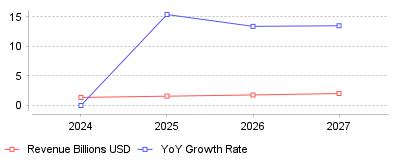
| Year | Revenue Billions USD | YoY Growth Rate |
|---|---|---|
| 2024 | 1.36 | N/A |
| 2025 | 1.57 | 15.4% |
| 2026 | 1.78 | 13.4% |
| 2027 | 2.02 | 13.5% |
The data reveals a rapid acceleration in the valuation of the OKR software market, driven primarily by the integration of Artificial Intelligence features. Specifically, the market is projected to grow from $1.36 billion in 2024 to $1.78 billion in 2026, representing a compound annual growth rate exceeding 13% [1] [2]. More importantly, this financial growth correlates with a functional shift: approximately 55% of organizations are now adopting AI-enabled goal tracking solutions, and 45% of new productivity software releases in 2024 included AI-based features like predictive task management [3] [4].
For the software industry, this signals the end of "static" goal tracking where users manually input progress percentages. The new standard is "Decision Intelligence," where software uses Neural-Level Precision to analyze internal data (like CRM or Jira logs) to auto-update goals and predict performance drops before they occur [5]. At a macro level, this transforms OKR platforms from administrative reporting tools into strategic "central nervous systems" for enterprises [5]. For micro-users (employees), it means the commoditization of strategy drafting; AI agents now assist with drafting OKRs, performing quality checks, and providing smart alignment recommendations, significantly lowering the barrier to entry for complex strategy frameworks [6].
This trend is critical because it addresses the historic failure rate of strategic execution; roughly 69% of enterprises using traditional management tools report goal misalignment within three months of execution [5]. By automating the connection between daily tasks and high-level objectives, companies using modern OKR software are reporting 50% higher employee engagement rates and 30% faster decision-making cycles [2]. Furthermore, the dominance of cloud-based deployment (78% market share) ensures these AI insights are available to distributed workforces, which is essential for maintaining alignment in hybrid work models [2].
The primary catalyst is the ubiquity of Generative AI (LLMs), which solved the "blank page problem" that previously made writing good OKRs difficult for non-executives [7]. Additionally, the permanent shift to remote and hybrid work (where remote work accounted for nearly 40% of the global workforce by 2024) necessitated digital tools that could autonomously "nudge" employees toward alignment without constant manager intervention [4]. Finally, the economic pressure to optimize efficiency has driven companies to seek tools that reduce "human lag"—the time between a market shift and a change in company strategy—effectively forcing software vendors to build adaptive, real-time systems [5].
The OKR software market is no longer just about tracking goals; it is about automating the intelligence required to achieve them. As we move toward 2026, the data suggests that platforms lacking AI-driven predictive capabilities and automated integration will likely become obsolete. The prominent takeaway for buyers is that the value of these tools now lies in their ability to reduce decision latency, turning strategy execution into a real-time, data-responsive process rather than a quarterly administrative burden.

Modern solutions are attempting to solve this through deep integration. For example, platforms that can automatically update a Key Result (e.g., "Launch 3 features") when a specific Epic is closed in Jira eliminate the need for manual reporting [6]. However, achieving this level of automation requires rigorous data governance and standardization of how work is tracked—a maturity level many organizations lack.
| Year | Revenue Billions USD | YoY Growth Rate |
|---|---|---|
| 2024 | 1.36 | N/A |
| 2025 | 1.57 | 15.4% |
| 2026 | 1.78 | 13.4% |
| 2027 | 2.02 | 13.5% |
The data reveals a rapid acceleration in the valuation of the OKR software market, driven primarily by the integration of Artificial Intelligence features. Specifically, the market is projected to grow from $1.36 billion in 2024 to $1.78 billion in 2026, representing a compound annual growth rate exceeding 13% [1] [2]. More importantly, this financial growth correlates with a functional shift: approximately 55% of organizations are now adopting AI-enabled goal tracking solutions, and 45% of new productivity software releases in 2024 included AI-based features like predictive task management [3] [4].
For the software industry, this signals the end of "static" goal tracking where users manually input progress percentages. The new standard is "Decision Intelligence," where software uses Neural-Level Precision to analyze internal data (like CRM or Jira logs) to auto-update goals and predict performance drops before they occur [5]. At a macro level, this transforms OKR platforms from administrative reporting tools into strategic "central nervous systems" for enterprises [5]. For micro-users (employees), it means the commoditization of strategy drafting; AI agents now assist with drafting OKRs, performing quality checks, and providing smart alignment recommendations, significantly lowering the barrier to entry for complex strategy frameworks [6].
This trend is critical because it addresses the historic failure rate of strategic execution; roughly 69% of enterprises using traditional management tools report goal misalignment within three months of execution [5]. By automating the connection between daily tasks and high-level objectives, companies using modern OKR software are reporting 50% higher employee engagement rates and 30% faster decision-making cycles [2]. Furthermore, the dominance of cloud-based deployment (78% market share) ensures these AI insights are available to distributed workforces, which is essential for maintaining alignment in hybrid work models [2].
The primary catalyst is the ubiquity of Generative AI (LLMs), which solved the "blank page problem" that previously made writing good OKRs difficult for non-executives [7]. Additionally, the permanent shift to remote and hybrid work (where remote work accounted for nearly 40% of the global workforce by 2024) necessitated digital tools that could autonomously "nudge" employees toward alignment without constant manager intervention [4]. Finally, the economic pressure to optimize efficiency has driven companies to seek tools that reduce "human lag"—the time between a market shift and a change in company strategy—effectively forcing software vendors to build adaptive, real-time systems [5].
The OKR software market is no longer just about tracking goals; it is about automating the intelligence required to achieve them. As we move toward 2026, the data suggests that platforms lacking AI-driven predictive capabilities and automated integration will likely become obsolete. The prominent takeaway for buyers is that the value of these tools now lies in their ability to reduce decision latency, turning strategy execution into a real-time, data-responsive process rather than a quarterly administrative burden.