


Recent data from late 2024 and early 2025 reveals a critical divergence in the GRC landscape: while organizations are rapidly expanding their third-party ecosystems (increasing vendor counts by over 20% year-over-year), the percentage of security breaches attributed to these third parties has nearly doubled. This trend highlights a dangerous "Vendor Sprawl," where reliance on exte
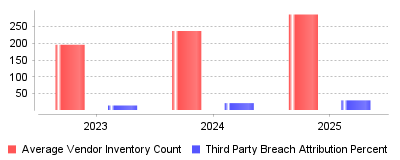
| Year | Average Vendor Inventory Count | Third Party Breach Attribution Percent |
|---|---|---|
| 2023 | 196 | 15 |
| 2024 | 237 | 22 |
| 2025 | 286 | 30 |
The data highlights a compounding risk factor in the GRC space: organizations are onboarding vendors at a record pace while simultaneously suffering more breaches through those very channels. Specifically, the average vendor inventory size per company jumped 21% from 237 in 2024 to 286 in 2025 [1]. Concurrently, the portion of data breaches linked to third-party access has surged from approximately 15% to 30% over the last reporting period [2].
This trend indicates that Third-Party Risk Management (TPRM) has shifted from a compliance checkbox to the primary frontline of enterprise security. The rapid expansion of vendor inventories suggests that businesses are decentralizing operations, relying heavily on specialized SaaS tools, MSPs, and data processors [2]. However, the correlation with rising breach rates implies that current GRC capabilities—often reliant on static questionnaires—are failing to keep pace with this expanded attack surface. For the industry, this signals a move toward "ecosystem risk," where an organization is only as secure as its least secure vendor, necessitating a shift from periodic assessments to real-time surveillance [3].
The financial and regulatory stakes are higher than ever, with 98% of organizations now having a relationship with at least one vendor that has been breached [4]. The cost of third-party breaches is typically 40% higher than internal ones, and new regulations like the EU's Digital Operational Resilience Act (DORA) are mandating strict oversight of ICT third-party risks [5]. Failure to manage this sprawl not only invites cyberattacks but also exposes companies to massive regulatory fines up to 1% of daily global turnover [6].
The primary driver is the aggressive digitization of business functions combined with the "shadow IT" adoption of AI tools, which has inflated vendor lists without proper vetting [3]. As companies rush to integrate Generative AI and cloud-native solutions, they inadvertently onboard "Nth-party" risks—vulnerabilities introduced by their vendors' vendors—which are notoriously difficult to track [7]. Additionally, the sheer volume of assessments has overwhelmed GRC teams; with the average team managing nearly 300 vendors, manual due diligence processes are breaking down, allowing high-risk vendors to slip through the cracks [1].
The data confirms that the traditional perimeter is dead; the modern security perimeter is the third-party contract. To survive 2025, organizations must abandon "point-in-time" assessments in favor of AI-driven, continuous monitoring platforms that can handle the volume of vendor sprawl [8]. The key takeaway for GRC leaders is that reducing vendor count is unlikely, so increasing the velocity and depth of automated risk analysis is the only viable path to resilience.
The governance, risk, and compliance (GRC) landscape is undergoing a structural paradigm shift in 2025. Historically viewed as a back-office obligation centered on avoiding penalties, GRC has evolved into a critical operational pillar essential for business continuity, brand reputation, and financial stability. As organizations face a "polycrisis" environment—characterized by geopolitical instability, accelerating cyber threats, and intricate regulatory webs—the traditional, fragmented approach to risk management is proving insufficient. The market for GRC platforms is consequently expanding, driven by the urgent need to replace manual, spreadsheet-based processes with integrated, intelligent systems capable of real-time monitoring and predictive analysis.
Research indicates that the stakes for operational failure have never been higher. Cybersecurity Ventures projects the global cost of cybercrime to hit $10.5 trillion annually by 2025, a figure that underscores the existential nature of digital risk [15]. Furthermore, the operational cost of non-compliance has surged. According to IBM’s 2024 Cost of a Data Breach Report, the average global cost of a data breach reached a record $4.88 million, with high levels of non-compliance significantly amplifying these losses [147].
This report analyzes the current trends and operational challenges shaping the GRC sector. It examines how automation and artificial intelligence (AI) are reshaping compliance workflows, the specific pressures facing distinct industry verticals, and the strategic outlook for organizations striving to maintain operational resilience in a volatile global economy.
The modern enterprise is increasingly reliant on a complex ecosystem of third-party vendors, digital infrastructure, and global supply chains. This interconnectedness has expanded the attack surface and complicated regulatory adherence. In response, the GRC & Risk Management Platforms market is moving away from point solutions toward unified ecosystems. The "Connected GRC" strategy is becoming a standard, designed to break down silos between IT security, legal, finance, and operations [144].
Operational resilience has superseded simple compliance as the primary objective. Regulations such as the European Union’s Digital Operational Resilience Act (DORA), effective January 2025, compel financial entities and their ICT providers to demonstrate robust capabilities to withstand, respond to, and recover from cyber incidents [12]. Similarly, in the United States, the SEC’s heightened disclosure rules regarding cybersecurity incidents are forcing boards to take an active role in risk governance. Organizations are finding that manual processes are incapable of keeping pace with these demands, creating a decisive market driver for automated Cybersecurity, Privacy & Compliance Software.

Despite the availability of sophisticated tools, a significant portion of the market continues to rely on legacy methods. Estimates suggest that up to 60% of GRC functions are still managed via spreadsheets and email, leading to data fragmentation and high error rates [55]. The operational inefficiency of manual GRC is quantifiable. Research highlights that manual compliance workflows are labor-intensive, prone to human error, and lack the agility required to address real-time threats [50].
The financial disparity between manual and automated approaches is stark. Organizations that employ extensive security AI and automation in their operations save an average of $2.2 million in data breach costs compared to those that do not [160]. Furthermore, manual audits are becoming unsustainable due to rising labor costs and the sheer volume of data requiring review. Automated audit management can reduce compliance costs by up to 40% and cut audit cycle times by 60-70% [77].
The speed of regulatory change is outstripping the capacity of human compliance teams. In 2025, organizations must navigate a convergence of global regulations, including AI governance laws (such as the EU AI Act), extended privacy mandates (expanding state-level US privacy laws), and stricter ESG reporting standards like the Corporate Sustainability Reporting Directive (CSRD) [1].
For multinational corporations, the lack of harmonization between jurisdictions creates operational friction. Compliance teams are forced to map controls across overlapping frameworks (e.g., GDPR, CCPA, ISO 27001, SOC 2) to avoid redundant work. This "compliance fatigue" is a primary driver for the adoption of platforms that offer "compliance-as-code" capabilities, allowing controls to be mapped once and applied across multiple frameworks [15].
Third-party risk management (TPRM) remains a critical vulnerability. As supply chains expand and digital dependencies grow, organizations are increasingly exposed to risks introduced by vendors. In 2025, TPRM is evolving from periodic vendor assessments to continuous, real-time monitoring. The expanded attack surface of the "extended enterprise" means that a breach at a fourth-party vendor can have cascading effects on the primary organization [144]. Organizations are now required to conduct due diligence not just on direct suppliers, but on their suppliers' suppliers, necessitating advanced data analytics and automated risk scoring.
Artificial Intelligence has moved from a theoretical advantage to a practical necessity in GRC. In 2025, AI is being utilized to automate evidence collection, predict risk events, and streamline regulatory change management. Approximately 43% of GRC professionals are actively evaluating AI solutions, while 13% have already integrated them into their frameworks [14].
Predictive Risk Intelligence: Rather than reacting to incidents, AI-driven platforms analyze vast datasets to forecast potential compliance failures or security breaches. This shifts the GRC function from defensive to proactive.
Generative AI in Compliance: GenAI is being deployed to interpret complex regulatory texts and map them to internal controls automatically. This capability significantly reduces the time required to assess the impact of new laws on existing operations [12].
However, the adoption of AI introduces its own set of GRC challenges, specifically around "Shadow AI"—the unsanctioned use of AI tools by employees—and the need for governance over AI models themselves to prevent bias and ensure data privacy [99].
While the macro trends affect all industries, the operational impact varies significantly by sector. The following analysis explores these nuances, highlighting where specialized GRC solutions are critical.
For technology companies, trust is the currency of the realm. Governance, Risk & Compliance (GRC) Tools for SaaS Companies are essential for managing the rigorous demands of frameworks like SOC 2 and ISO 27001. In 2025, the expectation for continuous compliance—rather than point-in-time audits—has become the industry standard. SaaS buyers, particularly in the enterprise segment, now demand real-time evidence of security controls before procurement [104].
Furthermore, SaaS companies are at the forefront of the AI governance challenge. As they embed AI features into their products, they face strict scrutiny regarding data residency, model safety, and algorithmic transparency. Automated GRC platforms that integrate directly with cloud infrastructure (AWS, Azure) to monitor security configurations are no longer optional but a prerequisite for market entry and scaling [102].
Marketing agencies face a uniquely hostile regulatory environment in 2025, centered on consumer privacy and data tracking. The proliferation of state-level privacy laws (such as the California Privacy Rights Act) and strict enforcement on tracking technologies like pixels and cookies have turned routine campaign operations into compliance minefields. Governance, Risk & Compliance (GRC) Tools for Marketing Agencies are vital for managing consent and tracking operational compliance.
Recent litigation trends have targeted the use of undisclosed tracking pixels that share user data with third parties (e.g., Meta or Google) without explicit consent. This has led to class-action lawsuits and significant regulatory fines [107]. Agencies must now maintain rigorous documentation of all data collection points and ensure that consent mechanisms function correctly across all jurisdictions, a task impossible to manage manually at scale [67].
The real estate sector is grappling with a dual pressure: anti-money laundering (AML) transparency and consumer protection regarding fees. Governance, Risk & Compliance (GRC) Tools for Property Managers are increasingly focused on complying with new prohibitions on "junk fees" and ensuring transparency in tenant screening. Regulatory bodies like the FTC and state legislatures are cracking down on hidden application fees and mandating clear disclosure of total rental costs [127].
Simultaneously, Governance, Risk & Compliance (GRC) Tools for Real Estate Agents are being deployed to handle the complexities of the Corporate Transparency Act (CTA). While legal challenges have created uncertainty, the requirement for reporting companies to disclose beneficial ownership information to FinCEN aims to curb illicit finance in the property market. Real estate professionals must navigate these reporting deadlines and assist clients in understanding their exposure, creating a significant compliance burden that requires organized data management [132].
The insurance industry faces operational risks stemming from producer licensing and the rising frequency of "nuclear verdicts"—exceptionally high jury awards that drive up liability costs. Governance, Risk & Compliance (GRC) Tools for Insurance Agents are pivotal in managing the intricate web of state-by-state licensing requirements. Automated solutions that track continuing education, license renewals, and carrier appointments are necessary to prevent lapses that could lead to regulatory fines or business stoppages [125].
Furthermore, insurers must manage their own operational resilience under new frameworks like the NAIC’s initiatives and state-specific rules. The focus is shifting toward ensuring that insurers have robust internal controls to manage underwriting risks and claim handling processes in an environment of increasing climate and social inflation risks [115].
Consulting firms operate in a high-stakes environment where reputational risk is paramount. Governance, Risk & Compliance (GRC) Tools for Consulting Firms help manage conflicts of interest, client data confidentiality, and independence requirements. As firms undergo digital transformation and integrate AI into their advisory services, they face the added challenge of ensuring their own operational resilience while advising clients on theirs. The "brain drain" and talent shortage in GRC roles further complicate this, forcing firms to rely more heavily on technology to maintain service quality and compliance [117].
For the construction industry, risk management is physical, financial, and regulatory. Governance, Risk & Compliance (GRC) Tools for Contractors are essential for tracking safety compliance, supply chain disruptions, and insurance requirements. In 2025, economic headwinds and labor shortages have heightened the risk of insolvency and project delays. GRC platforms allow contractors to monitor subcontractor insurance certificates, track safety training certifications, and manage contracts to mitigate legal risks associated with project defaults or accidents [45].
Looking ahead, the GRC market will be defined by the "Cognitive GRC" revolution. We expect a transition from static systems of record to dynamic systems of intelligence. By late 2025 and into 2026, AI agents will likely handle the majority of routine compliance tasks, such as control testing and preliminary risk assessments, leaving human professionals to focus on strategic decision-making and complex ethical considerations [144].
However, this reliance on technology will require a parallel focus on "GRC for AI"—ensuring that the automated systems themselves are governed, explainable, and secure. Organizations that succeed will be those that view GRC not as a cost center, but as a strategic enabler that builds trust with customers, investors, and regulators. The cost of inaction—measured in data breach expenses, regulatory fines, and lost reputation—is simply too high to ignore.
Recent data from late 2024 and early 2025 reveals a critical divergence in the GRC landscape: while organizations are rapidly expanding their third-party ecosystems (increasing vendor counts by over 20% year-over-year), the percentage of security breaches attributed to these third parties has nearly doubled. This trend highlights a dangerous "Vendor Sprawl," where reliance on exte
| Year | Average Vendor Inventory Count | Third Party Breach Attribution Percent |
|---|---|---|
| 2023 | 196 | 15 |
| 2024 | 237 | 22 |
| 2025 | 286 | 30 |
The data highlights a compounding risk factor in the GRC space: organizations are onboarding vendors at a record pace while simultaneously suffering more breaches through those very channels. Specifically, the average vendor inventory size per company jumped 21% from 237 in 2024 to 286 in 2025 [1]. Concurrently, the portion of data breaches linked to third-party access has surged from approximately 15% to 30% over the last reporting period [2].
This trend indicates that Third-Party Risk Management (TPRM) has shifted from a compliance checkbox to the primary frontline of enterprise security. The rapid expansion of vendor inventories suggests that businesses are decentralizing operations, relying heavily on specialized SaaS tools, MSPs, and data processors [2]. However, the correlation with rising breach rates implies that current GRC capabilities—often reliant on static questionnaires—are failing to keep pace with this expanded attack surface. For the industry, this signals a move toward "ecosystem risk," where an organization is only as secure as its least secure vendor, necessitating a shift from periodic assessments to real-time surveillance [3].
The financial and regulatory stakes are higher than ever, with 98% of organizations now having a relationship with at least one vendor that has been breached [4]. The cost of third-party breaches is typically 40% higher than internal ones, and new regulations like the EU's Digital Operational Resilience Act (DORA) are mandating strict oversight of ICT third-party risks [5]. Failure to manage this sprawl not only invites cyberattacks but also exposes companies to massive regulatory fines up to 1% of daily global turnover [6].
The primary driver is the aggressive digitization of business functions combined with the "shadow IT" adoption of AI tools, which has inflated vendor lists without proper vetting [3]. As companies rush to integrate Generative AI and cloud-native solutions, they inadvertently onboard "Nth-party" risks—vulnerabilities introduced by their vendors' vendors—which are notoriously difficult to track [7]. Additionally, the sheer volume of assessments has overwhelmed GRC teams; with the average team managing nearly 300 vendors, manual due diligence processes are breaking down, allowing high-risk vendors to slip through the cracks [1].
The data confirms that the traditional perimeter is dead; the modern security perimeter is the third-party contract. To survive 2025, organizations must abandon "point-in-time" assessments in favor of AI-driven, continuous monitoring platforms that can handle the volume of vendor sprawl [8]. The key takeaway for GRC leaders is that reducing vendor count is unlikely, so increasing the velocity and depth of automated risk analysis is the only viable path to resilience.