


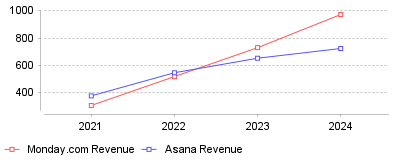
The Project Management Software category is undergoing a significant bifurcation, best illustrated by the diverging financial trajectories of market leaders monday.com and Asana over the last four years. While the broader market continues to grow, data reveals a decisive shift where "Work OS" platforms that bundle CRM and development tools are rapidly outpacing traditional task-based collaboration tools in revenue velocity. This trend highlights a critical change in buyer behavior: organizations are moving away from isolated project tracking toward consolidated, multi-function
| Year | Monday.com Revenue | Asana Revenue |
|---|---|---|
| 2021 | 308 | 378 |
| 2022 | 519 | 547 |
| 2023 | 730 | 653 |
| 2024 | 972 | 724 |
The data highlights a dramatic "flipping" of market leadership between two titans of the project management industry: monday.com and Asana. In 2021, Asana held a distinct revenue lead ($378M vs. $308M), but by the end of 2024, monday.com had not only closed the gap but surged ahead, generating $972M compared to Asana's $724M [1] [2]. While Asana's growth has decelerated to approximately 10-11% year-over-year, monday.com has maintained a high-velocity growth rate of over 30%, widening the revenue gap to nearly $250 million in the last fiscal period [3].
This divergence signals a macro-industry shift from pure "project management" to holistic "Work Operating Systems." The market is punishing platforms that strictly focus on task collaboration and rewarding those that offer a flexible database infrastructure capable of handling CRM, software development, and marketing workflows in a single hub [4]. For the industry, this suggests that the era of the standalone project management tool is fading; buyers now demand "platformization," where project data lives alongside sales and development data to reduce software sprawl. It also indicates that retention and expansion (Net Dollar Retention) are now driven by cross-selling new product lines rather than just adding more seats for task tracking [3].
This trend is critical because it validates the "multi-product" strategy over the "best-of-breed" point solution strategy in the current economic climate. With IT budgets tightening, companies are consolidating vendors; monday.com's ability to replace a CRM (like Pipedrive) and a PM tool (like Asana) simultaneously gives it a competitive moat [5]. Furthermore, monday.com's superior free cash flow margins (30% vs Asana's 1%) prove that the platform model is not only growing faster but is fundamentally more profitable at scale [5].
The primary driver appears to be monday.com’s aggressive expansion into specific verticals (Monday Sales CRM and Monday Dev), effectively expanding their Total Addressable Market (TAM) beyond just project managers [3]. Conversely, Asana has struggled to break out of the "general collaboration" mold, and their recent pivot to "AI Studio" has yet to yield the same immediate financial impact as Monday's product diversification [6]. Additionally, Asana’s slowing growth in customers spending >$5k suggests they are hitting saturation in their core demographic, while Monday's flexible architecture allows them to move upmarket into enterprise accounts more aggressively [6].
The "Project Management" category is effectively evolving into the "Business Operations" category. The rapid overtaking of Asana by monday.com serves as a case study that flexibility and consolidation capabilities are currently more valuable to buyers than pure-play task management features. Organizations evaluating software in 2025 should prioritize platforms that demonstrate a multi-product roadmap, as these vendors are more likely to survive the ongoing market consolidation.
The global landscape for project management software is undergoing a fundamental structural shift, moving away from static task tracking toward predictive, autonomous project intelligence. As organizations navigate an environment defined by high interest rates, labor shortages, and rapid technological disruption, the software market—projected to grow from approximately $8 billion in 2024 to over $40 billion by 2033—is fracturing into specialized verticals [1]. While generalist platforms continue to serve broad horizontal needs, the most significant value creation is occurring within industry-specific solutions that integrate deep operational logic, compliance frameworks, and "agentic" artificial intelligence capable of executing complex workflows without human intervention [2].
This report analyzes the current trends and operational challenges redefining Project Management & Productivity Tools. It examines the divergence between horizontal and vertical software solutions, the operational friction caused by data fragmentation, and the specific technological requirements of high-stakes industries ranging from construction to private equity.
For the past decade, the dominant narrative in project management software was the "single pane of glass"—a centralized dashboard for all work. However, 2024 and 2025 have demonstrated the limitations of one-size-fits-all platforms. As industries face distinct regulatory and operational pressures, generic tools often fail to capture the nuances of specific workflows, leading to the rise of Vertical SaaS. This segment is growing at a compound annual growth rate (CAGR) of nearly 24%, outpacing the broader market as companies seek tools that speak their specific industry language [3].
The operational reality is that a software development team in a SaaS company and a roofing contractor in the field have fundamentally different definitions of "project success." While the former prioritizes agile sprint velocity and code deployment, the latter focuses on material supply chains, weather dependencies, and physical safety compliance. This divergence has forced the Project Management Software category to split. Generalist giants are acquiring vertical features or AI capabilities to remain relevant, while niche players are capturing market share by solving high-stakes, specific problems—such as environmental, social, and governance (ESG) compliance or field-to-office synchronization [4].

The most transformative trend in the current market is the transition from generative AI, which creates content, to agentic AI, which executes tasks. Unlike passive chatbots that summarize meeting notes, AI agents are beginning to function as autonomous team members capable of planning and executing multi-step workflows [5].
In 2025, agentic AI is fundamentally altering the software development lifecycle and project administration. Advanced agents can now write code, run automated tests, and update documentation with minimal human oversight, collapsing cycle times from weeks to hours [2]. For project managers, this shifts the role from administrative coordination to strategic oversight. The operational challenge lies in "superagency"—the ability of leadership to deploy these agents effectively while managing the risks of AI "hallucinations" or autonomous errors [5].
Operational efficiency is increasingly driven by AI-based forecasting. Tools are now capable of analyzing historical project data to predict future resource demand, matching tasks to the right personnel based on skills and availability without manual intervention [6]. This capability is critical for large enterprises where resource leakage—paying for idle time or overutilizing staff—remains a primary margin killer. However, the effectiveness of these tools is often hampered by the quality of the underlying data, a challenge discussed in the operational analysis below.
While the promise of AI and automation is significant, the operational reality is often messy. The primary barrier to realizing the value of project management software is no longer feature scarcity but data fragmentation and integration complexity.
Nowhere is the operational friction more palpable than in the built environment. In the construction sector, it is estimated that 95% of data goes unused, leading to miscommunication and budget overruns that average 28% [7]. The industry is plagued by a "patchwork" of point solutions, where a contractor might use one tool for bidding, another for scheduling, and a third for billing, none of which communicate effectively [8].
For specialized trades, the need for integrated solutions is acute. Project Management Software for Contractors must bridge the gap between the office and the job site. The inability to sync real-time data leads to costly errors, such as crews arriving at sites without necessary materials or working off outdated blueprints [9]. This disconnect is not merely an inconvenience; it is a financial liability in an industry operating on razor-thin margins.
Similarly, Project Management Software for Roofing Companies faces the unique challenge of integrating aerial imagery and drone data into the estimation process. Modern workflows require that a drone inspection automatically populates a material takeoff and generates a client quote. When these systems are disconnected, the manual data entry introduces human error and delays, directly impacting the "speed-to-lead" metric that is crucial for winning residential contracts [10].
The plumbing sector faces parallel challenges driven by regulatory pressure. Project Management Software for Plumbers is increasingly relied upon to manage compliance with stricter water conservation standards and updated building codes [11]. The operational challenge here is mobility; technicians need access to complex compliance documents and inventory data on mobile devices in areas with poor connectivity. Software that lacks robust offline capabilities or complex inventory management for thousands of SKUs fails to meet the operational needs of this vertical [12].
In the financial sector, the challenges shift from physical logistics to data intelligence and security. Project Management Software for Private Equity Firms is currently grappling with the need for sophisticated data science capabilities. As traditional deal flow faces headwinds from high interest rates, firms are turning to "alternative data signals"—such as web traffic or supply chain analytics—to identify targets early [13]. The operational hurdle is integrating these vast, unstructured data sets into a coherent deal pipeline without overwhelming the investment team. Furthermore, cybersecurity has moved from a compliance check to a value creation lever; PE firms must ensure their portfolio companies utilize secure platforms to protect proprietary data during due diligence and post-merger integration [14].
For the software sector itself, the operational focus is on retention and efficiency. Project Management Software for SaaS Companies is evolving to handle the entire customer lifecycle, not just product development. With venture capital funding becoming more competitive, SaaS companies are under pressure to reduce churn [15]. Project management tools in this space are tasked with bridging the gap between product delivery (Agile/Scrum) and customer success, ensuring that feature releases translate directly into customer value. The challenge remains the "integration tax"—the cost and complexity of connecting product roadmapping tools with customer support and billing systems [15].
The labor market introduces another layer of complexity. Project Management Software for Staffing Agencies must navigate the dual pressures of a talent shortage and the demand for speed. In 2025, the global time-to-hire has risen to 44 days, up from 31 days in 2023 [16]. Staffing agencies are turning to software that automates candidate matching and outreach. However, the operational danger lies in "automation fatigue," where impersonal, AI-driven communication alienates high-quality candidates. Agencies must balance efficiency with the "high touch" experience required to secure top talent in a competitive market [17].
The trends and challenges outlined above present distinct business implications for organizations selecting and deploying project management infrastructure.
As vertical requirements become more specific, organizations in sectors like construction and engineering are increasingly facing a choice: purchase a specialized SaaS solution or build custom tools. Recent research suggests that in markets like India and among large enterprise contractors, there is a shift toward building custom software stacks to avoid the "bloat" of generalist tools and to ensure deep integration with legacy ERP systems [8]. However, for most mid-sized firms, the total cost of ownership (TCO) for custom solutions remains prohibitive, reinforcing the value proposition of specialized vertical SaaS.
Data fragmentation is quantifiable. In construction, the inability to utilize data effectively correlates with significant budget overruns [7]. For private equity, the lack of integrated data analytics can result in missed "alpha" or investment opportunities [13]. Businesses that persist in using fragmented "best-of-breed" point solutions without a robust integration strategy (iPaaS or native APIs) will face increasing operational overhead and reduced decision-making agility.
With cybercrime damages projected to reach astronomical levels, security features in project management software are no longer optional. For industries handling sensitive data—such as legal, finance (PE), and healthcare—the use of platforms with "confidential computing" and advanced encryption is a prerequisite for doing business [18]. European markets, driven by GDPR, are already seeing a preference for vendors that can guarantee data sovereignty and local hosting [4].
Looking ahead, the project management landscape will be defined by the maturation of autonomous systems and the convergence of physical and digital workflows.
The organizations that thrive in this new environment will be those that view project management software not as a passive repository of tasks, but as an active, intelligent operating system that connects strategy to execution across every vertical.
The Project Management Software category is undergoing a significant bifurcation, best illustrated by the diverging financial trajectories of market leaders monday.com and Asana over the last four years. While the broader market continues to grow, data reveals a decisive shift where "Work OS" platforms that bundle CRM and development tools are rapidly outpacing traditional task-based collaboration tools in revenue velocity. This trend highlights a critical change in buyer behavior: organizations are moving away from isolated project tracking toward consolidated, multi-function
| Year | Monday.com Revenue | Asana Revenue |
|---|---|---|
| 2021 | 308 | 378 |
| 2022 | 519 | 547 |
| 2023 | 730 | 653 |
| 2024 | 972 | 724 |
The data highlights a dramatic "flipping" of market leadership between two titans of the project management industry: monday.com and Asana. In 2021, Asana held a distinct revenue lead ($378M vs. $308M), but by the end of 2024, monday.com had not only closed the gap but surged ahead, generating $972M compared to Asana's $724M [1] [2]. While Asana's growth has decelerated to approximately 10-11% year-over-year, monday.com has maintained a high-velocity growth rate of over 30%, widening the revenue gap to nearly $250 million in the last fiscal period [3].
This divergence signals a macro-industry shift from pure "project management" to holistic "Work Operating Systems." The market is punishing platforms that strictly focus on task collaboration and rewarding those that offer a flexible database infrastructure capable of handling CRM, software development, and marketing workflows in a single hub [4]. For the industry, this suggests that the era of the standalone project management tool is fading; buyers now demand "platformization," where project data lives alongside sales and development data to reduce software sprawl. It also indicates that retention and expansion (Net Dollar Retention) are now driven by cross-selling new product lines rather than just adding more seats for task tracking [3].
This trend is critical because it validates the "multi-product" strategy over the "best-of-breed" point solution strategy in the current economic climate. With IT budgets tightening, companies are consolidating vendors; monday.com's ability to replace a CRM (like Pipedrive) and a PM tool (like Asana) simultaneously gives it a competitive moat [5]. Furthermore, monday.com's superior free cash flow margins (30% vs Asana's 1%) prove that the platform model is not only growing faster but is fundamentally more profitable at scale [5].
The primary driver appears to be monday.com’s aggressive expansion into specific verticals (Monday Sales CRM and Monday Dev), effectively expanding their Total Addressable Market (TAM) beyond just project managers [3]. Conversely, Asana has struggled to break out of the "general collaboration" mold, and their recent pivot to "AI Studio" has yet to yield the same immediate financial impact as Monday's product diversification [6]. Additionally, Asana’s slowing growth in customers spending >$5k suggests they are hitting saturation in their core demographic, while Monday's flexible architecture allows them to move upmarket into enterprise accounts more aggressively [6].
The "Project Management" category is effectively evolving into the "Business Operations" category. The rapid overtaking of Asana by monday.com serves as a case study that flexibility and consolidation capabilities are currently more valuable to buyers than pure-play task management features. Organizations evaluating software in 2025 should prioritize platforms that demonstrate a multi-product roadmap, as these vendors are more likely to survive the ongoing market consolidation.