


The rapid integration of Generative AI into Brand and Digital Asset Management (DAM) ecosystems has created a "GenAI Divide": while adoption rates have surged from 55% to nearly 80% in under two years, strategic maturity lags significantly behind. Data reveals that while 81% of marketers now utilize AI tools, a staggering 95% of GenAI pilots fail to reach production or achieve revenue acceleration, highlighting a critical gap between tool accessibility and operational value. This trend underscores that organizations are successfully acquiring AI capabilities but struggling to govern and operat
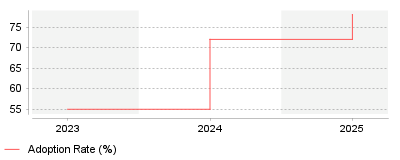
| Year | Adoption Rate (%) |
|---|---|
| 2023 | 55 |
| 2024 | 72 |
| 2025 | 78 |
The data illustrates a sharp upward trajectory in AI adoption within the enterprise and marketing sectors, rising from 55% in 2023 to 78% by 2025 [1]. However, this growth in usage is contrasted by a widening "efficiency gap," where the percentage of marketers reporting they possess technology they cannot fully utilize has increased from 30% to 38% year-over-year [2].
On a micro level, DAM users are being flooded with AI features—such as auto-tagging and generative content creation—yet they lack the governance frameworks to deploy them effectively, leading to "pilot purgatory" where 95% of initiatives fail to scale [2]. Macro-economically, the industry is shifting from a phase of "experimental hype" to "operational scrutiny," where the mere presence of AI is no longer a differentiator; the value now lies in the ability to integrate these tools into complex workflows without breaking brand compliance [3]. Vendors like Bynder report that while 41% of businesses have fully integrated AI into their DAMs, only 33% have a dedicated strategy to manage it, signaling a dangerous disconnect between purchase and practice [4]. This divides the market into "high performers" who achieve 10x ROI through strategic implementation and the majority who see zero enterprise-level P&L impact [5].
This trend is critical because the uncontrolled proliferation of AI-generated assets poses severe risks to brand integrity and legal compliance, the very problems DAM systems were built to solve. With 90% of global teams viewing human oversight as essential for safeguarding brand identity [3], the inability to operationalize AI threatens to turn asset libraries into chaotic repositories of unverified content. Furthermore, with the DAM market projected to reach $14.4 billion by 2031 [6], the winners will be determined not by who has the best AI models, but by who can successfully bridge the gap between generation and governance.
The surge in adoption is likely driven by extreme FOMO (Fear Of Missing Out) and executive pressure to demonstrate "AI readiness" to investors, pushing teams to adopt tools before use cases are defined. Simultaneously, DAM vendors have aggressively embedded "invisible" AI features (like semantic search and background removal) that inflate adoption numbers without necessarily requiring strategic buy-in from the user [7]. The high failure rate of pilots stems from brittle data infrastructure; organizations are attempting to layer advanced generative models on top of unstructured, messy asset libraries that are not "AI-ready" [5].
While AI ubiquity in Digital Asset Management is now inevitable, the data suggests we are entering a period of correction where "strategy" must catch up to "capability." The focus for the next 12 months will shift from simply acquiring AI tools to establishing the "Human-in-the-Loop" workflows necessary to make them safe and profitable. Organizations that fail to close the gap between their high adoption rates and low strategic maturity risk significant wasted investment and brand dilution.
The operational landscape of digital content is undergoing a fundamental shift. Historically viewed as passive storage lockers for files, Brand Asset & Digital Asset Management Platforms (DAM and BAM) have evolved into critical infrastructure for the modern enterprise. As the volume of digital content explodes—driven by personalization demands, omnichannel marketing, and the proliferation of video—organizations face a dual challenge: managing the operational chaos of asset production while ensuring strict brand governance and legal compliance. The market reflects this urgency, with projections estimating the global Digital Asset Management market will grow from approximately $6.6 billion in 2025 to over $27 billion by 2035, driven by a compound annual growth rate (CAGR) exceeding 15% [1].
This report analyzes the current trends reshaping the Design, Creative & Media Production Software sector, specifically focusing on the operational friction points that define today’s asset management strategies. Beyond simple file storage, today's platforms must solve complex problems regarding rights management, AI-driven automation, and the architectural shift toward composable, headless ecosystems.
The demand for digital content is no longer linear; it is exponential. Industry analysis suggests that the digital asset management market is accelerating as enterprises reposition these tools from cost centers to core pillars of their omnichannel strategy [2]. The primary driver is "content velocity"—the sheer speed and volume at which brands must produce, adapt, and distribute assets to remain relevant. Research indicates that the global DAM market was valued at approximately $7.73 billion in 2024 and is projected to reach nearly $32 billion by 2033 [3].
This growth is not merely about storage capacity; it is about throughput efficiency. Organizations are struggling with "content silos," where assets are scattered across local drives, cloud storage, and disconnected software tools. A 2025 forecast highlights that 41% of customers identify content silos as their primary challenge, while 37% cite low user adoption of legacy systems as a critical failure point [4]. Consequently, the market is seeing a migration away from on-premise solutions toward cloud-native and hybrid architectures that support remote work and global collaboration [2], [5].

The most significant technological trend in asset management for 2024 and 2025 is the integration of Artificial Intelligence (AI) to solve the "metadata debt" crisis. Historically, the utility of a DAM system was limited by the quality of its manual tagging. Assets without metadata are effectively invisible. Today, Digital Asset Management Tools with AI Tagging are transforming this workflow by automating the classification process.
Modern AI algorithms can now analyze visual content to identify objects, people, colors, and even sentiment, automatically populating metadata fields that would take humans hours to complete. Reports indicate that organizations leveraging AI-enhanced DAM solutions see productivity gains of up to 62% in asset search and preparation time [6]. Furthermore, generative AI is moving beyond simple tagging. It is now being used to generate alt text for accessibility compliance automatically, ensuring that images published online meet regulatory standards like the European Accessibility Act [2], [7].
However, the operational challenge here shifts from data entry to data verification. While AI can tag a "happy family on a beach," it often lacks the contextual nuance to understand if that specific asset is approved for a holiday campaign versus a summer clearance sale. Therefore, the role of the DAM manager is evolving into a gatekeeper of AI-generated taxonomy, ensuring accuracy while benefiting from the speed of automation. Generative AI pilots are already underway at 66% of large organizations to boost personalization at scale, fundamentally changing how assets are adapted for different markets [2].
As enterprises seek to integrate their tech stacks, the monolithic DAM model is being challenged by "headless" and composable architectures. A headless DAM separates the backend (where assets are stored and managed) from the frontend (where assets are presented), allowing assets to be delivered via API to any channel—be it a website, mobile app, or IoT device [8].
This trend is driven by the need for agility. In a composable enterprise, the DAM acts as a central engine that feeds content into Content Management Systems (CMS), Product Information Management (PIM) systems, and ecommerce platforms without requiring a heavy, pre-built frontend interface [9]. This "API-first" approach allows organizations to build custom experiences while maintaining a single source of truth for their assets. For example, 100% of enterprise-scale teams recently surveyed expected either native integrations or headless API flexibility to maintain workflow integrity [10].
The operational benefit is speed to market. By decoupling the content repository from the display layer, developers can iterate on customer-facing experiences without disrupting the underlying asset management structure. However, this creates an operational challenge for non-technical marketers who may lose the visual "browse" experience of a traditional DAM if the frontend implementation is not user-friendly [11].
One of the most acute operational risks facing brands today is digital rights management (DRM). As content channels multiply, tracking the expiration dates, geographic restrictions, and talent usage rights associated with every image and video becomes exponentially complex. A simplified spreadsheet is no longer sufficient when a single asset might be used across social media, broadcast TV, and digital display ads in multiple regions.
Using an asset after its license has expired can result in severe financial penalties and reputational damage. This has driven the adoption of Brand Asset Platforms with Rights Management features that enforce compliance at the download level. Advanced platforms now link assets directly to contract terms, automatically restricting access or watermarking files when usage rights expire [12].
The challenge is compounded by the "remix culture" of digital marketing. When an agency creates a composite video using stock footage, music, and voiceover, each element carries its own licensing terms. If the music license expires before the stock footage license, the entire asset becomes non-compliant. Operational leaders report that navigating these ins and outs is a major undertaking, particularly for product manufacturers who must manage talent agreements for models alongside copyright terms for photographers [13]. Without automated rights management, teams waste valuable time manually verifying asset status, or worse, "rogue" assets slip through the cracks and result in litigation.
For large enterprises, managing a single brand is difficult; managing a portfolio of brands is a logistical tightrope. Global conglomerates must balance the need for centralized brand consistency with the necessity of local market adaptation. This tension drives the need for specialized Brand Asset Management for Multi-Brand Organizations.
The core operational problem is "dilution." When regional teams or external agencies cannot easily find approved assets, they create their own. This leads to off-brand visuals, incorrect logo usage, and messaging that deviates from core values [14]. A centralized DAM/BAM platform serves as the "single source of truth," but only if it is configured to handle complex permission structures. A parent company must ensure that the "North American Beverage Team" only accesses assets relevant to their specific soda brands, while the "European Snack Team" sees a completely different view.
Research highlights that inconsistent branding can erode trust and confuse customers. The solution involves dynamic templating—where core brand elements are locked, but local teams can translate text or swap localized imagery within strict guardrails [15]. This "freedom within a framework" approach is essential for scaling operations without expanding headcount. It allows central creative teams to produce "master" assets that local marketers can adapt self-service, reducing the bottleneck that often paralyzes global marketing operations.
A DAM system is only as good as its searchability. If users cannot find an asset in less than a minute, they will likely recreate it or purchase a duplicate stock image, incurring unnecessary costs. This phenomenon, known as "asset recreation," is a symptom of poor metadata taxonomy. The operational challenge lies in enforcing a consistent taxonomy across different departments that use different terminology (e.g., Marketing calls it a "promo," Sales calls it a "deck," and Product calls it a "spec sheet") [16].
The accumulation of poorly tagged assets creates "metadata debt." Cleaning up a DAM with 500,000 assets is a massive undertaking that often stalls migration projects or platform upgrades. Successful operations now treat metadata as an ongoing governance product rather than a one-time project. This includes implementing controlled vocabularies and mandatory metadata fields upon upload to prevent "garbage in, garbage out" scenarios [17].
Furthermore, the rise of video content has exacerbated this challenge. Searching for a specific clip within a 60-minute video file is impossible with standard file-level metadata. Advanced DAMs are now employing AI to transcribe audio and recognize scene changes, allowing users to search inside video files. However, the operational overhead of verifying these automated transcriptions remains a factor for regulated industries [18].
The integration of DAM with ecommerce workflows is becoming a non-negotiable requirement for retail and consumer goods companies. In the high-velocity world of online retail, the speed at which product shots can move from the photography studio to the product page directly impacts revenue. This necessitates robust DAM Tools for Product & Ecommerce Teams that can integrate seamlessly with Product Information Management (PIM) systems.
The operational workflow typically involves linking a Stock Keeping Unit (SKU) in the PIM with the corresponding high-resolution images in the DAM. When these systems are disconnected, manual mapping errors occur—displaying the wrong color variant on a product page, for instance, which increases return rates. Integrated platforms automate this linkage, ensuring that if a product specification changes in the PIM, the associated assets in the DAM are flagged for review [19].
Moreover, the rise of 3D assets in ecommerce (for virtual try-ons and 360-degree views) is pushing legacy DAMs to their breaking point. Most older systems were built for 2D images and struggle to render or convert 3D files like GLB or USDZ. The market for 3D asset management is projected to grow from $29 billion in 2024 to nearly $98 billion by 2034, forcing DAM providers to upgrade their rendering engines rapidly [10].
A specific operational friction point exists between brands and their external partners. Creative agencies are often the primary producers of high-value assets, yet the handoff process remains archaic—often relying on WeTransfer links or disparate Dropbox folders. This breaks the chain of custody and metadata continuity.
Specialized Digital Asset Management for Creative Agencies focuses on the "work-in-progress" (WIP) phase of the asset lifecycle. Unlike a brand DAM which stores finished goods, an agency DAM must handle versioning, commenting, and approval loops. The operational challenge is syncing the final approved asset from the Agency DAM to the Client DAM without losing the usage rights data or the creative history [20]. Best-in-class operations are now establishing "portals" where agencies upload directly into a quarantine zone within the brand's DAM, ensuring metadata compliance before the asset ever enters the general library.
Looking toward 2025 and 2026, the issue of content authenticity will move to the forefront. With generative AI capable of creating photorealistic fake images, brands face a new risk: proving that their assets are genuine. The Coalition for Content Provenance and Authenticity (C2PA) is establishing open technical standards to certify the source and history of media content [21], [22].
Future DAM systems will likely serve as "authenticity engines," automatically embedding C2PA manifests into assets to prove their provenance. This will act as a digital nutrition label, showing who created the image, how it was edited, and if AI was involved [10], [23]. Operational workflows will need to adapt to preserve this chain of custody; stripping metadata during a file conversion could inadvertently break the trust signal, rendering an asset "unverified" in the eyes of the consumer.
Additionally, we are moving toward "Autonomous DAM" systems. Unlike today's automation which requires rules (e.g., "If file is named X, put in folder Y"), autonomous systems will use machine learning to predict where an asset should live and who should see it based on user behavior [4]. This could dramatically reduce the administrative burden of DAM maintenance, though it will require a high level of trust in the algorithm's decision-making capabilities.
The trends and challenges outlined above point to a singular conclusion: Asset management is no longer an IT procurement decision; it is a strategic business imperative. The operational inefficiencies of lost assets, rights violations, and slow content production directly impact the bottom line.
Key Business Implications:
Organizations that succeed in the coming years will be those that treat their DAM not as a library, but as a supply chain—an active, integrated, and automated engine that fuels the entire customer experience.
The rapid integration of Generative AI into Brand and Digital Asset Management (DAM) ecosystems has created a "GenAI Divide": while adoption rates have surged from 55% to nearly 80% in under two years, strategic maturity lags significantly behind. Data reveals that while 81% of marketers now utilize AI tools, a staggering 95% of GenAI pilots fail to reach production or achieve revenue acceleration, highlighting a critical gap between tool accessibility and operational value. This trend underscores that organizations are successfully acquiring AI capabilities but struggling to govern and operat
| Year | Adoption Rate (%) |
|---|---|
| 2023 | 55 |
| 2024 | 72 |
| 2025 | 78 |
The data illustrates a sharp upward trajectory in AI adoption within the enterprise and marketing sectors, rising from 55% in 2023 to 78% by 2025 [1]. However, this growth in usage is contrasted by a widening "efficiency gap," where the percentage of marketers reporting they possess technology they cannot fully utilize has increased from 30% to 38% year-over-year [2].
On a micro level, DAM users are being flooded with AI features—such as auto-tagging and generative content creation—yet they lack the governance frameworks to deploy them effectively, leading to "pilot purgatory" where 95% of initiatives fail to scale [2]. Macro-economically, the industry is shifting from a phase of "experimental hype" to "operational scrutiny," where the mere presence of AI is no longer a differentiator; the value now lies in the ability to integrate these tools into complex workflows without breaking brand compliance [3]. Vendors like Bynder report that while 41% of businesses have fully integrated AI into their DAMs, only 33% have a dedicated strategy to manage it, signaling a dangerous disconnect between purchase and practice [4]. This divides the market into "high performers" who achieve 10x ROI through strategic implementation and the majority who see zero enterprise-level P&L impact [5].
This trend is critical because the uncontrolled proliferation of AI-generated assets poses severe risks to brand integrity and legal compliance, the very problems DAM systems were built to solve. With 90% of global teams viewing human oversight as essential for safeguarding brand identity [3], the inability to operationalize AI threatens to turn asset libraries into chaotic repositories of unverified content. Furthermore, with the DAM market projected to reach $14.4 billion by 2031 [6], the winners will be determined not by who has the best AI models, but by who can successfully bridge the gap between generation and governance.
The surge in adoption is likely driven by extreme FOMO (Fear Of Missing Out) and executive pressure to demonstrate "AI readiness" to investors, pushing teams to adopt tools before use cases are defined. Simultaneously, DAM vendors have aggressively embedded "invisible" AI features (like semantic search and background removal) that inflate adoption numbers without necessarily requiring strategic buy-in from the user [7]. The high failure rate of pilots stems from brittle data infrastructure; organizations are attempting to layer advanced generative models on top of unstructured, messy asset libraries that are not "AI-ready" [5].
While AI ubiquity in Digital Asset Management is now inevitable, the data suggests we are entering a period of correction where "strategy" must catch up to "capability." The focus for the next 12 months will shift from simply acquiring AI tools to establishing the "Human-in-the-Loop" workflows necessary to make them safe and profitable. Organizations that fail to close the gap between their high adoption rates and low strategic maturity risk significant wasted investment and brand dilution.